The Quick Verdict on Electric Super Cars
Bottom line: Electric super cars like the 2026 Rimac Nevera, Lotus Evija, and Porsche Taycan Turbo GT deliver hypercar performance (0-60 under 2.5 seconds, 1,000+ HP) with zero tailpipe emissions, but ownership demands a reality check. Expect EPA ranges of 200-310 miles, peak DC fast charging up to 350 kW, and purchase prices from $180,000 to over $2 million. Unlike a gas exotic, you'll save on fuel and maintenance but face steeper insurance premiums, faster tire wear from instant torque, and the practical need for a dedicated 240V Level 2 home charger. These are weekend toys for collectors with charging infrastructure — not daily commuters.
Defining the Electric Super Car Segment
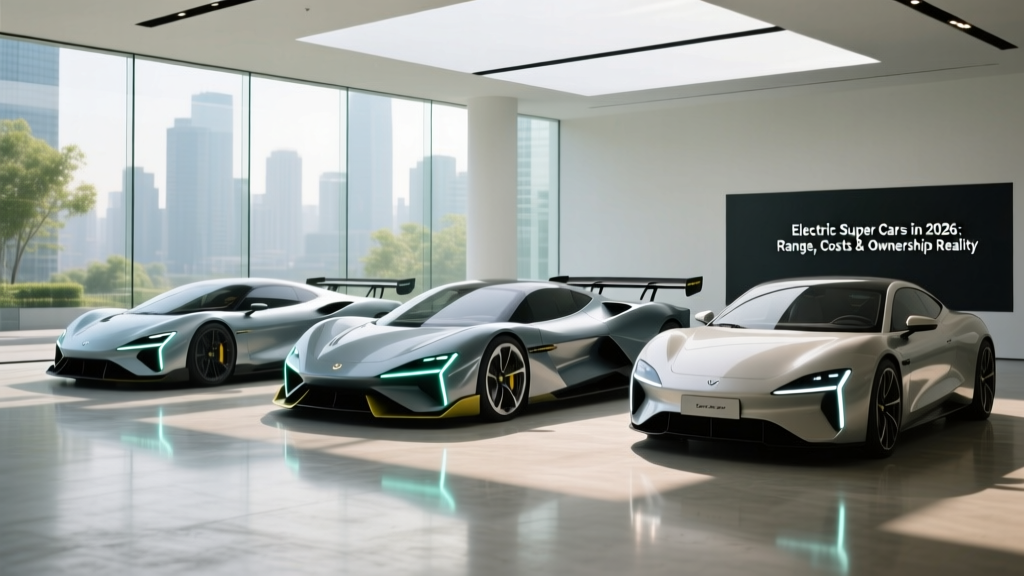
The term "electric super cars" covers a narrow but growing slice of the EV market: limited-production, high-performance battery-electric vehicles (BEVs) that compete directly with internal-combustion exotics like the Ferrari SF90 Stradale, Lamborghini Revuelto, and Porsche 911 Turbo S. Unlike mass-market performance EVs such as the Tesla Model S Plaid or Lucid Air Sapphire (which are super-sedans), true electric super cars prioritize low-volume craftsmanship, extreme power outputs exceeding 1,500 HP, and sub-2.0-second 0-60 mph times.
As of 2026, the segment's key players include:
- Rimac Nevera — 1,914 HP, $2.2M, 150 units produced
- Lotus Evija — 2,011 HP, ~$2.1M, 130 units planned
- Pininfarina Battista — 1,877 HP, ~$2.0M, 150 units planned
- Aspark Owl — 1,985 HP, ~$3.2M, 50 units
- Deus Vayanne (announced) — 2,200 HP, ~$2.0M, deliveries expected late 2026
These vehicles share common architecture: multi-motor all-wheel-drive layouts, large NMC (nickel-manganese-cobalt) battery packs in the 120 kWh range, carbon-fiber monocoque chassis, and active aerodynamics. None qualify for the federal §30D EV tax credit — all exceed the IRS MSRP cap of $80,000 for sedans or $85,000 for SUVs, and most buyers exceed the income phase-out thresholds.
Spec Showdown: Electric Super Cars vs. Gas Exotics
To understand where electric super cars fit, here's how the segment benchmarks against comparable gas and hybrid exotics on the metrics buyers actually care about.
| Metric | Rimac Nevera (BEV) | Porsche 911 Turbo S (Gas) | Ferrari SF90 Stradale (PHEV) |
|---|---|---|---|
| Base MSRP | $2,200,000 | $241,300 | $524,950 |
| Powertrain | Quad-motor AWD | 3.7L Twin-Turbo Flat-6 | 4.0L V8 + 3 Electric Motors |
| Horsepower | 1,914 HP | 640 HP | 986 HP (combined) |
| 0-60 mph | 1.85 seconds | 2.6 seconds | 2.5 seconds |
| Top Speed | 258 mph | 205 mph | 211 mph |
| EPA Range / Fuel | ~287 mi (est.) | 18 MPG combined | 14 mi electric + 45 MPGe |
| Battery / Tank | 120 kWh NMC | 17.9 gal fuel tank | 7.9 kWh + 17.2 gal |
| Peak Charge Rate | ~250 kW DC | N/A | ~7.4 kW AC (Level 2) |
| Curb Weight | 4,739 lbs | 3,636 lbs | |
| Cargo / Frunk | Minimal | 4.6 cu ft (frunk) | 2.6 cu ft |
Sources: Rimac Automobili, fueleconomy.gov, manufacturer press kits.
The data reveals a clear trade-off. Electric super cars dominate on straight-line acceleration and power output, but the weight penalty is severe — the Nevera carries over 1,100 lbs more than the 911 Turbo S. That mass affects cornering dynamics, tire wear, and braking distances, areas where mid-engine gas exotics still hold an edge on a road course.
Real-World Range and Charging: What the Sticker Doesn't Tell You
Manufacturer-claimed range figures for electric super cars should be treated with skepticism. The Rimac Nevera's WLTP rating of 340 miles (European standard) translates to an estimated EPA range of roughly 287 miles under US testing, which is more conservative. But real-world conditions compress that further.
EPA Estimated: ~287 miles (Nevera) | Real-World Highway (75 mph): ~210-230 miles | Cold Weather (30°F, highway): ~170-190 miles
High-performance EVs suffer disproportionate range loss at sustained high speeds because aerodynamic drag increases with the square of velocity. At 85 mph, expect to consume roughly 30% more energy per mile than at 65 mph. Cold temperatures further reduce battery efficiency and increase cabin heating load, even with a heat pump.
Charging infrastructure is the second critical variable. The Nevera supports peak DC fast charging at approximately 250 kW via a CCS connector (with NACS adapter availability expanding in 2026). On a 350 kW Electrify America or Tesla Supercharger stall (with adapter), you can expect:
- 10-80% charge: ~22-25 minutes (sustained average ~180 kW due to charge-curve taper above 60% SoC)
- 80-100% top-off: additional 35-40 minutes (charging slows dramatically to protect the NMC cells)
- Level 2 home charging (11 kW onboard): ~11 hours for a full 120 kWh pack
For a collector keeping this car in a climate-controlled garage with a dedicated ChargePoint or Wallbox Level 2 charger, overnight replenishment is effortless. For road trips, route planning around reliable 150+ kW DC chargers is mandatory — and charging-desert gaps remain in rural stretches of the Mountain West and Great Plains.
Total Ownership Cost: Purchase, Charging, Insurance, and Maintenance
Electric super cars reshape the traditional exotic-car cost equation. Here's a realistic 5-year ownership projection comparing a Rimac Nevera to a Porsche 911 Turbo S, assuming 3,000 miles driven annually (typical for a collector-grade weekend car).
| Cost Category | Rimac Nevera (5 Years) | Porsche 911 Turbo S (5 Years) |
|---|---|---|
| Purchase Price | $2,200,000 | $241,300 |
| Energy / Fuel (15,000 mi total) | ~$2,700 (at $0.15/kWh avg) | ~$5,850 (at $4.50/gal, 18 MPG) |
| Home Charger Install (Level 2) | $1,500 - $3,500 | $0 |
| Insurance (annual avg × 5) | $75,000 - $100,000 | $15,000 - $22,500 |
| Maintenance (tires, fluids, service) | $25,000 - $35,000 | $12,000 - $18,000 |
| Battery Warranty | 8 yr / 60,000 mi | N/A |
| Est. Depreciation (5 yr) | 30-45% (limited data) | 25-35% |
| Total Estimated 5-Yr Cost | ~$3,050,000+ | ~$310,000 - $330,000 |
Key takeaways from this breakdown:
- Fuel savings are real but negligible at this price point — saving ~$3,150 over five years on a $2.2M car is irrelevant to the buyer profile.
- Insurance is the budget killer. Specialty insurers like Hagerty and Chubb price electric hypercars aggressively due to limited repair networks, expensive carbon-fiber bodywork, and high-voltage safety protocols. Expect premiums 3-5× higher than a comparable gas exotic.
- Tire costs are elevated. The Nevera's 4,739-lb curb weight and 1,914 HP of instant torque chew through Michelin Pilot Sport Cup 2R tires (approx. $2,400 per set) in 3,000-5,000 miles under spirited driving.
- Maintenance is simpler but not cheap. No oil changes, spark plugs, or transmission fluid — but brake-by-wire systems, active aero actuators, and thermal management loops require specialized Rimac-certified service centers (fewer than 15 globally).
- No federal tax credit applies. All electric super cars exceed the IRS §30D MSRP and income caps.
Common Misconceptions About Electric Super Cars
| Myth | Fact |
|---|---|
| "Electric super cars are faster in every scenario." | They dominate 0-60 and quarter-mile sprints, but gas exotics often achieve higher top speeds and sustain lap times longer without thermal throttling. The Nevera set a Nürburgring record for EVs (7:05.298), but a 911 GT3 RS still laps faster overall. |
| "The battery will need replacing in a few years." | NMC packs in low-mileage collector cars experience minimal degradation. Rimac warranties the Nevera battery for 8 years / 60,000 miles with a 70% capacity retention guarantee. At 3,000 miles/year, the pack will likely outlast the ownership period. |
| "You can charge anywhere on a road trip." | DC fast-charging coverage is strong along major interstates, but 250+ kW chargers capable of utilizing the Nevera's peak charge rate remain concentrated in metro areas. Plan routes carefully. |
| "Electric super cars are silent and boring." | Rimac and Lotus engineer synthetic motor harmonics and cabin audio profiles. The driving experience is different — not silent — but lacks the mechanical theater of a flat-six or V12 at redline. |
| "They're self-driving." | No electric super car offers Level 4 autonomy. Driver-assist features (if equipped) are SAE Level 2 at best — requiring full driver engagement at all times. |
First-Time Buyer Considerations
If you're entering the electric super car market from a traditional exotic-car background, these practical factors will shape your ownership experience:
Home Charging Is Non-Negotiable
You need a dedicated 240V / 48-amp circuit (Level 2) installed by a licensed electrician in your garage. Expect $1,500-$3,500 for a quality Wallbox or ChargePoint unit plus installation. If your home electrical panel is at capacity, a panel upgrade to 200A service may add $2,000-$4,000. Public charging alone is not a viable long-term strategy for a collector vehicle.
Climate Matters More Than You Think
NMC battery chemistry performs best between 60-80°F. Owners in sub-freezing climates should precondition the battery (most models offer scheduled preconditioning via app) before driving or charging. Garage storage in a temperature-controlled environment is standard practice for this segment.
Resale Value Is Uncharted Territory
Gas exotics from Ferrari, Porsche, and Lamborghini have decades of auction data backing their depreciation curves. Electric super cars do not. Early Rimac Nevera resale transactions suggest 30-45% depreciation within five years, though extreme rarity (150 units total) may stabilize values long-term — similar to the Pagani Huaytra or Bugatti Chiron trajectory.
Service Network Limitations
Rimac operates a limited global service network. Lotus is leveraging its existing dealer infrastructure for the Evija, but high-voltage certification requirements mean not every Lotus dealer can perform warranty work. Factor in potential flatbed transport costs ($500-$1,500 per trip) to the nearest authorized center.
Decision Framework: Should You Buy an Electric Super Car?
Choose an electric super car if:
- You already own a gas exotic and want a complementary, zero-emission performance vehicle
- You have reliable Level 2 home charging and access to 150+ kW DC fast chargers for road trips
- You prioritize 0-60 acceleration and quarter-mile performance over track-day endurance
- You're comfortable with a 30-45% depreciation risk and specialty insurance premiums exceeding $15,000/year
- You value exclusivity — production runs of 50-150 units guarantee rarity
Stick with a gas or hybrid exotic if:
- You plan to drive the car at track days where sustained high-speed lapping is the priority
- You live in a region with limited DC fast-charging infrastructure
- You want established resale-value data and a broad dealer service network
- The visceral experience of engine sound, gear shifts, and mechanical feedback is central to your enjoyment
- Your budget is under $500,000 — the Porsche 911 Turbo S and Ferrari 296 GTB offer more accessible entry points
Frequently Asked Questions
What is the fastest electric super car in 2026?
The Aspark Owl claims a 1.72-second 0-60 mph time, followed closely by the Rimac Nevera at 1.85 seconds. Both figures are manufacturer-claimed under controlled conditions — real-world results on public surfaces typically add 0.1-0.3 seconds.
Do electric super cars qualify for any tax incentives?
No. The federal §30D Clean Vehicle Credit caps eligibility at $80,000 MSRP for sedans and $85,000 for SUVs/vans/pickups, with buyer income limits of $150,000 (single) or $300,000 (joint). All current electric super cars exceed these thresholds by an order of magnitude. Some states may offer registration-fee exemptions for EVs, but no meaningful purchase incentives apply.
How long do electric super car batteries last?
Rimac warranties the Nevera's 120 kWh NMC pack for 8 years or 60,000 miles with a minimum 70% capacity retention. At typical collector-car mileage (2,000-4,000 miles/year), the battery should retain 90%+ capacity well past the warranty period. Full pack replacement, if ever needed, is estimated at $80,000-$120,000 based on current NMC cell pricing.
Can I daily-drive an electric super car?
Technically yes, but practically no. Ground clearance is minimal (the Nevera sits at ~3.5 inches), cargo space is negligible, visibility is compromised by aggressive aero, and ride quality on imperfect roads is harsh. These are event cars, not commuters.
What's the difference between kW and kWh in this context?
kW (kilowatts) measures power — how fast energy flows during charging or how much force the motors produce. The Nevera's motors produce ~1,427 kW (1,914 HP), and it can accept up to 250 kW of charging power. kWh (kilowatt-hours) measures energy capacity — the size of the battery. The Nevera's 120 kWh battery is analogous to a 17.9-gallon fuel tank in the 911 Turbo S.
Are electric super cars safer than gas exotics?
There's insufficient crash-test data from NHTSA or IIHS for these low-volume vehicles. However, the carbon-fiber monocoque structures are engineered to FIA racing standards, and the low center of gravity (battery floor placement) reduces rollover risk. High-voltage disconnect systems automatically isolate the battery pack in a collision.