The Quick Answer: Consumer Electric Submarines Don't Exist (Yet)
If you're searching for an electric submarine you can buy and drive on public roads today, the honest answer is that no street-legal, consumer-available amphibious or submersible electric vehicle exists as of 2026. What does exist are three distinct categories that often get confused online: (1) military and research submersibles that use electric propulsion, (2) luxury personal submarines like the U-Boat Worx Nemo (~$4.5 million) that are watercraft only, and (3) regular production EVs that waterfront and boat owners are buying to replace gas vehicles near marinas and docks. This guide clarifies what's real, what's vaporware, and what electrified options actually make sense if you live near the water.
Why "Electric Submarine Car" Searches Keep Spiking
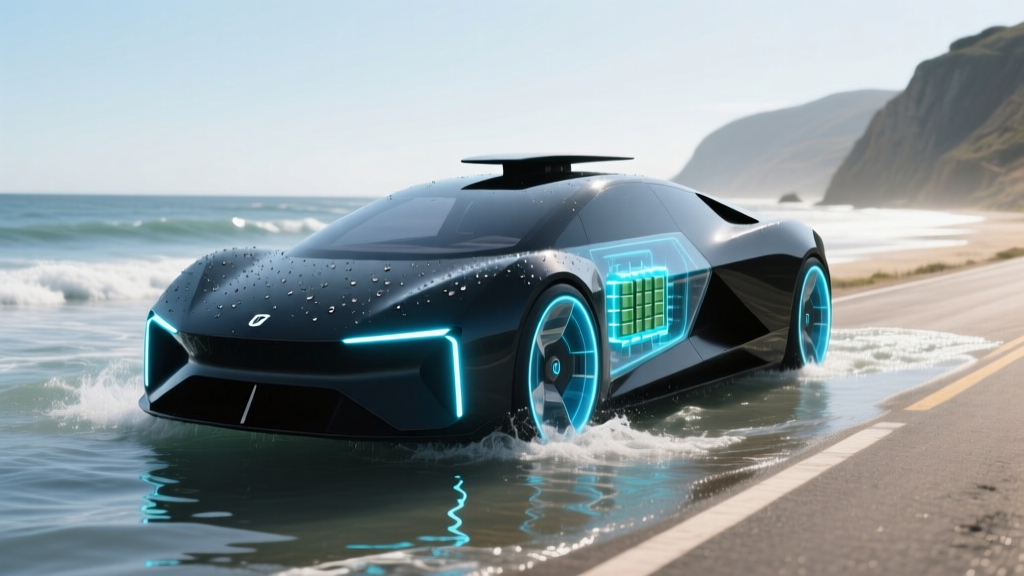
The term "electric submarine" has trended periodically thanks to viral concept renders, crowdfunding campaigns that never deliver, and AI-generated images of sleek submersible cars circulating on social media. A few high-profile projects have fueled interest:
- The sQuba (Rinspeed, 2008): A modified Lotus Elise that could drive on land and submerge to 10 meters. It was a one-off concept, never produced, and required occupants to use scuba regulators underwater.
- The Watercar Panther and Python: Amphibious (surface-only, not submersible) vehicles based on Jeep platforms with gas engines — not electric, not submarines.
- Various crowdfunding "submarine car" campaigns: Multiple Indiegogo and Kickstarter projects have promised consumer submersible EVs. None have delivered a production vehicle.
The engineering barriers are immense. A road-legal vehicle must meet NHTSA crash and safety standards, while a submersible must handle pressure differentials, sealed battery compartments, saltwater corrosion, and marine certification. Combining both in a single vehicle that costs less than a yacht remains an unsolved engineering challenge for the consumer market.
What Electric Submersibles Actually Exist
If your interest is in electric-powered underwater vehicles (not road-legal cars), here is the current landscape:
| Vehicle | Type | Propulsion | Max Depth | Price (approx.) | Consumer Available? |
|---|---|---|---|---|---|
| U-Boat Worx Nemo | Personal submarine | Electric (lithium battery) | 100 m / 328 ft | ~$4.5 million | Yes (ultra-luxury) |
| Triton Submarines 3300/3 | Personal submarine | Electric | 1,000 m / 3,280 ft | ~$5.5 million | Yes (ultra-luxury) |
| DeepFlight Dragon | Personal submarine | Electric | ~120 m / 394 ft | ~$2 million | Yes (limited) |
| Navy/Research UUVs | Military/scientific | Electric | Varies | Not consumer | No |
These are watercraft. They cannot be driven on roads, require marine licensing, and are purchased by superyacht owners, research institutions, or governments. They use lithium-based electric battery packs — the same fundamental chemistry (NMC or LFP cells) found in road-going EVs — but in marine-rated, pressure-sealed enclosures.
The Real Question: Best EVs for Waterfront and Boat Owners
Most people landing on "electric submarine" searches are actually waterfront property owners, marina operators, or boating enthusiasts looking for an EV that makes sense near water. Here's where the real buying decision lives.
Why Waterfront Owners Are Switching to EVs
If you live on a lake, coast, or near a marina, an EV offers specific advantages over a gas vehicle:
- No fuel storage near water: Gasoline and diesel near docks and marinas are an environmental liability. EVs eliminate spill risk entirely.
- Home charging at your dock or garage: Waterfront properties typically have dedicated parking and electrical panels, making Level 2 home charger installation straightforward.
- Quiet operation: Electric motors don't disturb wildlife or neighbors — critical in residential waterfront communities.
- Towing electric boats: If you tow a small electric boat (like a Candela C-8 or X Shore 1), pairing it with an EV tow vehicle creates a fully electric water-and-land transport chain.
2026 EV Picks for Waterfront Owners
| Vehicle | EPA Range | Battery (kWh) | Towing Capacity | Starting MSRP | §30D Credit Eligible? |
|---|---|---|---|---|---|
| Rivian R1S (Dual-Motor) | 352 mi | 128.9 kWh (NMC) | 7,700 lbs | $79,900 | Yes (SUV cap $80k, income limits apply) |
| Ford F-150 Lightning (Ext. Range) | 320 mi | 131 kWh (NMC) | 10,000 lbs | $69,995 | Yes (truck cap $80k) |
| Chevrolet Silverado EV (4WT) | 492 mi | 200+ kWh (NMC) | 10,000 lbs | $74,800 | Yes (truck cap $80k) |
| Tesla Model Y (Long Range AWD) | 320 mi | ~75 kWh (NMC) | 3,500 lbs | $44,990 | Yes (SUV cap $80k) |
| Hyundai Ioniq 5 (Long Range AWD) | 290 mi | 84 kWh (NMC) | 2,300 lbs | $49,950 | Yes (SUV cap $80k) |
Sources: fueleconomy.gov, manufacturer spec sheets. §30D credit eligibility depends on MSRP caps, buyer income limits, and battery-component/critical-mineral sourcing rules per IRS guidelines. Consult a tax professional.
Cost Comparison: EV vs Gas for Waterfront Living
Here's a realistic 5-year ownership comparison for a waterfront homeowner driving 12,000 miles/year, towing a small boat ~2,000 miles/year, and charging primarily at home on a Level 2 setup.
| Cost Category | EV (Ford F-150 Lightning) | Gas (Ford F-150 3.5L EcoBoost) |
|---|---|---|
| Purchase Price (base) | $59,990 | $48,000 |
| Federal Tax Credit (§30D) | −$7,500 (if eligible) | $0 |
| Home Charger Install (Level 2) | $1,200–$2,500 | $0 |
| 5-Year Fuel/Energy (60,000 mi) | $3,600 (home charging at $0.14/kWh) | $10,800 (gas at $3.50/gal, 20 MPG) |
| 5-Year Maintenance | ~$1,500 | ~$4,000 |
| 5-Year Insurance (avg) | ~$9,000 | ~$7,500 |
| 5-Year Total Cost | ~$67,790–$69,090 | ~$70,300 |
The EV breaks even or comes out ahead within 5 years, largely due to fuel and maintenance savings — even before factoring in any state or utility rebates. The key variable is home charging access: if you can install a Level 2 charger at your waterfront property, the economics strongly favor electric.
Real-World Ownership Considerations Near Water
Salt Air and Corrosion
Coastal and saltwater environments accelerate corrosion on any vehicle, EV or gas. EVs aren't immune — brake calipers, suspension components, and underbody hardware all face salt exposure. However, EVs eliminate the exhaust system (a major corrosion point on gas vehicles) and have fewer fluid-filled components vulnerable to salt damage. Regular undercarriage rinsing remains essential.
Flood and Storm Surge Risk
This is a critical concern for waterfront EV owners. Never drive any vehicle — EV or gas — through floodwater. While EV battery packs are sealed to IP67 or IP6K9K standards and can withstand temporary submersion (typically rated for 30 minutes at ~1 meter depth), prolonged saltwater exposure will compromise seals and create serious electrical hazards. If your area is flood-prone:
- Park on elevated ground or in a raised garage during storm warnings.
- Ensure your homeowner's insurance covers vehicle flood damage (standard auto policies often exclude this).
- Know that a saltwater-submerged EV battery is generally a total-loss replacement — expect $15,000–$30,000+ for a new pack.
Charging Infrastructure at Marinas
Public charging near marinas and boat ramps remains sparse in most regions. Plan to rely primarily on home charging. If your marina or HOA allows it, a Level 2 charger at your dock-side parking spot is ideal. Some newer marinas in Florida, California, and the Pacific Northwest have begun installing destination chargers, but don't count on them.
Cold-Weather Range Loss (Northern Waterfront Owners)
If your waterfront property is in a cold climate (Great Lakes, New England, Pacific Northwest winters), expect 20–30% range reduction in freezing temperatures. An F-150 Lightning rated at 320 miles EPA may deliver 220–250 real-world miles in 20°F weather. Vehicles with heat pumps (like the Hyundai Ioniq 5) lose less range in cold than those using resistive heating.
Common Misconceptions About Electric Submarines and Amphibious EVs
| Myth | Fact |
|---|---|
| "I can buy an electric submarine car for under $100k" | No consumer submersible road vehicle exists at any price. The cheapest personal submarines start around $2 million and are water-only. |
| "EVs can't go near water because of electrocution risk" | EV battery packs are hermetically sealed and IP67-rated. Rain, car washes, and puddles pose no electrocution risk. Flood submersion is a different concern (see above). |
| "Amphibious cars like the Watercar are electric" | The Watercar Panther and Python use gasoline engines (Honda/Acura V6). They are surface-amphibious only, not submersible. |
| "Tesla is secretly developing a submarine" | No credible evidence supports this. Elon Musk has made joking references, but Tesla has no announced submersible or amphibious vehicle program. |
| "EV batteries explode if they get wet" | Sealed battery packs are designed to withstand water exposure. Thermal runaway is caused by physical damage or manufacturing defects, not water contact under normal conditions. |
Decision Framework: What Should You Actually Buy?
If You Want a Submersible Vehicle (Water Only)
Budget $2M+: Look at U-Boat Worx Nemo, Triton 3300/3, or DeepFlight Dragon. These are electric-powered personal submarines available through specialty marine dealers. They require yacht-tender storage, marine licensing, and are not road-legal.
If You Want an Amphibious Vehicle (Surface Water + Road)
Budget $150k–$300k: The Watercar Panther (gas-powered Jeep Wrangler-based) is the most accessible option. It handles lakes and calm coastal water at surface level. It is not electric and not submersible.
If You're a Waterfront Homeowner Wanting a Practical EV
Need to tow a boat (5,000+ lbs): Ford F-150 Lightning, Rivian R1T, or Chevrolet Silverado EV. All offer 300+ miles EPA range, 7,700–10,000 lb towing, and Level 2 home charging capability.
Need a daily driver near the marina (no heavy towing): Tesla Model Y, Hyundai Ioniq 5, or Ford Mustang Mach-E. Lower cost, excellent efficiency, and sufficient range for coastal commutes.
Want maximum corrosion resistance: No EV is fully marine-grade, but aluminum-body vehicles (Rivian R1S/R1T, Ford F-150 Lightning) resist rust better than steel-bodied alternatives in salt-air environments.
Frequently Asked Questions
Can any production EV be driven underwater?
No. While EV battery packs are sealed to IP67 standards and can tolerate brief, shallow submersion (such as driving through a deep puddle), no production EV is designed, tested, or warranted for underwater operation. Attempting to submerge a road-legal EV will void warranties, damage non-sealed electronics (12V systems, infotainment, ADAS sensors), and create serious safety risks.
Are there electric boats that work like "submarines"?
Yes — semi-submersible electric boats exist. Companies like Bionic Yacht and various tourism operators offer electric semi-sub vessels for sightseeing. These are fully watercraft, not vehicles, and typically operate at shallow depths with viewing windows below the waterline.
Will we ever see a consumer electric submarine car?
The engineering barriers — crash safety certification (NHTSA), marine pressure certification, dual-mode propulsion, sealed occupant compartments, and cost — make a sub-$200k consumer amphibious/submersible EV unlikely before 2035 at the earliest. Current material science and regulatory frameworks don't support it. If one emerges, it will likely be a low-volume specialty vehicle priced above $500,000.
What's the best EV for someone who lives on a lake?
For lake homeowners who need to tow a boat: the Ford F-150 Lightning (Extended Range) offers the best combination of 320-mile EPA range, 10,000-lb towing, and available Pro Power Onboard (which can power dock tools or serve as backup power). For daily commuting without towing: the Hyundai Ioniq 5 provides strong value at ~$49,950 with 290 miles range and 800V fast charging (10–80% in ~18 minutes at a 350 kW station).
Do EVs need special insurance if I live near water?
Standard auto insurance covers EVs, but if you live in a flood zone, verify that your policy covers water damage to the vehicle. Some insurers exclude flood damage from standard auto policies. Additionally, EV insurance premiums tend to run 10–20% higher than equivalent gas vehicles due to higher repair costs for battery and structural damage. Get quotes from multiple insurers before purchasing.