Quick Answer: Is an Electric Step Van Right for Your Fleet?
An electric step van makes financial sense for last-mile delivery routes under 150 miles per day with predictable depot return for overnight Level 2 charging. Expect 120–170 miles of real-world range from current models like the Workhorse E-Gen or Lightning Electric Class 4, with operating costs roughly 40–60% lower per mile than diesel equivalents. Upfront purchase price runs $120,000–$180,000 before incentives, but federal §45W commercial clean vehicle credits (up to $40,000 for vehicles over 14,000 lbs GVWR) and state voucher programs can close the gap significantly. If your routes regularly exceed 180 miles, operate in extreme cold, or lack depot charging infrastructure, a diesel or CNG step van remains the pragmatic choice for now.
What Is an Electric Step Van — and Who Needs One?
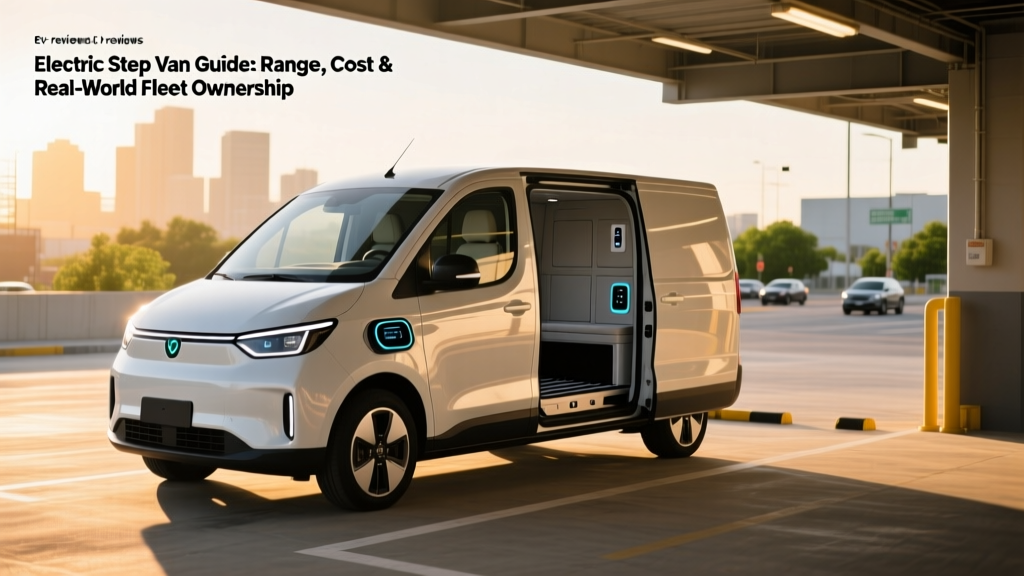
An electric step van is a battery-electric commercial walk-in delivery vehicle, typically Class 3 through Class 5 (10,001–19,500 lbs GVWR). These are the boxy, driver-friendly trucks used by parcel carriers, linen services, food distributors, and municipal fleets for stop-and-go urban and suburban routes. Unlike consumer EVs, step vans are purpose-built around cargo volume (typically 400–700 cubic feet), low step-in height, and all-day duty cycles of 80–200 stops.
The core appeal is simple: electric motors deliver peak torque at zero RPM, which is ideal for a heavy vehicle that accelerates from a stop hundreds of times daily. Regenerative braking recovers energy during deceleration, cutting brake wear dramatically. The absence of a diesel engine eliminates oil changes, DEF fluid, DPF filter maintenance, and the noise and vibration that fatigue drivers over a 10-hour shift.
Current production models available or in fleet delivery in 2026 include:
- Workhorse E-Gen / N-Gen platform — Class 3–4, available in multiple wheelbase configurations
- Lightning Electric Class 4 walk-in van — repower and new-build options
- GreenPower EV Star Cargo — Class 3, smaller footprint for urban routes
- Orange EV YT-Series terminal tractor / step van variants — yard and drayage applications
- BrightDrop Zevo 600 (formerly BrightDrop, now integrated under GM Commercial) — Class 3, 600 cu ft cargo
Electric Step Van Specs: Range, Battery, and Charging
Fleet buyers need exact numbers, not marketing claims. Here is a spec comparison of representative models available or in fleet delivery as of 2026:
| Spec | Workhorse N-Gen (Class 4) | GreenPower EV Star Cargo | BrightDrop Zevo 600 |
|---|---|---|---|
| GVWR | ~15,999 lbs | ~14,500 lbs | ~14,500 lbs |
| Battery Capacity | ~120 kWh (NMC) | ~118 kWh (NMC) | ~140 kWh (NMC, Ultium) |
| EPA-Estimated Range | ~150 mi | ~150 mi | ~250 mi (light load) |
| Real-World Range (loaded, mixed) | ~110–130 mi | ~100–125 mi | ~160–200 mi |
| Peak DC Fast Charge | ~80 kW | ~60 kW | ~120 kW |
| 10–80% DC Charge Time | ~90 min | ~110 min | ~70 min |
| Level 2 Charge Rate | ~19.2 kW | ~19.2 kW | ~19.2 kW |
| Level 2 Full Charge Time | ~7 hrs | ~7 hrs | ~8 hrs |
| Payload Capacity | ~4,500 lbs | ~4,000 lbs | ~3,800 lbs |
| Cargo Volume | ~500 cu ft | ~450 cu ft | ~600 cu ft |
| Base MSRP (approx.) | $140,000–$160,000 | $130,000–$145,000 | $150,000–$175,000 |
| Battery Warranty | 5 yr / 100,000 mi | 5 yr / 100,000 mi | 8 yr / 100,000 mi |
Real-world range caveat: EPA-equivalent range figures for commercial vehicles are less standardized than passenger cars. Expect 20–35% range reduction when fully loaded, and an additional 15–25% loss in cold weather (below 32°F) due to cabin heating and reduced battery efficiency. A van rated at 150 miles may deliver only 85–100 miles on a loaded winter route. Route planning should be based on worst-case seasonal range, not the sticker number.
Electric Step Van vs. Diesel Step Van: Cost Comparison
The purchase price of an electric step van is roughly 2–3× that of a comparable diesel (a new Freightliner MT55 or Workhorse W56 diesel chassis runs $55,000–$80,000). The financial case hinges on operating-cost savings over a 7–12 year fleet lifecycle. Here is a data-driven comparison based on a 120-mile/day, 250-day/year route profile:
| Cost Category | Electric Step Van | Diesel Step Van |
|---|---|---|
| Purchase Price (base) | $150,000 | $65,000 |
| Federal Tax Credit (§45W) | −$40,000 | $0 |
| State Incentive (e.g., CARB HVIP) | −$45,000–$75,000* | $0 |
| Net Acquisition Cost | $30,000–$65,000 | $65,000 |
| Energy Cost per Mile | $0.12–$0.18 (electricity) | $0.45–$0.65 (diesel) |
| Annual Energy Cost (30,000 mi) | $3,600–$5,400 | $13,500–$19,500 |
| Annual Maintenance | $1,500–$2,500 | $4,000–$6,500 |
| Brake Replacement Interval | 150,000+ mi (regen) | 40,000–60,000 mi |
| 5-Year Total Operating Cost | $25,500–$39,500 | $87,500–$130,000 |
*State incentive amounts vary widely. California's HVIP program, New York's Truck Voucher Incentive Program, and similar programs in New Jersey, Colorado, and Oregon can cover $45,000–$90,000+ depending on vehicle class and fleet size. Consult your state air quality district for current voucher availability.
The crossover point — where cumulative EV savings repay the higher net acquisition cost — typically arrives in years 2–4 for high-utilization routes. Over a 10-year lifecycle, total cost of ownership (TCO) for an electric step van can be $80,000–$150,000 lower than diesel, even after accounting for potential battery replacement.
Charging Infrastructure: What Fleet Operators Must Plan
Unlike consumer EVs that can rely on public fast-charging networks, electric step vans depend almost entirely on depot-based charging. Here is what a typical fleet depot installation involves:
| Component | Per-Stall Cost Range | Notes |
|---|---|---|
| Level 2 EVSE (19.2 kW) | $3,500–$6,000 | Commercial-rated, networked |
| DC Fast Charger (60–120 kW, shared) | $40,000–$90,000 | 1 DCFC per 4–6 vans for opportunity charging |
| Electrical panel / transformer upgrade | $15,000–$60,000 | Depends on existing service; may require new 480V 3-phase |
| Conduit, wiring, trenching | $5,000–$20,000 | Per run, varies by parking layout |
| Permitting & utility interconnection | $3,000–$15,000 | Utility may require demand-charge study |
| Software / fleet management | $500–$2,000/yr | Charge scheduling, load management |
| Total per stall (L2 only) | $8,000–$25,000 | Before utility make-ready incentives |
Critical consideration — utility demand charges: Commercial electricity bills include demand charges based on peak kW draw. Plugging in 10 vans simultaneously at 19.2 kW each creates a 192 kW spike that can trigger demand charges of $10–$25/kW/month, adding $2,000–$5,000/month to your bill. Networked chargers with load-management software can stagger charging to flatten the demand curve, cutting this cost by 50–70%. Engage your utility's EV fleet team early — many offer make-ready infrastructure incentives covering 50–100% of wiring and panel costs.
Charging time math: A 120 kWh battery charged at 19.2 kW (Level 2) requires roughly 6.5–7 hours for a full charge. For a van returning at 20% SoC after a 120-mile route, a 10-hour overnight shift provides ample time. DC fast charging is primarily useful for mid-day opportunity charging or route extensions, not daily use — frequent DCFC above 80 kW accelerates NMC battery degradation over time.
Common Misconceptions About Electric Step Vans
| Myth | Fact |
|---|---|
| "Electric vans can't handle a full day of deliveries." | Average last-mile routes run 80–130 miles/day. Current vans deliver 110–200 real-world miles loaded. The issue is route outliers, not averages — plan for your longest 5% of days. |
| "Battery replacement will bankrupt the fleet." | NMC commercial packs are warrantied for 5–8 years / 100,000+ miles at ≥70% capacity retention. At end-of-life, a replacement 120 kWh pack currently costs $25,000–$40,000 — significant, but offset by years of fuel/maintenance savings. Prices continue declining. |
| "The grid can't handle fleet charging." | Most depot charging occurs overnight during off-peak hours (10 PM–6 AM), when grid capacity is abundant. Managed charging software prevents simultaneous peak draws. Utilities actively incentivize off-peak fleet charging with reduced rates. |
| "Federal tax credits only apply to passenger cars." | The §45W Commercial Clean Vehicle Credit provides up to $7,500 for vehicles under 14,000 lbs GVWR and up to $40,000 for heavier vehicles. Unlike the consumer §30D credit, §45W has no MSRP cap, no buyer income limit, and no critical-mineral sourcing requirement. It applies per vehicle, with no manufacturer cap. |
| "Cold weather makes electric vans unusable." | Cold reduces range 15–25% and slows charging. Fleets in northern climates mitigate this with depot preconditioning (heating the cabin while plugged in), heated seats instead of full cabin air, and route-length buffers. It's a planning challenge, not a dealbreaker — thousands of electric delivery vans operate in Chicago, Minneapolis, and Boston. |
Real-World Ownership: What First-Time EV Fleet Buyers Must Know
Route Analysis Comes First
Before evaluating any vehicle, pull GPS telematics data from your existing diesel vans for 90 days. Document daily mileage, stop count, idle time, payload weight, and ambient temperature. Identify your 95th-percentile route distance — that's the number your EV must handle, not your average. If that number exceeds 170 miles with payload, you'll need either a mid-day DC fast-charge opportunity or a mixed fleet strategy.
Driver Training Is Non-Negotiable
Electric step vans drive differently: instant torque, heavy regenerative braking, near-silent operation at low speeds (a pedestrian safety concern requiring acoustic vehicle alerting systems, or AVAS). Budget 4–8 hours of behind-the-wheel training per driver, covering regen modulation, charge-plug procedures, range-maximizing driving techniques, and dashboard SoC monitoring. Fleets that skip training report 10–20% higher energy consumption and more range-anxiety-related complaints.
Maintenance Shifts, Not Disappears
Electric step vans eliminate engine oil, fuel filters, DEF, DPF, turbochargers, and exhaust systems. They still require tire rotation (EVs are heavier and wear tires faster), cabin air filter replacement, brake fluid checks, coolant system service for battery thermal management, and windshield washer fluid. Plan for roughly 30–40% fewer maintenance hours annually, not zero.
Insurance Costs More — Budget for It
Commercial EV insurance premiums typically run 15–30% higher than diesel equivalents, driven by higher replacement vehicle cost, specialized repair requirements, and limited actuarial data. Get quotes from your fleet insurer before committing to a purchase order. Some insurers offer EV-specific fleet policies with battery-coverage riders.
Decision Framework: Should You Buy an Electric Step Van?
Choose an Electric Step Van If:
- Your 95th-percentile daily route is under 160 miles
- Vans return to a depot nightly with 8+ hours for charging
- You have access to (or can install) 3-phase electrical service at your depot
- Your fleet operates in a state with commercial EV incentive programs (CA, NY, NJ, CO, OR, WA)
- You plan to keep vehicles 7+ years to capture full TCO savings
- Your routes are predominantly urban/suburban with frequent stops (maximizing regen braking)
- You face municipal clean-air mandates or customer ESG requirements
Stick With Diesel or CNG If:
- Your routes regularly exceed 180 miles/day with no mid-day charging option
- Your depot lacks electrical infrastructure and utility upgrades would exceed $100,000
- You operate in extreme cold (below 0°F) with no depot preconditioning capability
- You need to tow heavy trailers or carry payloads exceeding 5,000 lbs consistently
- Your fleet turns vehicles every 3–4 years (insufficient time to recover higher upfront cost)
- You operate in a region with no state incentive programs and electricity rates above $0.25/kWh
Consider a Mixed Fleet If:
- Some routes fit EV profiles and others don't — deploy electric vans on shorter urban routes and diesel on long-haul or rural routes
- You want to pilot 2–3 electric vans on controlled routes before full fleet conversion
- Your depot electrical capacity can support partial electrification now with planned expansion
Frequently Asked Questions
How long does an electric step van battery last?
Commercial NMC lithium-ion packs in step vans are designed for 1,500–3,000 full charge cycles before degrading to 70–80% of original capacity. At one cycle per day, that translates to 5–8 years of daily use. Most manufacturers warrant the battery for 5–8 years or 100,000 miles at ≥70% retention. Real-world fleet data from early adopters (UPS, FedEx, Amazon DSPs) shows approximately 2–3% degradation per year under normal use, meaning a 150-mile van might deliver 125–135 miles after 5 years.
Can I charge an electric step van on a standard outlet?
Technically yes, on a 120V/20A outlet (Level 1), but at roughly 1.4 kW, charging a 120 kWh battery from 20% to full would take over 80 hours — completely impractical for fleet operations. Level 2 at 19.2 kW is the minimum viable depot charging solution, delivering a full charge in 6–8 hours. Some fleets install 240V/50A circuits (roughly 11.5 kW) as a lower-cost alternative, extending charge time to 10–12 hours, which still works for overnight-only use.
What is the §45W commercial clean vehicle credit and how do I qualify?
The §45W credit provides 15% of the vehicle's cost basis (30% if placed in service before certain deadlines) up to $7,500 for vehicles under 14,000 lbs GVWR, or up to $40,000 for heavier vehicles. Key advantages over the consumer §30D credit: no MSRP cap, no buyer income limit, no per-manufacturer cap, and no battery-sourcing requirement. The vehicle must be used predominantly in the U.S. and acquired for business use. Consult a tax professional regarding your specific eligibility and whether to take the credit or elect direct pay (available for tax-exempt entities).
How does payload weight affect electric step van range?
Every 1,000 lbs of additional payload typically reduces range by 5–8%. A van rated at 150 miles with a 1,000-lb load may deliver only 120–130 miles at 4,000 lbs. Stop-and-go driving partially offsets this through regenerative braking, but sustained highway segments with heavy loads are the worst-case scenario. Fleet operators should spec their route-planning software with payload-weight inputs for accurate range projections.
Are electric step vans eligible for utility rebates?
Many investor-owned utilities offer commercial EV rebates covering $5,000–$25,000 per vehicle and/or 50–100% of depot charging infrastructure costs. Southern California Edison, PG&E, Con Edison, National Grid, and Xcel Energy all operate commercial fleet electrification programs with make-ready incentives. Contact your utility's commercial EV team or check the Alternative Fuels Data Center for a searchable database of federal and state incentives by ZIP code.
What happens if an electric step van runs out of charge on a route?
Unlike a diesel van that can be refueled in 10 minutes with a jerry can, a depleted EV requires a flatbed tow or a mobile DC charging unit. Most fleet operators mitigate this risk through conservative route planning (never spec below 30% SoC buffer at end of route), telematics-based SoC monitoring with dispatch alerts, and one DC fast charger at the depot for emergency mid-day top-ups. Some roadside-assistance providers now offer mobile EV charging trucks, but response times of 60–90 minutes are typical — unacceptable for time-sensitive deliveries.