If you're shopping for an electric vehicle in 2026, you've probably noticed that every modern EV uses an electric steering motor rather than the hydraulic power steering found in older gas cars. Here's the practical answer: an electric steering motor (part of an Electric Power Steering or EPS system) uses a dedicated electric motor — typically drawing 50 to 150 watts during operation — to assist your steering input, replacing the engine-driven hydraulic pump used in conventional vehicles. This switch saves roughly 3-5% in energy consumption compared to hydraulic systems, contributes to an EV's overall efficiency, and eliminates hydraulic fluid, hoses, and pump maintenance entirely. Replacement costs, when needed, typically range from $800 to $2,500 depending on the vehicle, though EPS failure rates remain low across major EV platforms.
Quick Answer: Electric Steering Motor in EVs
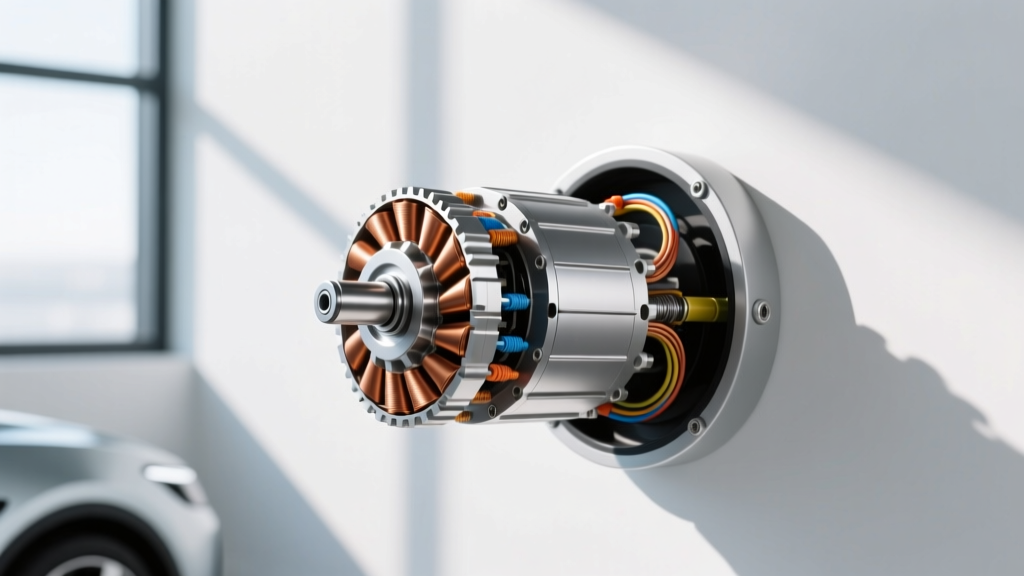
What it is: A brushless DC motor integrated into the steering column or rack that provides variable assist based on vehicle speed and driver input.
Power draw: 50-150W typical (peaks up to 400W during low-speed parking maneuvers).
Replacement cost: $800-$2,500 (parts + labor, varies by model).
Failure rate: Low — most EPS systems outlast 150,000 miles without service.
Maintenance: None — no fluid, no belts, no pump to replace.
How an Electric Steering Motor Actually Works in an EV
In a traditional internal-combustion vehicle, power steering relies on a hydraulic pump driven by the engine via a serpentine belt. That pump runs constantly whenever the engine is on, consuming roughly 2-5 horsepower of parasitic loss — energy you're paying for even when driving straight on the highway.
An electric steering motor eliminates this waste. The system consists of three core components:
- Torque sensor: Measures how much force you're applying to the steering wheel.
- Electronic Control Unit (ECU): Processes steering input, vehicle speed, and sometimes road conditions to determine how much assist to provide.
- Brushless DC motor: Applies assist force to either the steering column (column-type EPS) or directly to the steering rack (rack-type EPS).
In EVs like the Tesla Model Y, Hyundai Ioniq 5, and Ford Mustang Mach-E, the EPS system draws power directly from the 12V auxiliary battery (which is itself charged by a DC-DC converter from the main traction battery). The motor provides variable assist — heavy at low speeds for easy parking, lighter at highway speeds for stability and road feel.
Some 2026 models, including the Tesla Cybertruck, use a more advanced steer-by-wire system where there is no mechanical connection between the steering wheel and the wheels at all. Instead, the electric steering motor receives digital signals and actuates the rack independently. This is a significant evolution beyond conventional EPS, though it remains rare and carries different reliability considerations.
Electric Steering vs. Hydraulic: The Efficiency and Cost Numbers
The shift from hydraulic to electric steering wasn't driven purely by the EV transition — most new gas cars also use EPS today. But the efficiency advantage matters far more in an EV, where every watt-hour counts toward range.
| Factor | Hydraulic Power Steering (Older Gas Cars) | Electric Power Steering (Modern EVs & Gas Cars) |
|---|---|---|
| Parasitic power loss | 1.5-3.7 kW (2-5 HP) continuous | 0.05-0.15 kW (50-150W) on demand only |
| Range impact (EV equivalent) | ~5-8 miles on a 300-mile range pack | Negligible (<1 mile) |
| Maintenance items | Fluid flush every 30-50k mi, pump replacement, hose leaks | None — sealed system |
| Typical replacement cost | $400-$900 (pump), $200-$500 (hoses/rack) | $800-$2,500 (motor/ECU assembly) |
| Weight | 15-25 lbs (pump, fluid, hoses, reservoir) | 8-15 lbs (motor + ECU) |
| ADAS compatibility | Limited — requires additional actuators | Native — enables lane-keep, auto-park, SAE Level 2+ |
The efficiency math is straightforward. A hydraulic system running at 2 kW of parasitic drain over a 30-minute drive wastes roughly 1 kWh of energy. In an EV averaging 3-4 miles per kWh, that's 3-4 miles of range lost per half hour of driving. The electric steering motor's 50-150W draw over the same period consumes about 0.05-0.075 kWh — essentially negligible. According to fueleconomy.gov, ancillary systems like EPS, climate control, and DC-DC conversion collectively account for 5-15% of an EV's total energy consumption, with EPS representing the smallest slice of that figure.
Real-World Costs: What EV Owners Actually Spend on Steering
One of the strongest ownership arguments for EPS in EVs is the near-total elimination of steering-related maintenance. Here's how costs break down over a typical 5-year/75,000-mile ownership period:
| Cost Item | Hydraulic Steering (Gas Car, 5yr) | Electric Steering (EV, 5yr) |
|---|---|---|
| Power steering fluid flush (2x) | $160-$240 | $0 |
| Pump or hose repair (probability-adjusted) | $150-$400 | $0 |
| EPS motor replacement (probability-adjusted) | N/A | $50-$150 (low failure rate ~3-5%) |
| Serpentine belt contribution | $30-$60 | $0 |
| Total estimated 5-yr steering cost | $340-$700 | $50-$150 |
These are probability-weighted figures. The vast majority of EV owners will never touch their electric steering motor. When failures do occur, they tend to happen in the 100,000-150,000 mile range and often involve the torque sensor or ECU rather than the motor itself.
For context on total EV ownership economics, consider that a 2026 Hyundai Ioniq 5 SEL (MSRP ~$45,500, EPA range 303 miles, 84 kWh NMC battery) charging at home at $0.14/kWh spends roughly $600-$800/year on electricity versus $1,800-$2,400/year on gasoline for a comparable gas-powered Tucson AWD. The steering system savings are a smaller line item, but they compound with lower brake wear (thanks to regenerative braking), zero oil changes, and no transmission fluid service to create a meaningful total-cost-of-ownership gap.
Electric Steering Motor Reliability: What the Data Shows
EPS systems in EVs have proven highly reliable, but they're not immune to issues. Here's what the data and owner experience reveal:
Common Failure Modes
- Torque sensor drift: The sensor that reads steering input can degrade over time, causing uneven assist or a "dead zone" on-center. Repair: $400-$800.
- ECU software glitches: Firmware bugs can cause intermittent loss of assist or warning lights. Often resolved via OTA updates or dealer reflash at no cost under warranty.
- Motor bearing wear: High-mileage units (150k+ miles) may develop bearing noise or increased friction. Full motor replacement: $800-$2,500.
- Connector/wiring issues: Moisture ingress or vibration can damage wiring harness connections. Repair: $200-$500.
Warranty Coverage
Most manufacturers cover the EPS system under the basic vehicle warranty (typically 3 years/36,000 miles or 5 years/60,000 miles). Some, like Hyundai and Kia, extend coverage to 5 years/60,000 miles under the basic warranty and may cover steering components under the 10-year/100,000-mile powertrain warranty depending on the failure mode. Always verify with your specific manufacturer — coverage definitions vary.
According to NHTSA recall databases, EPS-related recalls have affected specific production runs across several brands (notably certain Hyundai, Toyota, and Ford models in 2020-2024), but these have largely been addressed through software updates or targeted component replacements rather than full system redesigns.
The Steer-by-Wire Caveat
Vehicles like the Tesla Cybertruck and Toyota bZ4X (in certain markets) use steer-by-wire, which eliminates the mechanical column entirely. While this enables packaging flexibility and variable steering ratios, it introduces redundancy requirements (dual motors, backup power) and potentially higher repair costs. Long-term reliability data on consumer steer-by-wire is still limited as of 2026.
How Electric Steering Enables ADAS and Autonomous Features
The electric steering motor isn't just about efficiency — it's the hardware foundation for every advanced driver-assistance system (ADAS) on the market. Lane-keeping assist, automatic parking, lane-centering, and emergency steering assist all require the ability to electronically command the steering rack without driver input.
SAE Automation Level Reminder
Features like Tesla Autopilot, Ford BlueCruise, and GM Super Cruise are SAE Level 2 driver-assist systems. The electric steering motor enables these features, but the driver must remain engaged and hands-on (or eyes-on, depending on the system). These are not self-driving. Only Level 4 services like Waymo operate without a driver — and those use purpose-built vehicles with redundant steering systems.
Hydraulic steering systems can technically support ADAS through add-on actuators, but the response time, precision, and energy efficiency of a native EPS motor make it the only practical choice for modern SAE Level 2 and Level 2+ features. When you engage lane-centering on a highway, the EPS motor is making micro-corrections dozens of times per minute — something a hydraulic system cannot do with the same speed or efficiency.
Common Misconceptions About Electric Steering Motors
| Myth | Fact |
|---|---|
| "Electric steering feels numb and disconnected." | Early EPS systems (2010-era) earned this reputation. Modern 2026 EPS systems use sophisticated tuning, road-force simulation, and variable damping to deliver natural feel. Reviews of the BMW i4 and Porsche Taycan consistently praise steering feedback. |
| "If the 12V battery dies, you lose all steering." | EPS systems have fail-safe modes. If the 12V system drops below threshold, you'll get a warning and reduced assist — but manual steering remains possible (just heavier). The 12V battery in an EV is continuously charged by the DC-DC converter from the traction battery while the vehicle is on. |
| "Electric steering motors need regular maintenance." | There are no service intervals for an EPS motor. No fluid to flush, no belt to replace, no reservoir to check. The system is sealed and designed to last the life of the vehicle under normal conditions. |
| "EPS failure means you can't steer at all." | Even with a complete EPS failure, the mechanical connection between steering wheel and rack remains intact (except in steer-by-wire vehicles, which have redundant motors). You'll lose power assist — steering becomes heavy but functional, similar to driving a classic car without power steering. |
| "Electric steering drains the EV battery significantly." | At 50-150W average draw, the EPS motor consumes less energy than the cabin ventilation fan. Over a 300-mile drive, total EPS energy consumption is roughly 0.3-0.5 kWh — about 1-2 miles of range. |
First-Time EV Buyer Decision Framework: Steering and Beyond
If you're evaluating your first EV purchase, the steering system itself rarely needs to be a decision factor — every 2026 EV uses EPS, and reliability is broadly strong across platforms. But here's how to think about it within the larger ownership picture:
Choose Your EV Based on These Priorities
IF you drive 15,000+ miles/year on highways → Prioritize EPA range (300+ mi) and DC fast charging speed (10-80% under 25 min). The Ioniq 5 (peak 240 kW, ~18 min) or Tesla Model Y (peak 250 kW, ~15 min) lead here. Steering feel matters on long drives — test-drive for on-center stability.
IF you live in a cold climate (sub-30°F winters) → Expect 20-30% range loss. A vehicle with EPA 300 mi may deliver 210-240 mi in January. EPS performance is unaffected by cold, but preconditioning your battery (a feature on most modern EVs) matters for charging speed. Choose an EV with a heat pump for cabin efficiency.
IF you rely on street parking or apartment living (no home charging) → Research public charging infrastructure near you before buying. EPS maintenance savings won't offset the inconvenience if you can't charge reliably. A PHEV like the Toyota RAV4 Prime (42 mi electric-only, 38 MPG gas) may be a better bridge.
IF you want ADAS features for highway commuting → All modern EPS systems support lane-centering, but implementation quality varies. GM Super Cruise and Ford BlueCruise offer hands-free driving on pre-mapped highways (still SAE Level 2 — eyes must remain on road). Verify the subscription cost: typically $25-$75/month after an initial trial.
IF you're budget-conscious and want lowest total cost → Look for models eligible for the federal §30D tax credit (up to $7,500, subject to MSRP caps of $55,000 for cars / $80,000 for SUVs and trucks, buyer income limits, and battery sourcing requirements). A $42,000 EV with the full credit effectively costs $34,500 — competitive with a well-equipped gas compact SUV, and the EPS system is one of many components you'll never pay to maintain.
Frequently Asked Questions
Can I feel the difference between electric and hydraulic steering?
Most drivers notice that EPS feels lighter at low speeds and more stable at highway speeds compared to hydraulic systems. Early EPS implementations were criticized for numbness, but 2026-era systems in vehicles like the Porsche Taycan, BMW i4, and even the Hyundai Ioniq 5 N deliver convincing road feel through software-tuned feedback profiles. The mechanical connection still exists in column-type and rack-type EPS — only steer-by-wire eliminates it.
How much does it cost to replace an electric steering motor in an EV?
Replacement costs range from $800 to $2,500 including parts and labor, depending on the vehicle. Tesla Model 3/Y EPS components typically run $1,200-$1,800 at a service center. Hyundai/Kia EPS replacements average $900-$1,500. Luxury vehicles (BMW iX, Mercedes EQS) can exceed $2,000. However, EPS failures are uncommon — most owners never encounter this expense.
Does the electric steering motor affect my EV's range?
Minimally. The EPS motor draws 50-150W during active steering, which translates to roughly 0.3-0.5 kWh over a 300-mile drive. That's approximately 1-2 miles of range — far less than climate control (which can consume 2-5 kW) or tire rolling resistance. The bigger efficiency story is what EPS eliminates: the 1.5-3.7 kW continuous parasitic loss of a hydraulic pump.
What happens if my EV's electric steering system fails while driving?
In conventional EPS (column or rack-mounted), the mechanical linkage between steering wheel and wheels remains intact even if the motor or ECU fails. You'll see a warning light and lose power assist, making steering noticeably heavier — especially at low speeds — but you retain full directional control. Pull over safely and have the vehicle towed. In steer-by-wire vehicles like the Cybertruck, redundant motors and backup power systems are designed to prevent total loss of steering function.
Is electric steering standard on all 2026 EVs?
Yes. Every battery-electric and plug-in hybrid vehicle sold in the US for the 2026 model year uses an electric power steering system. Hydraulic power steering has been phased out across nearly all new vehicles (including most gas cars) due to efficiency regulations and ADAS requirements. The specific EPS architecture — column-type, rack-type, or steer-by-wire — varies by manufacturer and model.
Do I need to worry about the 12V battery affecting steering?
The EPS motor is powered through the 12V electrical system, which in an EV is continuously replenished by a DC-DC converter from the main traction battery whenever the vehicle is powered on. A 12V battery failure in an EV is less likely to strand you than in a gas car because the DC-DC converter acts as a constant charger. However, if the 12V battery fails while the vehicle is off, you may not be able to start the vehicle at all — which is why many 2026 EVs include lithium-ion 12V batteries with longer lifespans and better cold-weather performance than traditional lead-accent units.