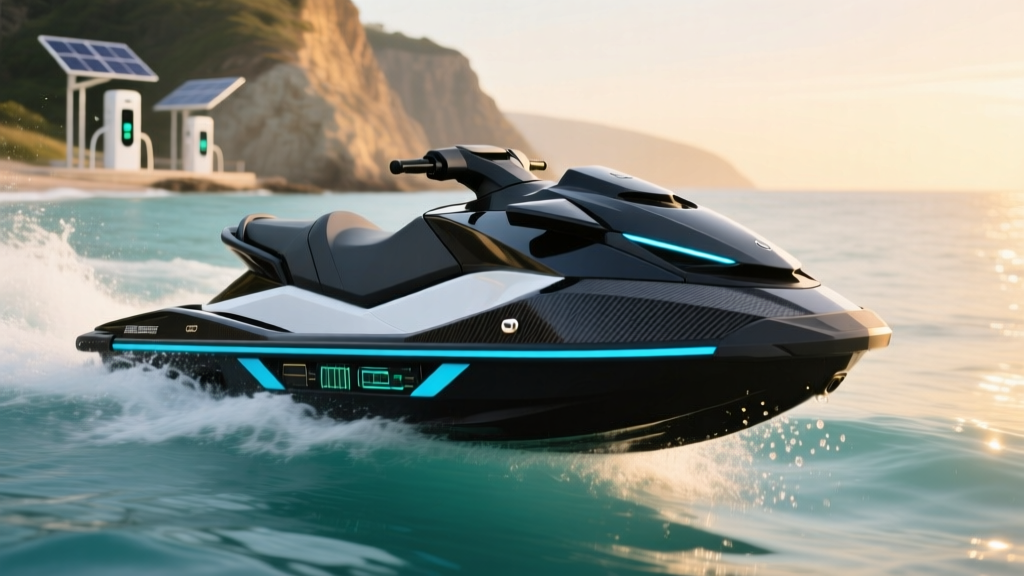
Quick Answer: As of early 2026, there is no mass-produced electric stand up jet ski available from a major manufacturer (Yamaha, Kawasaki, Sea-Doo). The stand-up segment — defined as rider-standing personal watercraft (PWC) with no seat — remains exclusively powered by internal-combustion engines (typically 2-stroke or 4-stroke gasoline). While electric sit-down PWCs exist (notably the Taiga Orca and concept-stage entries), none offer the stand-up form factor. If you want a zero-emission PWC today, your closest option is an electric sit-down model, or you must wait for announced concepts to reach production.
Why No Electric Stand Up Jet Ski Exists Yet (and What's Closest)
The stand-up jet ski segment is a niche within a niche. Yamaha's SuperJet and Kawasaki's SX-R are the only two production stand-up models globally, and both run on gasoline engines — the SuperJet on a 1,049 cc 4-stroke and the SX-R on a 1,498 cc 4-stroke. The physics and economics explain the gap:
- Energy density problem: A stand-up PWC weighs roughly 550–650 lbs dry. To deliver 60–90 minutes of aggressive riding (equivalent to ~15–25 kWh of usable energy), you'd need a battery pack weighing 200–350 lbs using current NMC lithium-ion cells. That mass fundamentally changes the hull dynamics, center of gravity, and the agility that defines the stand-up experience.
- Peak power demands: Stand-up riders expect rapid planing and aggressive hole-shot acceleration. Gas engines in this class produce 100–160 HP. Delivering 75–120 kW of sustained electrical power from a compact, marine-rated battery and motor system — while managing thermal loads in a sealed hull — is an engineering challenge no manufacturer has commercially solved for this form factor.
- Market size: The stand-up PWC segment represents a fraction of overall PWC sales (sit-down models dominate). Manufacturers prioritize R&D investment on higher-volume platforms.
The closest electrified watercraft available today include:
| Model | Type | Battery (kWh) | Motor (kW/HP) | Est. Ride Time | Status (2026) | MSRP |
|---|---|---|---|---|---|---|
| Taiga Orca | Sit-down PWC | 23 kWh (NMC) | 60 kW / 80 HP | ~60–90 min (mixed) | Available (limited) | ~$24,990 |
| Yamaha SuperJet | Stand-up (gas) | N/A | N/A / ~110 HP | ~2–3 hrs (16 gal tank) | Available | ~$10,699 |
| Kawasaki SX-R | Stand-up (gas) | N/A | N/A / ~160 HP | ~1.5–2.5 hrs (13.2 gal) | Available | ~$11,999 |
Electric PWC vs Gas PWC: Real Cost & Performance Comparison
Since a true electric stand up jet ski doesn't exist yet, the most useful comparison is between the electric sit-down option (Taiga Orca) and the gas stand-up models to illustrate what an eventual electric stand-up would need to overcome — and what you'd trade.
| Factor | Electric Sit-Down (Taiga Orca) | Gas Stand-Up (Yamaha SuperJet) |
|---|---|---|
| Upfront Cost | ~$24,990 | ~$10,699 |
| Fuel/Energy Cost per Hour | ~$1.50–$3.00 (electricity, varies by rate) | ~$12–$20 (premium gasoline, ~4–6 gal/hr) |
| Maintenance (Annual) | Minimal — no oil, spark plugs, winterization of engine | $200–$500 (oil changes, winterization, impeller wear) |
| Noise Level | ~65–75 dB at speed | ~85–95 dB at speed |
| Ride Duration (Real-World) | 60–90 min (aggressive use reduces to ~45 min) | 2–3 hours per tank |
| Refuel/Recharge Time | ~3–4 hrs (Level 2, 240V); ~8+ hrs (Level 1, 120V) | ~5 min (gas station or portable fuel can) |
| Top Speed | ~55 mph | ~54 mph |
| Weight | ~590 lbs | ~551 lbs (dry) |
The cost math over 5 years (assuming 100 hours/year of riding):
| Cost Category | Electric PWC (5-yr) | Gas Stand-Up PWC (5-yr) |
|---|---|---|
| Purchase Price | $24,990 | $10,699 |
| Energy/Fuel (500 total hrs) | $750–$1,500 | $6,000–$10,000 |
| Maintenance (5 yrs) | $300–$600 | $1,000–$2,500 |
| Insurance (est. avg) | $1,200–$1,800 | $1,000–$1,500 |
| Total 5-Year Cost | $27,240–$28,890 | $18,699–$24,699 |
Even with dramatically lower fuel and maintenance costs, the electric PWC's premium purchase price means gas remains cheaper over five years for most riders. The gap narrows if you ride more than 150 hours annually or if gas prices spike significantly.
What an Electric Stand Up Jet Ski Would Need to Succeed
Based on current battery technology trajectories and what stand-up riders actually demand, here are the engineering thresholds an eventual electric stand-up must meet:
- Battery capacity: Minimum 15–20 kWh usable to deliver 60+ minutes of mixed riding. At current NMC energy densities (~250 Wh/kg at cell level, ~160 Wh/kg at pack level), that's 94–125 kg (207–275 lbs) of battery alone.
- Total wet weight: Must stay under ~700 lbs to preserve the flickability and freestyle capability stand-up riders expect. Current gas stand-ups wet-weight around 600–650 lbs.
- Motor output: 60–80 kW (80–107 HP) continuous, with short burst capability to 100+ kW for hole-shot and trick maneuvers.
- Charge speed: DC fast charging at 20–40 kW minimum, enabling a 20–80% refill in 20–30 minutes — critical for all-day lake sessions.
- Marine-grade thermal management: Active liquid cooling for both battery and motor, sealed to IP67+ for water immersion, with corrosion resistance for saltwater use.
- Price point: Under $18,000 to be competitive with a fully accessorized gas stand-up (~$12,000–$14,000 out-the-door).
Solid-state batteries — anticipated in limited commercial availability by 2027–2028 — could improve energy density by 30–50%, potentially making an electric stand-up viable. Until then, the weight-to-performance equation doesn't work.
Real-World Ownership Considerations for Electric PWC
If you're considering the closest available option (electric sit-down PWC) or planning for a future electric stand-up, these ownership realities apply:
Charging Access at the Lake
Most marinas and boat ramps do not offer Level 2 (240V) charging. You'll likely charge at home on a 240V circuit (requiring a dedicated 30A or 50A outlet, similar to EV home charging) and arrive at the lake with a full battery. A Level 1 (120V standard outlet) trickle charge at a dock adds roughly 1–2 miles of equivalent range per hour — essentially useless for mid-session top-ups. If your lake house or dock has a 240V outlet (like a dryer or welder circuit), you could recharge in 3–4 hours during a lunch break.
Cold-Water and Cold-Air Performance
Lithium-ion batteries lose 10–20% of usable capacity in cold conditions (below 50°F / 10°C). If you ride in northern lakes during spring or fall, expect your 90-minute ride time to drop to 65–75 minutes. Battery preconditioning — a feature Taiga includes — mitigates this if you charge right before riding, but you can't precondition on a cold lake with no power source.
Trailer and Storage
Electric PWCs are similar in weight to gas models, so your existing PWC trailer and storage setup will work. However, long-term storage requires maintaining the battery at 40–60% state of charge (SoC) — never fully charged or fully depleted — to prevent calendar degradation. Most manufacturers recommend a storage-mode charge cycle every 30–90 days during off-season.
Battery Degradation and Replacement
Marine lithium-ion packs (NMC chemistry) typically retain 80–85% of original capacity after 1,000 full charge cycles. For a rider putting in 100 hours/year with one full cycle per session, that's roughly 10 years to reach 80% SoH (State of Health). Replacement cost for a 23 kWh pack is estimated at $6,000–$9,000 out of warranty — a significant long-term ownership cost that gas PWC buyers don't face in equivalent form.
Common Misconceptions About Electric Watercraft
| Myth | Fact |
|---|---|
| "Electric PWCs have zero maintenance" | They still require impeller inspection, hull cleaning, coolant system checks, and battery management. Just no oil changes or engine winterization. |
| "You can charge an electric PWC from any dock outlet" | Standard 120V dock outlets charge at ~1.4 kW — adding roughly 10–15 minutes of ride time per hour of charging. Practically useless for mid-day top-ups. |
| "Electric means it's waterproof and worry-free" | Marine-rated battery enclosures are sealed, but connectors, charging ports, and cooling systems require maintenance and inspection. Saltwater use demands thorough freshwater rinsing after every session. |
| "An electric stand up jet ski is available if you look hard enough" | As of 2026, no manufacturer sells a production electric stand-up PWC. Some custom/prototype builds exist but are not commercially available or certified for sale. |
| "Federal EV tax credits apply to electric PWCs" | The IRS §30D Clean Vehicle Credit applies to highway-capable vehicles with 4+ wheels. PWCs do not qualify. Some states may offer marine electrification incentives — check your state energy office. |
Decision Framework: What Should You Actually Buy?
Use this to decide your next PWC purchase:
If you MUST have a stand-up form factor AND you need it now:
→ Buy a Yamaha SuperJet (~$10,699) or Kawasaki SX-R (~$11,999). Gas is the only option. Budget $1,500–$2,500/year for fuel and maintenance. Accept the noise and emissions trade-off.
If you're open to sit-down AND want electric:
→ The Taiga Orca (~$24,990) is the only production option. Best for riders with home/dock 240V charging, who ride 60–90 minutes per session, and value quiet operation (important for lake communities with noise restrictions). Expect to save $1,000–$1,800/year on fuel vs. gas, but the $14,000+ price premium means a 8–14 year payback period.
If you want an electric stand up jet ski specifically:
→ Wait. Monitor Taiga Motors, Yamaha, and Kawasaki announcements. Solid-state battery commercialization (2027–2029 timeline) is the most likely unlock. Do not preorder from unknown startups without verified marine certification, UL/CE safety testing, and dealer service networks.
If you ride fewer than 50 hours/year:
→ Gas is almost certainly the better financial choice regardless of form factor. The electric premium isn't justified at low usage.
What First-Time Electric PWC Buyers Should Know
If you're coming from a gas PWC or considering your first watercraft and leaning electric:
- kW vs kWh matters here too: kW (kilowatts) is the motor's power output — how fast you accelerate and your top speed. kWh (kilowatt-hours) is the battery's energy capacity — how long you can ride. A 60 kW motor with a 23 kWh battery is roughly like a 80 HP engine with a 4-gallon tank.
- There is no public "charging network" for watercraft. Unlike EVs with Tesla Superchargers or Electrify America stations, PWC charging is entirely self-reliant. Plan accordingly.
- Insurance for electric PWCs is currently 10–25% more expensive than equivalent gas models, largely because replacement parts (especially the battery pack) are costly and repair shops with high-voltage marine certification are rare.
- Resale value is uncertain. The electric PWC market is too new to establish depreciation curves. Gas PWCs typically retain 50–65% of value after 5 years. Electric could be better (lower maintenance appeal) or worse (battery degradation fears) — we don't have enough data yet.
- No federal tax credit applies. Unlike electric cars and trucks, PWCs are not eligible for the IRS §30D Clean Vehicle Credit. Some utility companies offer rebates for marine electrification — check with your local provider.
Frequently Asked Questions
Is there an electric stand up jet ski I can buy in 2026?
No. As of 2026, no manufacturer produces a commercially available electric stand-up personal watercraft. Yamaha and Kawasaki — the only two stand-up PWC makers — both use gasoline engines. Electric PWCs exist only in sit-down form (Taiga Orca).
How much would an electric stand up jet ski cost if one existed?
Based on current battery costs (~$130–$160/kWh at pack level) and the engineering requirements (15–20 kWh battery, 60–80 kW motor, marine-grade enclosure and cooling), a realistic MSRP would be $18,000–$28,000 — roughly 2–3x the price of a gas stand-up. This aligns with the sit-down electric PWC pricing we see today.
How long do electric PWC batteries last?
NMC lithium-ion marine packs are rated for approximately 1,000–1,500 full charge cycles to 80% State of Health (SoH). At typical recreational use (50–100 hours/year, roughly one full cycle per session), that translates to 10–15 years before noticeable range reduction. Replacement cost is estimated at $6,000–$9,000.
Can I convert a gas stand-up jet ski to electric?
Technically possible but not recommended. The conversion requires removing the engine, fuel system, and exhaust; fitting a motor and battery pack within the hull; adding a marine-rated controller and cooling system; and ensuring waterproofing. No certified conversion kits exist for stand-up models. The cost ($8,000–$15,000 in parts and labor) typically exceeds the value of the base watercraft, and the result won't have manufacturer safety certification or insurance coverage.
Will Yamaha or Kawasaki make an electric stand-up PWC?
Neither company has announced a production electric stand-up model as of early 2026. Yamaha has shown electric concept vehicles across multiple categories and has invested in battery technology. Kawasaki has explored hydrogen combustion for motorcycles. Industry analysts expect electric sit-down models to expand first, with stand-up following only when battery energy density improves sufficiently to meet weight and performance requirements.
What's the cheapest way to ride an electric PWC today?
The Taiga Orca at ~$24,990 is the only production electric PWC. Some rental operations at premium resorts and lake communities offer Taiga rentals ($150–$250/hour), which is a practical way to experience electric PWC riding without the purchase commitment.