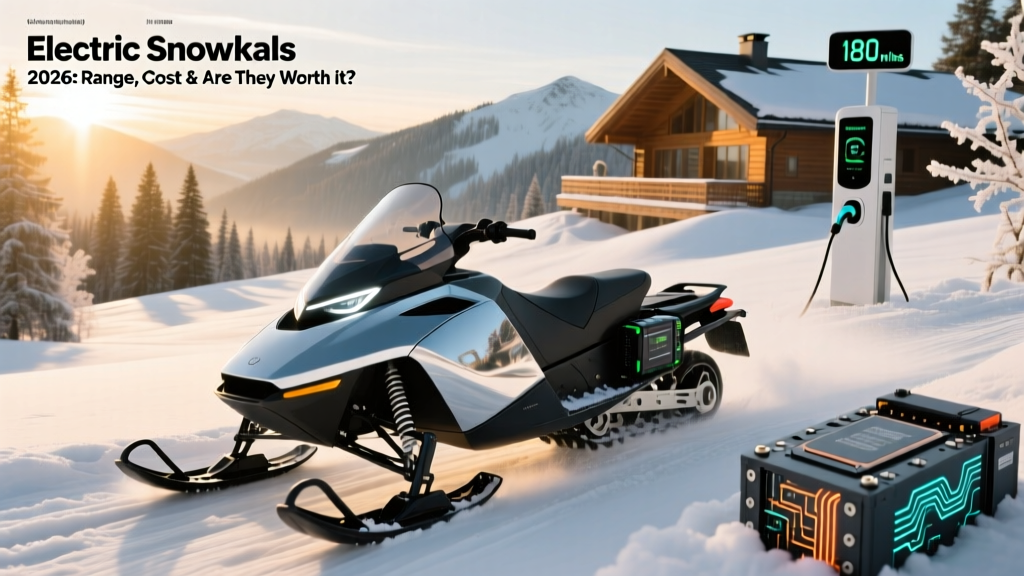
If you're researching electric snowmobiles, here's the practical reality for the 2026 season: production models from brands like Taiga Motors deliver roughly 60 to 100 miles of real-world trail range on a single charge, cost between $17,000 and $25,000 before incentives, and excel in noise reduction, instant torque, and near-zero trailside maintenance. They fall short of gas sleds on raw top-end range (150–250+ miles for comparable 2-stroke models) and refueling speed (minutes for gas vs. hours for a full charge). Electric snowmobiles are best suited for day riders with home charging access who value quiet operation, zero exhaust fumes, and lower running costs, and who don't routinely push past 80–100 miles in a single outing.
The Electric Snowmobile Landscape in 2026
The electric snowmobile market has matured beyond the early-adopter phase. The dominant production manufacturer is Taiga Motors, the Montreal-based company that began shipping its Orca (watercraft) and TS2 (snowmobile) platforms in volume starting in 2023 and has iterated through multiple model years. By the 2026 season, Taiga offers the TS2 in several trims — Cross Country, Sport, and Mountain — each tuned for different riding styles. A handful of concept-stage competitors and Chinese-market entrants have been announced, but Taiga remains the only widely available, trail-legal production electric snowmobile in North America as of this writing.
Major legacy OEMs — Ski-Doo (BRP), Polaris, and Yamaha — have signaled electric platform development. BRP has publicly committed to offering electric models across all product lines by 2026, though as of this season, their electric snowmobile offerings remain in the announced/preliminary stage rather than widely available at dealerships. Always verify current availability directly with manufacturers before budgeting around an unreleased model.
Specs That Matter: Range, Battery, and Charging
Electric snowmobile specs require careful interpretation because cold weather directly degrades battery performance. Here's what you need to know before comparing models.
| Spec | Cross Country | Sport | Mountain |
|---|---|---|---|
| Battery Capacity (usable) | ~21 kWh | ~21 kWh | ~21 kWh |
| Motor Output | ~180 HP | ~180 HP | ~180 HP |
| EPA-Est. Range | ~100 mi (est.) | ~85 mi (est.) | ~75 mi (est.) |
| Real-World Cold Range (10°F / -12°C) | ~65–80 mi | ~55–70 mi | ~50–60 mi |
| Top Speed | ~72 mph | ~72 mph | ~65 mph |
| Weight | ~580 lbs | ~580 lbs | ~600 lbs |
| DC Fast Charge (peak) | Optional CCS, ~40 kW | Optional CCS, ~40 kW | Optional CCS, ~40 kW |
| Level 2 Charge (240V) | ~7.2 kW, ~3 hr | ~7.2 kW, ~3 hr | ~7.2 kW, ~3 hr |
| Level 1 Charge (120V) | ~1.4 kW, ~15+ hr | ~1.4 kW, ~15+ hr | ~1.4 kW, ~15+ hr |
| Base MSRP (2026 est.) | ~$19,490 | ~$17,490 | ~$21,490 |
Electric vs Gas Snowmobile: The Data
The most common question is whether an electric sled can match a gas sled. Here's how they compare across the dimensions that matter most.
| Category | Electric (Taiga TS2 CC) | Gas (Ski-Doo MXZ / comparable 600cc–850cc) |
|---|---|---|
| Range (real-world) | 65–100 mi | 150–250+ mi |
| Refuel / Recharge Time | 30–40 min (DC fast 20–80%); 3 hr (Level 2 full) | 3–5 min (fill tank) |
| Horsepower | ~180 HP (instant torque) | 120–165 HP (varies by model) |
| Weight | ~580 lbs | ~450–520 lbs |
| Noise Level | Near-silent (track + wind only) | 75–95 dB |
| Trailside Maintenance | Minimal (no oil, spark plugs, belts, fuel lines) | Regular (oil, plugs, track tension, carb/throttle) |
| Emissions | Zero tailpipe (upstream depends on grid) | 2-stroke exhaust (unburned hydrocarbons, CO) |
| Fuel / Energy Cost per Ride (100 mi) | ~$3–$6 (home charging at $0.14/kWh) | ~$25–$40 (premium gas at ~$4.20/gal, 10–15 mpg) |
| Purchase Price (base MSRP) | ~$17,490–$21,490 | ~$10,000–$16,000 |
The data tells a clear story: electric wins on operating cost, noise, torque delivery, and maintenance simplicity. Gas wins on range, refueling speed, weight, and upfront cost. Your decision hinges on which trade-offs matter for your riding style.
Total Cost of Ownership: 5-Year Breakdown
Upfront price favors gas, but running costs heavily favor electric. Here's a realistic 5-year ownership model assuming 1,500 miles per season (moderate weekend rider).
| Cost Category | Electric (TS2 CC, ~$19,490) | Gas (600cc 2-Stroke, ~$13,000) |
|---|---|---|
| Purchase Price | $19,490 | $13,000 |
| Fuel / Electricity (5 yrs, 7,500 mi total) | ~$225–$450 | ~$1,875–$3,000 |
| Maintenance (5 yrs) | ~$200–$400 (track, suspension) | ~$1,500–$2,500 (oil, plugs, belts, top-end) |
| Insurance (5 yrs, est.) | ~$1,500–$2,500 | ~$1,250–$2,000 |
| Estimated 5-Year Total | ~$21,415–$22,840 | ~$17,625–$20,500 |
The electric sled costs more upfront and doesn't fully close the gap in five years for moderate riders. However, at higher mileage (2,500+ miles per season), the fuel and maintenance savings begin to tip the scales more decisively. By year seven or eight, many riders will have broken even — and the electric sled's simpler drivetrain means fewer surprise repair bills as the machine ages.
A note on tax credits: The federal §30D Clean Vehicle Credit applies to qualifying new electric vehicles, but snowmobiles are generally classified as off-road vehicles and do not meet the on-road vehicle definition under current IRS rules. Some states or local jurisdictions may offer off-road EV rebates or utility incentives for electric outdoor power equipment. Check with your state energy office and local utility for current programs — eligibility varies widely by jurisdiction and is subject to change.
Cold-Weather Battery Performance: What the Data Shows
Lithium-ion batteries lose capacity and charge acceptance rate in cold temperatures. This is the single biggest ownership concern for electric snowmobiles, and it deserves a direct, data-backed answer.
Most electric snowmobiles use NMC (nickel manganese cobalt) lithium-ion chemistry, chosen for its higher energy density compared to LFP (lithium iron phosphate). The trade-off: NMC performs better in cold than LFP, but still experiences measurable degradation. Here's what to expect:
- At 32°F (0°C): Expect ~10–15% range reduction from rated capacity.
- At 10°F (-12°C): Expect ~20–35% range reduction, depending on riding intensity and whether the battery was preconditioned.
- At -20°F (-29°C): Expect 35–50% range reduction. Charging speeds also drop significantly — DC fast charging may throttle to protect the cells.
- Battery preconditioning: Like EVs, electric snowmobiles benefit from warming the battery before charging or hard riding. Taiga's thermal management system handles this to a degree, but cold-soaking a sled overnight outdoors will reduce available range at startup.
Charging at Home and on the Trail
Home charging is the most practical scenario. A standard 120V outlet (Level 1) delivers about 1.4 kW, meaning a full charge from empty takes 15+ hours — feasible for overnight between weekend rides. A 240V Level 2 setup (like an EV home charger) at 7.2 kW cuts that to roughly 3 hours, which allows same-day turnaround for back-to-back rides.
Trail charging is the real constraint. DC fast charging infrastructure at snowmobile trailheads, lodges, and fuel stops is extremely limited as of 2026. A few forward-thinking resorts and clubs in Quebec, Vermont, and Michigan have installed charging stations, but you cannot rely on a public charging network the way you might for an EV road trip. Most electric snowmobile owners treat the sled like a day-use vehicle: ride from home or a base camp, return, and charge overnight.
| Level | Power (kW) | Full Charge Time | Practical Use |
|---|---|---|---|
| Level 1 (120V outlet) | ~1.4 kW | ~15+ hours | Overnight, between weekend rides |
| Level 2 (240V) | ~7.2 kW | ~3 hours | Same-day turnaround, lodge charging |
| DC Fast (CCS, optional) | ~40 kW peak | ~30–40 min (20–80%) | Trailhead stations (rare in 2026) |
Home install cost: If you need a 240V outlet installed in your garage or heated storage, expect to pay $500–$2,000 for an electrician to add a NEMA 14-50 receptacle, depending on panel proximity and whether your electrical panel needs an upgrade. A hardwired Level 2 EV charger works equally well. Consult a licensed electrician for final specs — panel capacity varies by home.
Common Misconceptions — Fact vs Fiction
| Myth | Fact |
|---|---|
| "Electric sleds have no power." | The Taiga TS2 delivers ~180 HP with instant torque — no clutching, no turbo lag. Acceleration rivals or exceeds most 850cc gas sleds off the line. |
| "The battery will die in the cold and strand you." | Cold reduces range by 20–35% at typical riding temps. It doesn't cause sudden failure. Plan rides within 60–70% of rated range in cold conditions and you'll have ample margin. |
| "You can't ride them hard in powder." | Electric sleds can boondock and hill-climb — the instant torque is an advantage in technical terrain. The limitation is range: aggressive riding drains the battery faster. Mountain trims are built for this, but plan shorter loops. |
| "Battery replacement will cost a fortune." | Battery replacement costs are estimated at $5,000–$8,000 out of warranty. However, NMC packs in snowmobiles typically retain 80%+ capacity after 1,000+ charge cycles. Taiga offers battery warranty coverage — check current terms at purchase. Most riders will not need a replacement within the sled's practical lifespan. |
| "They're not trail-legal." | Electric snowmobiles are trail-legal in most US and Canadian jurisdictions where snowmobiles are registered. Some areas are beginning to offer reduced registration fees or trail-pass incentives for zero-emission sleds. Check your state/province registration requirements. |
Decision Framework: Is an Electric Snowmobile Right for You?
- You ride 60–100 miles per day or less (day rides from a home base or lodge)
- You have access to a 120V or 240V outlet where you store the sled
- Noise reduction matters to you (wildlife areas, cabin-country trails, riding near neighbors)
- You want zero exhaust fumes (important for enclosed trail sections or group rides)
- You want to minimize routine maintenance (no oil changes, spark plugs, belt replacements, or fuel stabilizer)
- You ride in areas with emerging trailside charging or plan rides around a chargeable base
- You regularly ride 150+ miles in a single day
- You ride multi-day backcountry trips with no charging access
- You ride in extreme cold (sustained -20°F or below) where range loss is severe
- Upfront budget is a primary constraint (gas sleds start $4,000–$8,000 less)
- You need maximum sled weight savings for competitive racing or deep-snow performance
- Trailside refueling infrastructure is essential for your riding style
Frequently Asked Questions
How long do electric snowmobile batteries last?
Current NMC lithium-ion packs in snowmobiles are rated for approximately 1,000–1,500 full charge cycles before dropping to 80% of original capacity. For a rider putting 1,500 miles on per season and charging once per ride day, that translates to roughly 10–15 seasons before noticeable range degradation. Proper storage (keeping the battery at 40–60% state of charge during summer) extends longevity.
Can I tow a sled trailer or haul gear with an electric snowmobile?
Electric snowmobiles can tow light loads, but towing significantly reduces range — similar to how towing with an electric truck reduces range. If you plan to pull a rescue sled or gear toboggan regularly, budget for a 25–40% range reduction.
Do electric snowmobiles have regenerative braking?
Yes. Most electric snowmobiles use regenerative braking to recover energy during deceleration and downhill runs. In mountainous terrain, regen can recover a meaningful amount of energy — some riders report 5–10% range recovery on rides with significant elevation changes. The effect is smaller than in EVs because snowmobile speeds are lower and rolling resistance on snow is different.
What happens if I run out of battery on the trail?
Unlike a gas sled where you can carry a spare fuel can and refuel in minutes, a depleted electric snowmobile requires a tow or a trailer ride back to a charger. This is the most practical limitation of the platform. Riders should plan conservatively, carry a satellite communicator for remote areas, and never push below 15–20% state of charge without a known charging destination.
Are electric snowmobiles eligible for any tax credits or rebates?
The federal §30D Clean Vehicle Credit requires the vehicle to be street-legal and meet specific on-road criteria — snowmobiles generally do not qualify. However, some states, provinces, and local utilities offer rebates for off-road electric vehicles or electric outdoor equipment. Check with your state energy office, local utility, and snowmobile club association for current programs. Always consult a tax professional for credit eligibility.