Quick Answer: Should You Buy an Electric Skid Steer?
Bottom line: An electric skid steer (also called a compact electric loader) makes financial sense in 2026 if you work primarily indoors or in noise-sensitive urban job sites, run the machine 4-6 hours per day, and have access to 240V Level 2 charging at your shop or yard. Expect 6-10 hours of real-world runtime per charge on machines with 40-60 kWh battery packs, a purchase premium of $15,000-$30,000 over diesel equivalents, and fuel/energy savings of roughly $8,000-$12,000 per year based on 1,000 annual operating hours. Payback typically lands between 2.5 and 4 years before incentives.
Who should skip it: Remote job sites without grid power, heavy continuous trenching or milling work that demands sustained high hydraulic flow, and operations in extreme cold (below 20°F) where lithium-ion packs lose 20-30% of usable capacity.
What Is an Electric Skid Steer (and What It Isn't)
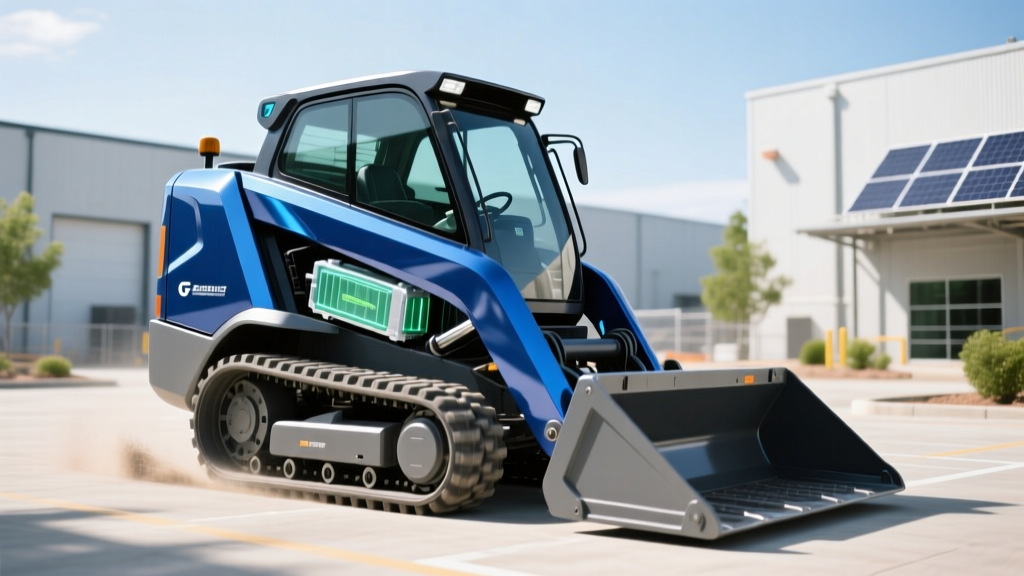
The search term "electric skid" usually refers to one of two things: a battery-electric compact track loader/skid steer used in construction and landscaping, or a smaller electric utility cart. This guide focuses on the construction-grade electric skid steer loader — machines like the Volvo ECR25 Electric, Bobcat T7X, and Sherpa 100 ECO that replace diesel or gasoline powertrains with lithium-ion battery packs and electric drive motors.
These machines retain the standard skid-steer form factor: two independently driven wheels or tracks, a front loader arm with quick-attach, and auxiliary hydraulics for attachments (augers, breakers, grapples). What changes under the skin:
- Powertrain: Electric traction motors (typically 20-40 kW peak) replace a diesel engine.
- Hydraulics: An electric-driven hydraulic pump provides flow to the loader arm and attachments (commonly 10-18 gpm).
- Energy storage: Lithium-ion packs ranging from ~20 kWh (compact models) to ~62 kWh (full-size units). Most use NMC chemistry for energy density; some newer models are moving to LFP for longer cycle life.
- No exhaust: Zero tailpipe emissions — the defining advantage for indoor demolition, warehouse work, and occupied-building renovations.
Spec Snapshot: 2026 Electric Skid Steers vs. Diesel Equivalents
| Spec | Electric Skid Steer (typical) | Diesel Skid Steer (typical) |
|---|---|---|
| Battery / Fuel | 40-62 kWh NMC/LFP pack | 15-20 gal diesel tank |
| Runtime (real-world) | 6-10 hrs (mixed duty) | 8-12 hrs |
| Rated operating capacity | 1,200-2,100 lbs | 1,500-2,500 lbs |
| Peak hydraulic flow | 12-18 gpm | 18-25 gpm (high-flow option) |
| Operating weight | 6,500-9,500 lbs | 7,000-10,500 lbs |
| Charge / refuel time | 6-8 hrs (Level 2, 240V) | 5-10 min |
| Noise level | ~75 dB | ~95-100 dB |
| Base MSRP (2026) | $75,000-$115,000 | $55,000-$85,000 |
Note: Runtime varies heavily with duty cycle. Continuous heavy digging or breaker use will drain a pack in 3-4 hours; light grading and material handling can stretch to 10+ hours.
Real-World Ownership: Charging, Climate, and Job-Site Reality
Charging Access Is the Make-or-Break Factor
Unlike diesel skid steers that refuel in minutes from a jerry can or truck tank, electric models require predictable access to grid power. Most manufacturers recommend a dedicated 240V / 50A circuit at your shop — essentially a heavy-duty Level 2 EV charger adapted for industrial equipment. Expect 6-8 hours for a full charge on a 60 kWh pack at 7.2 kW. Some models now support CCS1 DC fast charging at up to 25 kW, cutting a 10-80% session to roughly 90 minutes, but this remains a premium option.
Red flags for electric: If your typical workday starts at a remote site with no utility hookups and you can't trailer the machine back to a charged shop overnight, diesel remains the pragmatic choice.
Cold-Weather Range Loss Is Real
Lithium-ion chemistry suffers in the cold. At 20°F, expect roughly 20-25% reduction in usable capacity; at 0°F, losses can hit 30-40% due to both reduced electrochemical efficiency and energy diverted to pack heating (if equipped). Northern-climate operators should spec a machine with thermal management and plan for shorter winter shifts or midday top-ups.
Driving Patterns and Duty Cycle
Electric skid steers excel at stop-start, low-speed work — exactly the duty cycle that's hardest on diesel engines (which hate idling and short-run cold starts). Landscaping, interior demolition, warehouse reconfiguration, and utility trenching in urban settings are ideal use cases. Continuous high-load tasks like asphalt milling or heavy rock breaking remain diesel territory for now.
Total Cost of Ownership: 5-Year Breakdown
The purchase premium stings, but operating savings are substantial. Here's a realistic 5-year, 5,000-hour ownership model comparing a typical electric skid steer ($95,000) to a comparable diesel ($70,000):
| Cost Category (5 yr / 5,000 hrs) | Electric | Diesel |
|---|---|---|
| Purchase price | $95,000 | $70,000 |
| Fuel / electricity | $4,500 ($0.15/kWh, 6 kWh/hr avg) | $22,500 (1.5 gal/hr × $3/gal) |
| Maintenance (fluids, filters, belts) | $2,500 | $9,000 |
| DEF, oil changes, coolant | $0 | $2,000 |
| Insurance (est.) | $7,500 | $7,000 |
| Battery replacement reserve | $0 (under warranty) | $0 |
| Estimated resale (yr 5) | -$35,000 | -$30,000 |
| Net 5-year cost | $74,500 | $80,500 |
Takeaway: The electric unit breaks even around year 3-4 and pulls ahead afterward, assuming reliable Level 2 charging access and no battery out-of-warranty failure. Battery warranties on major 2026 models typically run 5 years / 5,000 hours with a 70-80% capacity retention guarantee — confirm the exact terms with your dealer.
Common Misconceptions — Myth vs. Fact
| Myth | Fact |
|---|---|
| "Electric skid steers are weak." | Electric motors deliver peak torque at 0 RPM. Breakout force on the bucket and tractive effort match or exceed diesel equivalents in the same weight class. What they lack is sustained high-flow hydraulics for the most demanding attachments. |
| "The battery will need replacing in 3 years." | Modern NMC packs are rated for 2,000-4,000 full cycles before reaching 80% state of health. At 1,000 hours/year, that's 8-15+ years of typical use. |
| "You can't use attachments." | Standard quick-attach and auxiliary hydraulics work with most common attachments. High-flow demands (e.g., large cold planers) may exceed the electric pump's capacity. |
| "Charging takes too long for real work." | Overnight Level 2 charging fully replenishes the pack. For multi-shift operations, opportunity charging during lunch or swapping to a second machine is the standard workaround. |
| "Federal EV tax credits apply." | The §30D clean vehicle credit applies to on-road vehicles meeting MSRP, income, and battery-sourcing rules. Off-road construction equipment does NOT qualify. Some states and utilities offer separate off-road electrification rebates — check your local programs. |
Decision Framework: Electric Skid Steer or Diesel?
Choose an electric skid steer if:
- You work indoors (warehouses, occupied buildings, demolition) where exhaust is prohibited or ventilation is costly.
- Your municipality or clients have noise ordinances — electric models run ~20-25 dB quieter.
- You have a shop or yard with 240V/50A power and predictable overnight charging windows.
- Your duty cycle is mixed/light (landscaping, material handling, utility work) rather than continuous heavy hydraulic load.
- You plan to keep the machine 5+ years to capture the operating-cost payback.
- ESG reporting or green-bid requirements give you a competitive advantage on contracts.
Stick with diesel if:
- You work remote sites with no grid power and can't trailer home nightly.
- Your daily work includes sustained high-flow hydraulic attachments (mulchers, large breakers, cold planers).
- You operate regularly in sub-20°F conditions without heated storage.
- You turn over equipment every 2-3 years — the electric payback window won't close in time.
- Your budget cannot absorb the $20,000-$30,000 upfront premium, and no local incentive is available.
FAQ: Electric Skid Steer Ownership
How long does an electric skid steer battery last?
Most 2026 models use NMC lithium-ion packs rated for 2,000-4,000 full charge cycles before degrading to 80% of original capacity. At typical contractor usage (1,000 hours/year, partial daily cycles), that translates to roughly 8-15 years before noticeable range loss. Warranty coverage is commonly 5 years / 5,000 hours.
Can I fast-charge an electric skid steer on the job?
Some models offer optional CCS1 DC fast-charge capability at up to 25 kW, reaching 80% in about 90 minutes. This requires access to a DC charger — increasingly available at industrial parks but not on most raw job sites. Level 2 (240V) remains the default.
Do electric skid steers qualify for the $7,500 federal EV tax credit?
No. The IRS §30D clean vehicle credit applies to on-road passenger and light-duty vehicles meeting MSRP, buyer-income, and battery-sourcing rules. Off-road construction equipment does not qualify. However, check state-level programs (California's CARB OFFROAD vouchers, for example) and local utility rebates for off-road electrification incentives.
What's the real daily runtime?
With a 60 kWh pack and mixed-duty work, expect 6-8 hours before needing a charge. Light material handling can stretch this to 10 hours; heavy, continuous digging or breaker work can drop it to 3-4 hours. Diesel equivalents typically run 8-12 hours on a 15-20 gallon tank.
Is maintenance really cheaper?
Yes. Electric skid steers eliminate engine oil, oil filters, fuel filters, DEF, coolant flushes, fan belts, and exhaust aftertreatment (DPF/SCR) — the biggest maintenance headaches on modern diesels. You still service hydraulic fluid, track/wheel bearings, and pins/bushings, but annual maintenance spend typically drops 60-75%.
How does cold weather affect performance?
At 20°F, expect roughly 20-25% reduction in usable battery capacity; at 0°F, losses can reach 30-40%. Machines with active thermal management (pack heaters) mitigate this but consume energy to do so. Store the machine in a heated shop when possible and precondition the pack before the workday.
Sources: Manufacturer spec sheets (Volvo CE, Bobcat, Sherpa), IRS clean vehicle credit guidance, and OSHA occupational noise standards for dB comparison context.