Quick Answer: 2026 Silverado EV Key Specs
The 2026 Chevrolet Silverado EV delivers up to 492 miles of EPA range (Work Truck Max Range trim with the 200+ kWh Ultium battery), up to 754 horsepower (RS/Trail Boss), a peak DC fast-charge rate of 200 kW (10–80% in roughly 45 minutes), and a maximum towing capacity of 10,000 pounds when properly equipped. Base pricing starts around $39,900 for the WT trim and climbs past $100,000 for the fully loaded RST First Edition. Federal §30D tax credit eligibility depends on MSRP caps (trucks capped at $80,000), buyer income, and battery-component/critical-mineral sourcing — the WT and LT trims may qualify, but higher trims exceed the price cap.
Range and Battery: What the EPA Numbers Actually Mean
Chevrolet offers the 2026 Silverado EV on GM's Ultium platform with two primary battery configurations. The standard pack provides roughly 200 kWh of usable capacity in the Max Range variants, while the smaller pack (available on WT and some LT trims) sits closer to 175 kWh usable. Both use NMC (nickel manganese cobalt) chemistry, which prioritizes energy density — important for a full-size truck pushing over 8,000 lbs curb weight.
| Trim | Battery (usable kWh) | EPA Range (mi) | Real-World Highway* | Cold Weather* |
|---|---|---|---|---|
| WT Standard Range | ~175 | ~360 | ~290–310 | ~240–270 |
| WT Max Range | ~200+ | ~492 | ~390–420 | ~320–360 |
| LT | ~175–200 | ~380–440 | ~310–360 | ~260–300 |
| RS | ~200 | ~400–440 | ~330–370 | ~275–310 |
| Trail Boss | ~200 | ~380–410 | ~310–345 | ~260–290 |
*Real-world estimates based on highway driving at 70+ mph and cold-weather (below 32°F) testing patterns observed across large Ultium-platform EVs. Actual results vary with driving style, terrain, and HVAC load.
The headline 492-mile figure applies specifically to the WT Max Range configuration with the most efficient wheel/tire setup and lightest payload. If you're spec'ing a Trail Boss with all-terrain tires and a bed full of cargo, expect that number to drop significantly — potentially below 300 miles in mixed driving. This is physics, not a flaw: a 9,000-pound truck with a frontal area larger than most SUVs requires substantially more energy per mile than a sedan.
Charging Speed and Infrastructure Reality
The Silverado EV supports a peak DC fast-charging rate of 200 kW via its native NACS (North American Charging Standard) connector — GM fully transitioned to NACS for the 2025 model year, meaning direct access to the Tesla Supercharger network (now open to non-Tesla EVs) without an adapter.
| Level | Power | Miles Added per Hour | Typical Use Case |
|---|---|---|---|
| Level 1 (120V) | ~1.4 kW | ~3–4 mi/hr | Emergency/top-up only |
| Level 2 (240V, 48A) | ~11.5 kW | ~28–34 mi/hr | Daily home charging |
| Level 2 (240V, 80A) | ~19.2 kW | ~45–55 mi/hr | High-power home (requires 100A circuit) |
| DC Fast Charge | Up to 200 kW | ~250+ mi in 30 min | Road trips |
At a 200 kW DC fast charger, the Silverado EV can add approximately 100 miles of range in roughly 12–15 minutes when starting from a low state of charge. A full 10–80% session takes approximately 40–50 minutes depending on battery temperature and charger capability. Expect the charge curve to taper significantly above 80% SoC — this is standard for NMC chemistry to protect cell longevity. If you're on a road trip, plan to charge to 80% and move on rather than waiting for the final 20%, which can take as long as the first 80%.
For home charging, the Silverado EV's onboard charger supports up to 19.2 kW on Level 2 when connected to an 80-amp circuit (requires a 100-amp breaker). Most residential installations use a 48-amp charger on a 60-amp circuit, delivering around 11.5 kW — sufficient to fully recharge even the Max Range battery overnight in roughly 17–18 hours. A Level 2 home installation typically costs $1,200–$3,500 depending on panel capacity and run length; if your home has a 200-amp panel with spare capacity, expect the lower end. A panel upgrade to 200A or 400A adds $2,000–$5,000.
Performance, Towing, and Payload
The Silverado EV's dual-motor AWD powertrain produces up to 754 horsepower and 785 lb-ft of torque in the RST and available Trail Boss configurations with Wide Open Watts mode. The 0–60 mph time for these high-output trims lands around 4.5 seconds — remarkable for a full-size truck, and useful for highway merging when loaded.
| Spec | WT / LT | RS | Trail Boss | RST |
|---|---|---|---|---|
| Horsepower | 510–645 hp | 645–754 hp | 645–754 hp | 754 hp |
| Torque (lb-ft) | 615–785 | 785 | 785 | 785 |
| 0–60 mph | ~5.5–6.5 sec | ~4.5–5.0 sec | ~4.8–5.2 sec | ~4.5 sec |
| Max Towing | 10,000 lbs | 10,000 lbs | 10,000 lbs | 10,000 lbs |
| Max Payload | ~1,800 lbs | ~1,600 lbs | ~1,500 lbs | ~1,300 lbs |
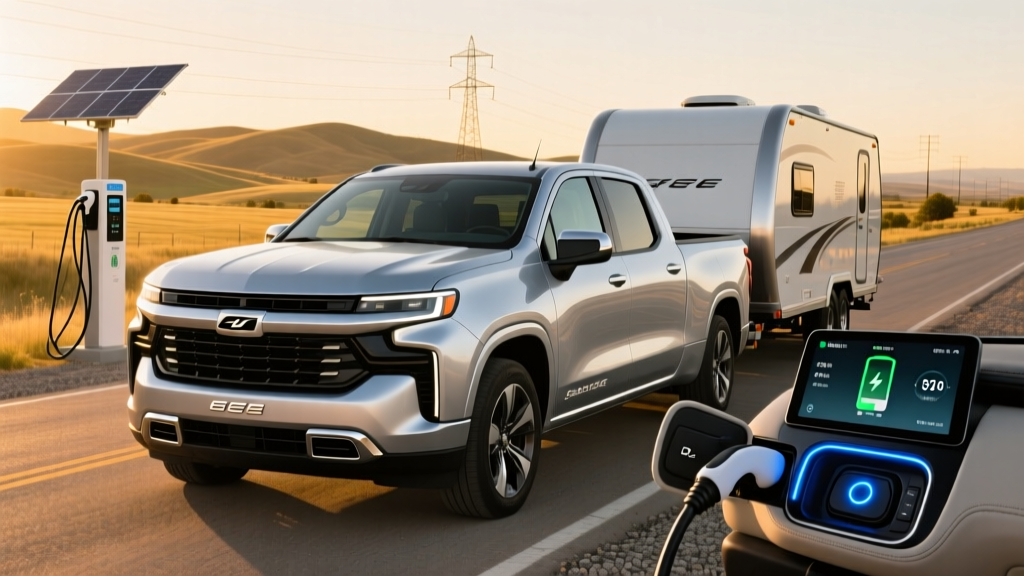
Towing and range interact heavily. When towing near the 10,000-pound maximum, expect range to drop by 40–60% depending on trailer profile and terrain. A 492-mile truck becomes a 200–280-mile truck under a heavy, boxy trailer. This is consistent across all EVs and is the single biggest limitation for truck buyers who tow frequently on long routes. DC fast-charging infrastructure near highways is improving, but towing-range planning remains essential.
The Silverado EV also offers V2L (Vehicle-to-Load) capability through available Pro Power-style outlets in the bed, providing up to 7.2 kW of continuous off-board power — enough to run power tools at a job site, a tailgate setup, or emergency home circuits during an outage.
Pricing, Trims, and Federal Tax Credit Eligibility
| Trim | Starting MSRP | §30D Credit Eligible? |
|---|---|---|
| WT (Fleet/Commercial) | ~$39,900 | Potentially (below $80K cap) |
| LT | ~$55,000–$65,000 | Potentially (below $80K cap) |
| RS | ~$70,000–$80,000 | Borderline (some configs exceed cap) |
| Trail Boss | ~$75,000–$85,000 | Mostly above $80K cap |
| RST First Edition | ~$95,000–$105,000 | No (exceeds $80K cap) |
The federal §30D tax credit offers up to $7,500, but eligibility is layered. For trucks (including the Silverado EV), the MSRP cap is $80,000. Additionally:
- Buyer income caps: $150K single / $225K head of household / $300K joint filers (modified AGI)
- Battery component requirement: A percentage of battery components must be manufactured or assembled in North America (phasing up annually)
- Critical minerals requirement: A percentage of critical minerals must be sourced from the U.S. or FTA partners
- Point-of-sale transfer: Eligible buyers can transfer the credit to the dealer at purchase, reducing the out-of-pocket price immediately
Because sourcing requirements tighten each year, a trim that qualified in 2025 may not qualify in 2026. Always verify current eligibility on the IRS website or with your tax professional before relying on the credit in your purchase math.
Silverado EV vs. Gas Silverado: 5-Year Cost Comparison
The sticker price of the Silverado EV is higher than a comparably equipped gas Silverado 1500, but ownership economics shift when you factor in fuel, maintenance, and potential credits. Here's a realistic 5-year/75,000-mile comparison between a Silverado EV LT (~$60K) and a gas Silverado 1500 LT (~$48K), both with AWD/4WD:
| Category | Silverado EV LT | Gas Silverado 1500 LT |
|---|---|---|
| Purchase Price | $60,000 | $48,000 |
| Federal Tax Credit | –$7,500 (if eligible) | $0 |
| Effective Purchase | $52,500 | $48,000 |
| Fuel/Energy (75K mi) | $4,500–$7,500* | $11,250–$13,500** |
| Maintenance (5 yr) | $1,000–$1,500 | $3,500–$5,000 |
| Insurance (5 yr) | $12,000–$15,000 | $9,000–$12,000 |
| Total 5-Year Cost | ~$70,000–$76,500 | ~$71,750–$78,500 |
*EV energy cost assumes $0.14/kWh average home charging with some DC fast charging at $0.40/kWh. Efficiency ~2.0 kWh/mi.
**Gas cost assumes 19 MPG combined at $3.50–$4.00/gallon.
The EV breaks roughly even or saves modestly over 5 years if you qualify for the tax credit and charge primarily at home. Without the credit, or if you rely heavily on expensive public DC fast charging, the gas truck retains a cost advantage. Insurance tends to be 15–25% higher on the EV due to repair costs and higher vehicle value — get quotes before buying.
Real-World Ownership: What First-Time EV Truck Buyers Should Know
Home Charging Is Non-Negotiable for Most Owners
A full-size EV truck with a 175–200 kWh battery is impractical to own without reliable home Level 2 charging. Public DC fast charging a battery this large is expensive ($30–$60+ per session at $0.35–$0.48/kWh rates) and time-consuming. If you lack home charging access — garage, driveway with a 240V outlet, or workplace charging — the Silverado EV will be a frustrating ownership experience.
Cold Weather Hits Trucks Harder
Large battery packs take longer to precondition, and the Silverado EV's massive frontal area and weight compound cold-weather range loss. In sub-freezing conditions, expect 20–35% range reduction even with the heat pump and battery preconditioning active. If you live in the northern U.S. and regularly drive 300+ miles in winter, the Max Range trim is strongly recommended.
Maintenance Is Genuinely Lower
No oil changes, no transmission fluid, no spark plugs, no exhaust system. Brake wear is significantly reduced thanks to regenerative braking — many EV truck owners report original brake pads at 60,000+ miles. Budget for tire replacement as the primary recurring maintenance item; the Silverado EV's weight (8,500–9,500 lbs depending on trim) accelerates tire wear, especially with aggressive torque delivery.
| Myth | Fact |
|---|---|
| "EV trucks can't tow seriously" | The Silverado EV tows 10,000 lbs — competitive with many gas 1500 configs. Range under tow drops significantly, but capability is real. |
| "The battery will need replacing in 5 years" | GM warrants the Ultium battery for 8 years/100,000 miles against degradation below 70% capacity. Real-world data on large NMC packs suggests 85–90% SoH at 100K miles. |
| "You'll be stranded with no charging stations" | The NACS connector gives Silverado EV access to 25,000+ Superchargers plus Electrify America, EVgo, and other networks. Planning is still required in rural areas. |
| "The electric grid can't handle EV trucks" | Most Silverado EV charging happens overnight at home on Level 2, drawing ~11.5 kW — comparable to a central AC unit or electric dryer. Grid strain is a regional/peak-demand issue, not a per-vehicle one. |
Decision Framework: Is the Silverado EV Right for You?
Choose the Silverado EV if:
- You have home Level 2 charging (or can install it) and drive under 250 miles daily
- You want a full-size truck with low daily operating costs and minimal maintenance
- You value instant torque, quiet operation, and available V2L off-board power for work or recreation
- You qualify for the §30D tax credit on your chosen trim, bringing the effective price closer to a gas equivalent
- You mostly tow locally or on routes with reliable DC fast-charging infrastructure
Stick with a Gas or Hybrid Silverado if:
- You regularly tow heavy trailers on long rural routes with sparse charging infrastructure
- You lack home or workplace charging access and cannot install a Level 2 charger
- Your budget is firm below $50,000 and you don't qualify for the tax credit
- You live in an extreme cold climate and regularly need 400+ miles of range in winter
- You want maximum payload capacity (the EV's battery weight reduces payload vs. gas equivalents)
Frequently Asked Questions
What is the real-world range of the Silverado EV?
The EPA rates the Max Range WT at 492 miles, but real-world highway driving at 70+ mph typically yields 390–420 miles. In cold weather (below 32°F), expect 320–360 miles. Lower trims with the smaller battery deliver 290–370 real-world miles depending on configuration and conditions.
How long does it take to charge the Silverado EV at home?
On a standard 48-amp Level 2 home charger (11.5 kW), a full charge from near-empty takes approximately 15–18 hours depending on battery size. Most owners charge nightly and never deplete fully, so a typical 30–50% daily top-up takes 5–8 hours — easily overnight.
Does the Silverado EV qualify for the $7,500 federal tax credit?
It depends on the trim, your income, and current battery-sourcing rules. Trims under the $80,000 MSRP cap (WT, LT, some RS configurations) may qualify if your modified AGI is within limits and the battery meets critical-mineral and component sourcing thresholds. Verify on IRS.gov before purchasing.
Can the Silverado EV power my home during an outage?
The Silverado EV offers V2L (Vehicle-to-Load) with up to 7.2 kW of off-board power through bed-mounted outlets. This can run tools, appliances, or emergency circuits. Full V2H (Vehicle-to-Home) bidirectional integration requires compatible home electrical equipment — check with your electrician and Chevrolet for the latest compatibility.
How does the Silverado EV compare to the Ford F-150 Lightning?
The Silverado EV offers more maximum range (492 vs. ~320 miles EPA for the F-150 Lightning Extended Range) and higher peak horsepower (754 vs. 580). The F-150 Lightning has been on sale longer, has a more established real-world track record, and starts at a lower price point. The Lightning also offers a front trunk (frunk) with significant cargo volume, while the Silverado EV uses a fixed midgate system for bed extension instead. Both are strong choices; the Silverado EV wins on range and power, the Lightning on practicality and price.
What is the battery warranty on the Silverado EV?
GM provides an 8-year/100,000-mile battery warranty covering defects and capacity degradation below 70% of original capacity. The bumper-to-bumper warranty is 3 years/36,000 miles, and the powertrain warranty (covering motors and related components) is 5 years/60,000 miles.