The Real Price of Going Electric: Class 8 Semis in 2026
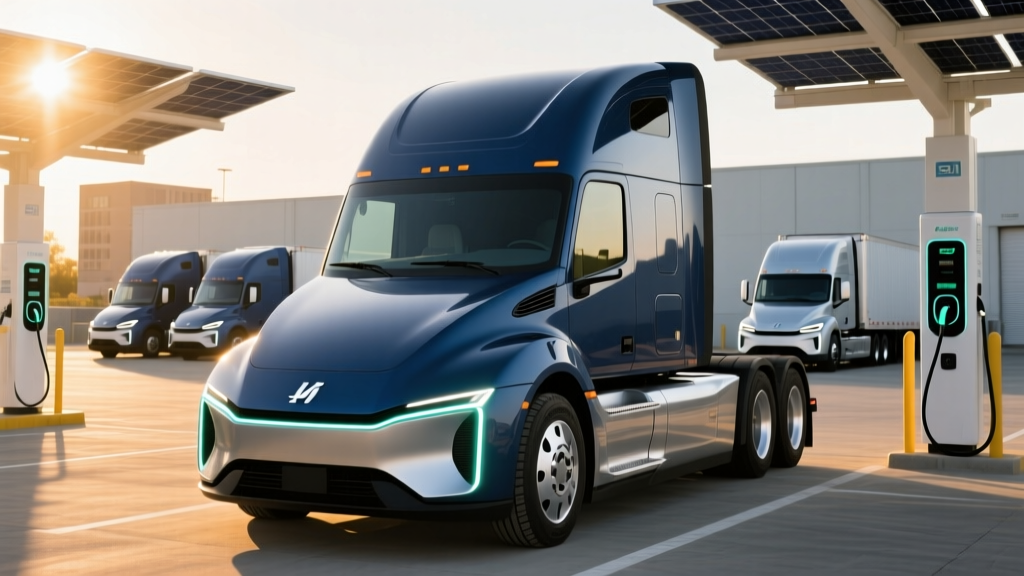
If you've been tracking electric semi truck prices, you already know the sticker shock is real. The Tesla Semi, Freightliner eCascadia, Volvo VNR Electric, and Peterbilt 579EV all carry base MSRPs between $180,000 and $290,000 — roughly two to three times the cost of a comparable diesel Class 8 rig. But fleet procurement isn't about the purchase price alone. It's about total cost of ownership (TCO) per mile, and that equation has shifted dramatically in favor of battery-electric trucks for regional and drayage routes.
This guide breaks down the exact numbers behind electric semi truck prices in 2026, including the federal commercial EV tax credit (up to $40,000 under IRS §45W — not the consumer §30D credit), state incentive stacks, charging infrastructure costs, and a realistic 5-year TCO comparison against diesel. Whether you're a fleet manager evaluating a 5-truck pilot or an owner-operator running a drayage route, the math below will tell you whether an electric semi pays for itself — and when.
Current Electric Semi Truck Prices by Model
Before diving into ownership costs, here's where the major Class 8 electric trucks land on price and core specs as of early 2026. Note: prices reflect base MSRP before incentives and vary by battery configuration and dealer.
| Model | Base MSRP | Battery (kWh usable) | EPA Est. Range | Peak DC Charge | GVWR |
|---|---|---|---|---|---|
| Tesla Semi (300 mi) | $180,000 | ~500 kWh (est.) | 300 mi | ~1,200 kW (Megacharger) | 82,000 lbs |
| Tesla Semi (500 mi) | $250,000 | ~900 kWh (est.) | 500 mi | ~1,200 kW (Megacharger) | 82,000 lbs |
| Freightliner eCascadia | $220,000–$260,000 | 297–475 kWh (NMC) | 150–230 mi | ~250 kW | 82,000 lbs |
| Volvo VNR Electric | $200,000–$240,000 | 264–565 kWh (NMC) | 150–275 mi | ~250 kW | 82,000 lbs |
| Peterbilt 579EV | $230,000–$280,000 | 282–442 kWh (NMC) | 150–200 mi | ~200 kW | 82,000 lbs |
| Kenworth T680E | $220,000–$270,000 | 396 kWh (NMC) | ~150 mi | ~200 kW | 82,000 lbs |
The Federal Tax Credit: §45W for Commercial EVs (Not §30D)
Here's where many fleet buyers get confused. The $7,500 consumer tax credit under IRS §30D applies to light-duty vehicles under 14,000 lbs GVWR — that's passenger cars, SUVs, and pickups. Class 8 semis (82,000 lbs GVWR) fall under a different provision: IRC §45W, the Commercial Clean Vehicle Credit.
- Credit amount: Up to $40,000 for vehicles over 14,000 lbs GVWR (30% of the incremental cost over a comparable diesel vehicle, capped at $40K)
- Eligible vehicles: Must be depreciable property used in a trade or business; must meet IRS clean vehicle sourcing requirements
- Battery sourcing: Same critical-mineral and battery-component rules as §30D apply — battery components must be manufactured or assembled in North America, and critical minerals must be sourced from the U.S. or FTA partners (phased thresholds increase annually)
- No MSRP cap: Unlike §30D, §45W has no manufacturer's suggested retail price ceiling
- No buyer income cap: Commercial credit is not subject to adjusted gross income limits
- Transferability: Starting in 2024, the credit can be transferred to the dealer for a point-of-sale price reduction (elective pay under §6417 for tax-exempt entities)
- Claim process: File IRS Form 8936 with your business tax return; seller must provide a written report with the vehicle's VIN and battery certification
Always confirm current-year eligibility at irs.gov and consult a tax professional — rules change and battery-sourcing compliance varies by model year.
For a Tesla Semi at $250,000, the incremental cost over a diesel Cascadia (~$160,000) is $90,000. At 30%, the credit calculates to $27,000 — below the $40K cap. For a Freightliner eCascadia at $240,000 with a $80,000 incremental cost, the credit would be $24,000. These are meaningful offsets, but they don't close the gap alone. That's where state incentives and operational savings come in.
State, Local, and Utility Incentives: The Stack
The biggest state-level incentive stacks are concentrated in California, which has aggressively funded heavy-duty electrification through the Hybrid and Zero-Emission Truck and Bus Voucher Incentive Project (HVIP) and Cap-and-Trade funded programs:
- California HVIP: Vouchers of $60,000–$120,000+ per Class 8 truck depending on fleet size and drayage eligibility (small fleets and drayage operations receive the highest vouchers)
- California CORE (Clean Off-Road Equipment): Applies to yard tractors and off-road equipment, not line-haul semis
- South Coast AQMD (SoCal): Additional regional incentives for trucks operating in the LA/Long Beach port complex — up to $50,000 per truck in some programs
- New York (NYSERDA Truck Voucher): Up to $185,000 for Class 8 electric trucks (capped per fleet)
- New Jersey, Oregon, Washington: Emerging programs with $25,000–$75,000 per truck, often tied to utility make-ready infrastructure support
Utility companies frequently offer make-ready incentives covering 50–100% of the electrical infrastructure cost for depot charging — a critical offset given that installing a single 350 kW DC charger can cost $100,000–$250,000 including transformer upgrades and trenching. Contact your utility's EV fleet program manager early in the planning process.
5-Year Total Cost of Ownership: Electric Semi vs. Diesel
The following TCO model assumes a regional/drayage duty cycle: 100–150 miles per day, 5 days per week, approximately 35,000 miles per year. Charging is depot-based with overnight Level 2 or scheduled DC fast charging. Diesel pricing is based on a national average of $4.10/gallon; electricity at a commercial/industrial rate of $0.14/kWh (varies significantly by region and time-of-use schedule).
| Cost Category | Electric Semi (e.g., eCascadia) | Diesel Semi (e.g., Cascadia) | Notes |
|---|---|---|---|
| Purchase Price (after credits) | $156,000–$200,000 | $155,000–$170,000 | Electric after $24K §45W + $60K HVIP; diesel baseline |
| Fuel / Energy (5 yr, 175K mi) | $30,600–$38,300 | $71,750–$82,000 | Electric: ~2.0 kWh/mi × $0.14/kWh; Diesel: ~6.5 mpg × $4.10/gal |
| Maintenance (5 yr) | $12,000–$18,000 | $35,000–$45,000 | No oil, no DPF, no DEF, regen braking saves brake wear |
| Insurance (5 yr) | $25,000–$35,000 | $20,000–$28,000 | Higher replacement-cost premiums; limited claims history |
| Depreciation (5 yr) | $45,000–$65,000 | $30,000–$45,000 | EV resale still uncertain; battery SoH drives value |
| Total 5-Year Cost | $268,600–$356,300 | $311,750–$370,000 | Electric wins on operating costs; purchase gap narrows with incentives |
| Cost Per Mile | $1.54–$2.04 | $1.78–$2.11 | Electric advantage grows at higher mileage |
Fuel Savings: Charging vs. Diesel Cost Per Mile
| Metric | Electric Semi | Diesel Semi |
|---|---|---|
| Energy consumption | ~2.0 kWh/mile | ~6.5 miles/gallon |
| Energy cost | $0.14/kWh (commercial depot) | $4.10/gallon (national avg) |
| Cost per mile (energy) | $0.28/mile | $0.63/mile |
| Annual fuel cost (35K mi) | $9,800 | $22,050 |
| 5-year fuel cost (175K mi) | $49,000 (at $0.28/mi) — adjusted to $30,600–$38,300 with TOU optimization | $110,250 — adjusted to $71,750–$82,000 with mpg variability |
The per-mile energy cost for an electric semi is roughly 55% lower than diesel. This is the single largest driver of TCO parity. However, commercial electricity rates vary dramatically: a fleet in Southern California on a time-of-use (TOU) rate may pay $0.08/kWh for overnight charging but $0.35/kWh during peak demand. Depot charging infrastructure with managed charging software (e.g., Amply, TeraWatt, or ChargePoint fleet) is essential to capture the lowest rates. Public DC fast charging at $0.40–$0.70/kWh should be used sparingly — it erodes the cost advantage quickly.
Maintenance Savings: Fewer Moving Parts, Real Dollars
| Maintenance Item | Diesel Semi (Annual) | Electric Semi (Annual) |
|---|---|---|
| Engine oil changes | $2,000–$3,500 (4–6 changes/yr) | $0 |
| Diesel particulate filter (DPF) | $3,000–$6,000 replacement cycle | $0 (no DPF) |
| Diesel exhaust fluid (DEF) | $800–$1,500/yr | $0 |
| Transmission service | $1,000–$2,000 | $0–$500 (single-speed or 2-speed) |
| Brake pads/rotors | $3,000–$5,000/yr | $500–$1,500/yr (regen braking extends life 2–3×) |
| Cooling system | $500–$1,000/yr | $500–$1,000/yr (battery thermal management) |
| Tires | $4,000–$6,000/yr | $4,000–$7,000/yr (heavier curb weight + instant torque) |
| Total Annual Maintenance | $14,300–$25,000 | $5,500–$10,500 |
Electric semis eliminate the entire diesel aftertreatment system — no DPF, no DEF, no EGR valve, no turbocharger maintenance. Regenerative braking handles 60–80% of deceleration in stop-and-go drayage work, dramatically extending brake life. The main maintenance risk unique to EVs is tire wear: the instant torque of electric motors and the heavier curb weight of battery packs (often 3,000–5,000 lbs more than diesel equivalents) accelerate tire wear. Budget for premium, EV-rated tires and more frequent rotations.
Insurance and Depreciation: Where EVs Still Cost More
Insurance Reality
Commercial insurance for electric semis is typically 15–30% higher than for diesel equivalents. The reasons are straightforward: higher replacement cost, limited repair networks for high-voltage battery systems, and a thin claims history that makes actuaries conservative. A fleet policy for a $240,000 eCascadia may run $5,000–$7,000 per year per truck vs. $4,000–$5,600 for a diesel Cascadia. As repair networks expand and loss data matures, premiums are expected to normalize — but in 2026, this is a real line-item increase.
Depreciation and Resale Value
This is the largest unknown in electric semi TCO modeling. The used market for Class 8 electric trucks is still nascent. Key factors affecting resale:
- Battery State of Health (SoH): A truck with 85% SoH after 5 years will command a premium over one at 75%. Most manufacturers warrant the battery to 70% capacity retention for 5 years / 300,000–500,000 miles (check specific terms — Freightliner offers 5 yr/500K mi on the eCascadia battery).
- Technology obsolescence: Rapid improvements in energy density and charging speed may depress resale of early-generation models — similar to what happened with early Nissan Leafs.
- Regulatory tailwinds: California's Advanced Clean Fleets rule and similar mandates in other states create a floor of demand for used electric trucks, which supports resale values.
- Estimated 5-year depreciation: 25–35% of purchase price for electric semis (vs. 20–28% for diesel). This gap narrows as the secondary market develops and battery health reporting becomes standardized.
Charging Infrastructure: The Hidden Capital Cost
No electric semi TCO analysis is complete without addressing depot charging infrastructure. A single 350 kW DC fast charger capable of serving a Class 8 truck costs:
- Charger hardware: $80,000–$150,000
- Electrical infrastructure (transformer, switchgear, trenching): $30,000–$100,000+
- Permits and engineering: $5,000–$20,000
- Total per charger: $115,000–$270,000
Most depot setups use a mix of overnight Level 2 (40–80 kW AC) chargers for scheduled routes and one or two DC fast chargers for opportunity charging. Utility make-ready programs can offset 50–100% of the infrastructure cost — this is the single most important incentive to secure before purchasing trucks. Plan 6–12 months lead time for utility interconnection and permitting.
For a fleet of 5 electric semis, expect to invest $300,000–$700,000 in charging infrastructure before incentives. With utility rebates and state infrastructure grants, the net cost may drop to $100,000–$250,000.
Decision Framework: When Does an Electric Semi Make Sense?
- Your routes are predictable and under 200 miles round-trip (regional haul, drayage, port operations)
- You have depot access with utility capacity for high-power charging
- You operate in a state with strong HVIP/voucher incentives (CA, NY, NJ, OR, WA)
- Your fleet turns over trucks every 5–7 years and you can capture the full fuel/maintenance savings
- Regulatory mandates (e.g., California Advanced Clean Fleets) require ZEV adoption in your timeline
- Your routes exceed 300 miles with no mid-route charging infrastructure
- You operate in a region with no state/utility incentives and high commercial electricity rates
- You need the flexibility of long-haul, irregular routes where charging downtime is unacceptable
- Your fleet is small (1–3 trucks) and the infrastructure investment per truck is disproportionate
Frequently Asked Questions
How much does it really cost to own an electric semi over 5 years?
Based on a 35,000-mile/year regional duty cycle, a 5-year TCO of $268,000–$356,000 for an electric semi vs. $312,000–$370,000 for a diesel equivalent — assuming full federal and state incentive capture. The electric truck breaks even or saves money by year 3–4 in most incentive-rich states, primarily through fuel and maintenance savings.
Do I qualify for the federal tax credit on a Class 8 electric semi?
Class 8 semis qualify under IRS §45W (Commercial Clean Vehicle Credit), not the consumer §30D credit. The credit is up to $40,000 (30% of the incremental cost over a diesel equivalent) with no MSRP cap and no buyer income limit. Battery-sourcing and critical-mineral requirements apply. File IRS Form 8936 and consult a tax professional. Rules are current for 2026 and subject to legislative change.
How much do I save on fuel and maintenance with an electric semi?
Energy cost per mile is approximately $0.28 (electric) vs. $0.63 (diesel), saving roughly $12,000–$14,000 per year at 35,000 miles. Maintenance savings add another $6,000–$15,000 per year by eliminating oil changes, DPF/DEF service, and extending brake life through regenerative braking. Combined annual operating savings: $18,000–$29,000 per truck.
Are electric semis more expensive to insure?
Yes — typically 15–30% more than diesel equivalents. Higher vehicle replacement cost, limited high-voltage repair networks, and a thin actuarial claims history drive premiums up. Expect $5,000–$7,000/year per truck vs. $4,000–$5,600 for diesel. This gap is expected to narrow as the technology matures.
How well do electric semis hold their value?
The used market is still developing. Expect 25–35% depreciation over 5 years (vs. 20–28% for diesel). Battery State of Health is the primary value driver — a well-maintained battery with 85%+ SoH retains significantly more value. California's ZEV mandates create demand-side support for used electric trucks, partially offsetting technology-obsolescence risk.
What about hydrogen fuel-cell semis as an alternative?
The Nikola Tre FCEV and Toyota/Kenworth T680 FCEV offer 300–500 mile range with 15–20 minute refueling. However, hydrogen fuel costs $15–$30/kg (equivalent to $6–$12/gallon diesel equivalent), and refueling infrastructure is extremely limited outside California. For most regional fleets, battery-electric remains the lower-TCO path in 2026.
Sources: IRS Clean Vehicle Credits, fueleconomy.gov, U.S. DOE TCO Analysis, manufacturer spec sheets (Freightliner, Volvo Trucks, Tesla). Always verify current-year incentive availability with your state air-quality district and utility provider.