Quick Answer: Which Electric Semi Truck Company Fits Your Fleet?
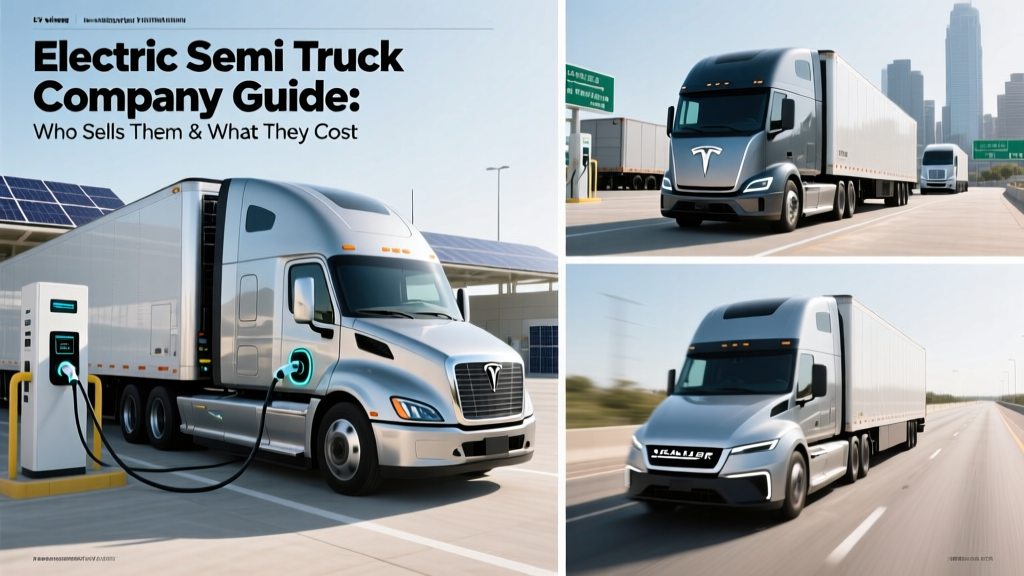
If you need a production electric Class 8 semi today, four companies dominate: Freightliner (eCascadia, ~230-mile range, regional haul), Tesla (Semi, ~500-mile range, long-haul focus), Volvo (VNR Electric, ~275-mile range, regional/drayage), and Kenworth (T680E, ~150-mile range, drayage/short-haul). Pricing ranges from roughly $250,000 to $400,000+ before incentives, with total cost of ownership often beating diesel within 3–5 years for high-utilization regional routes. The right electric semi truck company for you depends on your route length, depot charging access, and payload requirements.
The Major Electric Semi Truck Companies Selling in 2026
The commercial EV market has consolidated around a handful of manufacturers with genuine production volume and dealer support. Here is where each company stands with current model-year specs.
Freightliner eCascadia (Daimler Truck)
The eCascadia is the volume leader in North American electric Class 8 sales. Built on the proven Cascadia platform, it offers fleet operators familiar ergonomics and the widest dealer service network among electric semis. The 2026 model uses a 438 kWh usable battery pack (NMC chemistry), delivering an EPA-estimated 230 miles of range in a typical regional-haul configuration. Peak DC fast charging hits 180 kW, reaching 10–80% in approximately 90 minutes. Horsepower is rated at 470 HP (continuous), with 1,650 lb-ft of torque. Base MSRP sits around $275,000–$310,000 depending on battery and axle configuration.
Tesla Semi
Tesla's Semi remains the longest-range production electric Class 8 truck, with a claimed 500 miles of range (loaded at 82,000 lbs GVW). The battery pack is estimated at ~900 kWh (chemistry undisclosed, likely a mix of NMC and LFP cells), with peak charging at Tesla's Megacharger network targeting ~750 kW — enough to recover 70% range in roughly 30 minutes, per Tesla's published specs. The tri-motor powertrain produces over 1,000 HP. Tesla lists pricing at $250,000 for the 300-mile variant and $290,000 for the 500-mile variant, though actual delivery pricing and availability remain constrained. Real-world fleet operators report limited production slots and extended lead times into 2027.
Volvo VNR Electric
Volvo's VNR Electric targets regional distribution and drayage with a 6-battery pack configuration offering up to 275 miles of range (375 kWh usable, NMC). Charging peaks at 250 kW via CCS1, with a 10–80% session taking approximately 60–70 minutes. The electric drivetrain delivers 455 HP and 4,051 lb-ft of torque at the wheels. Pricing ranges from $260,000–$330,000 depending on configuration. Volvo's dealer network and Volvo Financial Services bundling (truck + charger + infrastructure) make this a popular choice for mid-size fleets.
Kenworth T680E (PACCAR)
The T680E is optimized for drayage and short-haul duty cycles. Its 282 kWh battery (NMC) provides approximately 150 miles of range — sufficient for port operations and local delivery. Peak charging is 135 kW (CCS1), with 10–80% in roughly 75 minutes. The powertrain produces 469 HP. MSRP starts near $250,000 for the base short-range configuration. PACCAR's parts and service infrastructure, shared with Peterbilt, is a significant advantage for existing fleet customers.
Spec Comparison: Electric Semi Trucks Side by Side
| Spec | Freightliner eCascadia | Tesla Semi (500 mi) | Volvo VNR Electric | Kenworth T680E |
|---|---|---|---|---|
| EPA Range (loaded) | ~230 mi | ~500 mi (claimed) | ~275 mi | ~150 mi |
| Battery (usable kWh) | 438 kWh | ~900 kWh (est.) | 375 kWh | 282 kWh |
| Chemistry | NMC | Undisclosed | NMC | NMC |
| Peak DC Charge Rate | 180 kW | ~750 kW (Megacharger) | 250 kW | 135 kW |
| 10–80% Charge Time | ~90 min | ~30 min (claimed) | ~65 min | ~75 min |
| Connector | CCS1 | Tesla Megacharger (proprietary) | CCS1 | CCS1 |
| Horsepower | 470 HP | 1,000+ HP | 455 HP | 469 HP |
| Base MSRP (est.) | $275K–$310K | $290,000 | $260K–$330K | $250,000+ |
| Warranty (battery) | 5 yr / 600K mi | 8 yr / 1M mi (claimed) | 5 yr / 600K mi | 5 yr / 400K mi |
Sources: Freightliner eCascadia specs, Volvo VNR Electric, manufacturer press materials. Tesla Semi specs are preliminary/published claims; independent fleet testing data remains limited.
Real-World Range: What the Sticker Doesn't Tell You
EPA range figures for electric semis assume moderate temperatures, flat terrain, and a standardized payload. Real-world fleet operators consistently report 15–30% range reduction under working conditions.
Range Reality Check
eCascadia (230 mi EPA): Expect 175–200 miles loaded on highway routes, 150–170 miles in cold weather (below 35°F). Regenerative braking partially offsets urban stop-and-go losses.
VNR Electric (275 mi EPA): Expect 210–240 miles in regional distribution, 180–200 miles with full trailer load on mixed highway. Volvo's thermal management system helps mitigate cold-weather losses to roughly 20%.
T680E (150 mi EPA): Expect 120–135 miles in drayage cycles. The shorter route profile means cold-weather impact is less operationally disruptive — most port runs are well within this envelope.
Tesla Semi (500 mi claimed): Independent fleet data is scarce. Conservative estimates based on energy density and aerodynamic modeling suggest 380–430 miles loaded at highway speeds, dropping to ~320 miles in cold/high-altitude corridors.
The critical planning number is not peak range but minimum range under worst-case conditions. Fleet managers should spec routes to the winter-loaded number, not the summer-unloaded sticker.
Total Cost of Ownership: Electric Semi vs. Diesel
The upfront price premium for an electric semi is significant — often 2.5x to 3x a comparable diesel Class 8. But total cost of ownership (TCO) over 5–8 years tells a different story for high-utilization fleets.
| Cost Factor | Diesel Class 8 (e.g., Cascadia) | Electric Class 8 (e.g., eCascadia) |
|---|---|---|
| Purchase Price | $130,000–$170,000 | $275,000–$330,000 |
| Federal Tax Credit (§45W Commercial) | $0 | Up to $40,000 |
| Fuel/Energy Cost per Mile | $0.55–$0.70 (diesel @ ~$4.00/gal, 6.5 MPG) | $0.12–$0.22 (electricity @ $0.10–$0.18/kWh, ~2 kWh/mi) |
| Fuel/Energy per Year (100K mi) | $55,000–$70,000 | $12,000–$22,000 |
| Maintenance per Year | $12,000–$18,000 | $4,000–$7,000 |
| 5-Year Fuel + Maintenance | $335,000–$440,000 | $80,000–$145,000 |
| Depot Charger Install (per stall) | N/A | $40,000–$150,000 |
| Estimated 5-Year TCO | $465,000–$610,000 | $395,000–$515,000 |
Energy costs based on U.S. DOE Alternative Fuels Data Center averages and utility commercial rates. Actual electricity costs vary significantly by region, time-of-use rates, and demand charges. The IRS §45W commercial clean vehicle credit provides up to $40,000 for qualifying Class 8 vehicles — eligibility depends on battery sourcing and manufacturer certification.
The breakeven point typically arrives between years 3 and 5 for trucks running 80,000+ miles annually. Below 50,000 miles per year, the diesel's lower purchase price is harder to overcome. Depot charging infrastructure is the wild card — a 10-stall fleet depot with 150 kW chargers and utility upgrades can cost $1–3 million, though state incentive programs and utility make-ready programs can offset 30–70% of infrastructure costs.
Charging Infrastructure: The Hidden Decision Factor
Unlike passenger EVs that can rely on public charging networks, electric semis require purpose-built depot charging. This is the single biggest operational commitment when choosing an electric semi truck company.
Depot Charging Basics
Most fleet operators install Level 2 AC chargers (40–80 kW per port) for overnight charging and DC fast chargers (150–350 kW) for opportunity charging during driver breaks. A 438 kWh eCascadia battery charging at 40 kW AC takes roughly 10–11 hours from 10–100% — ideal for overnight layovers. A 150 kW DC charger recovers 10–80% in about 90 minutes.
Utility Demand Charges
Commercial electricity pricing includes demand charges based on peak kW draw. A depot charging 10 trucks simultaneously at 150 kW each creates a 1.5 MW peak — potentially triggering $15–$40/kW monthly demand charges depending on the utility. Smart charging software that staggers sessions and integrates with time-of-use rates is not optional; it is essential for cost control.
Tesla's Megacharger Advantage (and Limitation)
Tesla's Megacharger network, designed for Semi charging at up to 750 kW, is a proprietary advantage — but it exists in very limited locations as of 2026. Tesla has installed Megachargers at select fleet customer depots (notably PepsiCo's Modesto facility) and a handful of public corridor locations, but the network is nowhere near the coverage of Tesla's Supercharger network for passenger vehicles. Fleets considering the Tesla Semi must plan around depot charging regardless.
Myths vs. Facts: Common Misconceptions About Electric Semis
| Myth | Fact |
|---|---|
| "Electric semis can't haul full loads." | All major models are rated for 82,000 lbs GVW. Battery weight (4,000–10,000 lbs) reduces payload slightly, but the federal 2,000-lb weight exemption for EVs partially offsets this. Most regional loads are weight-out well before hitting the limit. |
| "Batteries won't last the life of the truck." | Current NMC packs are warrantied for 5 years / 400,000–600,000 miles at 70–80% capacity retention. Real-world fleet data from early eCascadia and VNR Electric deployments shows 8–12% degradation at 300,000 miles. Replacement cost is $60,000–$120,000 depending on pack size. |
| "Charging takes too long for freight operations." | Overnight depot charging at 40–80 kW covers 90%+ of daily needs for regional routes under 200 miles. DC fast charging at 150–250 kW aligns with federally mandated 30-minute driver rest breaks. |
| "There are no incentives for commercial electric trucks." | The federal §45W credit provides up to $40,000 per vehicle. State programs (California's HVIP, New York's Truck Voucher Incentive) add $50,000–$240,000. Utility make-ready programs cover infrastructure. Total incentives can cut net cost by 40–60%. |
| "Electric semis are unreliable in cold weather." | Cold weather reduces range by 15–30% and slows charging speeds. Modern thermal management systems (liquid heating/cooling) mitigate this significantly. Fleets in Minnesota and Quebec are operating eCascadias year-round with route planning adjustments. |
Decision Framework: Choosing the Right Electric Semi Truck Company
If Your Routes Are…
Under 150 miles daily (drayage, port ops, local delivery): Choose the Kenworth T680E or base-config Volvo VNR Electric. Lower battery cost means faster ROI. Depot charging overnight at 40 kW is sufficient — no DC fast charger required.
150–250 miles daily (regional haul, distribution): Choose the Freightliner eCascadia or Volvo VNR Electric (6-battery config). Plan for one DC fast charger per 3–4 trucks for mid-day opportunity charging. This is the sweet spot where TCO advantage over diesel is most compelling.
300–500 miles daily (long-haul corridor): The Tesla Semi is the only current option, but availability is extremely limited. Realistically, most long-haul fleets should wait for next-generation Freightliner eCascadia and Volvo VNR variants (expected 2027–2028) with larger batteries and MCS (Megawatt Charging System) compatibility targeting 350+ mile range and 15-minute charge times.
If you have no depot or can't install chargers: Electric semis are not yet viable for your operation. Public DC fast charging for Class 8 trucks is in early pilot stages. Consider PHEV or CNG alternatives until depot charging is feasible.
If you operate in extreme cold (below 0°F routinely): Budget for 30% range loss and spec your route accordingly. All current manufacturers offer battery preconditioning, but energy consumed for cabin and battery heating is substantial. Volvo and Freightliner have the most mature cold-climate fleet data.
What First-Time Electric Fleet Buyers Need to Know
Transitioning from diesel to electric semis is a multi-year infrastructure project, not a vehicle swap. Here are the practical realities:
Start with utility engagement early. Depot charging for even 5 trucks at 150 kW each requires a dedicated transformer and potentially a new medium-voltage service line. Utility lead times for this work are 12–24 months in many regions. Contact your utility's commercial EV team before ordering trucks.
Pilot before scaling. Every major manufacturer offers pilot programs. Deploy 2–3 trucks on your most predictable routes for 6–12 months. Measure actual energy consumption per mile (expect 1.6–2.2 kWh/mi loaded), real-world range, and charger utilization before committing to a fleet-wide order.
Factor in the §45W commercial credit correctly. Unlike the consumer §30D credit, the commercial clean vehicle credit (§45W) is not capped by MSRP or buyer income, but it does require the vehicle to be placed in service for business use, and the credit cannot exceed the incremental cost over a comparable diesel vehicle. The maximum is $40,000 for vehicles over 14,000 lbs GVWR. Consult a tax professional — entity structure and depreciation elections (bonus depreciation, §179) interact with this credit in ways that materially affect net cost.
Budget for charger maintenance. DC fast chargers require annual maintenance (coolant, filters, connector inspection) and have a 7–10 year service life. Budget $2,000–$5,000 per charger per year for maintenance and software subscriptions.
Insurance premiums are higher. Commercial EV insurance currently runs 15–30% higher than equivalent diesel coverage, driven by higher vehicle values, specialized repair requirements, and limited actuarial data. Quotes vary widely — shop multiple carriers with commercial EV experience.
Frequently Asked Questions
Which electric semi truck company has the longest range?
Tesla claims 500 miles for the long-range Semi, but independent verification is limited and delivery availability is extremely constrained. Among widely available models, the Volvo VNR Electric offers up to 275 miles and the Freightliner eCascadia approximately 230 miles under EPA test conditions.
Can I charge an electric semi at a public truck stop?
As of 2026, public DC fast charging for Class 8 trucks is limited to a handful of pilot locations. Companies like WattEV, Terawatt Infrastructure, and Greenlane are building corridor charging stations with 350 kW–1 MW chargers designed for heavy trucks, but widespread availability is 3–5 years away. Depot charging remains the primary fueling strategy.
How long do electric semi batteries last?
Current NMC battery packs are warrantied for 5 years and 400,000–600,000 miles at 70–80% capacity retention. Early fleet data suggests 8–12% degradation at 300,000 miles with proper thermal management and charge-limit practices (avoiding sustained 100% SoC). Full pack replacement costs $60,000–$120,000 depending on capacity.
Do electric semis qualify for the federal tax credit?
Yes, under the §45W commercial clean vehicle credit (not the consumer §30D credit). The maximum credit is $40,000 for vehicles over 14,000 lbs GVWR. Eligibility depends on the vehicle being from a qualified manufacturer, meeting battery component sourcing requirements, and being placed in service for business use. The credit is non-refundable but can offset tax liability. Consult the IRS §45W guidance and a tax professional for your specific situation.
What is the Megawatt Charging System (MCS)?
MCS is the emerging standard for heavy-duty EV charging, supporting up to 1.25 MW (3,750A at 1,250V DC). It will enable electric semis to recover 200+ miles of range in 15–20 minutes. Freightliner, Volvo, and Kenworth have committed to MCS compatibility in next-generation models (expected 2027+). Tesla's Megacharger uses a proprietary connector. Fleets building depot infrastructure today should specify conduit and switchgear capacity for future MCS upgrades even if installing 150–350 kW CCS1 chargers now.
Are electric semis viable for long-haul trucking today?
Only marginally. The Tesla Semi's claimed 500-mile range approaches long-haul viability, but charging infrastructure gaps, limited production, and real-world range uncertainty make it impractical for most long-haul fleets in 2026. The consensus among fleet operators and analysts is that electric semis are best suited for regional and drayage routes under 250 miles today, with long-haul viability arriving with MCS infrastructure and next-generation batteries in the 2028–2030 timeframe.