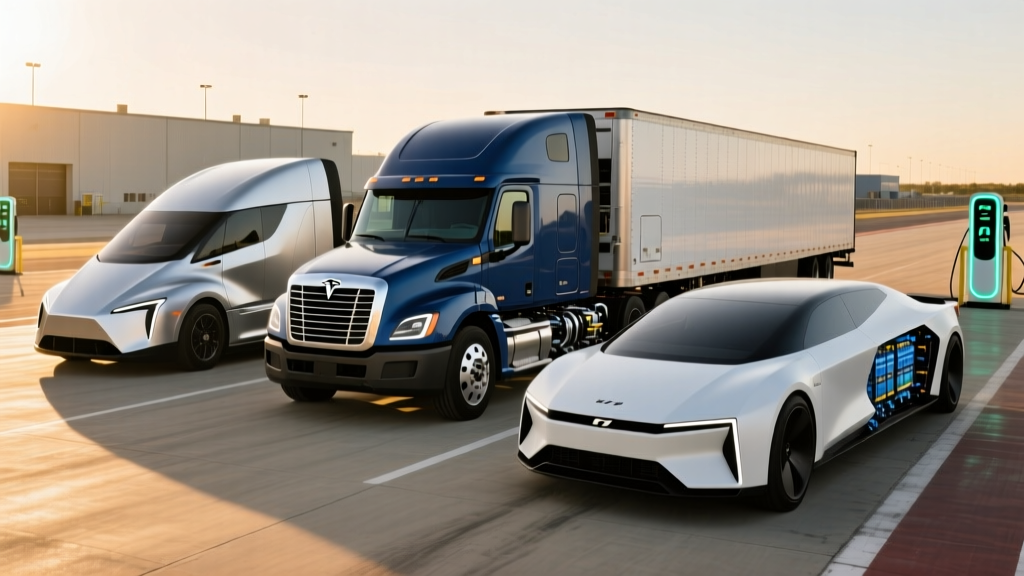
Fleet managers and owner-operators researching electric semi truck companies face a market that has matured significantly since the first Class 8 battery-electric trucks hit the road. The major players delivering production trucks in 2026 include Tesla (Semi), Freightliner (eCascadia), Volvo (VNR Electric), Peterbilt (579EV), and Kenworth (T680E). Each targets different duty cycles — regional haul, drayage, and short-hub routes — and the right choice depends on your route length, payload tolerance, depot-charging capability, and total-cost-of-ownership targets.
Quick Answer: Top Electric Semi Truck Companies in 2026
- Tesla Semi — Longest announced range (~500 mi loaded), lowest energy cost per mile (~2 kWh/mi), limited production scaling.
- Freightliner eCascadia — Most widely available, ~230 mi range, strong dealer/service network, ideal for regional/drayage.
- Volvo VNR Electric — ~275 mi range, 6-battery option, proven fleet deployments, excellent uptime support.
- Peterbilt 579EV — ~150 mi range (regional/drayage focus), PACCAR ecosystem support.
- Kenworth T680E — ~150 mi range, shared platform with Peterbilt, vocational/regional applications.
Why Fleets Are Switching to Electric Semis
The economic case for battery-electric Class 8 trucks rests on three pillars: fuel-cost savings, reduced maintenance, and regulatory compliance. Diesel prices fluctuate between $3.50 and $5.50 per gallon nationally, while commercial electricity rates average $0.12–$0.18 per kWh in most U.S. utility territories. A diesel semi averaging 6.5 MPG spends roughly $0.65–$0.85 per mile on fuel. An electric semi consuming 2.0–2.5 kWh per mile spends $0.24–$0.45 per mile on electricity — a 40–65% reduction in energy cost per mile.
Maintenance savings compound the advantage. Electric drivetrains eliminate oil changes, diesel particulate filter (DPF) servicing, exhaust gas recirculation (EGR) maintenance, and transmission overhauls. Fleet studies from early eCascadia and VNR Electric deployments report 30–50% lower maintenance costs per mile compared to diesel equivalents, though tire wear can increase due to higher torque delivery and vehicle weight.
Regulatory pressure is accelerating adoption. California's Advanced Clean Fleets rule mandates a transition to zero-emission medium- and heavy-duty vehicles, and states including New York, New Jersey, Washington, Oregon, and Massachusetts have adopted or are considering similar frameworks. The EPA's Phase 3 greenhouse gas standards for heavy-duty vehicles (effective 2027) further tighten emissions requirements, making electric trucks a compliance pathway rather than just an option.
Spec Comparison: Major Electric Semi Trucks Available in 2026
| Specification | Tesla Semi | Freightliner eCascadia | Volvo VNR Electric | Peterbilt 579EV | Kenworth T680E |
|---|---|---|---|---|---|
| Class | 8 | 8 | 8 | 8 | 8 |
| Battery Capacity (usable) | ~900 kWh (est.) | 291–438 kWh | 375 kWh (6-battery) | 282–396 kWh | 282–396 kWh |
| Chemistry | NMC (est.) | NMC | NMC | NMC | NMC |
| EPA Range (loaded, 82k GCW) | ~500 mi (announced) | ~230 mi | ~275 mi | ~150 mi | ~150 mi |
| Real-World Range Expectation | ~350–420 mi | ~160–200 mi | ~190–240 mi | ~100–130 mi | ~100–130 mi |
| Peak DC Fast Charge | ~1,000 kW (announced) | ~250 kW | ~250 kW | ~150 kW | ~150 kW |
| 10–80% Charge Time (est.) | ~30 min (announced) | ~90 min (438 kWh) | ~70–90 min | ~3–4 hours | ~3–4 hours |
| Motor Output | ~1,000+ HP (tri-motor) | ~425 HP continuous | ~455 HP (peak) | ~490 HP (peak) | ~490 HP (peak) |
| GCWR | 82,000 lbs | 82,000 lbs | 82,000 lbs | 82,000 lbs | 82,000 lbs |
| Base MSRP (est.) | $250,000–$290,000 | $300,000–$350,000 | $330,000–$380,000 | $300,000–$350,000 | $300,000–$350,000 |
| Battery Warranty | TBD (unannounced) | 5 yr / 600k mi | 5 yr / 600k mi | 5 yr / 600k mi | 5 yr / 600k mi |
Note: Tesla Semi specs remain partially estimated as production scaling continues. Real-world range figures assume mixed highway/city driving at 65–70 mph with 70,000–80,000 lb GCW. Cold-weather operation (below 32°F) can reduce range by 15–30%. All range and pricing data should be confirmed with manufacturer representatives before purchase.
Electric Semi vs. Diesel Semi: Total Cost of Ownership
The upfront cost gap between electric and diesel semis remains substantial — a new diesel Class 8 tractor costs $150,000–$180,000, while electric equivalents run $250,000–$380,000 before incentives. However, the total cost of ownership (TCO) equation shifts dramatically over a 5- to 7-year ownership period for fleets running 60,000–100,000 miles per year.
| Cost Category | Diesel Class 8 (Annual) | Electric Class 8 (Annual) | Notes |
|---|---|---|---|
| Purchase / Financing (7-yr amortized) | $22,000–$26,000 | $36,000–$54,000 | Before incentives; varies by credit terms |
| Fuel / Energy (80,000 mi/yr) | $52,000–$68,000 | $19,200–$36,000 | Diesel at $4.25/gal, 6.5 MPG; Elec at $0.12–0.18/kWh, 2.0 kWh/mi |
| Maintenance | $18,000–$24,000 | $9,000–$14,000 | No DPF, EGR, oil, or transmission service on EV |
| Insurance | $8,000–$12,000 | $10,000–$15,000 | Higher premiums for EVs due to battery replacement cost |
| Depot Charging Infrastructure (amortized) | $0 | $8,000–$18,000 | Level 2 depot chargers + electrical upgrades, per truck |
| Total Annual Cost | $100,000–$130,000 | $82,200–$137,000 | Parity achievable at high mileage + incentives |
The federal Commercial Clean Vehicle Credit (§45W) provides up to $40,000 for qualified commercial electric trucks (30% of the incremental cost over a comparable diesel vehicle, capped at $40,000 for vehicles over 14,000 lbs GVWR). Unlike the consumer §30D credit, §45W has no MSRP or buyer income caps but requires meeting battery-sourcing and domestic-assembly requirements. Consult the IRS §45W guidance and a tax professional to confirm eligibility for your fleet.
Additional incentive layers exist at the state level — California's HVIP (Hybrid and Zero-Emission Truck and Bus Voucher Incentive Project) can provide $60,000–$120,000+ per Class 8 electric truck, and similar programs operate in New York, New Jersey, and other states. When combined, federal + state incentives can close the purchase-price gap to near-parity with diesel.
Charging Infrastructure: The Real Bottleneck
The single most significant barrier to electric semi adoption is not the truck itself — it's the charging infrastructure. A fleet of 10 electric semis charging simultaneously at 250 kW each demands 2.5 megawatts of electrical capacity, equivalent to powering a small neighborhood. Most commercial properties require utility service upgrades, new transformers, switchgear, and trenching that can cost $200,000–$1,000,000+ depending on site conditions.
Charging Misconceptions vs. Reality
| Myth | Fact |
|---|---|
| "You can charge a semi at a public DC fast charger." | Most public DCFC stations max out at 150–350 kW and lack the physical space, pull-through lanes, and grid connection to support Class 8 trucks. Depot charging is the primary model. |
| "A semi charges as fast as a passenger EV." | Even at 250 kW, a 438 kWh battery takes ~90 minutes from 10–80%. Tesla's announced 1 MW+ charging is not yet widely deployed at public sites. |
| "Overnight depot charging is always sufficient." | At 40–80 kW Level 2 depot rates, a full charge takes 6–10 hours — sufficient for single-shift operations but inadequate for multi-shift or 24/7 fleets without oversized battery buffers. |
| "Electric semis eliminate all downtime." | Charging time replaces fueling time. A 90-minute mid-day charge session is real operational downtime unless routes are designed around depot returns. |
For fleets operating single-shift regional or drayage routes (100–200 miles out and back), overnight depot charging at 40–80 kW per stall is practical and cost-effective. For multi-shift or longer-haul operations, megawatt charging systems (MCS) operating at 1,000–3,750 kW are under development through the CharIN MCS standard, but widespread public MCS deployment is still years away.
Real-World Range: What the Sticker Doesn't Tell You
EPA range figures for electric semis assume controlled testing conditions that rarely match real-world operation. Several factors compress range significantly:
- Payload weight: A fully loaded 82,000-lb GCW combination consumes 25–40% more energy per mile than a bobtail or lightly loaded truck. The Tesla Semi's 500-mile claim assumes an 82,000-lb load, but real-world conditions (grade, wind, HVAC) reduce this to an estimated 350–420 miles.
- Highway speed: Aerodynamic drag scales with the square of velocity. Running 75 mph vs. 65 mph can increase energy consumption by 15–20% in a Class 8 tractor-trailer.
- Cold weather: Battery chemistry becomes less efficient below 32°F. Cabin and battery-preconditioning loads add 10–25% to energy consumption. Expect 15–30% range loss in sub-freezing conditions.
- Grade and terrain: Mountainous routes (I-70 through Colorado, I-80 over the Sierras) can halve range on sustained climbs, though regenerative braking recovers significant energy on descents.
- Auxiliary loads: PTO operations, liftgates, refrigeration units (for reefer trailers), and hotel loads all draw from the traction battery unless separately powered.
Fleet telematics data from early eCascadia deployments in Southern California drayage operations shows average energy consumption of 2.0–2.8 kWh/mile, with loaded highway segments at the higher end and empty urban segments at the lower end. Volvo's VNR Electric fleet data from the South Coast Air Quality Management District LIGHTS project demonstrated real-world ranges of 150–240 miles depending on route profile and payload.
Who Should Buy an Electric Semi (and Who Shouldn't)
Decision Framework: Is an Electric Semi Right for Your Fleet?
Choose an electric semi if:
- Your daily routes are under 200 miles round-trip (drayage, regional hub, port operations)
- You operate from a fixed depot where overnight Level 2 or DCFC charging can be installed
- Your fleet runs single-shift operations allowing 8–10 hour charging windows
- You operate in a state with ZEV mandates or strong incentive programs (CA, NY, NJ, WA, OR)
- Your fleet's annual mileage exceeds 60,000 miles per truck (accelerating fuel-cost payback)
- You have or can secure utility service upgrades for depot charging
Stick with diesel (or wait) if:
- Your routes regularly exceed 300 miles without return-to-base opportunities
- You operate multi-shift or 24/7 with no charging downtime tolerance
- You run in regions with no public MCS infrastructure and no depot-charging option
- Your trucks operate in extreme cold (sustained below 0°F) without heated depot storage
- You haul specialized/heavy loads requiring maximum payload (battery weight reduces cargo capacity by 2,000–5,000 lbs)
- Your utility cannot provide adequate service for depot charging without multi-year infrastructure projects
Company Profiles: What Each Manufacturer Brings
Freightliner eCascadia (Daimler Truck North America)
The eCascadia is the most widely deployed electric Class 8 truck in North America, with over 1,000 units in fleet service as of early 2026. Built on the proven Cascadia platform, it offers battery options from 291 kWh to 438 kWh and benefits from Daimler's extensive dealer and service network. The Detroit ePowertrain provides 425 continuous HP. Best suited for regional haul and drayage operations under 200 miles. Freightliner eCascadia specs.
Volvo VNR Electric
Volvo's VNR Electric, now in its third generation, offers up to six NMC battery packs totaling 375 kWh and a range of up to 275 miles. Volvo's dealer support and uptime services (including Volvo Action Service) provide strong fleet confidence. The VNR Electric has been deployed in major fleet programs including those with Knight-Swift and Quality Distributing. Peak output is 455 HP.
Tesla Semi
The Tesla Semi remains the most ambitious electric truck on paper, with a tri-motor drivetrain producing over 1,000 HP, an announced 500-mile range at full load, and megawatt-class charging capability. However, production volume remains limited, with most units deployed to Tesla's own logistics and a handful of early fleet customers (PepsiCo, Martin Brower). Service infrastructure outside of Tesla's direct network is nonexistent, and long-term parts availability for a low-volume production truck is an open question.
Peterbilt 579EV & Kenworth T680E (PACCAR)
PACCAR's electric offerings share drivetrain components and target similar duty cycles — regional haul and vocational applications under 150 miles. Battery options range from 282 to 396 kWh. The PACCAR dealer network provides strong aftermarket support, and both models integrate with PACCAR's connected-vehicle platforms. Best for fleets already in the PACCAR ecosystem seeking a known service relationship.
Frequently Asked Questions
What is the cheapest electric semi truck available?
The Tesla Semi starts at an announced $250,000 for the 300-mile variant and $290,000 for the 500-mile variant, making it the lowest-priced option on paper. However, limited availability and lack of service infrastructure make the Freightliner eCascadia (~$300,000–$350,000) the more practical entry point for most fleets. After the $40,000 federal §45W credit and state incentives, effective purchase prices can drop to $160,000–$250,000.
How long does it take to charge an electric semi truck?
At a 250 kW DC fast charger, a 438 kWh battery (eCascadia large pack) takes approximately 90 minutes from 10–80% state of charge. Overnight depot charging at 40–80 kW Level 2 rates requires 6–10 hours for a full charge. Megawatt Charging System (MCS) stations at 1,000+ kW could reduce DCFC times to 30–45 minutes, but MCS infrastructure is not yet widely available.
Can electric semis handle long-haul routes (500+ miles)?
Not yet, practically. Even the Tesla Semi's announced 500-mile range would require mid-route charging on longer hauls, and public megawatt-class charging infrastructure for semis is extremely limited in 2026. Electric semis are best suited for regional routes under 250 miles with depot charging. Long-haul electrification will require MCS corridor deployment and potentially hydrogen fuel-cell range extenders.
Do electric semi trucks qualify for tax credits?
Yes. The federal Commercial Clean Vehicle Credit (§45W) provides up to $40,000 for qualified electric trucks over 14,000 lbs GVWR. The credit equals 30% of the incremental cost over a comparable diesel vehicle. Battery sourcing and domestic assembly requirements apply. Many states offer additional vouchers — California's HVIP can add $60,000–$120,000+. Consult a tax professional for fleet-specific eligibility.
What happens when the battery degrades?
NMC batteries in electric semis are warrantied for 5 years or 600,000 miles, typically guaranteeing 70–80% capacity retention at the warranty threshold. Replacement costs for a 400+ kWh battery pack are substantial — estimated at $100,000–$200,000+ depending on chemistry and pack configuration. Fleet operators should factor in potential battery replacement or refurbishment at years 7–10 of ownership, though real-world degradation data from early deployments suggests most packs retain usable capacity beyond warranty periods when properly managed (avoiding sustained 100% SoC, using preconditioning, limiting DCFC frequency).
How does battery weight affect payload capacity?
Electric semi battery packs add 4,000–8,000 lbs to the tractor compared to a diesel equivalent with fuel tanks. Under the federal 82,000-lb GCW limit (with a 2,000-lb allowance for ZEV powertrains, permitting 84,000 lbs), this reduces available cargo capacity by roughly 2,000–5,000 lbs. For weight-sensitive loads (aggregates, liquids, dense goods), this can mean fewer pallets or partial loads — a real revenue impact that fleets must model into their route economics.
Bottom Line for Fleet Buyers
The electric semi truck market in 2026 is real but segmented. For fleets running predictable regional and drayage routes under 200 miles with depot-charging access, electric Class 8 trucks from Freightliner, Volvo, and PACCAR deliver compelling TCO advantages when incentives are applied. The Tesla Semi offers the most impressive specifications but remains a limited-production vehicle with unproven long-term service logistics. Long-haul and extreme-climate operations should continue with diesel or plan a phased transition as MCS charging infrastructure matures. Start by instrumenting your current routes with telematics data — energy consumption modeling tools from each OEM can project your fleet-specific range, charging, and cost outcomes before you commit capital.