The Short Answer on Electric Sea-Doo
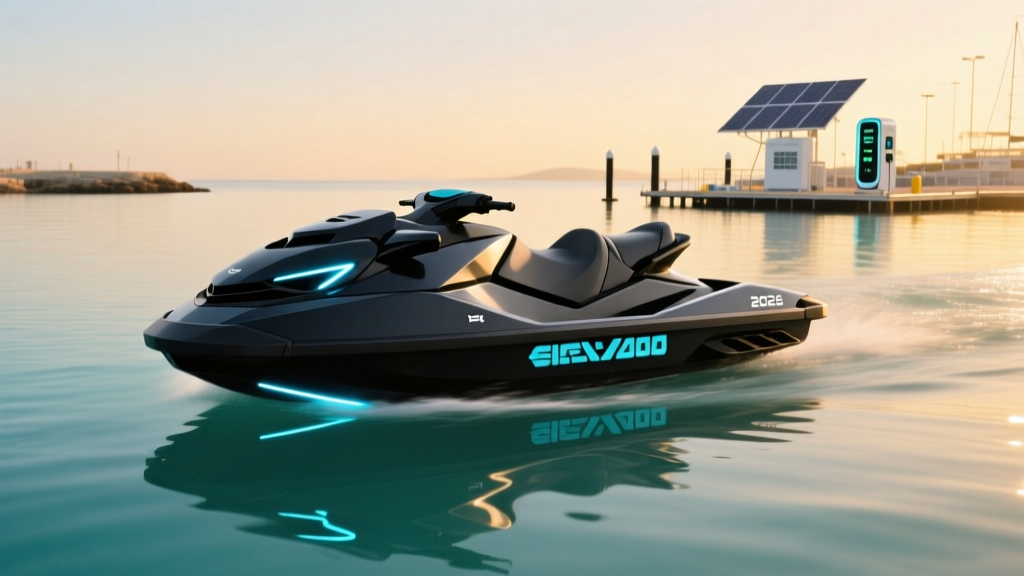
As of early 2026, BRP (the parent company of Sea-Doo) has not released a fully electric personal watercraft under the Sea-Doo brand. The closest electrified product in their lineup is the Sea-Doo Spark with the Rotax 900 ACE engine, which remains a gasoline-powered PWC. BRP has publicly committed to offering electric models across all product lines by 2026, but as of this writing, an electric Sea-Doo remains in the announced/preliminary stage — no final specs, pricing, or on-sale date have been confirmed.
If you're researching an electric Sea-Doo today, here's what you need to know about where the technology stands, what alternatives exist, and what to expect when BRP's electric PWC finally launches.
What BRP Has Said About an Electric Sea-Doo
BRP CEO José Boisjoli has stated repeatedly since 2022 that the company will introduce electric vehicles across every product line — including personal watercraft — by the end of 2026. The company has invested heavily in its Sherbrooke, Quebec battery innovation center and has showcased electric powertrain prototypes. However, BRP has been deliberate rather than aggressive, prioritizing battery energy density and thermal management for marine applications where weight, corrosion resistance, and sustained high-load operation matter far more than in a passenger car.
Key challenges BRP must solve before an electric Sea-Doo reaches dealers:
- Energy density under load: A gasoline PWC like the Sea-Doo Spark uses roughly 2.5–3.5 gallons per hour at moderate speeds. Replicating that runtime electrically requires a battery pack dense enough to fit in a hull designed for a 900cc twin-cylinder engine and a 12-gallon fuel tank.
- Marine-grade thermal management: Sustained wide-open throttle on water generates far more heat than stop-and-go driving. Battery cooling systems must handle continuous high-discharge rates in a sealed, waterproof enclosure.
- Weight distribution: PWC hulls are engineered around specific center-of-gravity points. Lithium-ion packs (typically NMC chemistry for energy density) are heavier per unit volume than a fuel tank, requiring hull redesign.
- Charging infrastructure: Unlike EVs with a growing DC fast-charging network, marinas and lakeside docks rarely offer Level 2 or DC charging. An electric PWC will likely rely on home Level 2 charging (240V) and possibly portable Level 1 (120V) trickle charging at the dock.
Current Gas Sea-Doo Spark: The Baseline for Comparison
Until an electric Sea-Doo ships, the gas-powered Spark remains the relevant benchmark. Here's what the current model delivers:
| Spec | Sea-Doo Spark (900 ACE) |
|---|---|
| Engine | Rotax 900 ACE, 3-cylinder, 90 HP |
| Fuel Capacity | 12 gallons (45 liters) |
| Fuel Consumption | ~2.5 gal/hr (cruise) / ~3.5 gal/hr (sport mode) |
| Runtime at Cruise | ~4–5 hours per tank |
| Top Speed | ~50 mph (80 km/h) |
| Dry Weight | ~410 lbs (186 kg) |
| MSRP (2025–2026) | $6,799–$7,999 depending on trim |
| Maintenance | Annual oil/filter, spark plugs every 200 hrs, winterization |
The Spark's combination of low weight, low price, and simple mechanics has made it the best-selling PWC in North America for years. Any electric Sea-Doo will need to match or beat these practical numbers — especially runtime and price — to displace it.
Electric PWC Alternatives Available Now
If you want an electric personal watercraft today, a few niche manufacturers offer models, though none match the Sea-Doo dealer network or support infrastructure:
| Model | Battery (kWh) | Runtime | Top Speed | Charge Time (Level 2) | Price (USD) |
|---|---|---|---|---|---|
| Narke GT-95 Electrojet | 21 kWh (NMC) | ~2 hrs cruise | ~35 mph | ~3 hours (6.6 kW) | ~$24,000 |
| QYSEA / Various e-surfboards | 1.5–3 kWh | 30–60 min | 25–35 mph | 1–2 hours (Level 1/2) | $8,000–$18,000 |
| Custom electric jet ski builds | Varies | Varies | Varies | Varies | $15,000–$40,000+ |
The Narke GT-95 from Hungary is the most credible electric PWC on the market, but its ~$24,000 price tag, limited dealer presence in North America, and 2-hour runtime at cruise illustrate the fundamental trade-off: battery energy density hasn't caught up to gasoline for sustained high-power marine use. For context, gasoline contains roughly 33.7 kWh of energy per gallon. The Spark's 12-gallon tank holds the equivalent of ~400 kWh — even accounting for the internal combustion engine's ~25% thermal efficiency, that's ~100 kWh of usable work. Matching that with a battery pack would require an impractically heavy and expensive system today.
Projected Electric Sea-Doo: What We Expect (Preliminary)
Based on BRP's public statements, patent filings, and the trajectory of marine battery technology, here's a reasonable projection for what an electric Sea-Doo might look like when it launches:
Estimated Electric Sea-Doo Specs (Unconfirmed / Preliminary)
- Battery: 15–25 kWh usable, likely NMC chemistry for energy density
- Runtime: 1.5–3 hours at moderate cruise (realistic, not marketing)
- Motor: 60–90 kW (80–120 HP) electric drive
- Top Speed: 45–55 mph
- Charging: Level 2 (240V, ~7–11 kW) in 2–4 hours; Level 1 (120V) overnight
- Price: $10,000–$16,000 estimated (battery cost is the main driver)
- Weight: 500–600 lbs (heavier than gas Spark due to battery mass)
Note: These are analyst estimates based on available information. BRP has not published final specifications. Treat all figures as preliminary.
Real-World Cost Comparison: Gas Spark vs. Projected Electric Sea-Doo
Let's compare 5-year ownership costs for the current gas Spark versus a hypothetical electric Sea-Doo at the projected specs above. This framework helps you decide whether waiting for electric makes financial sense.
| Cost Category | Gas Spark (5 Years) | Projected Electric (5 Years) |
|---|---|---|
| Purchase Price | $7,500 | $13,000 (est.) |
| Fuel / Electricity | $1,875 (150 hrs/yr × $4.17/gal avg) | $450 (150 hrs/yr × ~$0.60/hr electricity) |
| Maintenance | $1,500 (oil, filters, plugs, winterization) | $300 (minimal — no oil, plugs, or exhaust) |
| Insurance (est.) | $1,500 | $1,750 (higher replacement cost) |
| Depreciation (est.) | -$3,750 | -$7,800 (new tech depreciation risk) |
| 5-Year Total Cost | ~$12,375 | ~$23,300 (est.) |
The gas Spark wins decisively on total cost today, primarily because of its low purchase price. The electric Sea-Doo would need to come in closer to $9,000–$10,000 MSRP to compete on cost, which would require battery pack prices to fall below ~$100/kWh — possible by the late 2020s but not guaranteed for marine-grade, high-discharge cells.
Who Should Wait for Electric, and Who Should Buy Gas Now
Decision Framework: Gas Now or Wait for Electric?
Buy the gas Sea-Doo Spark now if:
- You ride 100+ hours per season and need 4–5 hours of runtime per outing
- You frequently ride at remote lakes without shore power access
- Your budget is under $8,000 for the watercraft itself
- You want established dealer support and easy winterization
- You trailer your PWC to different bodies of water regularly
Wait for the electric Sea-Doo if:
- You ride primarily at a lake house or dock with reliable 240V shore power
- Your typical sessions are under 2 hours
- Noise restrictions or environmental regulations affect your waterway (many lakes are moving toward electric-only boating)
- You want near-zero maintenance and don't mind a higher upfront cost
- You value instant torque and smooth, vibration-free operation
Common Misconceptions About Electric Watercraft
| Myth | Fact |
|---|---|
| "Electric jet skis have the same range as gas ones." | Current battery energy density gives electric PWCs roughly 1–3 hours of runtime vs. 4–5+ hours for gas. This will improve but remains a fundamental physics limitation today. |
| "You can fast-charge an electric PWC in 30 minutes at the dock." | DC fast charging at 50+ kW requires heavy, expensive infrastructure that virtually no marina has. Expect Level 2 (240V) charging at 2–4 hours as the practical standard. |
| "Electric PWCs qualify for the $7,500 federal EV tax credit." | The IRS §30D credit applies to qualified plug-in electric motor vehicles for use on public roads. Personal watercraft do not qualify. Check IRS guidelines for eligible vehicle categories. |
| "BRP's electric Sea-Doo is already available." | As of early 2026, BRP has not released a production electric Sea-Doo. The company's commitment is to offer electric options by end of 2026, but no model is on sale yet. |
| "Electric watercraft are completely maintenance-free." | While electric motors eliminate oil changes and spark plug replacements, you still need hull maintenance, impeller inspection, battery health monitoring, cooling system service, and winterization of the water cooling circuit. |
Charging at Home and the Dock: What You'd Need
When an electric Sea-Doo does launch, charging logistics will be the make-or-break factor for most buyers. Here's what a realistic setup looks like:
- Level 1 (120V standard outlet): Expect ~1.4 kW charging. A 20 kWh battery would take ~14 hours from empty — practical only for overnight charging between weekend sessions.
- Level 2 (240V, 30–50A circuit): Expect ~7–11 kW charging. A 20 kWh battery charges in ~2–3 hours. This requires a dedicated 240V outlet at your dock or garage — a licensed electrician should assess your panel capacity, especially if you're already running other high-draw equipment (boat lift, AC, welder).
- Marina shore power: Some marinas offer 30A or 50A 240V shore power for boats, which could double as PWC charging — but you'll need the marina's permission and possibly a metered connection.
- Solar trickle charging: A 400W marine solar panel can add roughly 2–3 kWh on a sunny day — enough for ~15–20 minutes of extra runtime. Not a primary charging strategy, but useful for topping off at a remote dock.
Installation cost for a dedicated 240V/50A circuit at a residential dock typically ranges from $1,500–$4,000 depending on panel proximity, conduit runs, and local permitting. If your electrical panel needs an upgrade from 100A to 200A service, add $2,000–$5,000.
What First-Time Electric PWC Buyers Should Know
If you're considering any electric watercraft — whether waiting for BRP's offering or looking at current alternatives — keep these ownership realities in mind:
- Battery degradation is real. NMC lithium-ion cells lose capacity over time and charge cycles. Expect ~10–15% capacity loss over 5 years of typical use (150 hours/season). Ask about warranty terms — look for at least 3 years with a capacity retention guarantee (e.g., 80% of original capacity).
- Cold water and cold storage reduce range. Battery internal resistance increases in cold temperatures. If you ride in northern lakes or store your PWC in an unheated garage, expect 15–25% range reduction in cold conditions.
- Resale value is uncertain. Electric PWCs are new enough that long-term resale data doesn't exist. Early adopters may face steeper depreciation as battery tech improves rapidly.
- Dealer support matters. BRP's dealer network is one of the largest in powersports. Niche electric PWC brands may have limited service options in your area — check before buying.
- No federal tax credit. Unlike electric cars, electric watercraft do not qualify for the IRS §30D clean vehicle credit. Some states may offer rebates for electric marine equipment — check your state's energy office or Alternative Fuels Data Center for current incentive programs.
Frequently Asked Questions
Is there an electric Sea-Doo I can buy right now?
No. As of early 2026, BRP has not released a production electric Sea-Doo. The company has committed to electrifying its lineup by late 2026, but no model is currently available for purchase. The gasoline-powered Sea-Doo Spark and other models remain the only options in the Sea-Doo PWC lineup.
How much will an electric Sea-Doo cost when it launches?
Based on current battery costs and comparable electric powersports pricing, we estimate an electric Sea-Doo would likely be priced between $10,000 and $16,000 — significantly more than the gas Spark's $6,799–$7,999 range. Battery pack cost is the primary price driver.
Will an electric Sea-Doo be as fast as the gas version?
Electric motors deliver instant torque, so acceleration could match or exceed the gas Spark's performance. Top speed will depend on the motor's power rating (kW) and the hull design. A 60–90 kW motor could realistically achieve 45–55 mph, comparable to the gas Spark's ~50 mph top speed.
Can I charge an electric PWC from a standard outlet?
Yes, but slowly. A standard 120V/15A outlet delivers roughly 1.4 kW, meaning a 20 kWh battery would take around 14 hours to fully charge. For practical daily use, a 240V Level 2 circuit (2–3 hour charge time) is strongly recommended.
Do electric watercraft need winterization?
Yes. While you skip the engine oil and fuel stabilizer steps, the water cooling system, exhaust cooling passages (if equipped), and hull still require winterization. Battery storage also requires attention — most manufacturers recommend storing lithium-ion packs at ~50% state of charge in a temperature-controlled environment to minimize degradation over winter.
Are electric jet skis allowed on all lakes?
Electric PWCs are generally allowed wherever gas PWCs are — and in some cases, they're the only type allowed. Several environmentally sensitive lakes and reservoirs have enacted gas-engine bans that exempt electric watercraft. Check your local waterway authority's regulations before purchasing any PWC.