The Quick Answer
The electric Scout Terra (pickup) and Scout Traveler (SUV) are Scout Motors' first two vehicles, slated for production in late 2027 as 2028 models. Both are body-on-frame, off-road-capable EVs built on the dedicated Scout Skateboard platform. Preliminary specs target 350+ miles of EPA range with an optional gasoline range extender, 800V architecture for fast DC charging, and a starting price expected around $60,000. Reservations opened in late 2024 with a refundable $100 deposit, and Scout has already reported over 100,000 reservations. The vehicles are not yet available for purchase; all specs below are preliminary and subject to change before production begins.
What Is the Electric Scout? Brand Origins and Platform
Scout Motors is a standalone American company backed by the Volkswagen Group, deliberately invoking the International Harvester Scout nameplate that ran from 1960 to 1980. Unlike VW's ID.4 or the discontinued Rivian EDV delivery van, the Scout Terra and Traveler are engineered from the ground up on a purpose-built platform called the Scout Skateboard — a body-on-frame chassis with solid rear axle, mechanical locking differentials available, and dual-motor all-wheel drive standard.
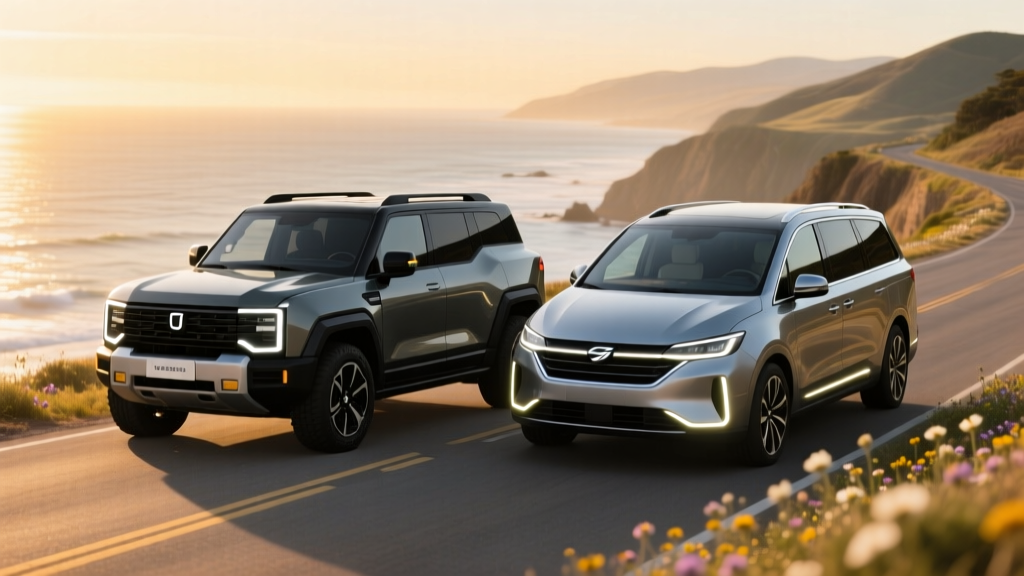
This isn't a crossover pretending to be a truck. Scout is targeting the Wrangler 4xe, Rivian R1T/R1S, and Ford Bronco buyer — someone who wants genuine off-road hardware with electric torque delivery. The Traveler is a two-row SUV with a removable roof and fold-flat windshield; the Terra is a midsize crew-cab pickup with a 5.5-foot bed.
Scout is also pursuing a direct-to-consumer sales model, bypassing traditional franchised dealerships. This has generated legal friction with the National Automobile Dealers Association, but Scout's position is that customers order online with transparent pricing — no haggling, no dealer markups.
Range, Battery, and the Range Extender Option
Scout has targeted a 350-mile EPA-estimated range for the battery-electric-only configuration of both the Terra and Traveler. The battery pack chemistry and total kWh capacity have not been officially confirmed, though industry analysts expect an NMC (nickel-manganese-cobalt) pack in the range of 100–120 kWh usable given the vehicle's size and range target.
EPA Range vs. Real-World Expectation
Scout's preliminary target of 350 miles is for the BEV-only configuration under EPA test cycles. Real-world expectations should account for:
- Highway driving (70+ mph): Expect approximately 280–310 miles. Large, boxy vehicles with solid axles face significant aerodynamic drag at speed.
- Cold weather (below 32°F): Range can drop 20–30%, meaning a realistic winter range of roughly 245–280 miles.
- Off-road / towing: Low-speed technical trails use less energy per mile, but towing a 5,000+ lb trailer can cut range roughly in half.
The headline feature is the optional Harvester range extender — a small gasoline engine that acts as a generator to recharge the battery on the fly, similar to the original BMW i3 REx or the Ramcharger's approach. Scout has suggested this could push total range well beyond 500 miles combined. This is aimed squarely at buyers who want daily electric commuting but aren't ready to risk stranding on remote trails or long rural stretches without charging infrastructure.
Scout has also confirmed support for the NACS (North American Charging Standard) connector, meaning native access to the Tesla Supercharger network — a significant advantage over CCS-equipped competitors that still require adapters.
Charging Speed and 800V Architecture
The Scout Skateboard platform uses an 800-volt electrical architecture, which enables faster DC fast charging and thinner, lighter wiring harnesses. While Scout has not published a peak kW charge rate, 800V platforms in comparable vehicles (Hyundai Ioniq 5, Kia EV9, Porsche Macan EV) typically achieve between 200–350 kW peak.
Here's what that means in practice:
| Charging Level | Power (kW) | Estimated Miles Added per Hour | Use Case |
|---|---|---|---|
| Level 1 (120V household) | ~1.4 kW | ~3–4 mi/hr | Emergency trickle; not practical for daily use on a 100+ kWh pack |
| Level 2 (240V home) | ~11.5–19.2 kW | ~30–50 mi/hr | Overnight home charging; full recharge in 7–10 hours |
| DC Fast (350 kW capable) | Up to ~270+ kW (est.) | ~600+ mi/hr at peak | 10–80% in approximately 20–25 minutes (estimated) |
Important charging-curve reality: No EV sustains its peak charge rate for the full session. A typical charge curve on an 800V pack will hold near peak kW up to roughly 50–60% State of Charge, then taper progressively. A "20-minute 10–80%" claim means the average power across that window, not a sustained peak. Expect the final 80–100% to add another 15–25 minutes — plan accordingly on road trips.
Performance and Off-Road Capability
Both vehicles come with dual-motor all-wheel drive as standard. Scout has not released official horsepower or 0–60 mph figures, but dual-motor setups in this class typically produce between 400–600 horsepower. Given Scout's emphasis on off-road capability over straight-line speed, expect 0–60 times in the 5–7 second range, which is brisk but not supercar territory.
The off-road hardware is where Scout differentiates from unibody electric crossovers:
- Body-on-frame construction with a solid rear axle for articulation
- Mechanical locking differentials (available) — not just brake-based torque vectoring
- Low-range gearing simulation via motor control for technical crawling
- Approach, departure, and breakover angles competitive with the Wrangler 4xe and Bronco
- Towing capacity: Scout has targeted competitive midsize-truck numbers, though an official figure is pending
This is a critical distinction: the Rivian R1T uses a fully independent suspension optimized for on-road comfort and moderate trails. Scout is positioning the Terra and Traveler for harder-core off-road use — think Moab, Rubicon Trail, and remote overlanding — where solid axles and locking diffs matter more than Nürburgring lap times.
Cost Breakdown: Purchase Price, Charging, and Ownership
Scout has not finalized pricing, but based on executive statements and competitive positioning, here is the expected cost landscape:
| Cost Factor | Scout Terra/Traveler (Est.) | Rivian R1T Dual-Motor | Jeep Wrangler 4xe |
|---|---|---|---|
| Base MSRP | ~$60,000 | $71,700 (2026) | $51,790 (2026) |
| Destination fee | ~$1,800 (est.) | $1,800 | $1,795 |
| Federal §30D tax credit | Up to $7,500 (if eligible) | Up to $7,500 (if eligible) | $3,750 (partial credit) |
| Effective starting price | ~$54,300 (best case) | ~$66,000 (best case) | ~$49,835 (best case) |
| Annual fuel/energy (15k mi) | ~$600–$900 (electric) | ~$600–$900 (electric) | ~$1,400 (gas + electric mix) |
| Annual maintenance | ~$200–$400 | ~$200–$400 | ~$600–$900 |
| Annual insurance (est.) | ~$2,200–$2,800 | ~$2,400–$3,000 | ~$1,800–$2,400 |
Federal tax credit caveats: The §30D credit of up to $7,500 is subject to MSRP caps ($80,000 for trucks/SUVs), buyer income limits ($150K single / $300K joint), and strict battery-sourcing and critical-mineral requirements under the Inflation Reduction Act. Scout, as a VW Group subsidiary, will need to meet domestic battery assembly and mineral-sourcing thresholds. Eligibility is not guaranteed at launch and could shift based on supply-chain changes. Always verify current-year rules at IRS.gov and consult a tax professional before assuming you'll receive the full credit. The credit can be transferred to the dealer at point of sale as a price reduction.
Five-Year Total Cost of Ownership Estimate
Assuming a $60,000 purchase price, $7,500 tax credit, 15,000 miles/year, $0.14/kWh home charging, and no major repairs under warranty:
| Category | 5-Year Cost (Scout, est.) |
|---|---|
| Net purchase (after credit) | $52,500 + tax/fees |
| Energy (electricity) | $3,750–$4,500 |
| Maintenance | $1,000–$2,000 |
| Insurance | $11,000–$14,000 |
| Depreciation (est. 45%) | ~$27,000 |
| Total estimated 5-yr cost | $95,250–$100,000 |
For comparison, a gas-powered midsize truck at $45,000 with 20 MPG combined and $3.50/gallon fuel would cost roughly $85,000–$90,000 over five years — making the Scout competitive but not dramatically cheaper when depreciation is factored in. The savings come primarily from lower maintenance and energy costs, not from the purchase price.
Scout vs. the Competition: How Does It Stack Up?
| Spec | Scout Terra (Preliminary) | Rivian R1T (2026 Dual-Motor) | Jeep Wrangler 4xe (2026) | Ford F-150 Lightning (2026) |
|---|---|---|---|---|
| Type | Midsize crew-cab pickup | Midsize crew-cab pickup | Compact SUV (PHEV) | Full-size crew-cab pickup |
| Powertrain | BEV (optional range extender) | BEV | Plug-in hybrid | BEV |
| EPA range (target) | ~350 mi | ~352 mi (Standard) | ~22 mi electric + ~370 mi gas | ~320 mi (Extended Range) |
| Battery (usable, est.) | 100–120 kWh | 106 kWh (Standard) | 17.3 kWh | 131 kWh (Extended) |
| DC fast charge (peak) | ~270+ kW (est.) | 220 kW | N/A (no DC fast) | 150 kW |
| Frame | Body-on-frame, solid rear axle | Unibody, independent | Body-on-frame, solid axles | Body-on-frame, independent rear |
| Off-road hardware | Locking diffs, low-range sim | Quad-motor tank turns (opt.) | Locking diffs, sway-bar disconnect | Limited off-road focus |
| Base MSRP | ~$60,000 | $71,700 | $51,790 | $56,975 |
| Sales model | Direct-to-consumer | Direct-to-consumer | Franchise dealers | Franchise dealers |
Which One Should You Choose?
- Choose the Scout Terra/Traveler if: You want a dedicated off-road EV with solid-axle durability, the option of a gas range extender for remote trips, and you're willing to wait for 2027–2028 production.
- Choose the Rivian R1T if: You want a truck you can buy today, with best-in-class on-road manners, available quad-motor performance, and an established Supercharger-compatible charging ecosystem.
- Choose the Wrangler 4xe if: You want proven off-road hardware with no range anxiety, an established dealer network for service, and a lower starting price — but accept higher fuel and maintenance costs.
- Choose the F-150 Lightning if: You need full-size truck capability, maximum towing (10,000+ lbs), and the most mature EV truck charging and service infrastructure today.
First-Time EV Buyer: What You Must Know Before Reserving a Scout
If the electric Scout Terra or Traveler would be your first EV, here are the practical realities that spec sheets don't cover:
Home Charging Is Non-Negotiable for Most Owners
With a ~100+ kWh battery, Level 1 (standard 120V outlet) charging adds only 3–4 miles per hour — meaning a full recharge would take over 30 hours. You will need a Level 2 (240V) home charger installed, typically a 48-amp circuit on a 60-amp breaker. Installation costs range from $800–$2,500 depending on panel capacity, conduit run length, and local permitting. If your home has a 100-amp electrical panel, you may need a panel upgrade to 200 amps, adding $1,500–$3,500. Get a quote from a licensed electrician before committing.
Public Charging Reliability Varies
Scout's NACS connector gives you native Tesla Supercharger access — currently the most reliable public network in the US. However, Supercharger stalls in rural areas and national-park-adjacent locations remain sparse. If you plan to use the Scout for remote overlanding, the range extender option becomes far more practical.
Cold Weather Reduces Range — Plan for It
Lithium-ion batteries lose efficiency in freezing temperatures. Expect a 20–30% range reduction in sustained sub-32°F driving, especially if you're using cabin heat. Scout has confirmed a heat pump for efficient cabin heating, which mitigates this somewhat compared to resistive heaters, but physics still applies.
Insurance Costs More Than You Expect
EV insurance premiums run 15–25% higher than comparable gas vehicles due to higher repair costs, specialized labor, and expensive battery replacement if damaged. Get quotes from your insurer before finalizing your purchase decision.
Common Misconceptions About the Electric Scout
| Myth | Fact |
|---|---|
| "The Scout is just a rebadged VW ID.4." | False. Scout uses an entirely separate body-on-frame Skateboard platform developed for off-road use. It shares no structural components with VW's MEB-based unibody crossovers. |
| "It'll qualify for the full $7,500 tax credit automatically." | Not guaranteed. §30D eligibility depends on battery sourcing, critical-mineral origin, MSRP caps, and buyer income — all of which could change between now and production. Check IRS.gov closer to launch. |
| "350 miles of range means I can drive 350 miles in any condition." | The EPA estimate is a blended test cycle. Real highway driving at 75 mph, cold weather, or towing will reduce this significantly. Plan for ~250–280 miles in realistic highway conditions. |
| "The range extender makes it a hybrid like a Prius." | No. The Harvester range extender is a series hybrid — the gas engine generates electricity but never directly drives the wheels. It's closer to a backup generator than a conventional hybrid powertrain. |
| "I can order one and get it in a few months." | Production is targeted for late 2027 at Scout's new facility in Blythewood, South Carolina. Reservations are open, but delivery timelines will likely stretch into 2028–2029 depending on demand and production ramp. |
Timeline: When Can You Actually Buy an Electric Scout?
Scout Motors broke ground on its production facility in Blythewood, South Carolina in early 2024. The timeline as currently understood:
- Reservations: Open now with a $100 refundable deposit at ScoutMotors.com
- Production start: Targeted for late 2027
- First deliveries: Expected late 2027 to early 2028
- Full production ramp: Likely 2028–2029, with priority given to early reservation holders
Scout has stated it will produce both the Terra and Traveler at the same facility, with an eventual target of over 200,000 vehicles per year at full capacity. Whether early buyers receive the BEV-only or range-extender configuration first has not been confirmed.
Frequently Asked Questions
Will the Scout Terra and Traveler have a front trunk (frunk)?
Scout has shown concept images with a front trunk area, but its size and functionality have not been confirmed for production. Given the range-extender option, vehicles equipped with the Harvester gas engine will likely have a reduced or eliminated frunk to accommodate the generator.
Can I tow with the electric Scout?
Yes. Scout has targeted competitive midsize-truck towing capacity, though an official maximum towing figure has not been published. Expect numbers in the 5,000–7,500 lb range based on the platform's capabilities. Keep in mind that towing at maximum capacity will roughly halve your electric range.
Will Scout offer a smaller, more affordable model?
Not at launch. Scout's first two vehicles are positioned in the $60,000+ midsize truck/SUV segment. A smaller, more affordable model is plausible for the 2029–2030 timeframe but has not been announced.
Does the Scout support vehicle-to-load (V2L) or vehicle-to-home (V2H)?
Scout has indicated that bidirectional charging capability is part of the Skateboard platform's design, but specific V2L/V2H features and power output have not been confirmed for production vehicles. This would be a significant feature for off-grid and emergency-power use cases.
What is the battery warranty?
Federal law requires a minimum of 8 years / 100,000 miles for EV battery warranties. Scout has not published specific warranty terms, but expect at least the federal minimum, likely with a capacity-retention threshold of 70% over the warranty period.
How do I check if I qualify for the federal EV tax credit?
The §30D clean vehicle credit has multiple requirements: buyer income caps ($150K single / $300K joint modified AGI), MSRP caps ($80,000 for trucks and SUVs), and battery-sourcing/critical-mineral rules. Verify current rules at IRS.gov and consult a tax professional. The credit can be applied as a point-of-sale price reduction through the dealer.