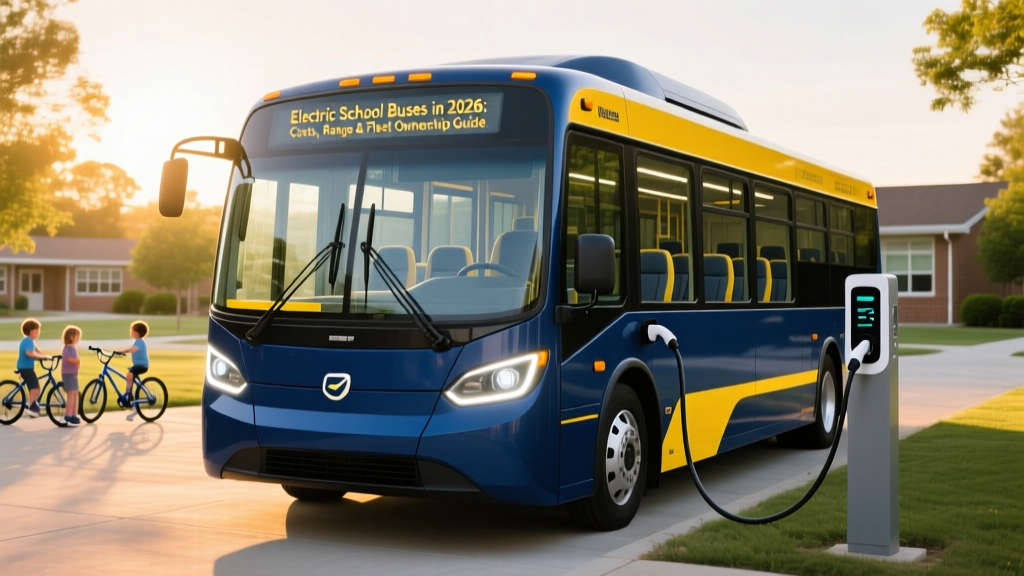
Quick Answer: Electric school buses carry a steep upfront premium—typically $250,000 to $350,000 per unit versus $110,000 to $130,000 for a new diesel Type C bus—but districts that can secure EPA Clean School Bus Program grants or state-level incentives often break even within 5 to 8 years thanks to dramatically lower fuel and maintenance costs. For a typical 60-mile daily route, expect real-world range of 100 to 140 miles on a full charge (from batteries in the 127–226 kWh range), overnight Level 2 charging in 4 to 8 hours, and annual operating savings of $5,000 to $10,000 per bus compared to diesel. The decision hinges on route length, depot charging access, local incentive availability, and climate.
The Case for Electric School Buses: What Districts Need to Decide
School districts face a specific calculus that passenger EV buyers don't: they operate fixed routes with predictable mileage, return to a central depot every night, and answer to taxpayers who scrutinize every dollar. Electric school buses fit this operational pattern remarkably well—most U.S. school bus routes run 50 to 80 miles per day, well within the real-world range of modern battery-electric platforms. But the purchase decision isn't as simple as comparing sticker prices.
The core question every fleet manager or school board member needs answered: Can we charge at the depot, do our routes fit the range, and do available incentives close the upfront cost gap enough to justify the transition?
As of 2026, the major players in the North American electric school bus market include Blue Bird (VisionE and All American RE Electric), Thomas Built Buses (Saf-T-Liner C2 Jouley), and Lion Electric (LionC). Each has moved past early-adopter growing pains into more mature production, though supply chains and dealer support still vary regionally.
Specs That Matter: Range, Battery, and Charging for Real Routes
Forget the marketing brochures—here are the numbers that determine whether an electric school bus can actually complete your routes on a single charge, especially in January in Minnesota or July in Phoenix.
| Specification | Blue Bird VisionE (2026) | Thomas C2 Jouley (2026) | Lion Electric LionC (2026) |
|---|---|---|---|
| Battery Capacity (usable) | ~150 kWh (LFP) | ~226 kWh (NMC) | ~130–169 kWh (NMC) |
| EPA Estimated Range | ~150 miles | ~135–150 miles | ~100–130 miles |
| Real-World Range (mixed) | ~110–130 miles | ~100–130 miles | ~80–110 miles |
| Cold-Weather Range (20°F) | ~80–100 miles | ~75–100 miles | ~60–85 miles |
| Max DC Fast Charge Rate | ~60–80 kW | ~60–80 kW | ~50–60 kW |
| Level 2 Charge Rate (AC) | 19.2 kW | 19.2 kW | 19.2 kW |
| Full Charge Time (L2, 19.2 kW) | ~8 hours | ~10–12 hours | ~7–9 hours |
| DC Fast 10–80% (est.) | ~90–120 min | ~120–150 min | ~80–110 min |
| GVWR | ~33,000 lbs | ~33,000 lbs | ~33,000 lbs |
| Passenger Capacity | Up to 72 | Up to 81 | Up to 72 |
| Base Price (approx.) | ~$280,000–$310,000 | ~$300,000–$340,000 | ~$250,000–$290,000 |
| Battery Warranty | 10 yr / unlimited mi | 10 yr / unlimited mi | 10 yr / unlimited mi |
Real-World Range Reality: EPA range figures for school buses are tested under controlled conditions. In practice, a heavily loaded bus running stop-and-go routes with frequent door openings, heater or A/C running, and hilly terrain will consume 2.0 to 3.0 kWh per mile. That means a 150 kWh usable battery yields roughly 50–75 miles under heavy-load, cold-weather conditions. Districts with routes exceeding 80 miles or operating in extreme climates should spec the largest available battery or plan mid-day opportunity charging.
Electric vs. Diesel School Bus: Total Cost of Ownership
The upfront cost gap is real and substantial. But school buses are typically kept for 12 to 15 years and rack up 12,000 to 15,000 miles annually. Over that lifespan, the operating economics shift dramatically.
| Cost Category (Annual) | Diesel Bus | Electric Bus | Annual Savings (EV) |
|---|---|---|---|
| Fuel / Electricity | $6,000–$9,000 (diesel at ~$3.80/gal, 6 mpg) | $1,500–$3,000 (at $0.12–$0.18/kWh) | $3,500–$6,500 |
| Maintenance (oil, filters, DPF, DEF, brakes) | $3,000–$5,000 | $800–$1,500 | $2,000–$3,800 |
| Insurance | $2,500–$3,500 | $2,800–$4,000 | –$200 to –$500 |
| Total Annual Operating Cost | $11,500–$17,500 | $5,100–$8,500 | $5,300–$10,000 |
Over a 12-year service life, cumulative operating savings of $63,000 to $120,000 per bus are achievable. That still leaves a significant gap against the $140,000 to $220,000 purchase premium—unless grant funding is stacked on top.
The Incentive Stack That Makes the Math Work
Federal and state programs have been the primary bridge for early-adopting districts:
- EPA Clean School Bus Program: Funded through the Bipartisan Infrastructure Law, this program has distributed billions in rebates since 2022, with awards of up to $345,000 per electric bus for qualifying high-needs districts. Check current-year availability at epa.gov/cleanschoolbus.
- State-Level Vouchers: States like California (HVIP), New York (NYTVIP), and Colorado offer additional vouchers of $50,000 to $175,000 per bus, stackable with federal funds in some cases.
- Utility Make-Ready Programs: Many electric utilities cover or subsidize the infrastructure costs—transformers, conduit, switchgear—for depot charging, which can run $50,000 to $200,000+ per site.
- IRS §45W Clean Vehicle Credit: Commercial fleet vehicles may qualify for up to $40,000 per vehicle under the IRS commercial clean vehicle credit, subject to battery sourcing requirements. Consult a tax professional for eligibility.
When a district receives a $285,000 EPA rebate plus a $100,000 state voucher, the net cost of a $310,000 electric bus drops below that of a diesel equivalent—and the operating savings become pure benefit.
Depot Charging: The Infrastructure Hurdle Nobody Talks About
Here's what most electric school bus guides gloss over: the bus is the easy part. The charging infrastructure is where projects stall, budgets balloon, and timelines slip by 12 to 18 months.
A fleet of 10 electric school buses charging simultaneously at 19.2 kW each requires approximately 192 kW of continuous electrical load—equivalent to the demand of a small shopping center. Most school bus depots were built with 200-amp or 400-amp residential-grade service, nowhere near adequate.
| Infrastructure Component | Estimated Cost (10-Bus Depot) | Timeline |
|---|---|---|
| Utility service upgrade (new transformer, feeder) | $50,000–$150,000 | 6–18 months |
| Switchgear and panel upgrades | $30,000–$80,000 | 3–6 months |
| Level 2 chargers (10 × 19.2 kW units) | $40,000–$70,000 | 2–4 months |
| Trenching, conduit, wiring | $25,000–$60,000 | 2–4 months |
| Permitting and engineering | $15,000–$40,000 | 2–6 months |
| Total Estimated Range | $160,000–$400,000 | 8–18 months |
Key insight: Contact your utility on day one of the planning process. Utility interconnection studies and transformer procurement can add 12+ months. Districts that ordered buses before securing charging infrastructure have had buses sitting idle for months—a mistake you don't want to repeat.
Some districts have explored DC fast charging at 60–80 kW to enable mid-day top-ups for longer routes. While this adds flexibility, it requires even heavier electrical infrastructure (a single 80 kW DC charger pulls roughly the same power as four Level 2 units) and the chargers themselves cost $40,000 to $80,000 each.
Vehicle-to-Grid (V2G): The Revenue Opportunity
Electric school buses sit parked and plugged in for roughly 18 hours a day and all summer long. That makes them ideal candidates for vehicle-to-grid (V2G) technology, where the bus battery discharges power back to the grid during peak demand periods, generating revenue for the district.
Blue Bird and Lion Electric offer V2G-capable models, and utilities in states like California, New York, and Massachusetts have piloted V2G programs paying $500 to $2,000 per bus per month for grid services. A fleet of 10 buses could theoretically generate $60,000 to $240,000 annually in V2G revenue—though real-world programs are still nascent and compensation structures vary widely.
The trade-off: V2G cycling adds battery wear. Manufacturers typically warrant batteries for 10 years, but V2G use may affect warranty terms. Districts should negotiate V2G-specific warranty language before committing.
Common Misconceptions About Electric School Buses
| Myth | Fact |
|---|---|
| "Electric buses can't handle cold weather." | Range drops 25–40% in sub-freezing temps. Districts in cold climates spec larger batteries, use electric block heaters, and pre-condition buses while plugged in. Routes under 60 miles remain viable in most U.S. climates. |
| "The batteries will need replacing at huge cost." | LFP and NMC packs in current models are warrantied for 10 years with capacity retention thresholds of 70–80%. Replacement cost runs $40,000–$80,000, but most packs are lasting well beyond warranty based on field data from early deployments. |
| "Charging takes too long for school schedules." | Overnight depot charging at 19.2 kW fully replenishes a 150 kWh pack in ~8 hours—plenty of time between afternoon return and morning departure. Mid-day charging is only needed for routes exceeding battery range. |
| "Electric buses are less safe than diesel." | Electric school buses undergo the same FMVSS crash testing. Battery packs are mounted low (improving rollover stability) and encased in reinforced housings. The absence of diesel fuel eliminates a flammable-liquid risk. |
| "The grid can't handle a whole fleet charging." | Managed charging software staggers charge times across the fleet, reducing peak demand. Most depot charging happens between 8 PM and 5 AM when grid load is lowest and electricity rates are cheapest. |
Decision Framework: Is an Electric School Bus Right for Your District?
Choose Electric If:
- Your average daily routes are under 80 miles (or under 60 miles in cold climates)
- You have a central depot where buses park overnight
- Your utility offers make-ready infrastructure support or favorable commercial EV rates
- You qualify for EPA Clean School Bus funding or state incentive programs
- You plan to keep buses 10+ years (maximizing operating savings)
- You want to eliminate diesel exhaust exposure for children—a documented health benefit supported by EPA research
Stick With Diesel (or Wait) If:
- Your routes regularly exceed 100 miles per day with no mid-day charging opportunity
- You operate in extreme cold (below 0°F regularly) with long rural routes
- Your depot has no feasible path to electrical service upgrades within your timeline
- No grant funding is available and your budget can't absorb the $150K+ premium
- You replace buses every 5–7 years (insufficient time to recoup the upfront premium through operating savings)
First-Time EV Fleet Buyer Checklist
- Audit your routes. GPS-log every bus for 30 days. Record daily mileage, elevation changes, and idle time. This data determines battery sizing.
- Call your utility. Ask specifically about commercial EV charging rates, demand charges, make-ready programs, and interconnection timelines. Get a written service upgrade estimate.
- Apply for grants before ordering buses. EPA Clean School Bus rebate rounds open and close on specific dates. State voucher programs have their own cycles. Align your procurement timeline to funding availability.
- Specify charging management software. Fleet charging platforms (e.g., Thundergrid, EV Connect) optimize charge scheduling to minimize demand charges and ensure every bus is ready by morning.
- Budget for training. Maintenance staff need high-voltage safety certification. Drivers need regenerative braking familiarization. Plan 40–80 hours of training per department.
- Negotiate battery warranty terms. Clarify capacity retention thresholds, V2G impact, and who pays for diagnostic labor during warranty claims.
Frequently Asked Questions
What is the real-world range of an electric school bus?
Under typical mixed-load conditions with moderate climate control, expect 100 to 130 miles from a 150 kWh battery. In extreme cold (below 25°F), plan for 60 to 100 miles. In hot climates with heavy A/C use, expect a 10–20% reduction. Always spec battery capacity 30–40% above your longest route to account for degradation and weather.
How long does it take to charge an electric school bus?
At a 19.2 kW Level 2 depot charger, a 150 kWh battery charges from empty to full in approximately 8 hours. A 226 kWh pack takes 10–12 hours. DC fast charging at 60–80 kW can add 50–80 miles of range in 30–45 minutes but is more expensive to install and isn't necessary for most overnight depot-charging scenarios.
What does an electric school bus cost compared to diesel?
Electric school buses cost approximately $250,000 to $350,000 depending on configuration and battery size, compared to $110,000 to $130,000 for a comparable diesel Type C bus. The $140,000 to $220,000 premium can be offset by federal and state grants, and annual operating savings of $5,000 to $10,000 per bus recoup remaining costs over 5–12 years.
Do electric school bus batteries need to be replaced?
Current-generation LFP and NMC battery packs are designed for 10–15 years of service with 70–80% capacity retention. Real-world data from early adopters (buses in service since 2020–2021) shows degradation rates of roughly 2–3% per year under normal cycling. If replacement is needed after warranty, expect $40,000 to $80,000 depending on pack size and chemistry.
Can electric school buses operate in cold climates?
Yes, but with range penalties of 25–40% in sub-freezing temperatures. Districts in northern states successfully operate electric buses by specifying larger battery packs, using electric pre-conditioning while plugged in, and routing shorter winter schedules where necessary. Battery thermal management systems in current models actively heat the pack during charging to maintain efficiency.
Are there federal tax credits for electric school buses?
The IRS §45W Clean Commercial Vehicle Credit provides up to $40,000 per qualifying electric school bus for tax-exempt entities (including public school districts) as a direct payment. Eligibility depends on battery component and critical mineral sourcing requirements that tighten annually. Consult the IRS commercial clean vehicle credit page and a tax professional for current-year rules.