The Short Answer on Electric School Buses
Electric school buses carry a premium upfront — typically $250,000 to $350,000 per unit versus $90,000 to $120,000 for a comparable diesel Type C bus — but deliver $6,000 to $11,000 in annual fuel and maintenance savings per vehicle. With EPA-estimated ranges of 120 to 210 miles depending on the model and battery size, modern electric school buses cover the vast majority of U.S. school routes (average daily run: 60–80 miles) with margin to spare. Federal incentives through the EPA's Clean School Bus Program and available state grants can offset $100,000 to $285,000 of the purchase price, bringing effective cost parity with diesel within 3–6 years for most fleets.
Why Districts Are Switching: The 2026 Landscape
As of the 2025–2026 school year, over 2,400 electric school buses have been funded or deployed across the United States, according to EPA Clean School Bus Program data. The shift is driven by three converging factors: tightening EPA emissions standards for medium- and heavy-duty vehicles, declining lithium-ion battery pack costs (now averaging roughly $115/kWh at the cell level), and growing evidence from early-adopter districts that electric buses deliver reliable daily service with dramatically lower operating costs.
The three dominant manufacturers in the U.S. electric school bus market are Blue Bird Corporation (Vision and All American BEV), Thomas Built Buses (Saf-T-Liner C2 Jouley), and Lion Electric (LionC). Each offers a Type C or Type D battery-electric model with battery capacities ranging from 126 kWh to 210 kWh and DC fast-charging capability up to 150 kW.
Specs That Matter: Range, Battery, and Charging
Unlike consumer EVs, school buses operate on predictable, short routes with overnight depot charging — a usage pattern that plays to battery-electric strengths. Here's how the leading 2026 models stack up:
| Specification | Blue Bird Vision BEV | Thomas C2 Jouley | Lion Electric LionC |
|---|---|---|---|
| Battery Capacity | 150 kWh (LFP) | 210 kWh (NMC) | 126–168 kWh (LFP/NMC) |
| EPA-Estimated Range | ~150 miles | ~210 miles | ~120–175 miles |
| Real-World Range (mixed route) | ~110–130 miles | ~160–185 miles | ~90–145 miles |
| DC Fast Charge (peak kW) | 150 kW (CCS1) | 150 kW (CCS1) | 150 kW (CCS1) |
| 10–80% DC Charge Time | ~60–75 min | ~90–105 min | ~50–70 min |
| Level 2 AC Charge Rate | 19.2 kW | 19.2 kW | 19.2 kW |
| Overnight L2 Charge (0–100%) | ~8 hours | ~11 hours | ~6.5–9 hours |
| GVWR | 33,000 lbs | 33,000 lbs | 33,000 lbs |
| Passenger Capacity | Up to 83 | Up to 81 | Up to 83 |
| Base MSRP (approx.) | $290,000–$320,000 | $310,000–$350,000 | $250,000–$290,000 |
| Battery Warranty | 10 yr / unlimited mi | 10 yr / unlimited mi | 10 yr / unlimited mi |
Real-World Range vs. EPA Estimates
School bus EPA range figures assume a standardized duty cycle. In real-world operation, expect 15–25% range reduction from the sticker number due to frequent stop-and-go driving, passenger load (up to 83 students), HVAC usage (especially cabin heating in cold climates), and route topography. A Blue Bird Vision BEV rated at 150 miles EPA will typically deliver 110–130 usable miles on a mixed suburban route. In sub-freezing winter conditions, add another 10–15% loss for battery thermal management and electric cabin heat — bringing effective range down to roughly 95–115 miles. For districts with routes exceeding 100 miles daily, mid-day opportunity charging or the higher-capacity Thomas Jouley platform should be part of the deployment plan.
Cost Breakdown: Purchase, Charging, Maintenance, and Total Ownership
The upfront price gap between electric and diesel school buses is real and significant. But school transportation is a high-utilization, long-hold application — most buses run 12–15 years and accumulate 150,000–200,000 miles. Over that lifespan, operating cost advantages compound.
| Cost Category | Electric Bus | Diesel Bus | 5-Year Difference |
|---|---|---|---|
| Purchase Price (base) | $300,000 | $105,000 | +$195,000 (EV) |
| Federal/State Incentives Applied | −$175,000 | $0 | −$175,000 (EV) |
| Net Effective Purchase | $125,000 | $105,000 | +$20,000 (EV) |
| Fuel/Energy (5 yrs, 12K mi/yr) | $12,500 | $42,000 | −$29,500 (EV saves) |
| Maintenance (5 yrs) | $8,000 | $22,000 | −$14,000 (EV saves) |
| Charging Infrastructure (share per bus) | $15,000 | $0 | +$15,000 (EV) |
| Insurance (5 yrs) | $18,000 | $15,000 | +$3,000 (EV) |
| 5-Year Net TCO | $178,500 | $184,000 | −$5,500 (EV saves) |
Key assumptions: electricity at $0.12/kWh average commercial rate (varies significantly by utility and time-of-use schedule); diesel at $3.80/gallon; fuel economy of 6 mpg for diesel; energy consumption of 2.1 kWh/mile for electric; 12,000 miles driven annually. Districts with access to off-peak utility rates or solar-covered depots can push energy costs well below $0.08/kWh, widening the savings gap further.
The $15,000 per-bus charging infrastructure allocation covers a depot-installed Level 2 charger (19.2 kW, ~$4,000–$7,000 for hardware) plus electrical panel upgrades, conduit runs, and permitting. For DC fast-charging depots, add $40,000–$80,000 per charger unit — justified only for high-utilization or mid-day top-up scenarios.
Electric vs. Diesel vs. Propane: How Do They Compare?
| Metric | Battery Electric | Diesel | Propane Autogas |
|---|---|---|---|
| Purchase Price | $250K–$350K | $90K–$120K | $100K–$130K |
| Fuel Cost per Mile | $0.25–$0.35 | $0.60–$0.75 | $0.35–$0.45 |
| Maintenance Cost per Mile | $0.10–$0.15 | $0.30–$0.40 | $0.25–$0.35 |
| Tailpipe Emissions | Zero | NOx, PM, CO₂ | Lower NOx/PM than diesel |
| Cold-Weather Range Impact | −15% to −30% | Minimal | Minimal |
| Refueling/Recharge Time | 6–11 hrs (L2) / 1–2 hrs (DC) | 10–15 min | 10–15 min |
| Typical Daily Range Needed | 60–100 mi (covers ~85% of routes) | Unlimited | Unlimited |
| Vehicle-to-Grid (V2G) Revenue | Potential $1,000–$4,000/yr | None | None |
Propane autogas sits between diesel and electric on both cost and emissions. It's a viable bridge fuel for districts with very long routes or extreme cold climates where electric range loss is unacceptable. However, propane still produces tailpipe NOx and particulate matter near school loading zones — a health consideration that electric buses eliminate entirely.
Charging Infrastructure: What Districts Need to Plan
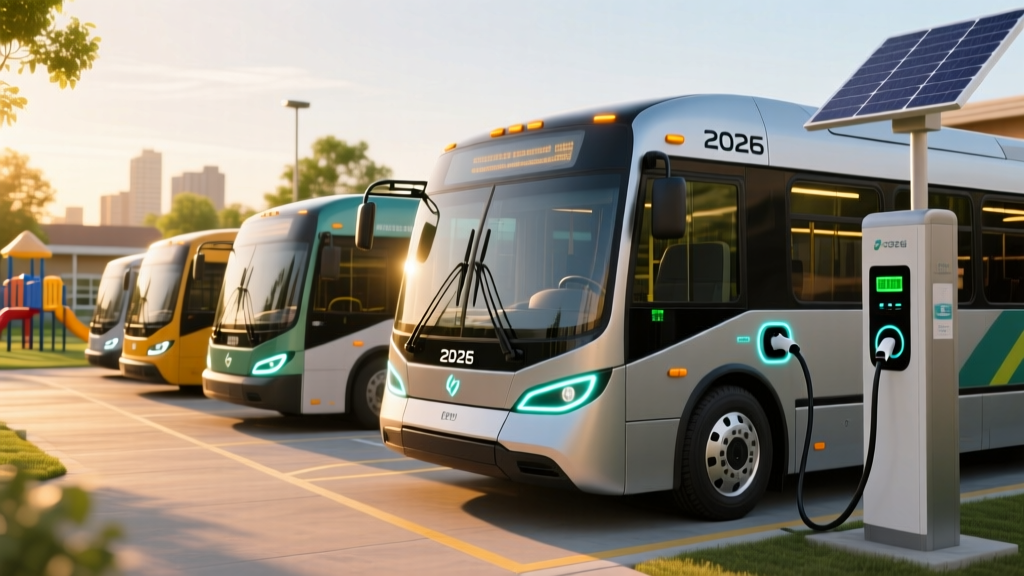
Depot charging is the backbone of electric school bus operations. Most districts charge overnight at the bus yard using Level 2 (19.2 kW) chargers, one per bus or shared between two buses on staggered schedules. Here's what a typical 10-bus depot electrification looks like:
- Electrical service upgrade: Many bus depots need a new 480V three-phase service or transformer upgrade. Cost: $20,000–$80,000 depending on existing capacity and utility interconnection requirements.
- Charger hardware: 10 Level 2 pedestals at $4,000–$7,000 each = $40,000–$70,000.
- Installation (conduit, wiring, panels, permits): $50,000–$120,000 for a 10-bus site.
- Smart charging software: Fleet management platforms (e.g., Highland Electric Fleets, Zum) optimize charge timing to hit off-peak utility rates. Software licensing: $1,000–$3,000/year per site.
- Total depot electrification cost (10 buses): $110,000–$270,000, or roughly $11,000–$27,000 per bus.
Utility partnerships are critical. Many investor-owned utilities now offer make-ready programs that cover the infrastructure costs on the utility side of the meter, and some offer time-of-use tariffs specifically designed for fleet charging that push off-peak rates to $0.06–$0.09/kWh. Contact your utility's commercial EV programs team early in the planning process — lead times for transformer upgrades can run 6–12 months.
Incentives and Funding: Federal, State, and Utility Programs
The single largest funding source for electric school buses is the EPA Clean School Bus Program, funded by the Bipartisan Infrastructure Law. Through 2026, the program has allocated roughly $5 billion in rebates for zero-emission and low-emission school buses, with awards of up to $285,000 per zero-emission bus for qualifying high-need, rural, and tribal school districts. Standard districts can receive up to $100,000–$150,000 per bus depending on the funding round.
- EPA Clean School Bus Rebates: $100,000–$285,000 per bus (competitive, round-based)
- State programs: Vary widely — California's HVIP offers up to $120,000 per bus; New York's truck voucher program offers up to $185,000; many states have smaller or no dedicated programs
- Utility make-ready programs: Cover infrastructure costs ($10,000–$50,000+ per site)
- VW Settlement funds: Some states still have remaining Environmental Mitigation Trust funds applicable to school bus electrification
- Federal tax credits: The commercial clean vehicle credit (IRS §45W) provides up to $40,000 for qualifying electric vehicles over 14,000 lbs GVWR — applicable to school buses purchased by taxable entities (private schools, contractors)
Important caveat: IRS §45W (not §30D, which applies to consumer vehicles) has its own MSRP, sourcing, and entity eligibility rules. School districts as tax-exempt entities may access credits through direct pay (elective pay) provisions under the Inflation Reduction Act, receiving the credit as a direct payment from the IRS. Consult a municipal finance advisor for eligibility specifics.
Common Misconceptions — Addressed with Data
| Myth | Fact |
|---|---|
| "Electric buses can't handle cold weather." | Range drops 15–30% in sub-freezing temps, but most routes are short enough to absorb this loss. Districts in Minnesota, Massachusetts, and New York operate electric buses year-round. Preconditioning and battery thermal management mitigate the impact. |
| "Batteries will need replacing every few years at huge cost." | Modern LFP and NMC bus batteries are warrantied for 10 years with guaranteed 70–80% capacity retention. Real-world degradation data from early deployments shows ~2–3% annual loss. A battery replacement at year 12–15 runs $40,000–$65,000 — significant, but offset by years of fuel savings. |
| "The grid can't handle a depot full of electric buses." | A 10-bus depot charging at 19.2 kW each draws ~192 kW total — roughly equivalent to a small commercial building. With smart charging software staggering start times and targeting off-peak hours, most utility circuits handle this without major upgrades. |
| "Electric buses are slower and less powerful." | Electric drivetrains deliver peak torque from 0 RPM, giving electric buses stronger acceleration and hill-climbing than comparable diesels. The LionC produces 335 HP and 2,100 lb-ft of torque at the wheels. |
| "Charging takes too long for school schedules." | Overnight Level 2 charging (6–11 hours) fully replenishes the battery during off-service hours. For split-shift or mid-day routes, DC fast charging adds ~80 miles of range in 30 minutes. |
Decision Framework: Is an Electric School Bus Right for Your District?
Choose Electric If:
- Your average daily routes are under 100 miles per bus (covers approximately 85% of U.S. school bus routes)
- You have a centralized depot where buses park overnight and electrical service can support Level 2 charging
- Your district qualifies for EPA Clean School Bus rebates or state incentive programs that close the purchase-price gap
- You operate in an area with moderate or warm winters, or you're willing to spec higher-capacity batteries and plan for cold-weather range loss
- You want to eliminate diesel exhaust exposure at school loading zones and along routes — a documented respiratory health benefit for students
- Your utility offers favorable commercial EV rates or make-ready infrastructure programs
Stick with Diesel or Consider Propane If:
- Your routes regularly exceed 130+ miles per day (activity buses, long rural routes, field trips)
- You operate in extreme cold climates (consistently below −10°F) and cannot accommodate mid-day charging
- Your district does not qualify for meaningful federal or state incentives, making the effective purchase price gap too large for your budget cycle
- You lack depot property or the ability to install charging infrastructure (street-parked or dispersed bus storage)
- Your fleet turnover cycle is under 8 years, limiting the time horizon to recoup operating savings
Frequently Asked Questions
How long does an electric school bus battery last?
Current-generation electric school bus batteries (LFP and NMC chemistries) are warrantied for 10 years with capacity retention guarantees of 70–80%. Real-world data from fleets deployed in 2019–2021 shows annual degradation of roughly 2–3%. Expect usable battery life of 12–15 years before capacity drops below 70%, at which point the bus still functions but with reduced range. Full battery replacement costs $40,000–$65,000 depending on capacity and chemistry.
Can electric school buses do field trips and long extracurricular routes?
With real-world ranges of 90–185 miles (depending on model and conditions), electric buses can handle many field trips — but not all. A 150-mile round-trip to a competition venue is feasible with a Blue Bird Vision BEV or Thomas Jouley in mild weather, but tight in cold conditions. Most districts that operate electric buses keep a small number of diesel or propane reserves for long-range needs, or plan mid-trip DC fast-charging stops.
What about vehicle-to-grid (V2G) revenue?
V2G technology allows parked electric school buses to discharge power back to the grid during peak demand events, earning revenue for the district. Pilot programs with utilities in California, New York, and Massachusetts have demonstrated $1,000–$4,000 per bus per year in V2G revenue. However, V2G requires bidirectional-capable chargers ($15,000–$30,000 each), utility interconnection agreements, and fleet management software. It's a promising revenue stream but not yet widely available or standardized. Factor it as upside potential, not a budget assumption.
Are electric school buses safe?
Electric school buses meet or exceed all NHTSA Federal Motor Vehicle Safety Standards applicable to school buses, including crashworthiness, rollover protection, and emergency egress. Battery packs are mounted in reinforced enclosures and undergo thermal runaway testing. No electric school bus battery fire has been reported in U.S. service as of early 2026. The high-voltage system automatically de-energizes in a collision.
What's the charging connector standard for electric school buses?
All major U.S. electric school bus models use the CCS1 (Combined Charging System) connector for DC fast charging and a J1772 inlet for Level 2 AC charging. This is the standard for all commercial EVs in North America and is compatible with chargers from ChargePoint, EVgo, Blink, and other commercial providers. Tesla's NACS connector is not used in the school bus segment.
How does driver training differ for electric school buses?
Electric buses drive differently than diesels: they're significantly quieter (a pedestrian safety consideration at stops), deliver instant torque (smoother acceleration but requires a lighter foot), and feature regenerative braking that slows the bus when the accelerator is released. Most manufacturers provide 1–2 days of driver and maintenance training as part of the purchase. Drivers typically adapt within the first week and overwhelmingly prefer the electric drivetrain's smoothness and reduced noise and vibration.