The Short Answer
The core electric school bus transition challenges in 2026 come down to three hard numbers: a Type C electric school bus costs roughly $250,000–$390,000 upfront versus $90,000–$120,000 for a diesel equivalent; real-world range sits at 75–150 miles depending on climate and terrain (against an EPA-rated 100–175 miles); and depot charging infrastructure demands $50,000–$150,000+ per site in electrical upgrades, chargers, and installation. Districts that run fixed urban/suburban routes under 100 miles with overnight depot access see payback in 6–10 years via fuel and maintenance savings. Rural, cold-climate, or long-route districts face a much harder math problem.
Why School Districts Are Going Electric (and Why It's Harder Than It Looks)
The push toward electric school buses is driven by three forces: EPA Clean School Bus Program funding (which has distributed billions since 2022), state-level zero-emission mandates in places like California, New York, and Maryland, and the promise of lower operating costs over a 12–15 year bus lifecycle. The health case is compelling — diesel exhaust exposure is linked to respiratory illness in children, and a 2024 EPA Clean School Bus Program report estimated each replaced diesel bus yields $49,000–$243,000 in monetized health benefits.
But fleet electrification is not the same as buying a personal EV. A district isn't choosing one car — it's reengineering its entire transportation operation: routing, charging logistics, electrical grid capacity, driver training, maintenance staffing, and capital budgeting. The transition challenges are systemic, not just vehicular.
The Big Three Electric School Bus Manufacturers: 2026 Specs
Three manufacturers dominate the U.S. Type C (conventional-style) electric school bus market. Here's how their current flagship models compare on the specs that matter to fleet managers:
| Spec | Blue Bird Vision Electric | Thomas Built Saf-T-Liner C2 Jouley | IC Bus CE Series Electric |
|---|---|---|---|
| Battery Capacity (usable) | 155 kWh (LFP) | 226 kWh (NMC) | 210 kWh (NMC) |
| EPA-Estimated Range | ~150 mi | ~135 mi | ~130 mi |
| Real-World Range (cold/hwy) | ~90–115 mi | ~80–100 mi | ~75–95 mi |
| DC Fast Charge (peak kW) | 60 kW (CCS1) | 60 kW (CCS1) | 60 kW (CCS1) |
| Charge Time 0–100% (Level 2, 19.2 kW) | ~8 hours | ~12 hours | ~11 hours |
| DC Fast 10–80% (est.) | ~90 min | ~120 min | ~110 min |
| Motor Output | ~250 kW (335 hp) | ~200 kW (268 hp) | ~200 kW (268 hp) |
| GVWR | 33,000 lbs | 33,000 lbs | 33,000 lbs |
| Seating Capacity | 72–84 | 72–81 | 72–84 |
| Base MSRP (approx.) | $290,000–$340,000 | $300,000–$370,000 | $280,000–$350,000 |
| Battery Warranty | 10 yr / unlimited mi | 10 yr / 150,000 mi | 10 yr / 150,000 mi |
Key takeaway: Battery chemistry matters here. Blue Bird's shift to LFP (lithium iron phosphate) cells trades some energy density for better cycle life, safer thermal behavior, and more tolerance for daily 100% charging — exactly what a depot-charged fleet vehicle needs. NMC packs in the Jouley and CE Series offer more range per kWh but degrade faster when consistently charged to full.
Range Reality: Why EPA Numbers Mislead Fleet Planners
A 135-mile EPA range sounds adequate for most school routes — the National Association of State Directors of Pupil Transportation Services estimates the average U.S. school bus route covers 60–90 miles per day. But EPA test cycles don't replicate January in Minnesota with the heater running, a full load of 72 students, and hilly terrain.
Real-World Range Expectations for Electric School Buses
EPA sticker: 130–175 miles depending on model
Mild climate, suburban flat route, half load: ~110–140 miles
Hot climate, A/C running, full load: ~95–120 miles
Cold climate (below 32°F), heater, full load, hills: ~65–90 miles
Cold climate + highway-speed segments (55+ mph): ~55–75 miles
Cold weather is the single biggest range killer. Electric school buses, unlike passenger EVs, must heat a 40-foot cabin with minimal aerodynamic advantage, and they can't rely on waste heat from an internal combustion engine. Some newer models include heat pumps, which cut heating energy consumption by roughly 30–40% compared to resistive heaters, but the range penalty in sub-freezing weather remains 25–45%.
For districts planning fleet sizes, the rule of thumb is: design routes around your worst-day range, not your best-day range. If a bus can only do 70 miles on a cold January day, that's the number your route map must accommodate.
The Infrastructure Problem: Depot Charging Is Not Plug-and-Play
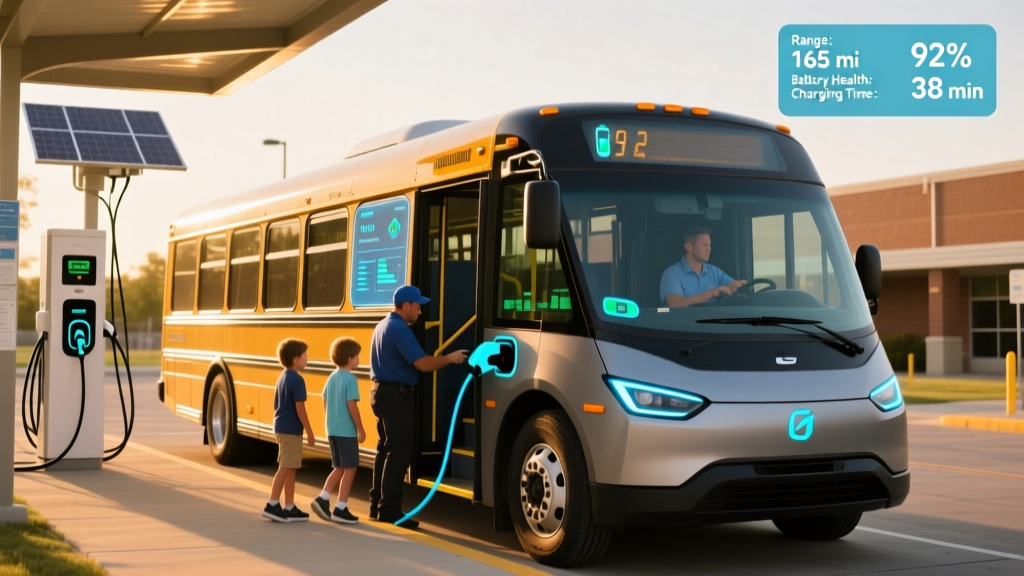
This is where most districts hit their first wall. Charging 10, 20, or 50 school buses overnight at a single depot requires electrical infrastructure that most school bus yards were never designed to support.
| Component | Low Estimate | High Estimate | Notes |
|---|---|---|---|
| Level 2 chargers (19.2 kW each, 10 units) | $40,000 | $80,000 | $4,000–$8,000 per unit, commercial-grade |
| DC fast chargers (60 kW, 2 units) | $60,000 | $120,000 | Optional but critical for mid-day top-ups |
| Electrical panel & transformer upgrade | $30,000 | $150,000 | Depends on existing service; may need utility-side work |
| Trenching, conduit, wiring | $15,000 | $60,000 | Distance from panel to chargers drives cost |
| Permits, engineering, utility interconnection | $10,000 | $40,000 | Utility lead times can be 6–18 months |
| Charge management software | $3,000/yr | $12,000/yr | Smart scheduling to avoid demand charges |
| Total (10-bus depot) | $158,000 | $462,000 | Before any utility rebates or grants |
The single biggest hidden cost is the utility interconnection timeline and demand charge. Many school districts discover that their local utility needs 12–18 months to upgrade the transformer serving the bus depot, and that commercial electricity rates include demand charges based on peak kW draw. Charging 10 buses simultaneously at 19.2 kW each means a 192 kW peak — which can trigger demand charges of $10–$25/kW/month in some utility territories, adding $2,000–$4,800/month just in demand fees.
Smart charge management software that staggers charging sessions and avoids peak demand windows is not optional — it's essential for cost control.
Total Cost of Ownership: Electric vs. Diesel School Bus
The purchase price gap is stark, but fleet decisions should be made on total cost of ownership (TCO) over the bus's 12–15 year service life. Here's a realistic 12-year comparison for a single Type C bus running 90 miles/day, 180 school days/year:
| Cost Category | Electric Bus | Diesel Bus |
|---|---|---|
| Purchase price (base) | $320,000 | $105,000 |
| Federal/state grant offset (est.) | −$150,000 | $0 |
| Net acquisition cost | $170,000 | $105,000 |
| Depot charging infrastructure (share per bus) | $25,000 | $0 |
| Fuel/energy (12 years, 16,200 mi/yr) | $28,000 | $72,000 |
| Maintenance (12 years) | $22,000 | $65,000 |
| Battery replacement (year 12, if needed) | $45,000–$75,000 | N/A (engine rebuild ~$15,000) |
| Insurance (12 years) | $36,000 | $30,000 |
| Total 12-Year TCO (no grants) | $496,000–$526,000 | $272,000 |
| Total 12-Year TCO (with $150K grant) | $346,000–$376,000 | $272,000 |
The math: Without grants, the electric bus costs roughly $225,000–$255,000 more over 12 years. With a $150,000 grant (achievable through EPA Clean School Bus or state programs), the gap narrows to $75,000–$105,000 — and in districts with high diesel prices, aggressive utility rates, or additional state incentives, breakeven can arrive within the bus's service life. Districts paying $4+/gallon diesel and $0.08/kWh electricity see the fastest payback.
Energy cost detail: an electric school bus consumes roughly 2.0–2.5 kWh/mile. At $0.12/kWh (a blended commercial rate), that's $0.24–$0.30/mile. A diesel bus at 6 MPG with fuel at $3.80/gallon costs $0.63/mile. The per-mile energy savings is real — roughly 50–60% — but it takes years to offset the acquisition premium.
Common Misconceptions About Electric School Buses
| Myth | Fact |
|---|---|
| "Electric buses can't handle cold weather." | They can, but range drops 25–45% below freezing. Districts in cold climates must spec routes conservatively, add cabin pre-heating while plugged in, and consider auxiliary diesel heaters for extreme cold days. |
| "You need V2G (vehicle-to-grid) to make the economics work." | V2G revenue remains speculative in most utility territories as of 2026. Only a handful of pilots (notably in California and New York) have demonstrated meaningful revenue. Don't build your business case on it. |
| "Maintenance savings are massive." | They're real but moderate. Electric buses eliminate oil changes, DPF replacements, and transmission overhauls — saving roughly $3,000–$5,000/year. But suspension, brakes, tires, and HVAC still need service, and specialized EV technician training adds cost. |
| "The battery will need replacing at year 8." | Modern LFP packs are rated for 4,000–6,000 charge cycles before dropping below 80% capacity. At one cycle/day, 180 days/year, that's 22–33 years of cycle life. Calendar degradation is the real factor — expect 80–85% capacity at year 12. Most warranties guarantee 70–80% at year 10. |
| "EPA grants cover the full cost difference." | EPA Clean School Bus Program rebates cover up to $375,000 for priority districts (high-need, rural, tribal) and up to $200,000 for non-priority districts. But demand far exceeds funding — in recent funding rounds, only 20–30% of applicants received awards. |
Decision Framework: Is Your District Ready for Electric Buses?
Choose Electric School Buses If:
- Your longest daily route is under 90 miles (or under 70 miles in cold climates)
- You have a central depot with access to three-phase power or a utility willing to upgrade
- Your utility interconnection timeline is under 12 months
- You qualify for EPA Clean School Bus rebates or state incentive programs covering 40%+ of the purchase premium
- You operate in a state with zero-emission school bus mandates with compliance deadlines approaching
- Your electricity rates are under $0.15/kWh (blended, including demand charges)
- You can start with a pilot of 3–5 buses before committing the full fleet
Stick With Diesel (or Consider Propane/CNG) If:
- Your routes regularly exceed 120 miles/day or include long highway segments
- You operate in extreme cold (sustained below 0°F) with no mid-day charging option
- Your depot has no three-phase power and the utility quotes 18+ months for upgrades
- You have no access to grants or incentives and capital budgets are tight
- Your fleet is under 10 buses and infrastructure costs can't be spread across enough vehicles
- You run split-shift or activity routes that require the same bus for afternoon/evening runs without charging downtime
What First-Time EV Fleet Buyers Need to Know
If your district is evaluating its first electric school buses, here's the operational reality that nobody puts in the brochure:
1. Start with route analysis, not bus specs. GPS-log every route in your fleet for a full semester. Identify which routes fit within 75% of the worst-case electric range. Those are your Phase 1 candidates.
2. Engage your utility on day one. The interconnection study, transformer upgrade, and service line work can take longer than the bus procurement itself. Some districts have received buses before their chargers were energized.
3. Budget for driver and mechanic training. Regenerative braking changes driving behavior — a trained driver can recapture 15–20% more range through smooth regen use. Mechanics need high-voltage safety certification (typically a 2–4 week program), and districts that skip this step report longer downtime for simple repairs.
4. Plan for the "summer problem." School buses sit idle for 2–3 months in summer. LFP batteries tolerate storage better than NMC, but any battery left at 100% or 0% state of charge for weeks degrades faster. Districts need a storage protocol: park at 50–60% SoC and check monthly.
5. Insurance costs are higher. Commercial EV insurance premiums run 10–25% above diesel equivalents due to higher vehicle values and specialized repair requirements. Get quotes before finalizing your budget.
Funding the Transition: Federal and State Programs in 2026
The EPA Clean School Bus Program, funded through the Bipartisan Infrastructure Law, remains the primary federal funding source. As of 2026, the program offers rebates of up to $375,000 per bus for priority districts (Title I schools, rural, tribal, and low-income areas) and up to $200,000 for non-priority districts. Infrastructure funding of up to $20,000–$130,000 per bus is also available for charging equipment.
Key eligibility caveats:
- Funding is competitive — not all applicants receive awards in any given round
- Buses must be manufactured by an EPA-listed participant
- Districts must commit to scrapping or disabling the replaced diesel bus
- Federal funds may not always stack with all state incentives — check AFDC for state-specific rules
State-level programs vary enormously. California's Hybrid and Zero-Emission Truck and Bus Voucher Incentive Project (HVIP) can add $120,000–$260,000 on top of federal rebates. New York, New Jersey, and Maryland offer additional per-bus incentives tied to their zero-emission mandates. Districts in states without programs face a significantly larger out-of-pocket gap.
Frequently Asked Questions
How long does it take to charge an electric school bus?
On a 19.2 kW Level 2 charger, a fully depleted 155–226 kWh battery takes 8–12 hours — suitable for overnight depot charging. On a 60 kW DC fast charger, a 10–80% charge takes approximately 90–120 minutes. Note that kW is the charge rate (power) and kWh is the battery capacity (energy) — these are not interchangeable. A 60 kW charger does not fill a 226 kWh battery in under 4 hours because charging speed tapers significantly above 80% state of charge to protect battery health.
Can electric school buses handle rural routes?
It depends entirely on route length and terrain. Rural routes under 70 miles round-trip with moderate grades are feasible. Routes exceeding 100 miles, especially with sustained highway speeds above 50 mph and significant elevation changes, currently exceed what electric buses can reliably deliver in all weather conditions. Mid-day opportunity charging (a DC fast charger at a turnaround point) can extend range but adds infrastructure cost and scheduling complexity.
What happens if the battery fails out of warranty?
Battery replacement for a Type C electric school bus costs approximately $45,000–$75,000 in 2026, depending on chemistry and capacity. However, modern LFP and NMC packs are designed to retain 70–80% capacity at 10–12 years, and complete failure is rare. Most degradation is gradual, not catastrophic. Districts should budget for a battery reserve fund of roughly $4,000–$6,000/year per bus starting in year 8.
Are electric school buses safer than diesel buses in a crash?
Electric school buses meet the same FMVSS crashworthiness standards as diesel buses. The battery packs are mounted low in the chassis (improving rollover stability) and are housed in reinforced enclosures. Fire risk from lithium battery thermal events is extremely low in school bus applications — LFP chemistry in particular is highly resistant to thermal runaway. No U.S. school bus battery fire involving student injuries has been reported as of 2026.
How does the electric school bus transition compare to passenger EV adoption?
Fleet electrification is fundamentally harder than consumer EV adoption. A homeowner can install one Level 2 charger and buy one car. A school district must electrify dozens of vehicles simultaneously, build depot-scale charging infrastructure, retrain staff, restructure routes, and navigate public procurement rules — all while maintaining uninterrupted student transportation. The technology is proven; the operational transition is what makes it challenging.