The Quick Answer on Electric School Bus Problems
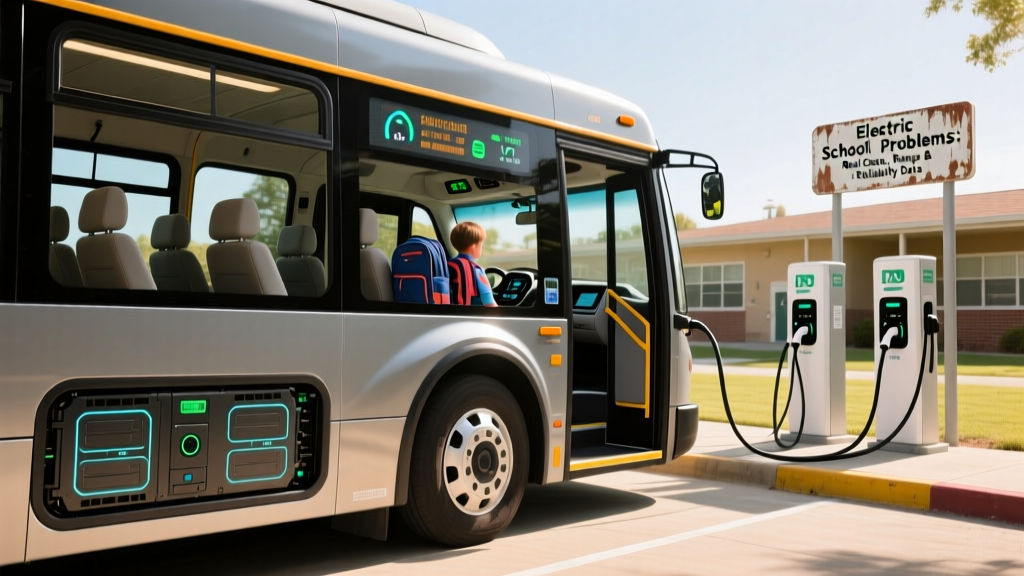
Most electric school bus problems trace back to three issues: cold-weather range loss (up to 40% below EPA estimates in sub-freezing climates), charging infrastructure delays at depots, and higher upfront acquisition costs ($250,000–$400,000 per bus vs. $90,000–$120,000 for diesel). However, districts that have solved depot charging and operate in moderate climates report 60–80% lower fuel and maintenance costs over a 12-year bus lifecycle. The core decision isn't whether electric buses work — they do — but whether your district's routes, climate, and electrical infrastructure can support them today.
What Are the Most Common Electric School Bus Problems?
Districts operating fleets from Thomas Built (Saf-T-Liner C2 Jouley), Blue Bird (Vision Electric), and Lion Electric (LionC) have reported a consistent pattern of challenges since large-scale deployments began in the early 2020s. Here are the most documented issues:
Range Shortfall in Real-World Conditions
Most current electric school buses carry battery packs between 150 kWh and 226 kWh (typically NMC lithium-ion chemistry). EPA-estimated range sits around 100–150 miles on a full charge. In practice, a loaded bus running a stop-and-go route with HVAC running will deliver 75–110 miles in moderate weather. In cold climates — think Minnesota, upstate New York, or Montana — that figure can drop to 55–80 miles due to battery chemistry limitations and cabin heating demands.
Real-World Range Reality: A Blue Bird Vision Electric with a 155 kWh battery pack rates at roughly 130 miles EPA. Expect ~100 miles on a mild-weather urban route with stops, and as low as 60–75 miles at 10°F with heat running. Plan routes conservatively with a 20% buffer.
Depot Charging Infrastructure Delays
This is consistently the #1 reported problem. Installing DC fast chargers or even Level 2 AC chargers at a bus depot requires utility upgrades, transformers, trenching, and permitting. Many districts report 12–24 month lead times between ordering buses and having functional chargers. A single 60 kW DC charger installation can cost $50,000–$150,000 depending on whether the site needs a panel upgrade or new utility service.
Battery Degradation and Replacement Costs
Like all EVs, school bus batteries degrade over time. Most manufacturers warranty their packs for 5–10 years or 100,000 miles, retaining at least 70–80% of original capacity. A full battery replacement on a 155–226 kWh pack can cost $40,000–$80,000+ out of warranty — a significant expense that districts must plan for in years 8–12 of a bus's service life.
Software and Telematics Glitches
Early-generation electric buses from several manufacturers experienced software faults affecting battery management systems, charger communication protocols, and route telematics. While firmware updates have improved reliability, some districts report downtime while waiting for manufacturer technicians to diagnose and resolve faults — a contrast to diesel buses where most local mechanics can handle common repairs.
Electric School Bus vs. Diesel: Cost Comparison
The financial case for electric school buses hinges entirely on total cost of ownership (TCO), not sticker price. Here's how the numbers break down over a typical 12-year, 150,000-mile service life:
| Cost Category | Electric Bus (155–226 kWh) | Diesel Bus |
|---|---|---|
| Purchase Price (base) | $250,000–$400,000 | $90,000–$120,000 |
| EPA Clean School Bus Rebate (2026) | Up to $375,000 (priority districts) | $0 for new diesel |
| Fuel/Energy Cost (lifetime) | $15,000–$30,000 | $60,000–$90,000 |
| Maintenance (lifetime) | $15,000–$25,000 | $40,000–$65,000 |
| Charger Installation | $50,000–$150,000 (per charger) | $0 |
| Battery Replacement (if needed) | $40,000–$80,000 | N/A |
| Estimated 12-Year TCO | $180,000–$400,000* | $190,000–$275,000 |
*Highly dependent on federal/state rebates and utility electricity rates. With full EPA Clean School Bus Program funding, electric TCO can drop well below diesel.
The EPA Clean School Bus Program has been the single largest factor making electric buses financially viable. For the 2025–2026 funding cycles, priority districts (high-need, rural, or tribal) can receive up to $375,000 per zero-emission bus plus $20,000–$130,000 for charging infrastructure. Districts that don't qualify for priority status may receive substantially less or nothing — making the math far less favorable.
Charging Speeds, Connectors, and Depot Requirements
Understanding charging logistics is essential before committing to an electric fleet. School buses typically use one of two charging approaches:
| Charging Level | Power (kW) | Typical Charge Time (10–80%) | Miles Added Per Hour | Best Use Case |
|---|---|---|---|---|
| Level 2 (AC, J1772 or NACS) | 19.2–25 kW | 6–10 hours | ~15–20 miles/hr | Overnight depot charging |
| DC Fast Charge (CCS1) | 50–60 kW | 2–3 hours | ~50–65 miles/hr | Mid-day top-up, shorter depots |
| DC Fast Charge (CCS1 high-power) | 100–150 kW | 1–1.5 hours | ~90–120 miles/hr | High-utilization fleets |
Key distinction: kW (kilowatts) measures charging power — how fast energy flows into the battery. kWh (kilowatt-hours) measures battery capacity — how much energy the battery stores. A 60 kW charger delivering power for one hour adds roughly 60 kWh of energy to the battery.
Most electric school buses use CCS1 connectors for DC fast charging and J1772 for Level 2, though newer models are beginning to adopt the NACS (Tesla-style) connector. Always confirm connector compatibility with your charging equipment vendor before purchasing.
For overnight charging — the most common strategy — a fleet of 10 buses charging at 19.2 kW each requires roughly 192 kW of continuous electrical capacity. That's a significant load that most standard commercial panels cannot support without a utility service upgrade, which can cost $100,000–$500,000+ and take 1–3 years to complete.
Real-World Ownership: What Districts Should Expect
Climate Matters More Than You Think
Electric school buses perform best in moderate climates (40–85°F). Districts in the Sun Belt report the fewest range-related problems. In northern states, battery preconditioning — warming the pack before charging and during operation — is essential but not all bus models support it equally. Cold-weather range loss of 30–40% is well-documented and must be factored into route planning.
Route Length and Topography
Buses running routes under 80 miles round-trip on relatively flat terrain have the fewest operational problems. Hilly routes, frequent stops (special-ed and Head Start routes), and routes exceeding 100 miles require careful modeling. Some districts have had to maintain a mixed fleet — electric for shorter routes, diesel or CNG for longer ones — which adds operational complexity.
Driver and Mechanic Training
Electric buses require different driving techniques to maximize regenerative braking and range. More critically, maintenance staff need high-voltage safety certification (NFPA 70E) to work on electric drivetrains. Many districts report a 6–12 month learning curve before their maintenance teams feel confident handling basic EV service tasks.
Common Misconceptions About Electric School Buses
| Myth | Fact |
|---|---|
| "Electric buses can't handle cold weather at all." | They can, but range drops 30–40%. Districts in Minnesota and New York operate them successfully with route adjustments and battery preconditioning. |
| "They'll save money immediately." | Without federal or state rebates, the higher purchase price takes 8–12 years to recoup through fuel and maintenance savings. With EPA rebates, payback can be 2–4 years. |
| "Charging is as simple as plugging in." | Depot charging requires utility coordination, electrical upgrades, load management software, and often 12–24 months of lead time. |
| "Electric buses are maintenance-free." | They eliminate oil changes, transmission service, and exhaust repairs — but still need brake, suspension, tire, HVAC, and electrical system maintenance. Battery health monitoring adds a new maintenance category. |
| "The battery will need replacing every 5 years." | Modern NMC packs are warrantied for 5–10 years with 70–80% capacity retention. Many packs last 12–15 years with manageable degradation, though capacity loss is real and should be modeled. |
Decision Framework: Is an Electric School Bus Right for Your District?
Choose an electric school bus if:
- Your routes are under 80 miles round-trip on mostly flat terrain
- You qualify for EPA Clean School Bus Program priority funding or state-level incentives
- Your depot has access to sufficient electrical capacity (or your utility can upgrade within your timeline)
- You operate in a moderate climate or can adjust routes seasonally for cold-weather range loss
- You have a 2–3 year planning horizon for charger installation and staff training
Stick with diesel, CNG, or consider a hybrid approach if:
- Your routes regularly exceed 100 miles or include steep grades
- Your utility cannot deliver sufficient power to the depot within 24 months
- You operate in extreme cold (sustained sub-0°F) without route flexibility
- You don't qualify for meaningful federal or state funding and face tight budgets
- You need buses deployed within 6 months and cannot wait for infrastructure
2026 Electric School Bus Models: Key Specs
| Specification | Blue Bird Vision Electric | Thomas Built C2 Jouley | Lion Electric LionC |
|---|---|---|---|
| Battery Capacity | 155 kWh (NMC) | 226 kWh (NMC) | 169–210 kWh (NMC) |
| EPA-Estimated Range | ~130 miles | ~150 miles | ~100–150 miles |
| DC Fast Charge (peak kW) | 60 kW (CCS1) | 60 kW (CCS1) | 50–60 kW (CCS1) |
| 10–80% Charge Time (DC) | ~2.5 hours | ~3 hours | ~2.5–3 hours |
| Level 2 Charge Rate | 19.2 kW | 19.2 kW | 19.2 kW |
| GVWR | 33,000 lbs | 33,000 lbs | 33,000 lbs |
| Seating Capacity | Up to 78 | Up to 78 | Up to 72 |
| Base Price (est. 2026) | ~$300,000–$350,000 | ~$350,000–$400,000 | ~$250,000–$320,000 |
| Battery Warranty | 10 yr / 100,000 mi | 10 yr / 100,000 mi | 5–10 yr (varies) |
Note: Pricing is estimated and varies by configuration, dealer, and order volume. Always request current quotes directly from manufacturers. Federal funding through the EPA Clean School Bus Program can offset $200,000–$375,000 for eligible districts.
Frequently Asked Questions
Do electric school buses qualify for the federal §30D EV tax credit?
No. The §30D Clean Vehicle Credit applies to light-duty vehicles under 14,000 lbs GVWR purchased by individuals. School buses fall under the Commercial Clean Vehicle Credit (§45W), which offers up to $40,000 for qualified commercial electric vehicles. However, most school districts are tax-exempt entities and cannot directly claim tax credits. Instead, districts typically rely on the EPA Clean School Bus Program rebates, state-level grants, and utility incentive programs. Consult your district's legal counsel and the IRS guidelines for specifics.
What happens if a battery fails mid-route?
Electric school buses have redundant battery management systems and will typically enter a reduced-power "limp mode" well before complete failure, allowing the driver to pull over safely. However, a stranded bus requires a flatbed tow — you cannot jump-start or roadside-repair a high-voltage traction battery. Districts should maintain at least one spare diesel bus for contingency coverage.
How do V2G (vehicle-to-grid) capabilities factor in?
Some electric school bus models, particularly from Lion Electric and Blue Bird, offer V2G capability — allowing the bus battery to export power back to the grid during peak demand. Utilities in California, New York, and Massachusetts have offered financial incentives for V2G participation. However, V2G adds complexity, requires bidirectional chargers ($30,000–$80,000 each), and accelerates battery cycle wear. It's a potential revenue stream but not a guaranteed offset.
How long does depot charger installation actually take?
From decision to energized chargers, expect 12–36 months. The timeline includes: utility interconnection study (2–6 months), electrical design and permitting (2–4 months), equipment procurement (3–6 months for DC chargers), construction and trenching (2–6 months), and utility energization and inspection (1–3 months). Districts that start infrastructure planning before ordering buses avoid the most common deployment failure: buses sitting idle because chargers aren't ready.
Are electric school buses safer than diesel in a crash?
Electric school buses meet the same FMVSS crash standards as diesel buses. The battery packs are mounted low in the chassis and enclosed in reinforced housings. There is no diesel fuel to ignite, though high-voltage systems present different (not greater) risks that first responders are trained to handle. NHTSA crash data for school buses does not differentiate powertrain type, but the structural safety profile is comparable.
Bottom line: Electric school buses work reliably for districts with the right combination of short routes, moderate climate, accessible depot power, and grant funding. The most common "problems" — range shortfall, charging delays, and high upfront cost — are solvable with planning, but they require honest assessment before committing. Start with your utility, map your routes, and apply for EPA funding before signing a purchase order.