Quick Answer: Are Electric School Buses Worth It for Districts?
The primary benefits of electric school buses for school districts are 60–70% lower fuel costs (electricity vs. diesel), 40–50% lower maintenance spend (no oil changes, fewer brake replacements thanks to regenerative braking, no DPF/SCR emissions systems), and zero tailpipe emissions that directly improve student and community air quality. A typical Type C electric school bus carries a base MSRP of $230,000–$330,000 compared to $90,000–$120,000 for a diesel equivalent — but with EPA Clean School Bus Program rebates of up to $287,500 per bus plus $20,000 for charging infrastructure (for qualifying high-need districts in 2026), the net acquisition cost can drop below that of a new diesel bus. Over a 12-year service life, most districts report $50,000–$100,000 in total cost-of-ownership savings per bus, depending on route length, electricity rates, and local utility incentives.
The Real Numbers: Electric vs. Diesel School Bus Specs
Before evaluating benefits, fleet managers need hard data. Here is how the leading 2026-model Type C electric school buses compare to a conventional diesel baseline:
| Specification | Blue Bird Vision Electric (2026) | Thomas Built Saf-T-Liner C2 Jouley (2026) | Diesel Baseline (Type C) |
|---|---|---|---|
| Base MSRP | $280,000–$310,000 | $270,000–$300,000 | $95,000–$120,000 |
| Battery Capacity | 155 kWh (LFP) | 226 kWh (NMC) | N/A (30-gal diesel tank) |
| EPA Range | ~120 miles | ~138 miles | ~300+ miles |
| Real-World Range (mixed) | 90–110 miles | 100–125 miles | 250–290 miles |
| DC Fast Charge (peak kW) | 60 kW (CCS1) | 150 kW (CCS1) | N/A |
| 10–80% Charge Time | ~2.5 hours | ~1.5 hours | ~10 min (refuel) |
| Level 2 AC Charge | 19.2 kW | 19.2 kW | N/A |
| Motor Output | 200 kW (~268 hp) | 220 kW (~295 hp) | ~200–260 hp |
| Passenger Capacity | Up to 78 | Up to 81 | Up to 84 |
| Estimated Fuel/Energy Cost per Mile | $0.14–$0.22 | $0.14–$0.22 | $0.45–$0.65 |
| Powertrain Warranty | 5 yr / unlimited mi (battery 10 yr) | 5 yr / 100,000 mi (battery 10 yr) | 5 yr / 100,000 mi |
Key takeaway: Electric school buses deliver roughly one-third to one-half the range of diesel. That's a real limitation — but the average U.S. school bus route is 25–35 miles round-trip, meaning most daily routes fall well within electric range even with cold-weather and HVAC loads factored in.
Cost Breakdown: Purchase, Charging, Maintenance, and Total Ownership
The upfront price gap between electric and diesel school buses is the single biggest barrier. But fleet decisions should be based on total cost of ownership (TCO), not sticker price alone. Here's a 12-year TCO comparison for a single Type C bus running a typical 30-mile daily route, 180 school days per year:
| Cost Category | Electric School Bus | Diesel School Bus |
|---|---|---|
| Vehicle MSRP (base) | $290,000 | $105,000 |
| EPA Clean School Bus Rebate (high-need district) | −$287,500 | $0 |
| Charging Infrastructure (Level 2 + DCFC install) | $30,000–$60,000 | $0 |
| Utility Make-Ready Incentive (varies) | −$10,000–$25,000 | $0 |
| Net Acquisition Cost | $15,000–$62,500 | $105,000 |
| Annual Fuel/Energy (5,400 mi/yr) | $900–$1,300 | $2,700–$3,900 |
| 12-Year Fuel/Energy Total | $10,800–$15,600 | $32,400–$46,800 |
| Annual Maintenance | $1,500–$2,500 | $3,500–$5,500 |
| 12-Year Maintenance Total | $18,000–$30,000 | $42,000–$66,000 |
| Estimated 12-Year TCO (net) | $44,000–$108,000 | $180,000–$218,000 |
Sources for fuel math: Diesel at ~$3.80/gal and 6 mpg yields ~$0.63/mile. Electricity at $0.12–$0.18/kWh and ~2.0 kWh/mile (typical for a loaded Type C) yields ~$0.14–$0.22/mile. Actual rates vary by utility and time-of-use tariff — districts should negotiate commercial EV charging rates with their utility provider.
Real-World Range Reality Check
An EPA-rated 138-mile range on the Thomas Built Jouley is achievable under ideal conditions: moderate temperatures, flat terrain, and minimal HVAC use. In practice:
- Cold weather (below 20°F): Expect 30–40% range reduction due to battery chemistry limitations and cabin/compartment heating loads. A 138-mile EPA bus may deliver 80–95 miles.
- Hot weather (above 95°F): Expect 10–20% reduction from air conditioning draw.
- Hilly terrain: Add 10–15% energy consumption on sustained grades, though regenerative braking recovers some energy on descents.
- Practical planning rule: Size routes so the daily mileage is no more than 60–65% of EPA range to account for weather, detours, and battery degradation over years of service.
Charging Infrastructure: What Districts Actually Need
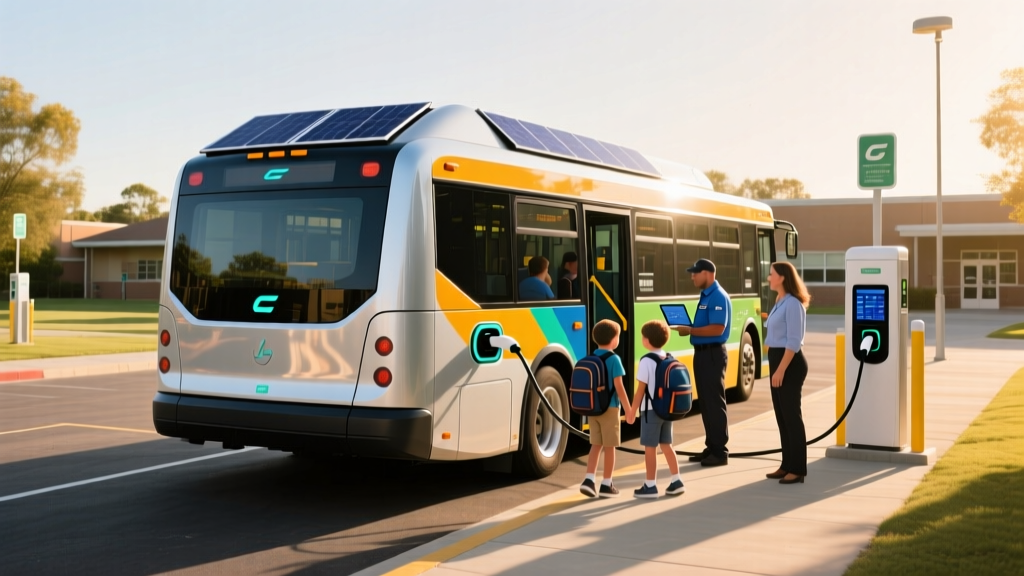
Charging is the operational pivot point. A district cannot simply buy electric buses — it must build or upgrade depot charging. Here's what that looks like in practice:
| Charging Level | Power (kW) | Miles Added per Hour | Best Use Case | Equipment Cost per Charger |
|---|---|---|---|---|
| Level 2 (AC) | 19.2 kW | ~12–15 mi/hr | Overnight depot charging (8–10 hrs) | $3,000–$7,000 |
| DC Fast (CCS1) | 60–150 kW | ~45–100 mi/hr | Midday top-up, opportunity charging | $25,000–$80,000 |
Installation costs are the real budget item. A single Level 2 charger installation (including panel upgrade, conduit, and permitting) typically runs $8,000–$20,000 per stall. A DC fast charger installation can reach $50,000–$150,000 per stall, especially if utility service upgrades or new transformers are needed.
Critical planning steps:
- Engage the utility early. Many utilities offer make-ready programs that cover the cost of wiring and panel upgrades to the site boundary. Some have dedicated school bus electrification tariffs.
- Right-size charging to routes. If all buses return to the depot by 4 PM and leave at 6 AM, Level 2 overnight charging is sufficient for most routes. DC fast chargers are only necessary for midday opportunity charging or very high-utilization fleets.
- Plan for fleet growth. Install conduit and panel capacity for 2–3× the initial number of chargers. Trenching once is far cheaper than re-trenching later.
- Understand kW vs. kWh. A 150 kW DC fast charger delivers power at a high rate, but the bus battery (measured in kWh) determines how much energy it can store. Peak charge rates are only sustained at low states of charge — above 80% SoC, charging slows significantly to protect battery health.
Health, Environmental, and Community Benefits
Beyond economics, the benefits of electric school buses for school districts extend into student health and regulatory compliance:
- Zero tailpipe emissions. Diesel exhaust contains particulate matter (PM2.5) and nitrogen oxides (NOx) linked to childhood asthma and respiratory illness. A 2023 EPA analysis estimated that replacing one diesel school bus prevents up to $170,000 in health-related costs over its lifetime, including reduced hospital visits and missed school days.
- Quieter operation. Electric buses produce significantly less noise, reducing noise pollution in residential neighborhoods and improving the in-cabin experience for students and drivers.
- Idling elimination. Diesel buses often idle at stops and loading zones, concentrating exhaust near children. Electric buses produce no emissions at rest.
- Climate compliance. States like California (via the Advanced Clean Trucks regulation), New York, and Maryland have mandated zero-emission school bus purchases on specific timelines. Early adoption positions districts ahead of regulatory deadlines.
Federal Funding and Incentives in 2026
The cost equation changes dramatically with available funding. Districts should stack multiple incentive sources:
| Program | Amount | Eligibility Notes |
|---|---|---|
| EPA Clean School Bus Program (CSBP) | Up to $287,500 per bus + $20,000 infrastructure (high-need) | Prioritizes high-need, rural, tribal, and Title I districts. Competitive lottery and rebate rounds. Check epa.gov/cleanschoolbus for current-year deadlines. |
| State/Local Incentives | $0–$150,000 per bus (varies widely) | California HVIP, New York Truck Voucher Incentive, Colorado ALT Fuels, and others. Consult your state energy office. |
| Utility Make-Ready Programs | $10,000–$100,000+ per site | Covers electrical infrastructure to the site. Available from PG&E, ConEdison, Xcel Energy, National Grid, and others. |
| IRS §45W Commercial Clean Vehicle Credit | Up to $40,000 per vehicle | Available to tax-exempt entities (including public school districts) as a direct payment under the Inflation Reduction Act. File IRS Form 3468. Consult a tax professional for eligibility. |
| VW Settlement Funds (remaining) | Varies by state | Some states still have unallocated funds from the Volkswagen dieselgate settlement earmarked for school bus replacement. |
Important caveat: The §45W commercial credit is distinct from the §30D consumer credit that applies to personal vehicles. Public school districts and other tax-exempt entities can receive §45W as a direct payment (not just a tax offset), which is a significant advantage. Always confirm current-year rules with the IRS and a qualified tax advisor, as program parameters can shift.
Common Misconceptions About Electric School Buses
| Myth | Fact |
|---|---|
| "Electric buses can't handle cold weather." | Cold reduces range by 30–40%, but most routes are short enough to accommodate this with proper planning. Battery thermal management systems and preheating while plugged in mitigate losses. Districts in Minnesota, Michigan, and Maine operate electric buses year-round. |
| "The battery will need replacing in 5 years." | Modern LFP and NMC bus batteries are warrantied for 10 years or more with guaranteed capacity retention (typically 70–80% of original). Real-world degradation data from early-adopter fleets shows 2–3% annual capacity loss, meaning a bus battery should remain functional through most or all of a 12-year service life. |
| "Charging takes too long for bus schedules." | Overnight Level 2 charging (8–10 hours) fully replenishes most bus batteries. A 155 kWh battery at 19.2 kW takes roughly 8 hours from empty. Most buses don't return fully depleted — a 50% SoC bus needs only ~4 hours. |
| "The grid can't handle a fleet of electric buses." | Managed charging (staggered start times, off-peak scheduling) keeps demand within most utility circuits. A fleet of 10 buses charging at 19.2 kW each draws ~192 kW — comparable to a small commercial building. Utility coordination is essential but manageable. |
| "Electric buses are less safe in crashes." | Electric school buses must meet the same FMVSS crash standards as diesel buses. Battery packs are mounted in reinforced enclosures and undergo thermal runaway testing. NHTSA has not flagged elevated safety risks for electric school buses. |
Decision Framework: Should Your District Go Electric?
If-Then Guide for Fleet Managers
- IF your average daily route is under 60 miles round-trip AND buses return to a central depot overnight → Electric is a strong fit with Level 2 depot charging.
- IF your routes exceed 80 miles daily AND include midday runs → Consider a mixed fleet — deploy electric on shorter routes and retain diesel or CNG for longer routes, or invest in DC fast opportunity charging.
- IF your district qualifies as high-need, rural, or tribal under EPA CSBP → The economics heavily favor electric — rebates can bring net acquisition cost below diesel.
- IF your utility offers robust make-ready incentives and commercial EV time-of-use rates → Infrastructure costs drop significantly, accelerating payback.
- IF you operate in a state with a zero-emission bus mandate timeline → Start pilot programs now to build operational experience before the mandate takes effect.
- IF your routes regularly face extreme cold (below 0°F) with long distances and no midday charging → Proceed cautiously — oversize batteries, spec battery heaters, and plan for 40%+ range derating.
- IF your depot lacks three-phase power and a utility upgrade would cost $200,000+ → Factor infrastructure costs into TCO and explore whether utility make-ready programs can offset the expense.
First Steps for Districts Considering Electric Buses
For transportation directors evaluating a transition, here is a practical sequence:
- Audit your routes. Log daily mileage, terrain, ambient temperature ranges, and dwell times for every bus in the fleet. Identify which routes fall within 60% of current electric bus EPA range.
- Map your funding stack. Check EPA CSBP application windows, state incentive programs, utility make-ready offers, and §45W eligibility. Build a per-bus acquisition model with and without incentives.
- Request utility site assessments. Most utilities will conduct a free or low-cost assessment of your depot's electrical capacity and estimate upgrade timelines and costs.
- Start with a pilot of 1–3 buses. Operate them on your most favorable routes for one full year, including winter. Track energy consumption per mile, charge times, maintenance events, and driver feedback.
- Build a phased replacement plan. Align electric bus procurement with your existing diesel replacement cycle. As older buses age out, replace them with electric units as funding allows.
Frequently Asked Questions
How long does it take to charge an electric school bus?
At a 19.2 kW Level 2 charger, a fully depleted 155 kWh battery takes approximately 8 hours to charge — ideal for overnight depot use. At a 150 kW DC fast charger, the same battery reaches 80% in roughly 1–1.5 hours, though charging slows significantly above 80% to protect battery longevity.
Do electric school buses qualify for the $7,500 federal EV tax credit?
No. The §30D consumer tax credit (up to $7,500) applies only to light-duty personal vehicles under 14,000 lbs GVWR. School buses fall under the §45W Commercial Clean Vehicle Credit, which provides up to $40,000 per vehicle and is available as a direct payment to tax-exempt entities like public school districts.
What happens when the battery degrades?
Battery degradation in electric school buses averages 2–3% per year under normal use. Most manufacturers warrant the battery to retain at least 70–80% of original capacity for 10 years. If a battery drops below the warranty threshold, the manufacturer replaces or refurbishes it at no cost. Full out-of-warranty battery replacement costs $30,000–$60,000 depending on chemistry and capacity, but this is rarely needed within a bus's 12-year service life.
Can electric school buses handle rural routes with long distances?
Current electric school buses offer 90–138 miles of real-world range. Rural routes exceeding 80 miles round-trip are feasible but require careful planning — potentially including midday opportunity charging or reduced-speed operation. For routes exceeding 120 miles, a diesel or hybrid bus may remain the more practical choice until battery energy density improves.
What charging connector do electric school buses use?
All current-production electric school buses sold in the U.S. use the CCS1 (Combined Charging System) connector for DC fast charging and the J1772 connector for Level 2 AC charging. The NACS (Tesla) connector is not currently used on commercial school buses.
How does regenerative braking affect maintenance?
Regenerative braking uses the electric motor to slow the bus, recovering energy back to the battery. This significantly reduces wear on the friction brake pads and rotors — many electric bus fleets report brake service intervals 2–3× longer than diesel equivalents. This is one of the largest maintenance savings factors.