Quick Answer: Is the Electric Santa Fe Worth It?
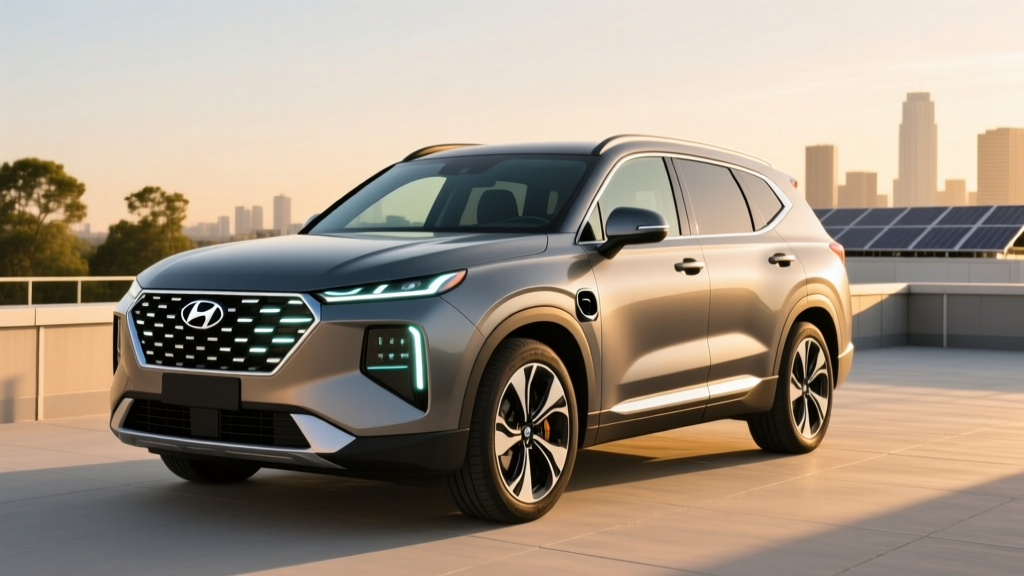
The 2026 Hyundai Santa Fe EV offers up to 300 miles of EPA-estimated range with a starting MSRP around $43,000. Real-world highway driving yields approximately 250-270 miles, dropping to 220-240 miles in cold weather. With DC fast charging up to 250 kW (10-80% in ~18 minutes) and potential eligibility for the $7,500 federal tax credit, it competes directly with the Kia EV9 and Tesla Model Y for three-row family SUV buyers who need electric range without range anxiety.
Range Reality: EPA Sticker vs Real-World Driving
Hyundai rates the 2026 Santa Fe EV at up to 300 miles EPA-estimated range on the Long Range AWD trim with its 84 kWh usable battery pack (NMC chemistry). But EPA numbers represent ideal conditions. Here's what to expect in practice:
Real-World Range Expectations
- City/suburban mixed driving: 280-300 miles (regenerative braking recovers energy)
- Highway cruising at 70 mph: 250-270 miles (aerodynamic drag reduces efficiency)
- Cold weather (below 32°F): 220-240 miles (battery chemistry slows, cabin heating draws power)
- Hot weather with A/C: 270-285 miles (thermal management less impactful than cold)
The Santa Fe EV includes a heat pump for improved cold-weather efficiency, but expect 15-25% range loss in freezing temperatures regardless. Preconditioning the battery while plugged in mitigates some loss.
Compared to the gas-powered Santa Fe Hybrid (36 MPG combined, ~500-mile range on a 14-gallon tank), the EV trades range for lower per-mile fuel costs and zero tailpipe emissions. The hybrid wins for cross-country road trips; the EV wins for daily commuting under 150 miles round-trip.
Charging Speed and Infrastructure Access
The Santa Fe EV supports DC fast charging at up to 250 kW peak power on 350 kW chargers, though sustained rates taper significantly above 80% state of charge. Level 2 home charging maxes out at 10.9 kW.
| Charging Level | Power (kW) | Miles Added Per Hour | Use Case |
|---|---|---|---|
| Level 1 (120V outlet) | 1.4 kW | 3-4 miles/hour | Emergency/trickle charging |
| Level 2 (240V home) | 10.9 kW | 30-35 miles/hour | Overnight home charging (8-10 hours 10-100%) |
| DC Fast (350 kW station) | 250 kW peak | ~180 miles in 18 min | Road trips (10-80% in ~18 min, 80-100% adds 15+ min) |
The charge curve matters: you'll hit 250 kW only between 10-40% state of charge. From 40-80%, speeds drop to 150-180 kW. Above 80%, charging slows dramatically to protect battery longevity—plan to charge to 80% on road trips unless you need the extra range.
The Santa Fe EV uses the NACS (Tesla-style) connector as of 2025, granting access to Tesla Superchargers via Hyundai's partnership. This expands your charging network significantly compared to CCS-only vehicles.
Purchase Price and Tax Credit Eligibility
The 2026 Santa Fe EV starts at approximately $43,000 for the SE trim, rising to $52,000 for the Limited AWD. Federal tax credit eligibility under IRS §30D depends on multiple factors:
§30D Federal Tax Credit Requirements (2026)
- MSRP cap: Vehicle must be under $80,000 (Santa Fe EV qualifies)
- Buyer income limits: $150,000 single / $300,000 joint modified AGI
- Battery sourcing: Critical minerals and battery components must meet percentage thresholds from U.S. or free-trade-agreement countries
- Point-of-sale transfer: You can apply the credit at purchase to reduce upfront cost, or claim it on your tax return
- Final assembly: Must occur in North America (verify VIN eligibility)
Important: Battery sourcing requirements tighten annually. Check the official DOE/IRS list before purchase—eligibility can change mid-year. Consult a tax professional for your specific situation.
With the full $7,500 credit, effective pricing drops to $35,500-$44,500 depending on trim. Compare this to the gas Santa Fe Hybrid ($39,000-$48,000 MSRP) and the EV becomes price-competitive upfront, not just over time.
Total Cost of Ownership: EV vs Gas vs Hybrid
Purchase price tells only part of the story. Here's a 5-year cost comparison assuming 15,000 miles/year, $3.50/gallon gas, and $0.14/kWh electricity (national average):
| Cost Category | Santa Fe EV (AWD) | Santa Fe Hybrid (AWD) | Santa Fe Gas (AWD) |
|---|---|---|---|
| Purchase price (after credit) | $40,500 | $42,000 | $38,000 |
| Fuel/energy (5 years) | $3,150 | $7,290 | $10,500 |
| Maintenance (5 years) | $1,500 | $3,000 | $3,500 |
| Insurance (5 years) | $9,000 | $7,500 | $7,500 |
| Total 5-year cost | $54,150 | $59,790 | $59,500 |
The EV saves $5,350-$5,640 over five years despite higher insurance premiums (typical for EVs due to repair costs). Key assumptions: you have home charging access at residential electricity rates. Public DC fast charging costs 2-3x more ($0.35-$0.50/kWh), eroding savings if used exclusively.
Common Misconceptions About the Electric Santa Fe
| Myth | Fact |
|---|---|
| "EVs need battery replacement after 100,000 miles" | Hyundai warranties the battery for 10 years/100,000 miles with 70% capacity retention minimum. Most EVs retain 85-90% capacity at 150,000 miles based on Recurrent data. |
| "I can't take road trips" | With 250 kW charging, you add 180 miles in 18 minutes. Plan stops every 2-2.5 hours for bathroom/food breaks anyway. |
| "EVs are worse in winter" | Range drops 15-25%, but EVs start reliably (no cold-crank issues), and heated seats/steering wheel use less energy than cabin air heating. |
| "Charging takes too long" | Home charging happens overnight while you sleep (8-10 hours). Road-trip DC charging takes 18-25 minutes for 10-80%. |
Decision Framework: Is the Electric Santa Fe Right for You?
Choose the Electric Santa Fe if:
- You have home charging access (garage/driveway with 240V outlet capability)
- Your daily driving is under 150 miles round-trip
- You qualify for the $7,500 federal tax credit (income under $300k joint)
- You want a three-row SUV with lower per-mile fuel costs
- You take road trips 2-3 times per year (not weekly)
- You live in a region with reliable public charging infrastructure
Choose the Santa Fe Hybrid instead if:
- You lack home charging access (apartment/street parking only)
- You regularly drive 300+ miles between stops
- You live in extreme cold climates (below 0°F regularly)
- You're on a tighter upfront budget and don't qualify for tax credits
- You tow frequently (hybrid has higher towing capacity)
Choose the gas Santa Fe if:
- You need maximum towing capacity (3,500 lbs vs 2,000 lbs EV)
- You drive in remote areas with no charging infrastructure
- You want the lowest purchase price and don't care about fuel savings
First-Time EV Buyer Considerations
If this is your first electric vehicle, plan for these ownership realities:
- Home charging installation: Budget $800-$2,000 for a Level 2 charger and electrician (240V/40A circuit). Older homes may need a $2,000-$4,000 electrical panel upgrade.
- Charging apps: Download PlugShare, ChargePoint, and EVgo before road trips. Not all networks work seamlessly.
- Regenerative braking: The Santa Fe EV offers adjustable regen levels. Start with low regen and work up to one-pedal driving as you adapt.
- Tire wear: EVs are heavier and have instant torque. Expect tire replacement every 30,000-40,000 miles vs 50,000+ for gas cars.
- Insurance shopping: Get quotes before purchase. EV insurance runs 15-25% higher on average.
Frequently Asked Questions
What's the real-world range of the electric Santa Fe?
Expect 250-270 miles on highway trips and 220-240 miles in freezing weather, down from the 300-mile EPA estimate. City driving with regenerative braking can achieve 280-300 miles.
How long does it take to charge at home?
A Level 2 home charger (10.9 kW) takes 8-10 hours for a 10-100% charge. Most owners charge overnight and wake up to a full battery daily.
Does the Santa Fe EV qualify for the $7,500 tax credit?
It may, depending on battery sourcing requirements and your income level. Check IRS.gov for current eligibility before purchase, as rules change annually.
Can I tow with the electric Santa Fe?
Yes, but capacity is limited to 2,000 pounds—adequate for a small trailer or bike rack, but not a boat or large camper. The hybrid tows 3,500 pounds.
How does the Santa Fe EV compare to the Kia EV9?
Both are three-row electric SUVs on the same platform. The EV9 offers slightly more range (310 miles) and a lower starting price ($42,000), while the Santa Fe EV has a more premium interior. Test drive both.
What happens if the battery degrades?
Hyundai warranties 70% capacity retention for 10 years/100,000 miles. Real-world data shows most EVs retain 85-90% capacity at 150,000 miles. Full battery replacement costs $12,000-$18,000 if needed out of warranty.