Quick Answer: Electric RV trailers—campers with onboard battery packs and motors that assist the tow vehicle—are entering the market in 2026 after years of prototypes. Models from Lightship, Airstream, and others promise to reduce or eliminate the range penalty EVs face when towing. However, production volumes remain extremely limited, prices start above $75,000, and real-world validation of range-extension claims is still sparse. If you're shopping today, an electric RV trailer is best viewed as an emerging technology worth watching, not a proven solution you can reliably order and take delivery on within weeks.
What Is an Electric RV Trailer, Exactly?
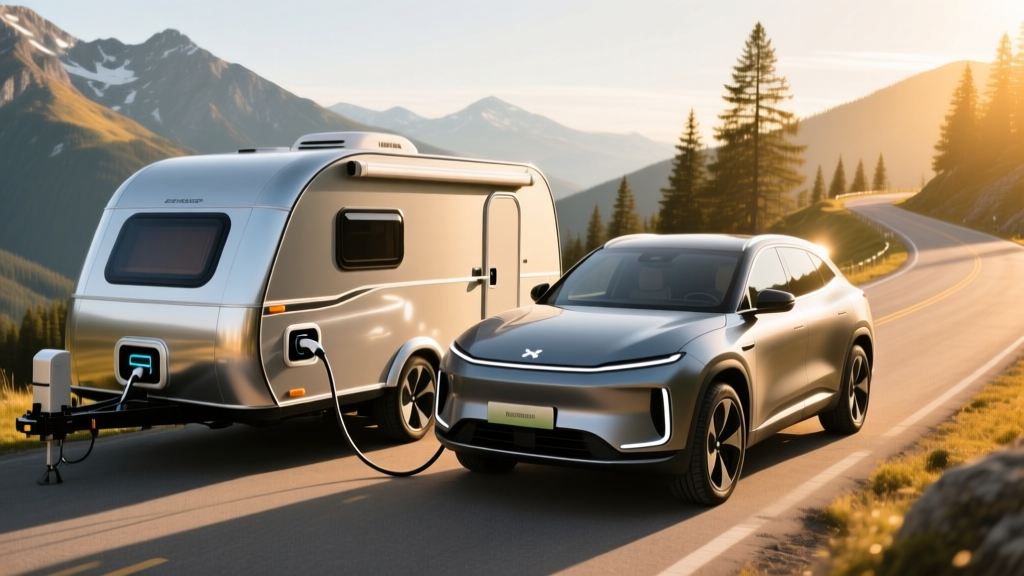
An electric RV trailer is a towable camper equipped with its own high-voltage battery pack (typically 40–80 kWh) and one or more electric motors on the trailer axle. Unlike a conventional travel trailer that is dead weight on the tow vehicle's drivetrain, an electric RV trailer can propel itself in sync with the tow vehicle, effectively reducing the energy demand on the EV doing the towing.
The concept works through a proprietary controller that communicates between the tow vehicle and the trailer. When the tow vehicle accelerates, the trailer's motors engage to assist. During regenerative braking, the trailer's motors can recapture energy back into the trailer's battery. The result: manufacturers claim the EV towing experience should feel similar to driving the EV unloaded, with only modest range reduction instead of the 40–60% range loss that conventional trailers cause.
This is distinct from a motorized electric RV (like the Winnebago e-RV or Thor's Project Zeus concepts), which is a self-contained drivable vehicle. Electric RV trailers remain trailers—they require a tow vehicle—but they carry their own energy and propulsion.
The 2026 Electric RV Trailer Landscape
As of early 2026, the electric RV trailer market is in early production or late-prototype stages. Here's where the major players stand:
Lightship L1 (now under the L1 name after rebranding from "Lightship One") — The most advanced program. Lightship began limited deliveries of its aerodynamic, solar-equipped electric travel trailer starting in late 2025. The L1 features a ~80 kWh battery pack, an integrated motor on the trailer axle, and a claimed self-propulsion capability that reduces tow-vehicle energy consumption by up to 50%. The aerodynamic design (with a low profile and deployable upper section at camp) reduces drag significantly compared to conventional boxy trailers. Base price: approximately $85,000 before options. Production remains limited, with delivery timelines stretching months out.
Airstream e-Trailer Concept — Airstream, in partnership with Thor Industries, has shown a battery-electric trailer concept with propulsion assist. As of 2026, it remains in the concept/testing phase with no confirmed production timeline or pricing. Airstream has indicated the system would work with both EV and gas tow vehicles.
Pebble (now part of a broader RV-tech startup wave) — Announced a compact electric trailer aimed at smaller EVs. The design focuses on lightweight construction and a moderate battery pack (~45 kWh) with axle-mounted motors. Pricing was projected around $75,000, but production availability in 2026 is limited to reservation holders from early campaigns.
Other entrants — Several smaller firms have announced electric or hybrid-electric trailers, but most remain at the render or prototype stage. Be cautious of pre-order deposits with companies that lack a demonstrated production track record.
EV Towing Reality: Why Electric RV Trailers Exist
To understand the value proposition, you need to understand the problem. Towing with an EV is range-punishing. Here's the data:
| Scenario | EV (e.g., Ford F-150 Lightning) | Gas Truck (e.g., F-150 3.5L EcoBoost) |
|---|---|---|
| No trailer, highway efficiency | ~2.0 mi/kWh (EPA combined ~70 MPGe) | ~22 MPG highway |
| Towing 5,000-lb conventional trailer | ~0.8–1.0 mi/kWh (range drops to ~120–150 mi) | ~9–11 MPG (range drops to ~250–300 mi) |
| Range reduction percentage | 50–60% | 45–55% |
| Refuel/recharge needed (300-mi trip) | 2+ DC fast charges (30–40 min each) | 1 fuel stop (~10 min) |
The physics are brutal for EVs. A 5,000-pound trailer roughly doubles the total vehicle weight and dramatically increases aerodynamic drag at highway speeds. Since EVs are already heavy (the F-150 Lightning weighs ~6,500 lbs unloaded), adding a conventional trailer pushes energy consumption to levels that make the 230-mile EPA range of the Lightning's standard battery effectively useless for trips longer than 100 miles without charging.
An electric RV trailer addresses this by contributing its own propulsion energy. If the trailer's 80 kWh battery and motors offset half the energy demand, the effective range of the tow vehicle could remain closer to 180–200 miles—still reduced, but dramatically more practical.
Cost Breakdown: Electric RV Trailer Ownership
Electric RV trailers carry a steep premium over conventional travel trailers. Here's a realistic ownership cost comparison for 2026:
| Cost Category | Electric RV Trailer (Lightship L1 class) | Conventional 25-ft Travel Trailer |
|---|---|---|
| Purchase price (MSRP) | $85,000–$95,000 | $25,000–$45,000 |
| Sales tax (est. 7%) | $5,950–$6,650 | $1,750–$3,150 |
| Insurance (annual avg) | $1,800–$2,500/yr | $600–$1,200/yr |
| Maintenance (5-yr total) | $500–$1,000 (minimal mechanical) | $2,000–$4,000 (axles, brakes, bearings, seals) |
| Battery degradation risk | Moderate (trailer battery ages whether used or not) | N/A |
| Tow vehicle energy cost (50 camping nights, 150 mi/day avg) | ~$1,200–$1,800 (home charging + public DC) | ~$2,500–$4,000 (gas for conventional towing) or ~$2,400–$3,600 (EV towing without assist) |
| Estimated 5-year total | $105,000–$125,000 | $38,000–$63,000 |
The financial case for an electric RV trailer is challenging. You're paying a $40,000–$60,000 premium primarily for the battery pack, motors, and control system. The energy savings over five years of recreational use (typically 2,000–4,000 miles of towing per year for most campers) won't close that gap. The value proposition is about capability—being able to tow with your EV without crippling range loss—not cost savings.
Federal tax credit note: Electric RV trailers do not qualify for the IRS §30D Clean Vehicle Credit. That credit applies to motor vehicles capable of highway travel under their own power. A trailer, even one with propulsion assist, is not a qualifying vehicle. The trailer's battery components may theoretically factor into residential energy credits if the trailer supports V2H (vehicle-to-home) functionality at campsite or home, but this is a gray area—consult a tax professional before claiming any credit for trailer-related equipment.
Real-World Ownership Considerations
If you're seriously evaluating an electric RV trailer in 2026, these practical factors matter more than spec sheets:
Charging infrastructure on the road. Even with trailer propulsion assist, you'll need to charge both the tow vehicle and the trailer battery on longer trips. Most RV parks offer 30-amp or 50-amp NEMA 14-50 outlets (Level 2 at 7.2–12 kW), which can replenish a trailer's 80 kWh battery overnight (8–12 hours). However, DC fast charging a trailer battery requires dedicated infrastructure that barely exists in 2026. Lightship has indicated the L1 can charge via the tow vehicle's charge port through a pass-through system, but this adds charging time since you're charging two batteries through one connection.
Weight and tow ratings. Electric RV trailers are heavy. The battery pack alone adds 800–1,500 pounds compared to a conventional trailer. The Lightship L1's GVWR is estimated around 7,500 pounds. Your tow vehicle must be rated for this—check your EV's maximum tow rating (the Rivian R1S is rated for 7,700 lbs; the F-150 Lightning for 7,700–10,000 lbs depending on configuration; the Tesla Model X for 5,000 lbs). Exceeding tow ratings voids warranties and compromises safety.
Cold-weather performance. Lithium-ion batteries lose 20–30% of usable capacity in sub-freezing temperatures. An electric RV trailer's battery will be exposed to ambient air underneath the trailer, with less thermal management than the tow vehicle's pack. If you camp in cold climates, expect the trailer's propulsion-assist contribution to diminish significantly in winter, reducing the range benefit you paid for.
Storage and battery care. Most RV owners store their trailers for months between trips. A high-voltage battery pack sitting at full charge or full discharge degrades faster than one maintained at 40–60% state of charge. You'll need to plug the trailer in periodically or use its onboard systems to maintain the battery—adding another maintenance consideration that conventional trailer owners don't face.
Service and parts availability. With production volumes in the hundreds (not tens of thousands), getting warranty service or replacement parts for an electric RV trailer in 2026 means dealing with small companies that may have limited service networks. A damaged battery pack or motor could mean weeks or months of downtime waiting for specialized components.
Common Misconceptions About Electric RV Trailers
| Myth | Fact |
|---|---|
| "Electric RV trailers give you full EV range back while towing." | They reduce the range penalty—typically by 30–50% based on prototype data—not eliminate it. You'll still see meaningful range reduction, just less severe. |
| "You can charge the trailer at any EV fast charger." | Most DC fast chargers are designed for vehicles, not trailers. You'd need to unhitch and position the trailer at a charger, or charge through the tow vehicle's pass-through system at slower effective rates. |
| "The trailer battery powers the campsite appliances for days." | While the large battery can run A/C, lights, and outlets at camp, using the battery for camping drains the propulsion reserve. You'd arrive at your next destination with less assist available. |
| "They qualify for EV tax credits." | Trailers are not motor vehicles under IRS §30D rules. No federal purchase credit applies. |
| "Any EV can tow an electric RV trailer." | The trailer still has significant weight. Your EV must meet the trailer's GVWR within its rated tow capacity. Smaller EVs (Model Y, Ioniq 5) cannot safely tow 7,500-lb electric trailers. |
Decision Framework: Should You Consider an Electric RV Trailer?
Choose an electric RV trailer if:
- You already own a large EV with a 7,500+ lb tow rating (F-150 Lightning, Rivian R1T/R1S, Chevy Silverado EV)
- You take 4+ camping trips per year covering 150+ miles each way
- You've experienced the frustration of 100-mile effective range while towing and want a solution
- You can absorb the $80,000+ purchase price without financial strain
- You're comfortable being an early adopter with limited service infrastructure
- You camp primarily in moderate climates (less battery cold-weather penalty)
Stick with a conventional trailer (or wait) if:
- You tow with a mid-size or smaller EV (tow rating under 5,000 lbs)
- You camp 1–2 times per year within 100 miles of home
- The $40,000+ premium over a conventional trailer doesn't make financial sense for your usage
- You need a trailer now and can't wait months for limited-production delivery
- You camp in extreme cold (below 20°F) regularly
- You want established dealer support and easy parts availability
Consider a PHEV or gas truck as your tow vehicle if:
- Range anxiety while towing is your primary concern and budget doesn't allow an electric RV trailer
- A gas or diesel truck towing a conventional trailer gives you 250–350 miles of range with a 10-minute refuel—a practical solution that works today at a fraction of the cost
- You don't want to depend on emerging technology for family camping trips
What's Next for Electric RV Trailers
The technology trajectory is promising. As battery costs continue to decline (LFP cells have dropped below $50/kWh at the pack level for some suppliers), the premium for electric RV trailers should narrow. By 2028–2030, expect larger production volumes, more established service networks, and potentially a secondary market of used units. Some manufacturers are exploring solar-integrated trailer roofs that can add 5–15 miles of propulsion range per day of sunny parking—useful for extended boondocking trips.
Regulatory clarity will also matter. The National Highway Traffic Safety Administration (NHTSA) has not yet published specific FMVSS standards for self-propelled trailers, and state-by-state registration requirements for electric trailers vary. Before purchasing, confirm with your state DMV how an electric RV trailer is titled and registered—it may require different documentation than a standard travel trailer.
For now, the electric RV trailer is an exciting solution in search of production scale. If you have the budget, the tow vehicle, and the patience, it represents the most compelling answer to the EV towing problem. If you need practicality today, a conventional trailer behind a capable gas truck remains the path of least resistance—and lowest cost.
Frequently Asked Questions
Can I tow an electric RV trailer with a Tesla Model X or Model Y?
The Model X has a 5,000-lb tow rating, and the Model Y is rated for 3,500 lbs. Most electric RV trailers with propulsion batteries weigh 6,000–7,500 lbs GVWR, which exceeds these ratings. You'd need a full-size EV truck or SUV (F-150 Lightning, Rivian R1T/R1S, Silverado EV) to tow current electric RV trailers within rated limits. Always check your specific vehicle's tow rating on the door jamb sticker and in the owner's manual—ratings vary by configuration.
How does the trailer's propulsion system communicate with my EV?
Current systems use a dedicated wireless or hardwired controller that reads the tow vehicle's throttle position, brake application, and speed through the 7-pin trailer connector or a proprietary module. The trailer's motors then apply proportional assist or regen. This is transparent to the driver—you press the accelerator normally, and the trailer responds. The system is designed to be compatible with any tow vehicle, EV or gas, though the range-extension benefit is most meaningful for EVs.
What happens if the trailer battery is depleted?
If the trailer's battery is fully depleted, the trailer becomes dead weight—functionally identical to a conventional trailer. Your EV's range will drop to standard towing levels (50–60% reduction). This is why managing the trailer's state of charge before and during trips is critical. Most systems reserve a buffer (typically 10–15% of pack capacity) to prevent full depletion.
Can I use the trailer's battery to power my home during an outage?
Some electric RV trailer concepts include V2H (vehicle-to-home) or at minimum robust AC outlet capability. The Lightship L1, for example, includes high-power AC outlets that can run campsite appliances and could theoretically power essential home circuits through a transfer switch. However, this is not the same as a certified home battery system like a Tesla Powerwall. Consult a licensed electrician before connecting any trailer battery to home wiring.
Are electric RV trailers insured differently than conventional trailers?
Yes, in most cases. The high-voltage battery pack and electric drivetrain components represent significant replacement cost, and insurers are still developing actuarial models for these products. Expect premiums 50–100% higher than equivalent conventional trailers. Shop quotes from RV-specialty insurers (Good Sam, National General, Progressive RV) before purchasing, as mainstream auto insurers may not have rating categories for electric trailers yet.
Do electric RV trailers require special maintenance?
Mechanical maintenance is actually lower than conventional trailers—no wheel bearings to repack as frequently (regenerative braking reduces friction brake wear), no axle lubrication on electric-drive axles in some designs. However, you gain battery maintenance responsibilities: periodic state-of-charge management during storage, thermal system checks, and eventual battery replacement (projected 15–20 year lifespan, but replacement cost could be $15,000–$25,000 for an 80 kWh pack based on current LFP pricing trends).