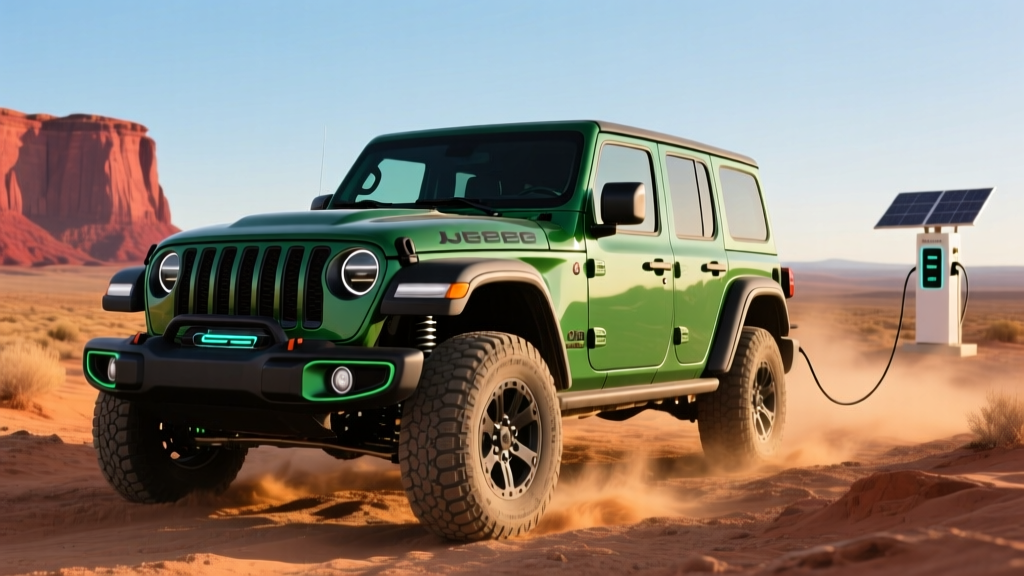
If you're searching for an "electric Rubicon," you're almost certainly looking at the Jeep Wrangler 4xe Rubicon — the plug-in hybrid (PHEV) version of Jeep's most capable off-road trim. Here's the quick answer: the 2026 Wrangler 4xe Rubicon delivers an EPA-estimated 22 miles of electric-only range from its 17.3 kWh battery pack, combined with a 2.0L turbo engine for a total range of roughly 370 miles. It starts around $55,895 (destination included) before incentives, and qualifies for up to a $3,750 federal tax credit under current §30D rules — not the full $7,500, due to battery-sourcing requirements. It is not a fully electric vehicle (BEV); it's a PHEV that blends electric and gas power.
What "Electric Rubicon" Actually Means: PHEV, Not BEV
A common misconception is that the "electric Rubicon" is a fully battery-electric vehicle. It isn't. The Wrangler 4xe is a plug-in hybrid electric vehicle (PHEV) — meaning it pairs a battery and electric motor with a conventional gasoline engine. You can plug it in to charge, drive short distances on electricity alone, and then the 2.0L turbocharged four-cylinder kicks in for longer trips.
Jeep has not announced a fully electric Wrangler (BEV) as of early 2026. The 4xe remains the closest thing to an "electric Rubicon" you can buy. If you need a pure-electric off-roader, you'd need to look at vehicles like the Rivian R1S or the upcoming Jeep Recon — but neither carries the Rubicon badge or its specific solid-axle, locking-differential hardware.
2026 Wrangler 4xe Rubicon: Full Specs
| Spec | Value |
|---|---|
| Powertrain | 2.0L Turbo I4 + 2 electric motors (P0 + P2) |
| Combined Output | 375 HP / 470 lb-ft torque |
| Battery | 17.3 kWh usable (NMC chemistry, 400V) |
| EPA Electric Range | 22 miles |
| Real-World Electric Range | 16–20 mi (highway/cold); 20–22 mi (city, mild weather) |
| EPA MPGe (combined) | 49 MPGe |
| Gas-Only MPG (battery depleted) | 20 MPG combined |
| Total Range (gas + electric) | ~370 miles |
| Level 2 Charge Time (0–100%) | ~2.5 hours at 7.2 kW |
| Level 1 Charge Time (120V) | ~12 hours |
| DC Fast Charging | Not supported |
| 0–60 mph | ~6.0 seconds |
| Towing Capacity | 3,500 lbs |
| Drivetrain | 4WD with front/rear lockers, sway-bar disconnect |
| Base MSRP (Rubicon 4xe) | $55,895 (incl. destination) |
| Federal Tax Credit (§30D) | Up to $3,750 (sourcing-limited) |
| Battery Warranty | 8 years / 100,000 miles |
Sources: EPA fueleconomy.gov, Jeep.com 4xe specs
Wrangler 4xe Rubicon vs. Gas Rubicon: Cost & Efficiency Breakdown
The gas-only Wrangler Rubicon (3.6L V6, mild-hybrid eTorque) starts around $49,595 and gets an EPA-rated 19 MPG combined. The 4xe Rubicon costs roughly $6,300 more upfront but can run on electricity for short trips. Here's what that means for your wallet over 5 years, assuming 15,000 miles/year, 60% city driving, $3.50/gal gas, and $0.14/kWh electricity:
| Cost Factor (5-Year) | Gas Rubicon 3.6L V6 | 4xe Rubicon (PHEV) |
|---|---|---|
| Purchase Price (base) | $49,595 | $55,895 |
| Federal Tax Credit | $0 | −$3,750 |
| Effective Purchase | $49,595 | $52,145 |
| Fuel/Energy (75k mi) | $13,816 | $10,240 |
| Maintenance (est.) | $3,200 | $2,900 |
| Insurance (est.) | $9,500 | $10,200 |
| 5-Year Total | $76,111 | $75,485 |
The 4xe's fuel savings (~$3,576 over 5 years) nearly offset its higher purchase price after the tax credit. The break-even point depends heavily on how often you charge and drive within that 22-mile electric window. If your daily round-trip commute is under 20 miles and you charge nightly, you'll skew heavily toward electric driving and save more. If you rarely charge, you're carrying 800+ lbs of dead battery weight and getting roughly the same 20 MPG as the gas model.
Real-World Range: What 22 Electric Miles Actually Looks Like
The EPA's 22-mile electric estimate assumes a mix of city and highway driving at moderate temperatures. In practice, several factors compress that number:
- Highway driving (70+ mph): Expect 16–18 miles. The Wrangler's boxy aerodynamics and 5,000+ lb curb weight demand significant energy at speed.
- Cold weather (below 40°F): Battery efficiency drops 15–25%. Expect 14–17 electric miles, especially if using cabin heat (which draws from the battery unless you switch to the gas engine's waste heat).
- Off-road / low-range use: Electric-only mode works at low speeds on trails, but heavy throttle use on rock crawling will deplete the battery faster than the EPA cycle suggests. Plan for 10–15 miles of electric trail use.
- City driving, mild weather: This is the best case — regenerative braking recaptures energy in stop-and-go traffic. You may hit the full 22 miles or slightly more.
The 17.3 kWh battery uses NMC (nickel-manganese-cobalt) chemistry, which offers good energy density but is more temperature-sensitive than LFP. Jeep includes a battery thermal management system, but it's primarily designed for longevity, not aggressive preconditioning like a Tesla or Hyundai E-GMP platform.
Charging at Home: What You'll Need
Charging the 4xe Rubicon at home is straightforward, but it requires planning:
| Charging Level | Power (kW) | 0–100% Time | Setup Cost |
|---|---|---|---|
| Level 1 (120V outlet) | ~1.4 kW | ~12 hours | $0 (included cord) |
| Level 2 (240V, 32A) | 7.2 kW | ~2.5 hours | $500–$1,500 (installed) |
Level 1 works if you drive less than 20 miles daily and can plug in overnight — 12 hours is enough to fully recharge while you sleep. Level 2 is strongly recommended if you want to recharge between multiple daily trips (e.g., morning commute + afternoon errand). A Level 2 home charger installation typically costs $500–$1,500, depending on whether your electrical panel needs upgrading. Hire a licensed electrician to assess your panel capacity — a 200-amp panel usually handles a 40-amp EV circuit without issue, but older 100-amp panels may require a $1,500–$3,000 upgrade.
Federal Tax Credit: What You Actually Qualify For
Under current IRS §30D rules, the Wrangler 4xe qualifies for a partial credit of up to $3,750, not the full $7,500. Here's why:
- $3,750 critical minerals requirement: Met (battery minerals sourced from FTA-partner countries).
- $3,750 battery component requirement: Not fully met for 2026 model year — some cell components are manufactured outside North America, disqualifying half the credit.
- MSRP cap: The 4xe Rubicon at ~$55,895 is under the $80,000 SUV/truck cap. ✓
- Buyer income cap: Modified AGI must be ≤$150,000 (single), ≤$225,000 (head of household), or ≤$300,000 (joint). ✓ for most buyers.
- Point-of-sale transfer: Available — you can apply the $3,750 as a down-payment reduction at the dealer rather than waiting for a tax refund.
Always confirm eligibility with a tax professional before purchase. Credit rules are subject to change, and the battery-sourcing requirements tighten annually.
Common Misconceptions About the Electric Rubicon
| Misconception | Fact |
|---|---|
| "It's a fully electric Jeep" | It's a PHEV — gas engine + electric. No BEV Wrangler exists yet. |
| "I'll never buy gas again" | Only true if you drive under 22 mi/day and charge daily. Most owners still use gas regularly. |
| "It qualifies for the full $7,500 credit" | Currently $3,750 max due to battery-component sourcing rules. |
| "I can DC fast-charge on road trips" | No DC fast charging. Level 2 (7.2 kW) is the maximum charge speed. |
| "Electric mode won't work off-road" | It works — instant torque is actually great for crawling. But range drops to ~10–15 mi under heavy load. |
| "The battery will need replacing soon" | Warranted 8 yr/100k mi. PHEV batteries are smaller and cycled less deeply than BEVs — expect 10–15+ year lifespan with normal use. |
Decision Framework: Is the 4xe Rubicon Right for You?
Choose the Wrangler 4xe Rubicon if:
- Your daily commute is under 20 miles round-trip and you can charge at home nightly
- You want genuine Rubicon off-road hardware (solid axles, lockers, disconnecting sway bar) with the bonus of silent electric trail crawling
- You take road trips but don't want to plan around charging infrastructure — the gas engine eliminates range limitations
- You value the 375 HP / 470 lb-ft instant torque for both on-road passing and off-road technical sections
Choose the gas Rubicon instead if:
- You can't install a home charger (apartment, no garage, no 240V access)
- Your daily driving regularly exceeds 30+ miles — the 4xe advantage disappears without frequent charging
- You want the lowest upfront cost and don't care about fuel savings
- You prioritize lighter weight for extreme off-road use (the 4xe adds ~800 lbs)
Consider a full BEV (Rivian R1S, Jeep Recon) if:
- You want zero gasoline use and have reliable home + public charging access
- You're willing to accept range limitations on long off-grid trips
- You want a full $7,500 tax credit (if the model qualifies under §30D sourcing rules)
Frequently Asked Questions
Can the Wrangler 4xe Rubicon drive on electricity alone at highway speeds?
Yes, up to about 75 mph in electric mode. However, highway driving dramatically reduces the electric range — expect 16–18 miles instead of the EPA-rated 22. The gas engine will seamlessly engage once the battery depletes or when you demand heavy acceleration.
How long will the 4xe battery last before it needs replacement?
Jeep warranties the high-voltage battery for 8 years or 100,000 miles against capacity loss below 70%. Real-world data from 4xe owners (the platform launched for the 2021 model year) shows minimal degradation — typically 5–8% over the first 3–4 years. The smaller 17.3 kWh battery cycles less deeply than a BEV's pack, which helps longevity. Replacement cost, if needed out of warranty, is estimated at $8,000–$12,000 including labor.
Does the 4xe Rubicon sacrifice off-road capability compared to the gas model?
Minimally. Ground clearance, approach/departure/breakover angles, and the Dana 44 axles with front and rear lockers are identical. The main trade-off is weight: the 4xe is roughly 800 lbs heavier, which can affect suspension articulation on extreme terrain and increases tire wear. The added instant torque from the electric motors is actually an advantage for slow-speed rock crawling.
What happens if the battery is completely depleted — can I still drive?
Yes. The 4xe operates as a conventional hybrid once the battery is depleted. The 2.0L turbo engine and regenerative braking maintain a small buffer charge, so you'll never be stranded. You'll just get roughly 20 MPG combined on gasoline alone, similar to the gas-only Wrangler.
Is the Wrangler 4xe eligible for state incentives too?
It depends on your state. Some states (California, Colorado, New York, among others) offer additional PHEV rebates ranging from $1,000–$4,000, but many state programs now prioritize full BEVs over PHEVs. Check your state's energy office or AFDC state incentive database for current programs in your jurisdiction.
Can I charge the 4xe at a Tesla Supercharger?
No. The Wrangler 4xe uses a J1772 connector for Level 2 AC charging. It does not support DC fast charging at all, so even with a NACS adapter, Tesla Superchargers (which are DC-only) won't work. You can charge at any public Level 2 station (ChargePoint, EVgo Level 2, Blink, etc.) using the standard J1772 plug.