The Short Answer on Electric Roads
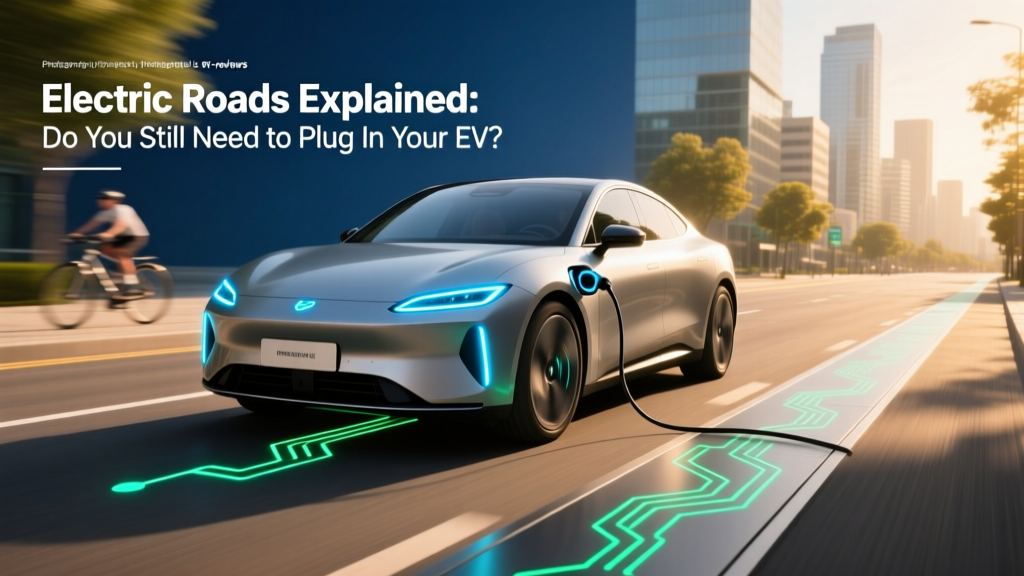
Electric roads — also called dynamic wireless charging lanes or electrified roadways — embed power-delivery hardware directly into pavement so a specially equipped EV can charge while driving. As of 2026, the technology works but is deployed only in short pilot segments (typically 0.5–2 miles) in places like Detroit, Sweden's E16 corridor, and select European test tracks. It does not eliminate the need to plug in, and no consumer EV sold in the U.S. today ships with the required receiver hardware as standard. For buyers, electric roads are a future consideration, not a current purchasing factor. Your real-world EV decision still hinges on EPA range, home Level 2 charging access, DC fast-charge speed (kW), and the federal §30D tax credit.
What Electric Roads Actually Are (and Aren't)
Electric roads deliver energy to a moving vehicle through one of three methods:
- Inductive (wireless): Coils buried in the asphalt create a magnetic field picked up by a receiver on the car's undercarriage. This is the approach used in the ENRX (formerly Electreon) Detroit pilot on a 1-mile stretch of Woodward Avenue.
- Conductive rail: A powered rail sits in or beside the road, contacted by a mechanical arm on the vehicle — similar to how slot cars or trams draw power. Sweden's eRoadArlanda project used this method.
- Overhead catenary: Wires above the road power trucks via pantographs, like a trolley. Tested in Germany's A5 autobahn eHighway pilot for heavy freight, not passenger cars.
None of these systems charge a standard Tesla Model Y, Ford Mustang Mach-E, or Hyundai Ioniq 5 off the showroom floor. The vehicle must be retrofitted or factory-equipped with a specific receiver, and the road must be purpose-built. Today's electric-road segments are measured in miles, not thousands of miles of interstate.
The Numbers: Pilot Data, Power Levels, and Costs
Here's what the limited real-world data tells us about dynamic charging feasibility:
| Project | Location | Length | Power Transfer | Method | Status |
|---|---|---|---|---|---|
| ENRX / MDOT Pilot | Detroit, MI (Woodward Ave) | ~1 mile | Up to 200 kW (theoretical), ~20–50 kW sustained in testing | Inductive | Operational pilot since 2023, expanded 2025 |
| eRoadArlanda | Stockholm, Sweden | ~1.2 miles | ~300 kW peak (conductive rail) | Conductive rail | Testing phase; commercial roadmap unclear |
| eHighway A5 | Hesse, Germany | ~6 miles | ~450 kW (overhead) | Catenary | Pilot ended 2023; battery-electric trucks favored |
| ARENA / Project ATLAS | Australia (Victoria) | Announced | TBD | Inductive | Announced; construction pending |
For context, a modern DC fast charger delivers 150–350 kW at a fixed station. Electric roads aim for similar power levels but face massive infrastructure cost: estimates from the Indiana DOT and Purdue University research peg inductive electrified lanes at $1.1 million to $2.5 million per lane-mile to install, not including ongoing maintenance, grid interconnection, or receiver hardware on vehicles.
A standard 2026 Hyundai Ioniq 5 (Long Range AWD, 84 kWh usable battery, NMC chemistry) has an EPA range of 290 miles, peaks at 240 kW DC fast charging (10–80% in ~18 minutes), and starts at $47,350 MSRP. An electric road delivering even 50 kW continuously over a 100-mile highway stretch would add roughly 100 miles of range en route — meaningful for freight corridors, marginal for a commuter who already plugs in at home overnight.
EV vs. Gas vs. Hybrid: Do Electric Roads Change the Math?
Short answer: not yet. The economics of EV ownership in 2026 are driven by home electricity rates, DC fast-charging access, and the federal §30D clean vehicle credit (up to $7,500 with MSRP, income, and battery-sourcing requirements), not dynamic charging.
| Category | 2026 EV (e.g., Ioniq 5 Limited, ~$52k MSRP) | 2026 PHEV (e.g., RAV4 Prime, ~$46k) | 2026 Gas (e.g., RAV4 LE, ~$32k) |
|---|---|---|---|
| Purchase after §30D / incentives | ~$44,500 (if eligible) | ~$42,250 (partial credit) | $32,000 |
| Fuel/energy (5 yrs) | $4,200 (home L2 @ $0.14/kWh) | $5,800 (gas + electric mix) | $11,250 (@ $3.50/gal, 28 MPG) |
| Maintenance (5 yrs) | $1,800 | $3,200 | $4,500 |
| Insurance premium delta | +$1,200 over 5 yrs vs. gas avg | +$600 | Baseline |
| Estimated 5-yr total | ~$51,700 | ~$51,850 | ~$47,750 |
Sources: EPA fueleconomy.gov, IRS §30D rules, AAA Your Driving Costs 2025. Actual costs vary by state, utility rate, and driving pattern. Federal credit eligibility depends on MSRP caps ($55k cars / $80k SUVs/pickups), buyer AGI limits, and critical-mineral/battery-component sourcing — consult a tax professional.
Even if a 50-mile electric-road corridor existed on your commute, the fuel savings would be modest compared to the cost differential already captured by home charging. Electric roads make the most sense for heavy-duty freight where battery weight and downtime are prohibitive — not a 4,500-lb passenger crossover.
Real-World Ownership: What Actually Matters in 2026
Before speculating about future infrastructure, get these fundamentals right:
Home Charging Access
Level 2 home charging (240V, 7.7–11.5 kW) adds 25–44 miles of range per hour and is the backbone of practical EV ownership. Expect $500–$2,000 for a quality Level 2 EVSE plus $800–$3,000 for electrician installation depending on panel capacity. A 200-amp panel with spare breaker slots handles most installations; a panel upgrade to 200A or 400A can add $2,000–$5,000. If you live in an apartment or lack a dedicated parking spot, public charging reliability — not electric roads — is your real concern.
Climate and Range Reality
EPA range is measured under ideal conditions. Expect 15–30% range loss in sub-freezing weather (below 30°F) due to battery chemistry and cabin heating demands. A 290-mile EPA Ioniq 5 might deliver 200–230 miles in a Minnesota January. Heat pumps (standard on most 2026 Hyundai/Kia/Tesla models) mitigate this by 5–10 percentage points. Highway driving at 75+ mph also reduces range 10–15% versus the EPA combined cycle.
DC Fast-Charging Curve Taper
Peak charge rates (e.g., 240 kW) apply only between roughly 10–50% state of charge. Above 80%, the charge curve tapers dramatically to protect battery health — a session from 80–100% can take as long as 10–80%. Plan road trips around 10–80% charging windows, not 0–100%.
Common Electric Road Myths vs. Facts
| Myth | Fact |
|---|---|
| "Electric roads mean I never have to plug in." | Current pilots cover single-digit miles. You still plug in at home and at DC fast stations for 99%+ of driving. |
| "My Tesla or Ford can use electric roads today." | No consumer vehicle sold in the U.S. has a factory-installed dynamic charging receiver. Retrofit kits are commercial/fleet-only. |
| "The government is building electric highways everywhere." | Federal and state DOTs are funding research pilots, not production deployment. No interstate-scale electric road is funded or under construction as of 2026. |
| "Inductive charging from roads damages my battery." | Power levels in testing (20–50 kW sustained) are well within battery-management-system tolerances. No degradation data suggests harm. |
| "Electric roads will make smaller batteries viable." | Theoretically yes — a vehicle that charges while driving could carry a 40–60 kWh pack instead of 80–100 kWh. But this requires thousands of miles of electrified road, not pilot segments. |
Decision Framework: Should Electric Roads Factor Into Your 2026 EV Purchase?
Use This If/Then Logic
- IF you can install Level 2 at home and drive under 60 miles/day: THEN buy any mainstream EV (Model Y, Ioniq 5, EV6, Equinox EV) now. Electric roads are irrelevant to your use case.
- IF you lack home charging and rely on public DC fast chargers: THEN prioritize vehicles with ≥200 kW peak charge rates and NACS access to Tesla Superchargers (now open to Ford, GM, Rivian, Hyundai, and others via adapter or native port). Electric roads won't help you for at least a decade.
- IF you drive 300+ miles on highways regularly in cold climates: THEN choose an EV with ≥320 miles EPA range and a heat pump (e.g., Model Y Long Range at 330 mi EPA, or Rivian R1S Dual-Motor at 352 mi EPA). Plan charging stops around the 10–80% curve, not speculative infrastructure.
- IF you operate a commercial fleet on a fixed corridor: THEN electric roads may become relevant within 5–8 years. Engage with pilot programs (INDOT, Caltrans, MDOT) and spec vehicles with receiver-ready platforms.
- IF you're considering a PHEV because you're unsure about charging access: THEN a PHEV (RAV4 Prime: 42 mi electric-only, 38 MPG combined, ~$46k MSRP) remains a practical bridge. Electric roads don't change this calculus.
What a First-Time EV Buyer Should Know Instead
The headlines about electric roads are exciting but premature. Here's what actually determines your ownership experience:
- Battery chemistry matters. LFP (lithium iron phosphate) batteries — found in the Tesla Model 3 RWD and base Model Y — tolerate daily 100% charging and degrade more slowly but offer ~10% less range per kWh than NMC. NMC packs (most long-range EVs) prefer 20–80% daily cycling for longevity.
- Warranty is your safety net. Federal law mandates a minimum 8-year/100,000-mile battery warranty with a capacity-retention threshold (typically 70% of original capacity). Hyundai/Kia offers 10 years/100,000 miles. Track your State of Health (SoH) via the vehicle's battery management display.
- Tax credits are not guaranteed. The §30D credit requires the vehicle's MSRP to fall under caps ($55,000 for sedans/wagons, $80,000 for SUVs/pickups/vans), your adjusted gross income to be below $150k single / $300k joint filers, and the battery to meet critical-mineral and component sourcing thresholds that tighten annually. Many popular EVs qualify for only $3,750 or $0 in 2026. Verify on fueleconomy.gov before purchasing.
- NACS is winning. Tesla's North American Charging Standard has been adopted by nearly every major automaker for 2025–2026 models. CCS1 is being phased out on new vehicles. If you're buying a 2024 CCS vehicle, confirm adapter availability for Supercharger access.
- Insurance costs more. EV premiums average 15–25% higher than equivalent gas vehicles due to repair complexity and battery replacement costs. Get quotes before signing a purchase agreement.
Frequently Asked Questions
Are electric roads available anywhere in the U.S. for public use?
Only in limited pilot form. The most notable U.S. deployment is the ENRX/Electreon inductive charging segment on Woodward Avenue in Detroit, Michigan — roughly 1 mile of instrumented road used primarily for testing with equipped fleet vehicles. There is no public consumer electric-road network you can drive on today with a standard EV.
How much would it cost to electrify the U.S. interstate system?
Rough estimates based on pilot data suggest $1–2.5 million per lane-mile for inductive systems. The U.S. has approximately 48,000 miles of interstate highways with an average of 4 lanes, implying a cost in the range of $200–500 billion — not including grid upgrades, maintenance, or vehicle-side receivers. For comparison, the 2021 Infrastructure Investment and Jobs Act allocated $7.5 billion specifically for EV charging networks, a fraction of what full roadway electrification would require.
Will my 2026 EV be compatible with future electric roads?
Almost certainly not without a significant aftermarket retrofit, and no major automaker has announced factory-installed dynamic wireless charging receivers for U.S.-market consumer vehicles. If electric roads scale in the 2030s, it will likely be for purpose-built commercial and transit fleets first.
Do electric roads work in rain, snow, and ice?
Inductive systems function through non-metallic surfaces and are sealed beneath the road surface, so precipitation doesn't directly interfere with magnetic coupling. However, snow plows, road salt corrosion, freeze-thaw pavement damage, and heavy-vehicle wear all present maintenance challenges that pilot programs are still evaluating. Conductive rail systems are more vulnerable to weather and debris.
Should I wait for electric roads before buying an EV?
No. Electric roads are a 10–20-year infrastructure prospect for passenger vehicles at best. Today's EVs with 250–350 miles of EPA range, 200–350 kW DC fast charging, and home Level 2 access solve the range problem for the vast majority of drivers. The technology you need to own an EV confidently already exists and is widely available.
What's the difference between electric roads and battery swapping?
Battery swapping (pioneered by NIO in China) replaces a depleted battery pack with a fully charged one in ~3–5 minutes at a dedicated station. Electric roads deliver energy continuously while the vehicle drives. Battery swapping requires standardized pack designs across manufacturers and significant station inventory; electric roads require standardized receiver hardware and billions in pavement infrastructure. Neither has scaled meaningfully in the U.S. passenger vehicle market as of 2026.