Quick Answer: Yes, You Can Bring an Electric Razor on a Plane
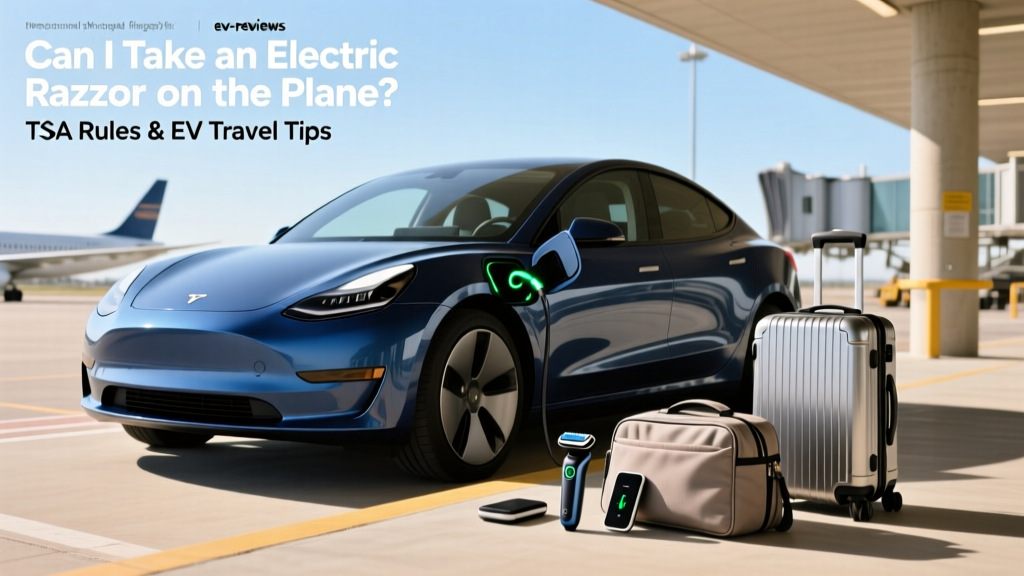
The TSA permits electric razors in both carry-on and checked luggage with no special restrictions. Lithium-ion batteries inside the razor are small enough (typically under 2 Wh) to fall well below the FAA's 100 Wh carry-on limit. You do not need to remove the razor from your bag at security, and no airline currently bans them. If you're flying to pick up a new EV or combining air travel with an electric road trip, pack your razor in your carry-on to avoid any checked-bag battery concerns.
TSA and FAA Rules for Electric Razors in 2026
The TSA's prohibited items list does not include electric razors or personal grooming devices. They are treated like any other small electronic device — phones, tablets, or electric toothbrushes. The relevant regulation is the FAA's lithium battery rule, which restricts spare (uninstalled) lithium batteries over 100 Wh in carry-on bags and bans them entirely from checked luggage.
A typical electric razor contains a lithium-ion cell rated between 1.5 Wh and 5 Wh — a fraction of the 100 Wh threshold. For context, a laptop battery runs 50–90 Wh, and even those fly without issue when installed in the device.
Key Rules at a Glance
- Carry-on: Allowed. No declaration required.
- Checked bag: Allowed when the battery is installed in the device. The device must be powered off and protected from accidental activation.
- Spare batteries: If your razor uses removable lithium cells, pack spares in your carry-on only, in original packaging or a battery case.
- International flights: IATA mirrors FAA rules. No major international carrier bans installed-device batteries under 100 Wh.
Why EV Owners Ask This Question (and What They Really Need to Know)
Searches for "can I take an electric razor on the plane" spike among EV buyers who are flying to another state to pick up a vehicle, attending an EV delivery event, or planning a multi-modal trip that combines a flight with an electric road leg. The underlying concern isn't the razor — it's battery anxiety transferring from the car to the suitcase.
Here's the reality check: your EV's traction battery (60–120 kWh) and your razor's battery (1.5–5 Wh) share chemistry but not regulatory treatment. The FAA's concern is fire risk from damaged or short-circuited spare cells in the cargo hold. An installed, intact razor battery poses negligible risk.
Common Misconceptions About Batteries and Air Travel
| Myth | Fact |
|---|---|
| "All lithium batteries are banned on planes." | Only spare batteries over 100 Wh face restrictions. Installed batteries in personal devices are unrestricted. |
| "I must declare my electric razor at security." | No declaration needed. TSA does not flag grooming devices. |
| "My EV battery makes all my electronics risky." | Your EV battery stays in the car. Air travel rules apply to what you carry, not what you drove to the airport. |
| "Airlines ban all battery-powered devices in checked bags." | Installed batteries in powered-off devices are permitted in checked luggage. Spare lithium batteries are carry-on only. |
Flying to Pick Up an EV? Here's Your Ownership Cost Snapshot
If you're flying cross-country to take delivery of an EV — a common move given limited dealer inventory in some states — the razor question is just one item on a longer checklist. The real numbers that matter are what you'll spend to own and operate the vehicle once you drive it home.
Let's use the 2026 Tesla Model Y Long Range AWD as a representative mid-size electric SUV, since it remains one of the most-purchased EVs nationally.
2026 Tesla Model Y Long Range AWD — 5-Year Ownership Cost vs. Gas Equivalent
| Cost Category | Model Y (EV) | Toyota RAV4 AWD (Gas) |
|---|---|---|
| Base MSRP | $44,990 | $32,350 |
| Federal §30D tax credit (if eligible) | −$7,500* | $0 |
| Effective purchase price | $37,490 | $32,350 |
| Energy/fuel cost (5 yr, 75,000 mi) | $3,750 (home L2, $0.15/kWh) | $9,375 ($3.50/gal, 30 MPG) |
| Maintenance (5 yr) | $1,200 | $3,500 |
| Insurance (5 yr avg.) | $9,500 | $7,200 |
| Estimated depreciation | $18,000 | $14,500 |
| Total 5-year cost | $69,940 | $66,925 |
*The IRS §30D credit requires buyer income under $150K (single) / $300K (joint), vehicle MSRP under $80K for SUVs, and compliance with battery-sourcing and critical-minerals rules. Verify eligibility with a tax professional. Point-of-sale transfer is available at participating dealers.
The EV's fuel and maintenance savings ($7,925 over five years) nearly close the upfront gap, even before accounting for state rebates or utility off-peak charging discounts. Insurance remains the main cost headwind — EV premiums run 15–25% higher on average due to repair complexity and parts pricing.
EV vs. Gas vs. Hybrid: A Data-Driven Comparison
Whether you're flying to grab a BEV, a PHEV, or sticking with gas depends on your driving pattern, home charging access, and climate. Here's how the three powertrains stack up using real EPA figures.
| Metric | BEV (Model Y LR) | PHEV (Toyota RAV4 Prime) | Gas (RAV4 AWD) |
|---|---|---|---|
| EPA range / electric range | 320 mi | 42 mi electric, 600 mi total | 448 mi (14.5 gal tank) |
| Efficiency | 122 MPGe / 28 kWh/100mi | 94 MPGe (EV mode), 38 MPG (gas) | 30 MPG combined |
| 0-60 mph | 5.0 sec | 5.7 sec | 8.1 sec |
| Battery / chemistry | 75 kWh usable, NMC | 18.1 kWh, NMC | N/A |
| Max DC fast charge | 250 kW peak (10-80% ~25 min) | 6.6 kW (Level 2 only) | N/A |
| Annual fuel/energy cost* | $750 | $1,050 (mixed driving) | $1,875 |
| Powertrain warranty | 8 yr / 120,000 mi | 10 yr / 150,000 mi (hybrid sys.) | 5 yr / 60,000 mi |
*Based on 15,000 mi/yr, $0.15/kWh home charging, $3.50/gal gasoline. Source: fueleconomy.gov.
Real-World Range: What the EPA Sticker Doesn't Tell You
The Model Y's 320-mile EPA rating assumes mixed driving at moderate temperatures. In real-world highway use at 75 mph, expect 260–280 miles. In sub-freezing winter conditions (below 30°F), cold-weather range loss of 20–30% is typical, dropping usable range to 220–250 miles. Battery preconditioning — routing the car to a Supercharger — partially mitigates this by warming the pack for faster charging.
The RAV4 Prime's 42-mile electric range covers most daily commutes gas-free, and its gas engine eliminates range anxiety entirely on road trips. For buyers without reliable home charging, a PHEV is often the more practical bridge.
Home Charging Access: The Make-or-Break Factor
Owning a BEV without home charging is possible but significantly less convenient and more expensive. Public DC fast charging costs $0.30–$0.50/kWh on networks like Electrify America and EVgo — roughly double to triple the cost of home Level 2 charging at $0.10–$0.18/kWh depending on your utility.
Home Level 2 Installation Cost Breakdown
| Component | Typical Cost Range |
|---|---|
| Level 2 charger (240V, 32–48A) | $300–$700 |
| Electrician labor (4–8 hrs) | $600–$1,800 |
| Permit & inspection | $50–$250 |
| Electrical panel upgrade (if needed, 100A→200A) | $1,500–$3,500 |
| Total (no panel upgrade) | $950–$2,750 |
| Total (with panel upgrade) | $2,450–$6,250 |
A 48-amp Level 2 charger delivers roughly 11.5 kW of power, adding about 35–44 miles of range per hour of charging — enough to fully replenish most EV batteries overnight in 6–9 hours. This is the single biggest ownership advantage of a BEV: waking up to a full "tank" every morning for roughly $0.04–$0.05 per mile.
If you live in an apartment, rely on street parking, or lack access to a dedicated 240V circuit, a PHEV or HEV eliminates this barrier entirely while still cutting fuel consumption.
Decision Framework: Which Powertrain Fits Your Life?
If This Is You → Choose This
- If you have a garage or driveway with 240V access, drive under 250 miles/day, and want the lowest per-mile cost → BEV (Model Y, Ioniq 5, Equinox EV).
- If you lack home charging but want electric commuting for short trips → PHEV (RAV4 Prime, Wrangler 4xe, Tucson PHEV).
- If you regularly drive 400+ miles between stops, tow heavy loads, or live in extreme cold with sparse charging infrastructure → HEV or gas remains practical for now.
- If you're buying a second car for commuting and have one gas vehicle for road trips → BEV as the daily driver maximizes savings.
- If you qualify for the full §30D credit and your target BEV's MSRP is under the cap → the effective price gap narrows substantially, favoring BEV.
What First-Time EV Buyers Should Know Before Flying to Pick Up a Car
- Verify tax credit eligibility before signing. The §30D credit has income caps ($150K single, $300K joint), MSRP caps ($55K sedans, $80K SUVs/trucks), and battery-sourcing requirements that change annually. Check IRS.gov or consult a tax professional before assuming $7,500 off.
- Plan your drive-home route around chargers. Use A Better Routeplanner or the car's native navigation to map DC fast-charger stops. Plan for 20–30 minute breaks every 200–250 miles on the highway.
- Activate insurance before you leave the lot. Most insurers let you bind coverage by phone. EV-specific insurers (like Tesla Insurance in eligible states) may offer competitive rates.
- Set up home charging before delivery. Schedule your electrician 2–4 weeks ahead. A Level 2 install takes 4–8 hours once the panel and conduit are ready.
- Understand the charge curve. DC fast charging peaks at the advertised kW (e.g., 250 kW) only at low state-of-charge (10–30%). Above 80%, charging slows dramatically to protect the battery. Plan your stops to charge from 10–80%, not 0–100%.
Frequently Asked Questions
Do I need to take my electric razor out at airport security?
No. TSA does not require you to remove electric razors, toothbrushes, or similar personal electronics from your bag. Only laptops and tablets larger than a cell phone need separate screening bins at standard lanes (TSA PreCheck exempts even those).
Can I pack a cordless razor with a lithium battery in checked luggage?
Yes, as long as the battery is installed in the device, the device is powered off, and it's protected from accidental activation (e.g., in a travel case). Spare lithium batteries must go in carry-on only.
Does flying with electronics affect my EV's battery warranty?
No. Your EV's battery warranty (typically 8 years/100,000 miles minimum, per federal mandate) covers the car's traction battery. Personal electronics have no bearing on it.
What if my electric razor has a removable battery?
If the battery is lithium-ion and removable, pack it in your carry-on in its original packaging or a protective case to prevent short circuits. Installed batteries can stay in the razor in either carry-on or checked bags.
Are there any airlines that ban electric razors?
No major U.S. or international airline bans electric razors. All follow IATA/FAA guidelines that permit personal electronic devices with installed lithium batteries under 100 Wh.
Can I charge my electric razor on the plane?
Most airlines allow you to use USB ports or seatback power to charge small personal devices during cruise. Check with your specific airline, as some restrict power use during taxi, takeoff, and landing.
The Bottom Line for EV Owners and Travelers
Your electric razor is the least complicated battery you'll deal with as an EV owner. It flies without restriction, needs no special handling, and won't raise a single eyebrow at TSA. The bigger battery questions — home charging installation, real-world highway range, §30D credit eligibility, and DC fast-charging logistics — are where your research time should go. Pack the razor in your carry-on, and spend the flight planning your charge stops on the drive home.