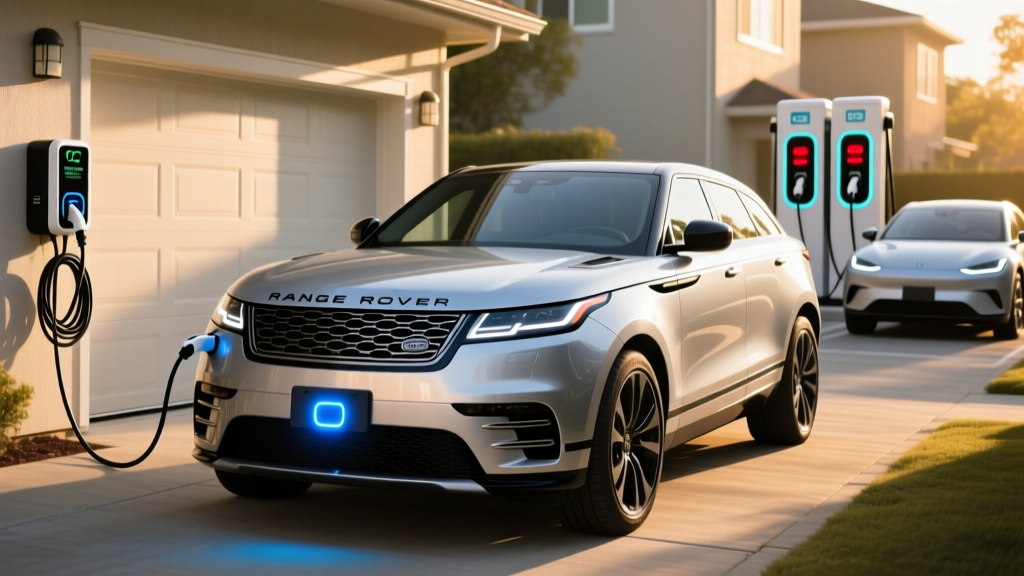
The Range Rover Velar has long been Land Rover's design-forward midsize SUV, and its transition to an all-electric powertrain on the Flexible Modular Architecture (FMA) marks a pivotal moment for the brand. But owning the electric Range Rover Velar isn't just about luxury and off-road pedigree — it's about understanding how to keep its large battery pack charged efficiently at home and on the road. This guide breaks down the exact charging specifications, home installation requirements, equipment picks, and per-mile costs you'll face as a Velar EV owner.
Electric Range Rover Velar: Battery and Charging Specs at a Glance
Before we discuss chargers and installations, let's establish the vehicle's core electrical architecture. The electric Range Rover Velar is expected to feature a battery pack in the range of 100-117 kWh (usable capacity), built on Land Rover's 800-volt-capable FMA platform. This voltage architecture is critical — it enables faster DC charging by pushing higher power at lower current, reducing heat and improving charge-curve sustainability.
Electric Range Rover Velar — Estimated Charging Specs
| Battery Capacity (usable) | ~100-117 kWh (NMC chemistry) |
| EPA Range (est.) | ~280-350 miles (final EPA pending) |
| Max DC Fast Charge Rate | ~200-250 kW peak (800V architecture) |
| 10-80% DC Fast Charge Time | ~25-30 minutes (est.) |
| Level 2 AC Charge Rate | 11 kW (onboard charger) |
| Level 2 Full Charge Time (0-100%) | ~10-11 hours |
| Charging Port / Connector | CCS1 (US market); NACS adapter expected |
Note: Specs are based on announced FMA platform data and may be revised upon official US launch. Always verify with Land Rover USA for final model-year figures.
Charging Levels Explained: How Fast Will Each Add Range?
Understanding the three charging tiers is essential for planning daily routines and road trips with the Velar EV. Power is measured in kilowatts (kW) — the rate of energy delivery — while your battery stores energy in kilowatt-hours (kWh). Think of kW as how fast water flows from a hose, and kWh as the total volume in the bucket.
| Charging Level | Voltage / Current | Power (kW) | Miles of Range Added per Hour | Best Use Case |
|---|---|---|---|---|
| Level 1 | 120V / 12A | ~1.4 kW | ~3-4 miles/hr | Emergency top-up only; adds ~40 miles overnight |
| Level 2 | 240V / 40-48A | 9.6-11.5 kW | ~28-35 miles/hr | Daily home charging; full overnight refill |
| DC Fast Charging | 400-800V DC | 50-250 kW | ~150-500+ miles/hr (peak) | Road trips; 10-80% in ~25-30 min |
For a ~110 kWh battery like the Velar's, Level 1 charging is effectively useless for anything beyond maintaining charge if you're parked for multiple days. Level 2 is the workhorse — plugging in overnight for 10 hours adds roughly 280-350 miles, comfortably refilling the pack. DC fast charging is your road-trip solution, but understand the charge curve: the Velar will pull peak power (200-250 kW) only between roughly 10-40% state of charge, then taper progressively. The 10-80% time is the useful benchmark, not the peak kW number.
Home Charger Installation: Requirements, Costs, and Panel Upgrades
Installing a Level 2 home charger for the electric Range Rover Velar is the single most impactful ownership decision you'll make. The majority of EV charging happens at home, and a properly installed Level 2 station means waking up to a full battery every morning.
Electrical Requirements
The Velar's 11 kW onboard charger can accept up to 48 amps on a 240-volt circuit. For maximum charging speed, you'll want a dedicated 60-amp circuit (which delivers 48A continuous per the 80% electrical code rule for continuous loads). A 50-amp circuit (40A continuous / 9.6 kW) is also acceptable and will fully charge the Velar in roughly 12 hours — still adequate for overnight use.
Will You Need a Panel Upgrade?
This is where costs can escalate. Most homes built after 1990 have a 200-amp main electrical panel, which typically supports a 60-amp EV circuit without issue. However, if your home has a 100-amp panel (common in older construction), or if your existing panel is near capacity with HVAC, electric oven, dryer, and other large loads, you may need a panel upgrade to 200A or a load-management device that throttles charger draw when other appliances cycle on.
| Cost Component | Low Estimate | High Estimate | Notes |
|---|---|---|---|
| Level 2 Charger (Equipment) | $350 | $750 | Smart Wi-Fi chargers, 40-48A, 25ft cable |
| Electrician Labor | $400 | $1,500 | Depends on run length, conduit, wall type |
| Permit & Inspection | $50 | $250 | Required by most jurisdictions |
| Panel Upgrade (if needed) | $1,500 | $3,500 | 200A upgrade; only if existing panel is insufficient |
| TOTAL (no panel upgrade) | $800 | $2,500 | Typical scenario for modern homes |
| TOTAL (with panel upgrade) | $2,300 | $6,000 | Older homes or 100A panels |
Federal incentive note: The §30D tax credit covers the vehicle itself, but a separate credit under IRC §25C (Energy Efficient Home Improvement Credit) may cover up to 30% of home charging equipment and installation costs (capped at $1,000). Verify current eligibility on IRS.gov and consult a tax professional, as rules and caps change.
Connector Compatibility: NACS, CCS, and Adapter Realities
The EV charging connector landscape has consolidated significantly since 2023, when Ford and GM began adopting the North American Charging Standard (NACS) developed by Tesla. For the electric Range Rover Velar's US launch, the vehicle is expected to ship with a CCS1 (Combined Charging System) port — the legacy standard still used by most non-Tesla OEMs. However, Land Rover has indicated NACS adapter support, which is critical for accessing the Tesla Supercharger network.
| Connector Type | Network Access | Velar Compatibility | Adapter Needed? |
|---|---|---|---|
| CCS1 | Electrify America, EVgo, ChargePoint, Ionity | Native (expected) | No |
| NACS (Tesla) | Tesla Supercharger network (17,000+ stalls) | Via adapter | Yes — CCS-to-NACS adapter (~$200-400) |
| CHAdeMO | Legacy; largely retired in US | Not compatible | N/A — network mostly decommissioned |
Practical advice: Purchase a CCS-to-NACS adapter from Land Rover or an approved third party at purchase. The Tesla Supercharger network remains the most reliable and widespread DC fast-charging infrastructure in the US, and having adapter access eliminates a major pain point for road-trip charging. For home Level 2 charging, any J1772 connector (the universal Level 2 standard) will work — NACS and CCS vehicles both accept J1772 for AC charging.
Charging Cost Per Mile: Velar EV vs Gas Equivalent
One of the strongest ownership arguments for the electric Velar is fuel cost savings — but the math depends heavily on how and where you charge. Let's compare the electric Velar against a gas-powered Range Rover Velar P400 (which averages roughly 21 MPG combined per EPA data).
| Scenario | Rate | Cost per Mile (Velar EV) | Cost per Mile (Gas Velar P400) |
|---|---|---|---|
| Home Off-Peak (utility TOU rate) | $0.10/kWh | $0.031 | $0.17 (at $3.60/gal, 21 MPG) |
| Home Standard Rate | $0.16/kWh | $0.049 | $0.17 |
| Public Level 2 (ChargePoint, etc.) | $0.30/kWh | $0.092 | $0.17 |
| DC Fast Charging (Electrify America) | $0.48/kWh | $0.148 | $0.17 |
Assuming the Velar EV averages roughly 3.2 miles per kWh (a reasonable estimate for a luxury SUV of this mass and aerodynamics), home off-peak charging delivers roughly 80% lower fuel cost per mile compared to gasoline. Even at DC fast-charging prices, you're still saving modestly — but frequent reliance on public DC charging erodes the economic advantage significantly. The takeaway: home charging access is the economic linchpin of EV ownership.
Best Home Level 2 Chargers for the Electric Range Rover Velar
With an 11 kW onboard charger, the Velar can take full advantage of 48-amp Level 2 stations. Here are three proven options suited to a luxury EV owner's expectations for build quality, smart features, and reliability.
Best Overall: ChargePoint Home Flex
- Power: Up to 11.5 kW (48A, 240V)
- Connector: J1772 (compatible with Velar CCS/NACS)
- Cable Length: 23 feet
- Smart Features: Wi-Fi, app scheduling, Alexa, energy reporting
- Amperage Adjustable: 16A-48A to match circuit
- NEMA Rating: NEMA 4 (indoor/outdoor rated)
- Price: ~$550-$700
UL-listed, adjustable amperage means you can install on a 50A or 60A circuit and configure accordingly. Excellent app and reliability track record.
Premium Pick: Tesla Universal Wall Connector
- Power: Up to 11.5 kW (48A, 240V)
- Connector: Built-in NACS + J1772 adapter included
- Cable Length: 24 feet
- Smart Features: Wi-Fi, OTA updates, power-sharing between units
- Amperage Configurable: Via app
- NEMA Rating: NEMA 4 (outdoor rated)
- Price: ~$600
Ideal if you also own a Tesla or want native NACS without adapters. The integrated J1772 adapter means it works with any CCS-equipped EV including the Velar.
Value Smart Charger: Emporia Level 2
- Power: Up to 11.5 kW (48A, 240V)
- Connector: J1772
- Cable Length: 24 feet
- Smart Features: Wi-Fi, detailed energy tracking, solar integration, load management
- Amperage: Configurable via app
- NEMA Rating: NEMA 4
- Price: ~$350-$400
Best energy-monitoring app in the segment. Ideal if you have solar panels or want granular cost tracking. Slightly less premium build than ChargePoint but strong value.
All three chargers deliver the full 11 kW the Velar can accept. The decision comes down to ecosystem preference (Tesla integration), monitoring depth (Emporia), or brand trust (ChargePoint). Avoid undersized 32A or 16A