The Bottom Line on the Electric Ram 1500
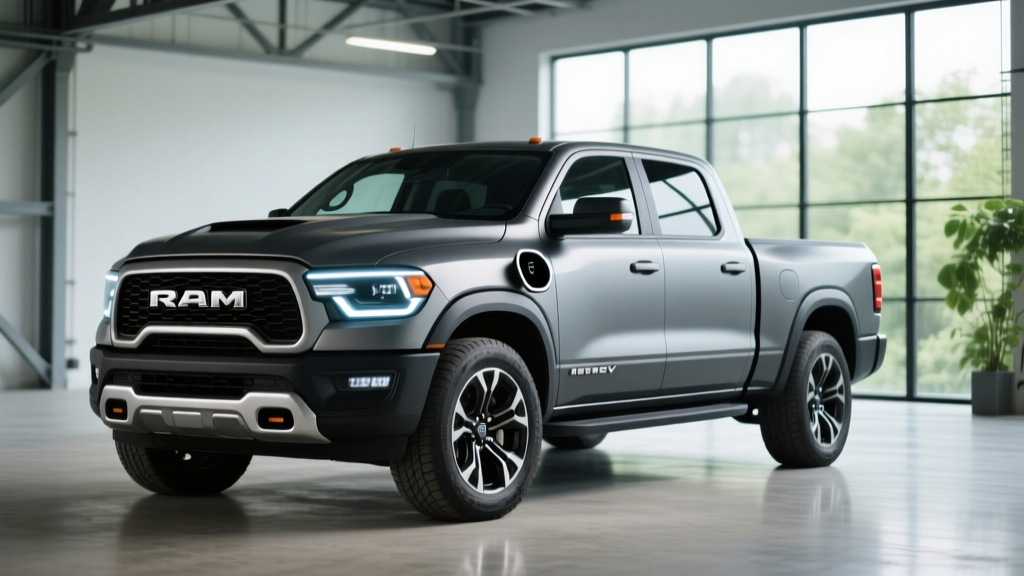
The 2026 Ram 1500 REV is a full-size battery-electric pickup built on Stellantis' STLA Frame platform with a 92 kWh NMC battery delivering an EPA-estimated 340 miles of range (in the standard-pack Tradesman and Big Horn trims). A larger 229 kWh battery pack option targets up to 500 miles of EPA range on higher trims. Pricing starts around $58,095 before destination, and federal tax credit eligibility under IRS §30D depends on battery sourcing, buyer income, and MSRP caps — it is not a guaranteed $7,500 for every buyer. If you tow frequently over 5,000 lbs, expect real-world range to drop by 40–55%. If your daily driving stays under 100 miles with home Level 2 charging, the REV cuts fuel and maintenance costs substantially versus a gas V6 or Hemi Ram 1500.
Specs That Matter: Battery, Range, and Charging
The Ram 1500 REV uses a dual-motor all-wheel-drive layout producing up to 654 horsepower and 620 lb-ft of torque, with a 0–60 mph time in the mid-4-second range. But for truck buyers, the battery and charging specs carry more weight than acceleration numbers.
| Specification | Standard Pack (92 kWh) | Extended Pack (229 kWh) |
|---|---|---|
| Usable Battery Capacity | ~92 kWh (NMC) | ~229 kWh (NMC) |
| EPA Range | ~340 miles | ~500 miles (est.) |
| Real-World Highway Range | ~260–290 miles | ~380–420 miles |
| Real-World Towing Range (5,000+ lbs) | ~150–190 miles | ~230–280 miles |
| Peak DC Fast Charge Rate | ~230 kW | ~230 kW |
| 10–80% DC Fast Charge | ~24 minutes | ~45 minutes |
| Level 2 Home Charging (11.5 kW) | ~9 hours (0–100%) | ~22 hours (0–100%) |
| Horsepower / Torque | 654 hp / 620 lb-ft | 654 hp / 620 lb-ft |
| 0–60 mph | ~4.4 seconds | ~4.4 seconds |
| Max Towing Capacity | ~14,000 lbs | ~14,000 lbs |
| Max Payload | ~2,700 lbs | ~2,600 lbs |
Real-World Range Reality Check
The EPA sticker says 340 miles for the standard pack. In practice, expect 260–290 miles on a highway road trip at 70–75 mph, and significantly less — around 150–190 miles — when towing a 5,000+ lb trailer. Cold weather (below 30°F) can reduce range by an additional 20–30% due to battery heating demands and cabin climate load. The Ram 1500 REV includes a heat pump for improved cold-weather efficiency, but physics still governs: a large, boxy truck pushing air at highway speeds consumes energy fast. Plan charging stops around 200-mile intervals on road trips with the standard pack to maintain a comfort buffer.
EV vs Gas Ram 1500: The Numbers Side by Side
How does the electric Ram 1500 REV stack up against the gas-powered Ram 1500 with the 3.6L Pentastar V6 (the volume seller) and the 5.7L Hemi V8? Here's a data-driven comparison using EPA figures from fueleconomy.gov and manufacturer MSRP.
| Metric | Ram 1500 REV (92 kWh) | Ram 1500 Gas V6 (3.6L eTorque) | Ram 1500 Gas V8 (5.7L Hemi) |
|---|---|---|---|
| Starting MSRP | ~$58,095 | ~$42,670 | ~$48,670 |
| Energy/Fuel Cost per Mile | ~$0.05–0.07 (home charging) | ~$0.17 (at $3.50/gal, 22 MPG) | ~$0.20 (at $3.50/gal, 17 MPG) |
| Annual Fuel/Energy (15k mi/yr) | ~$750–1,050 | ~$2,550 | ~$3,000 |
| Annual Maintenance (est.) | ~$200–350 | ~$600–900 | ~$700–1,000 |
| EPA Combined Efficiency | ~72 MPGe | 22 MPG combined | 17 MPG combined |
| Federal Tax Credit (§30D) | Up to $7,500 (if eligible) | $0 | $0 |
| 5-Year Fuel/Energy Cost | ~$3,750–5,250 | ~$12,750 | ~$15,000 |
The upfront price gap is real: roughly $15,000 more for the REV versus the V6 gas model. But over five years and 75,000 miles, the REV saves approximately $7,500–10,000 in fuel alone, plus another $2,000–3,000 in reduced maintenance (no oil changes, no transmission fluid, regenerative braking extends pad life). Factor in a potential $7,500 federal tax credit — bringing the effective price gap to under $5,000 — and the REV reaches cost parity around year 3–4 for drivers who charge primarily at home.
Charging at Home: What It Actually Takes
Home charging is where the ownership economics of the Ram 1500 REV succeed or fail. The truck comes with an 11.5 kW onboard charger for Level 2 AC charging, meaning a full 240-volt circuit can add roughly 25–30 miles of range per hour.
| Item | Estimated Cost |
|---|---|
| Level 2 EVSE (48-amp hardwired charger) | $500–800 |
| Electrician labor (240V/60A circuit run) | $800–2,500 |
| Electrical permit | $50–200 |
| Panel upgrade (if needed: 100A → 200A) | $1,500–3,500 |
| Total typical install | $1,350–3,500 (no panel upgrade) / $2,850–7,000 (with panel upgrade) |
The critical variable is your electrical panel. Most homes built after 2000 have 200-amp service with spare capacity for a 60-amp EV circuit. Older homes with 100-amp panels may need an upgrade. Always get a load calculation from a licensed electrician before committing — do not assume capacity based on panel label alone.
For daily use, plugging in each evening and charging overnight on Level 2 easily replenishes 100–150 miles of driving. The 92 kWh pack fully recharges in about 9 hours at 11.5 kW. The extended 229 kWh pack is a different story: a full charge takes roughly 22 hours on Level 2, meaning you'll rarely charge it from 0–100% at home. Instead, plan to keep it between 20–80% for daily use and top up opportunistically.
DC Fast Charging and Road Trip Practicality
The Ram 1500 REV's peak DC fast-charge rate of approximately 230 kW (via NACS connector, giving access to Tesla Supercharger stations with a Magic Dock adapter or natively on newer Superchargers) means a 10–80% session takes roughly 24 minutes on the standard pack.
But here's what spec sheets don't tell you: the charge curve tapers significantly above 80% State of Charge. Charging from 80–100% can take nearly as long as 10–80%. For road trips, the efficient strategy is to charge to 80% and move on — plan your stops around 180–200 mile intervals with the standard pack. With the extended 229 kWh pack, the 10–80% time stretches to roughly 45 minutes because there is simply more energy to push into a larger battery at the same peak rate.
Public charging costs vary widely. Electrify America and EVgo typically charge $0.35–0.55 per kWh, putting a 10–80% session for the standard pack at roughly $20–35. That's still cheaper than $60–80 in gas for equivalent miles, but the savings gap narrows on road trips versus daily home charging.
Tax Credits, Incentives, and True Purchase Cost
The federal EV tax credit under IRS §30D offers up to $7,500 for qualifying new EVs, but eligibility for the Ram 1500 REV hinges on several factors that change with model year and sourcing:
- MSRP cap: Pickup trucks must be under $80,000 MSRP to qualify. Most REV trims fall under this, but fully loaded Laramie Longhorn or Limited models with the extended-range pack may approach or exceed the cap.
- Buyer income limits: Modified AGI must not exceed $150,000 (single), $225,000 (head of household), or $300,000 (joint filers).
- Battery sourcing requirements: A percentage of critical minerals and battery components must be sourced from the U.S. or FTA partners. These thresholds increase annually — verify current-year compliance on the fueleconomy.gov tax credit tool.
- Point-of-sale transfer: As of 2024, eligible buyers can transfer the credit to the dealer at purchase, reducing the out-of-pocket price immediately rather than waiting for a tax refund.
State incentives vary significantly and are not covered here — check your state energy office or DSIRE database for local rebates that can stack on top of the federal credit.
5-Year Total Cost of Ownership Breakdown
| Cost Category | Ram 1500 REV (92 kWh) | Ram 1500 Gas V6 |
|---|---|---|
| Purchase Price (after $7,500 credit) | ~$50,595 | ~$42,670 |
| Fuel/Energy (5 yr, 75k mi) | ~$4,500 | ~$12,750 |
| Maintenance (5 yr) | ~$1,250 | ~$3,750 |
| Insurance (5 yr, est.) | ~$9,500 | ~$7,500 |
| Home Charger Install (one-time) | ~$2,500 | $0 |
| Estimated Depreciation (5 yr) | ~$22,000 | ~$18,000 |
| 5-Year Total | ~$90,345 | ~$84,670 |
The REV still carries a ~$5,700 premium over five years in this scenario, largely driven by higher insurance costs (EV premiums average 15–25% more than equivalent gas vehicles due to repair cost structures) and steeper projected depreciation. However, this gap narrows to near-zero if gas prices rise above $4.00/gallon, if your state offers additional rebates, or if you drive more than 15,000 miles per year. The equation flips in the REV's favor around year 6–7 for high-mileage drivers.
Battery Warranty, Longevity, and Replacement Reality
Stellantis provides an 8-year/100,000-mile warranty on the REV's high-voltage battery, covering defects and capacity loss below a specified threshold (typically 70% State of Health). This is industry-standard and mandated at the federal minimum level.
NMC batteries in large trucks face greater thermal stress from heavy loads and towing. Expect approximately 8–12% degradation over the first 100,000 miles under normal use, with the curve flattening after the initial break-in period. A full battery replacement out of warranty is estimated at $15,000–22,000 for the standard pack and substantially more for the 229 kWh extended pack — a figure that should inform your long-term ownership horizon.
Practical care tips: avoid routinely charging to 100% on the extended pack (set daily limits to 80%), use preconditioning before DC fast charging in cold weather, and minimize extended periods parked at very low or very high State of Charge in extreme temperatures.
Common Misconceptions: Fact vs Fiction
| Myth | Fact |
|---|---|
| "The REV can tow 14,000 lbs and still get 340 miles." | Max towing capacity and max range cannot be used simultaneously. Towing at max capacity cuts range by 40–55%, yielding roughly 150–190 real-world miles on the standard pack. |
| "I'll save $7,500 on every electric truck." | The §30D credit has income caps, MSRP caps, and battery sourcing requirements that change annually. Verify eligibility for your specific situation via the IRS and fueleconomy.gov before purchasing. |
| "Electric trucks need zero maintenance." | No oil changes or spark plugs, yes — but tire wear is 15–25% faster due to higher vehicle weight and instant torque. Cabin air filters, brake fluid, coolant, wiper fluid, and suspension components still require service. |
| "I can charge the 229 kWh pack overnight at home." | At 11.5 kW Level 2, a full charge takes ~22 hours. You'll charge incrementally, not fully, which is fine for daily use but matters for trip planning. |
| "The REV is self-driving with Hands-Free Active Driving Assist." | Hands-Free Active Driving Assist is an SAE Level 2 driver-assistance system. You must remain attentive, keep your eyes on the road (monitored by a driver-facing camera), and be ready to take over instantly. It is not autonomous driving. |
SAE Level 2 — Not Self-Driving
The Ram 1500 REV's Hands-Free Active Driving Assist operates at SAE Level 2: the system controls steering and speed on compatible highways, but the driver is fully responsible for monitoring the environment and intervening at any time. This is the same automation tier as Tesla Autopilot, Ford BlueCruise, and GM Super Cruise. Only driverless robotaxi services (Waymo, Zoox) operate at Level 4. No production consumer vehicle sold in 2026 is self-driving.
Decision Framework: Is the Electric Ram 1500 Right for You?
Choose the Ram 1500 REV if:
- You have access to home Level 2 charging (garage, driveway, or dedicated parking with 240V access).
- Your daily driving is under 150 miles and most charging happens at home.
- You want instant torque for light-to-moderate towing and job-site use under 5,000 lbs.
- You plan to keep the truck 5+ years to capture the full fuel/maintenance savings and ride out depreciation.
- You qualify for the federal §30D credit and/or state incentives, narrowing the upfront price gap.
- You value a quiet, vibration-free cabin and V2L (vehicle-to-load) capability for powering tools or devices on-site.
Stick with a gas or hybrid Ram 1500 if:
- You regularly tow over 7,000 lbs on long hauls (200+ miles) and cannot accommodate 30–45 minute charging stops every 150–200 miles.
- You lack reliable access to home or workplace Level 2 charging.
- You live in a region with extreme cold (sustained sub-zero temperatures) and limited DC fast-charging infrastructure.
- Your budget is firmly under $45,000 and you cannot absorb the upfront premium even with incentives.
- You plan to trade in within 3 years, where the REV's steeper early depreciation erases operational savings.
Frequently Asked Questions
What is the real-world range of the electric Ram 1500 REV?
The standard 92 kWh pack carries a ~340-mile EPA estimate. Expect 260–290 miles on highway trips at 70–75 mph, roughly 200–240 miles in cold weather (below 30°F), and 150–190 miles when towing a 5,000+ lb trailer. The extended 229 kWh pack targets ~500 miles EPA but real-world highway figures land closer to 380–420 miles.
How long does it take to charge the Ram 1500 REV at home?
On a Level 2 home charger (11.5 kW, 240V/48A), the standard 92 kWh pack charges from 0–100% in roughly 9 hours. The extended 229 kWh pack requires approximately 22 hours for a full charge. Most owners charge incrementally, topping up from 20–80% overnight, which takes 5–6 hours for the standard pack.
Does the Ram 1500 REV qualify for the $7,500 federal tax credit?
It may, depending on the trim MSRP (must be under $80,000 for trucks), your modified adjusted gross income (under $150k single / $300k joint), and whether the battery meets current-year critical mineral and component sourcing thresholds. Check the latest eligibility on fueleconomy.gov and consult a tax professional before relying on the credit.
Can I use the Ram 1500 REV to power my tools or home?
The REV supports V2L (vehicle-to-load) functionality, allowing you to power tools, appliances, and devices from the truck's battery through built-in outlets. This is useful for job-site work, camping, and emergency backup. V2H (vehicle-to-home) capability for full home backup depends on additional bidirectional charging hardware and utility compatibility — check with Stellantis and your utility provider for current support.
How does insurance cost compare to the gas Ram 1500?
EV insurance premiums run 15–25% higher on average due to specialized repair requirements, higher parts costs, and the need for certified high-voltage technicians after collisions. Expect to pay roughly $1,800–2,200/year for the REV versus $1,400–1,700/year for the gas V6 model, though rates vary significantly by insurer, driving record, and state. Shop quotes from multiple carriers before purchasing.
What happens if the battery needs replacement?
The battery is warranted for 8 years/100,000 miles against defects and excessive degradation (below ~70% capacity). Out-of-warranty replacement for the 92 kWh pack is estimated at $15,000–22,000 based on current NMC cell pricing and labor. The 229 kWh extended pack would cost significantly more. Battery prices continue to decline, and by the time most trucks exit warranty, replacement costs are expected to be lower than today's estimates.