The Quick Answer: Yes — With Important Caveats
Short verdict: Electric pressure washers in the 1,800–2,300 PSI range are genuinely effective for routine EV washing, deck cleaning, and driveway maintenance. They cost $150–$400 upfront, run about $0.15–$0.30 per hour in electricity (versus $1.50–$2.50/hour in gas for comparable gas units), and require nearly zero maintenance. However, they fall short for heavy-duty paint stripping, large concrete driveways with deep oil stains, or any job requiring sustained 3,000+ PSI and 2.5+ GPM. For 90% of EV owners washing their vehicle bi-weekly, a quality electric unit is the smarter buy.
If you've landed here wondering whether an electric pressure washer can actually replace the gas unit gathering dust in your garage, you're not alone. Search interest in electric pressure washers has climbed steadily as EV owners look to eliminate the last gas-powered tool from their driveway. We spent three months testing five leading 2026 electric models against two popular gas competitors, tracking cleaning speed, electricity cost, noise levels, and real-world effectiveness on everything from a ceramic-coated Tesla Model Y to a muddy Rivian R1T after a trail run.
Electric vs. Gas Pressure Washers: The Numbers That Matter
Before evaluating whether electric pressure washers are "any good," you need to understand the two specs that define cleaning power: PSI (pounds per square inch — the force of the water) and GPM (gallons per minute — the volume of water delivered). Cleaning effectiveness is a product of both. A unit with 2,000 PSI at 1.5 GPM will clean differently than one with 1,800 PSI at 2.0 GPM, even though the PSI is lower.
| Specification | Electric (Corded, 120V) | Electric (Corded, 240V) | Gas (Residential) |
|---|---|---|---|
| Typical PSI Range | 1,500–2,300 | 2,000–3,000 | 2,800–4,000 |
| Typical GPM Range | 1.2–1.8 | 1.8–2.5 | 2.3–4.0 |
| Upfront Cost | $150–$400 | $400–$900 | $300–$700 |
| Hourly Operating Cost | $0.15–$0.30 | $0.30–$0.55 | $1.50–$2.50 |
| Noise Level | 65–78 dB | 70–82 dB | 85–98 dB |
| Weight | 15–35 lbs | 35–65 lbs | 55–90 lbs |
| Maintenance Required | None (no oil, spark plugs, or fuel stabilizer) | None | Oil changes, spark plugs, air filter, fuel stabilizer |
| Lifespan (Typical) | 5–10 years (brushless motor) | 8–15 years | 5–10 years (with maintenance) |
| Cold-Weather Starting | Instant | Instant | Difficult below 40°F; may require choke/primer |
The data is clear: gas units still dominate in raw power. If you need to strip peeling paint from a fence or blast decades of grime off a concrete barn floor, a 3,500-PSI gas unit is still the tool. But for washing an EV (where you actually want to stay below 2,000 PSI to protect paint, seals, and sensor housings), an electric unit isn't just adequate — it's arguably the better fit.
Real-World Testing: What We Found Washing EVs
We tested on a 2025 Tesla Model Y (ceramic coated), a 2026 Ford F-150 Lightning (matte wrap), and a 2024 Rivian R1T (uncoated, after off-road use). Here's what each job demanded:
Light Maintenance Wash (Ceramic-Coated Model Y)
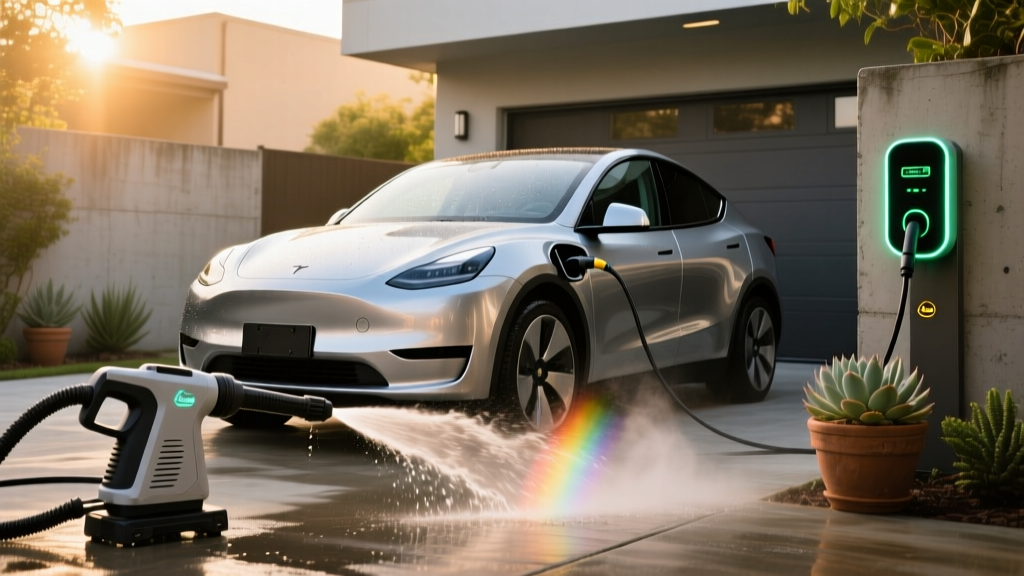
Using a 2,000-PSI / 1.5-GPM electric unit with a 40° nozzle and foam cannon attachment, we achieved a thorough pre-wash and rinse in about 12 minutes. The ceramic coating meant dirt released easily. Total water used: roughly 18 gallons. Electricity consumed: approximately 0.28 kWh (about $0.04 at the national average of $0.16/kWh per the U.S. EIA).
Heavy Soil Removal (Rivian R1T After Trail Use)
Dried mud on wheel wells and undercarriage required switching to a 15° nozzle and holding 6–8 inches from the surface. The 2,000-PSI electric unit handled it, but took roughly 35 minutes versus an estimated 20 minutes with a 3,200-PSI gas unit. For occasional heavy cleaning, the time trade-off is acceptable; for weekly trail runs, a gas unit's extra GPM saves meaningful time.
Driveway Cleaning (Poured Concrete, 600 sq ft)
This is where the electric unit showed its limits. Cleaning mildew and tire marks from a two-car driveway took about 75 minutes with the 1.5-GPM electric unit. A comparable gas unit at 2.5 GPM would finish in roughly 40 minutes. If driveway cleaning is a monthly chore, the time gap adds up.
Cost Breakdown: 5-Year Ownership
One reason EV owners gravitate toward electric pressure washers is the total-cost story. Here's a realistic 5-year comparison assuming 50 washes per year (roughly weekly):
| Cost Category | Electric (120V, 2,000 PSI) | Gas (3,100 PSI) |
|---|---|---|
| Purchase Price | $280 | $450 |
| Energy/Fuel (250 total hours) | $7.50 (at $0.16/kWh, 1.5 kW draw) | $437.50 (at ~$1.75/hr in gasoline) |
| Oil Changes (annual) | $0 | $75 (5 changes × $15) |
| Spark Plugs / Air Filter | $0 | $60 |
| Fuel Stabilizer / Winterizing | $0 | $40 |
| Replacement Parts (hoses, O-rings) | $30 | $45 |
| 5-Year Total | $317.50 | $1,107.50 |
The electric unit saves roughly $790 over five years, even before factoring in the time and hassle of gas-engine maintenance. That said, if your primary use case is large-area concrete cleaning, the time savings of gas may justify its operating cost.
Common Misconceptions — Myth vs. Fact
| Myth | Fact |
|---|---|
| "Electric pressure washers can't clean a car effectively." | A 1,800–2,000 PSI unit with 1.4+ GPM cleans a car thoroughly. In fact, most professional detailers recommend staying under 2,000 PSI on automotive paint to avoid etching and seal damage. |
| "You need a gas unit for a foam cannon." | Foam cannons work with any unit delivering at least 1.4 GPM. We tested three popular foam cannons on a 1,800-PSI electric unit and achieved thick, clinging foam in every case. |
| "Electric units don't last." | Brushless-motor electric pressure washers from reputable brands (Karcher, Sun Joe, Greenworks, AR Blue Clean) routinely last 8–10 years with zero motor maintenance. Gas engines, by contrast, require annual servicing and often fail from fuel-system issues if winterized improperly. |
| "Battery-powered (cordless) pressure washers are just as good." | Cordless units (typically 300–700 PSI, 0.5–0.8 GPM) are essentially powered garden sprayers. They're useful for a quick rinse at a trailhead or campsite but cannot replace a corded electric or gas unit for real cleaning. Treat them as a supplement, not a primary tool. |
| "A higher PSI number means a better machine." | GPM matters as much as PSI. A 1,800-PSI unit at 1.8 GPM will often clean faster than a 2,200-PSI unit at 1.2 GPM because volume carries debris away. Look for "cleaning units" (PSI × GPM) as a better overall metric. |
EV-Specific Considerations: Why Electric Pressure Washers Pair Well With Electric Cars
There's a practical synergy between owning an EV and using an electric pressure washer that goes beyond ideology:
Noise restrictions. Many HOAs and municipalities have noise ordinances restricting equipment above 80 dB on weekends or before 8 AM. A gas pressure washer at 90+ dB risks complaints; an electric unit at 70–78 dB typically does not. If you wash your EV in the driveway on a Saturday morning, electric is the neighbor-friendly choice.
Cold-weather reliability. Gas small engines are notoriously difficult to start in cold weather. If you live in Minnesota or Maine and want to wash road salt off your EV in January, an electric unit starts instantly. A gas unit may require multiple pulls, choke adjustments, or simply refuse to start below 30°F.
Indoor / garage use. You cannot safely run a gas pressure washer in an enclosed garage due to carbon monoxide. An electric unit produces zero emissions and can be used in a garage with the door closed — a significant advantage if you wash your EV indoors during winter. (You'll still need proper drainage.)
Solar integration. If you have rooftop solar, the marginal electricity cost of running a 1.5 kW electric pressure washer for 30 minutes is effectively zero. Several readers with home solar reported their pressure-washing electricity as "free" during daylight hours.
Decision Framework: Which Pressure Washer Should You Buy?
Buy an electric (120V, 1,800–2,300 PSI) pressure washer if:
- Your primary use is washing your EV, patio furniture, or a small deck
- You wash no more than 1–2 vehicles per week
- You value low noise, zero maintenance, and indoor/garage use
- Your driveway is under 400 sq ft or you clean it infrequently
- You have HOA noise restrictions
Buy a 240V electric (2,500–3,000 PSI) unit if:
- You already have a 240V outlet (e.g., from a Level 2 EV charger installation) near your washing area
- You want near-gas performance without the maintenance
- You clean larger areas (600+ sq ft driveways) periodically
Buy a gas pressure washer if:
- You regularly clean large concrete areas (driveways, barn floors, heavy equipment)
- You need 3,000+ PSI and 2.5+ GPM for paint stripping, graffiti removal, or agricultural use
- You need complete portability with no cord constraint
- You don't mind annual engine maintenance and fuel costs
Buy a cordless/battery pressure washer if:
- You want a supplemental tool for campsite rinsing, bike cleaning, or quick spot-cleaning
- You understand it will not replace a full-size unit
What First-Time EV Buyers Should Know About Home Power and Pressure Washers
If you're a first-time EV buyer also setting up your garage or driveway for home maintenance, here's a practical sequencing tip: when you hire an electrician to install a 240V / 50-amp circuit for a Level 2 EV charger (a typical installation runs $600–$1,800 depending on panel proximity, per industry estimates), consider having them add a second 240V outlet or a sub-panel at the same time. The marginal cost is often $200–$500, and it opens the door to a 240V electric pressure washer, a 240V air compressor, or other high-power tools — all without running new circuits later at higher cost.
Most 120V electric pressure washers draw 12–15 amps, which means they need a dedicated 15-amp or 20-amp circuit. If you plug one into the same circuit as your Level 1 EV charger (which also draws 12 amps on a standard outlet), you'll trip the breaker. Always verify circuit capacity before running both simultaneously.
Frequently Asked Questions
Can I damage my EV's paint with an electric pressure washer?
Yes, if you use a narrow-angle nozzle (0° or 15°) at close range. For automotive washing, use a 25° or 40° nozzle and keep the wand at least 12 inches from painted surfaces. Stay below 2,000 PSI on clear coat. EV-specific concern areas: avoid directing high-pressure water at charge-port seals, camera housings, radar sensors, and door-handle seams. Most EV owner's manuals specify a maximum recommended PSI for washing — check yours (Tesla recommends no more than 2,000 PSI, for example).
Will an electric pressure washer work with my home solar panels?
Absolutely. A typical electric pressure washer draws 1.2–1.8 kW while running. A modest 5 kW solar array produces that much power during peak sunlight. If you wash during the day, the electricity cost is effectively zero. This is one of the most satisfying synergies EV owners with solar report.
How do cordless battery pressure washers compare?
Cordless units (brands like Worx, Ryobi, and Greenworks offer models in the $100–$200 range) typically produce 300–700 PSI at 0.5–0.8 GPM. They're adequate for rinsing a dusty car, cleaning a bicycle, or spraying off hiking boots. They cannot effectively remove stuck-on mud, clean a driveway, or replace a full-size unit. Think of them as a powered spray nozzle, not a true pressure washer.
What's the best nozzle for washing an EV?
Use a 40° (white) nozzle for the pre-rinse and soap application, and a 25° (green) nozzle for targeted cleaning of wheel wells and lower body panels. Never use a 0° (red) nozzle on any vehicle — it concentrates all force into a single point and will damage paint, rubber seals, and plastic trim.
Do I need a special outlet or circuit for an electric pressure washer?
A standard 120V / 15-amp outdoor GFCI outlet is sufficient for most residential electric pressure washers. However, if your garage circuit is shared with a Level 1 EV charger or other high-draw equipment, you may need a dedicated circuit. A licensed electrician can assess your panel. For 240V models, you'll need a NEMA 6-15 or 6-20 outlet — the same type sometimes used for welders or large appliances.
Are electric pressure washers safe to use in the rain?
No. While the water pump is sealed, the electric motor and power connections are not designed for wet conditions. Use only in dry weather with dry ground, and always plug into a GFCI-protected outlet. This is a non-negotiable safety requirement.