Quick Answer: Yes, Electric Pressure Washers Are Safe for EV Detailing
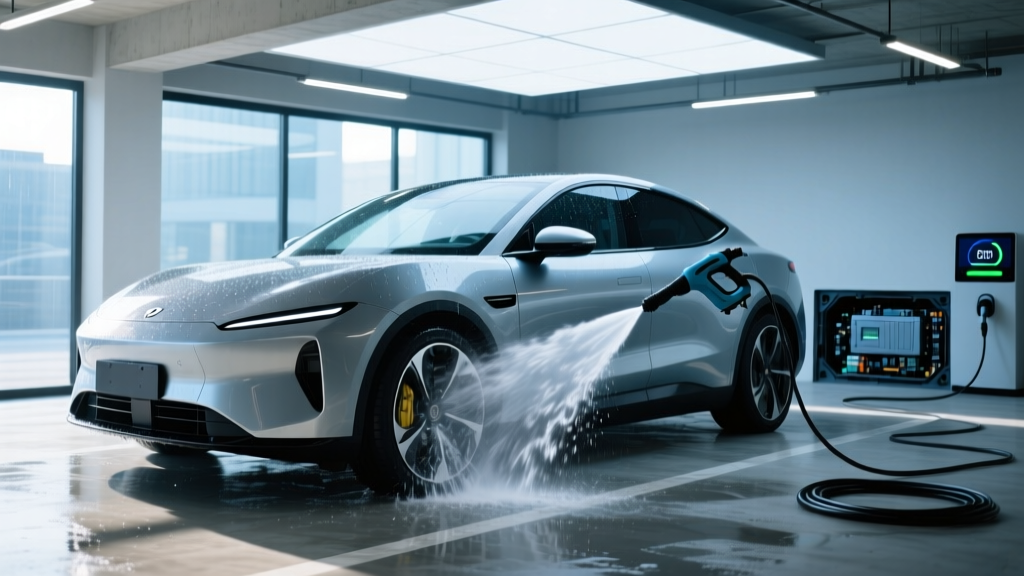
Electric pressure washers (1,200–2,000 PSI models) are safe for washing electric vehicles when used correctly. The key constraints: keep PSI under 2,200 on painted panels, maintain a 12-inch minimum nozzle distance, avoid direct spray on charge-port seals, sensor housings, and 12V battery compartments, and always use a GFCI-protected outlet within 25 feet of your washing area. Expect to spend $150–$350 on a quality electric unit and $0.08–$0.15 per wash in electricity — a fraction of the $8–$15 per fill-up a gas-powered washer demands.
Electric vehicle ownership changes how you think about maintenance — and that extends to something as basic as washing your car. With no engine bay grime, no exhaust soot, and fewer fluid reservoirs to worry about, EV detailing is simpler in many ways. But EVs also pack sensitive electronics, high-voltage cable routing, sealed charge ports, and exterior sensor arrays (cameras, ultrasonic sensors, LiDAR housings on vehicles like the Tesla Model Y, Hyundai Ioniq 5, and Ford Mustang Mach-E) that demand a careful approach to high-pressure water.
If you've been searching for electric pressure washer car detailing guidance specific to EVs, this guide covers PSI safety thresholds, equipment picks, outlet requirements, cost comparisons against gas washers, and the mistakes that can damage seals or void warranty coverage.
Why EV Owners Are Switching to Electric Pressure Washers
The typical EV owner drives a vehicle that costs $40,000–$60,000, garages it at home (where Level 2 charging is installed), and values quiet, low-emission operation. An electric pressure washer aligns with all three: it's silent compared to a gas unit (65–75 dB vs. 85–95 dB), produces zero tailpipe emissions at the point of use, and plugs into the same 120V or 240V garage infrastructure you already have for EV charging.
Practical advantages for EV detailing specifically:
- No engine-bay degreasing needed: EVs have a front trunk (frunk) or a sealed motor compartment. You're washing painted surfaces, glass, and wheels — tasks well within an electric washer's 1,200–2,000 PSI range.
- Garage-friendly operation: No carbon monoxide risk means you can wash inside a garage with the door partially open — useful in cold climates or HOA-restricted neighborhoods.
- Lower ongoing cost: An electric pressure washer drawing 1,400W for 20 minutes uses roughly 0.47 kWh — about $0.07 at the U.S. average residential rate of ~$0.15/kWh.
PSI Safety Limits: What Your EV's Paint and Seals Can Handle
Electric vehicles are not waterproof in the same way a submarine is — they're water-resistant, with seals rated to IP67 or IP6K9K standards on critical high-voltage components (battery pack, inverter, charge port). Those seals are designed for rain, puddles, and car-wash jets, but sustained close-range pressure can compromise them over time.
| Surface / Component | Max Safe PSI | Min Nozzle Distance | Spray Angle |
|---|---|---|---|
| Painted body panels | 1,800–2,000 PSI | 12 inches | 45° or wider fan |
| Wheel wells & undercarriage | 2,000–2,200 PSI | 8 inches | Wide fan |
| Charge port door & seal | 1,200 PSI max | 18 inches | Indirect only |
| Camera/sensor housings | 800 PSI max | 24 inches | Indirect, low pressure |
| Window & sunroof seals | 1,500 PSI max | 14 inches | Parallel to seal edge |
| Badges & trim adhesive | 1,200 PSI max | 16 inches | Avoid direct blast |
Real-world tip: Most consumer electric pressure washers ship with a 15° or 25° nozzle tip. The 25° (green) tip is your best default for EV detailing — it spreads pressure over a wider area, reducing the risk of stripping clear coat or forcing water past seals.
Cost Breakdown: Electric vs. Gas Pressure Washer Ownership
For EV owners weighing an electric pressure washer for car detailing against a gas-powered alternative, the total cost of ownership tells a clear story over a 5-year period.
| Cost Factor | Electric Pressure Washer | Gas Pressure Washer |
|---|---|---|
| Purchase price (mid-range) | $180–$300 | $280–$450 |
| Energy/fuel per wash (20 min) | $0.07 (0.47 kWh) | $0.90–$1.40 (0.3 gal gas) |
| Annual cost (biweekly washing) | $1.82 | $23–$36 |
| Oil changes / engine maintenance | $0 | $25–$50/year |
| Winterization (fuel stabilizer) | $0 | $10–$15/year |
| Noise level | 65–75 dB | 85–95 dB |
| 5-year operating cost | ~$9–$10 | ~$190–$330 |
| 5-year total cost of ownership | $189–$310 | $470–$780 |
The electric unit wins on cost by a wide margin — and the savings compound if you wash more frequently. The trade-off is peak pressure: most consumer electric washers top out at 2,000–2,300 PSI, while gas units can reach 3,000–4,000 PSI. For EV detailing, that trade-off is irrelevant. You don't need 3,500 PSI to clean a Tesla Model 3 or a Rivian R1T — you need controlled, consistent pressure with the right nozzle geometry.
Electrical Requirements: GFCI Outlets, Circuit Capacity, and Extension Cords
This is where EV owners have an infrastructure advantage — and a potential pitfall.
What you need:
- A GFCI-protected 120V/15A or 20A outlet within 25 feet of your washing area. Most modern garages have GFCI outlets (required by code since the 1990s). If yours doesn't, a licensed electrician can install one for $150–$300.
- A dedicated circuit is ideal. A 1,800W electric pressure washer draws ~15 amps — right at the limit of a standard 15A circuit. If you're also running a Level 2 EV charger on the same subpanel, verify your panel has headroom. A 200-amp service panel (standard in most homes built after 2000) typically handles both without issue.
- Never use a standard extension cord. If you must extend reach, use a 12-gauge, outdoor-rated cord no longer than 50 feet. Longer or thinner cords cause voltage drop, which reduces washer performance and can trip breakers.
The pitfall: Some EV owners have their Level 2 charger (typically a 40A or 48A circuit on a 60A breaker) and their pressure washer outlet on the same garage subpanel. Running both simultaneously can trip the subpanel breaker. Solution: wash the car after charging is complete, or have an electrician add a dedicated 20A circuit for your detailing area ($200–$500 depending on conduit run length).
Step-by-Step: Detailing an EV with an Electric Pressure Washer
Here's a practical workflow optimized for electric vehicles — accounting for charge ports, sensor arrays, and the smooth underbody panels common on EVs like the Hyundai Ioniq 6 or Lucid Air.
- Close and latch the charge port door. Verify it's sealed. On a Tesla, use the app to confirm the port is closed. On a Ford Mach-E or BMW iX, check the physical latch.
- Pre-rinse at low pressure (800–1,200 PSI, 25° tip). Start from the roof and work down. This removes loose grit before you touch the paint with a wash mitt.
- Apply foam cannon or soap. Use a pH-neutral car shampoo. Let it dwell for 3–5 minutes. Do not let soap dry on the surface.
- Hand-wash with a microfiber mitt. Focus on lower panels, rockers, and wheel wells where road film accumulates.
- Rinse at medium pressure (1,500–1,800 PSI). Maintain 12-inch distance on paint. Switch to the 40° (white) tip for sensitive areas around cameras and charge-port surrounds.
- Undercarriage rinse. EVs often have flat, enclosed underbodies (aerodynamic panels covering the battery pack). A 2,000 PSI wide-fan rinse is safe and helps remove road salt — critical in winter climates where corrosion can attack suspension components and brake calipers.
- Spot-free rinse or dry. Use a deionized water filter ($80–$150) for a spot-free finish, or dry with a clean microfiber towel and a leaf blower for crevices around door handles and mirror caps.
Common Myths About Pressure Washing EVs — Fact-Checked
| Myth | Fact |
|---|---|
| "Water will short out the battery pack." | EV battery packs are sealed to IP67 (submersible to 1 meter for 30 minutes). Pressure washing the exterior poses no risk to the traction battery. |
| "You can't use a pressure washer near the charge port." | You can, at reduced pressure (under 1,200 PSI) and indirect angle. The charge port seal is designed for rain and automated car washes. Just don't blast it head-on at close range. |
| "Electric pressure washers are too weak for car detailing." | Consumer electric units at 1,800–2,000 PSI with 1.2–1.5 GPM are ideal for car paint. Professional detailers routinely use 1,500 PSI for paint-safe work. Higher PSI is for concrete stripping, not vehicles. |
| "The high-voltage cables run under the hood and can be damaged." | HV cables are routed through sealed conduits and the underbody battery enclosure. They are not exposed in the frunk or engine bay. A pressure rinse of the frunk interior at low PSI (800) is safe. |
| "Washing an EV voids the battery warranty." | No manufacturer voids battery warranty for exterior washing. The 8-year/100,000-mile battery warranty (standard under federal requirements) covers capacity degradation, not wash-related issues. |
Decision Framework: Which Electric Pressure Washer Setup Is Right for You?
Choose a 1,200–1,600 PSI electric unit ($100–$180) if:
- You wash a sedan or compact crossover (Tesla Model 3, Chevrolet Equinox EV, Volvo EX30) biweekly
- Your garage has only a standard 15A outlet
- You primarily need light-duty rinse and foam-cannon capability
Choose a 1,800–2,000 PSI electric unit ($180–$300) if:
- You own a larger EV (Rivian R1S, Ford F-150 Lightning, Kia EV9) with more surface area
- You want undercarriage rinse capability for winter road salt
- You have a 20A GFCI outlet available
Choose a 2,000–2,300 PSI electric unit ($300–$450) or consider gas if:
- You also need to clean concrete driveways, decks, or fencing
- You have a 240V outlet available (some premium electric washers support this)
- You detail multiple vehicles per week and need higher GPM flow rates
Real-World Ownership Considerations for EV Detailing
Cold-climate owners (below 32°F / 0°C): Electric pressure washers cannot be used in freezing temperatures without winterization — water in the pump will freeze and crack internal seals. Store the unit indoors and drain all water after each use. If you wash in winter, do it on days above 40°F and dry the vehicle thoroughly to prevent ice formation on door seals and charge-port latches.
Apartment dwellers without garage access: Portable electric pressure washers with built-in water tanks (e.g., 5-gallon integrated tanks) exist, but they're typically limited to 700–1,000 PSI — adequate for a light rinse but not a full detail. Your best option may be a touchless automatic car wash, which most EVs handle without issue (check your owner's manual for "automatic car wash" guidance, especially for vehicles with hands-free driving sensors).
Solar-panel owners: If you have rooftop solar and net metering, your pressure-wash electricity cost drops to effectively $0.00 — making the electric washer even more economical over gas.
Frequently Asked Questions
Can I pressure wash my Tesla's camera and sensor housings?
Use indirect spray only, at under 800 PSI and from 24+ inches away. Tesla's Autopilot cameras (mounted on the fenders, B-pillars, and rear hatch) have sealed housings, but direct high-pressure jets can force moisture past the seal over time. A gentle rinse followed by a microfiber wipe is the safest approach. Remember: Autopilot and FSD (Supervised) are SAE Level 2 systems — keeping sensors clean and unobstructed is critical for safe operation.
Will pressure washing affect my EV's range or efficiency?
No. Range is determined by battery state of charge, driving behavior, temperature, and tire pressure. However, removing caked mud, road salt, and bug debris from the underbody and wheel wells can marginally reduce aerodynamic drag — a clean EV is fractionally more efficient, though the effect is negligible (less than 1% range difference).
Do I need a special soap for washing an EV?
No EV-specific soap is required. Use any pH-neutral automotive shampoo (pH 6.5–7.5). Avoid household dish detergents, which strip wax and ceramic coatings. If your EV has a ceramic coating or paint protection film (PPF), use a coating-safe shampoo to preserve hydrophobic properties.
How does EV ownership change my overall maintenance costs compared to gas?
EVs eliminate oil changes, transmission fluid, spark plugs, exhaust system repairs, and fuel-system maintenance. The U.S. Department of Energy estimates EV maintenance costs at roughly $0.061/mile vs. $0.101/mile for gas vehicles. Add in electricity costs of ~$0.04–$0.06/mile (home charging) vs. $0.12–$0.16/mile for gasoline, and the per-mile savings compound quickly. Pressure-washer detailing fits into this low-maintenance ownership model — a $250 electric unit and $2/year in electricity covers your washing needs for half a decade.
Is it safe to wash my EV immediately after charging or driving?
Wait 15–20 minutes after a DC fast charge session. The battery pack and charge-port area can be warm (up to 110°F / 43°C at the connector) after a 150–250 kW fast charge. Spraying cold water on hot components won't damage the sealed battery, but it can cause thermal shock to the charge-port connector pins over time. After normal Level 2 home charging, no waiting period is needed.