If you're transitioning from a gas vehicle to an electric vehicle (EV) or plug-in hybrid (PHEV), you may be wondering about maintenance differences under the hood. One of the most common questions we hear from new EV shoppers: does electric power steering use fluid?
Quick Answer: No
Electric power steering (EPS) does not use hydraulic fluid. Instead of a belt-driven hydraulic pump, EPS uses an electric motor mounted directly on the steering column or rack to provide steering assist. This means there is no power steering fluid to check, top off, flush, or replace — ever. Nearly every EV and PHEV sold today uses EPS exclusively.
How Electric Power Steering Works in an EV
Traditional hydraulic power steering relies on a pump driven by the engine's accessory belt. That pump pressurizes hydraulic fluid, which is routed to a steering gear to multiply your steering input. The system requires hoses, seals, a fluid reservoir, and periodic maintenance.
Electric power steering eliminates all of that. Here's what replaces it:
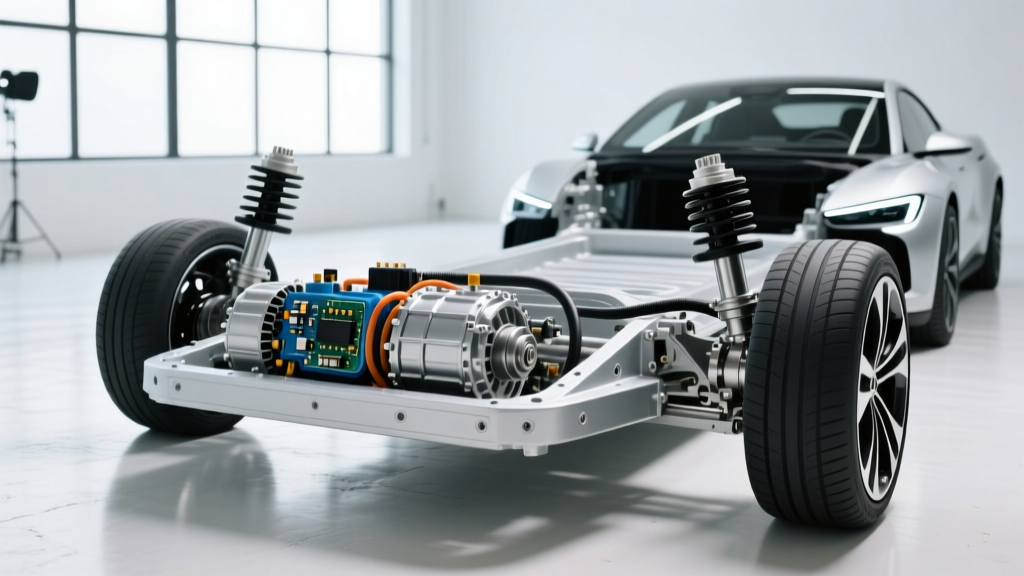
- Electric motor: A brushless DC motor mounted on the steering column (column-assist EPS) or directly on the steering rack (rack-assist EPS) provides the assist force.
- Torque sensor: Detects how much steering effort the driver is applying and in which direction.
- Electronic control unit (ECU): Processes inputs from the torque sensor, vehicle speed sensor, and other systems to calculate the precise amount of assist needed.
- No fluid, no pump, no hoses: The entire system is electromechanical, drawing power from the vehicle's 12V auxiliary battery (which is itself charged by the high-voltage traction battery via a DC-DC converter).
The result is a steering system that is lighter, more energy-efficient, and essentially maintenance-free for the life of the vehicle. In 2026, EPS is standard on virtually every new EV — from the Chevrolet Equinox EV (315 miles EPA range, starting at $33,600) to the Tesla Model Y (320 miles EPA, starting at $44,990) to the Hyundai Ioniq 5 (303 miles EPA, starting at $42,450).
EV vs Gas Car: Steering Maintenance Compared
The absence of hydraulic fluid is just one piece of a broader maintenance advantage EVs hold over internal combustion engine (ICE) vehicles. Let's put real numbers to the comparison.
| Maintenance Item | Gas Vehicle (Hydraulic PS) | EV (Electric PS) |
|---|---|---|
| Power steering fluid flush | $100–$165 every 50k mi | $0 — no fluid exists |
| PS pump replacement | $400–$800 (if it fails) | N/A — no pump |
| PS hose/seal leak repair | $200–$600 per incident | N/A — no hoses or seals |
| Serpentine belt replacement | $150–$300 (drives PS pump) | N/A — EVs have no accessory belt |
| Estimated 5-year steering maintenance | $200–$1,065 | $0 |
According to fueleconomy.gov, EVs have significantly fewer moving parts than gasoline vehicles, which translates to lower maintenance costs across the board. The U.S. Department of Energy estimates that EV maintenance costs average roughly $0.061 per mile compared to $0.101 per mile for gasoline vehicles — a savings of approximately $3,000 over 75,000 miles of driving, with steering system elimination being one contributor.
The Real Cost of EV Ownership: Beyond Steering
While the maintenance savings from EPS and other eliminated systems are real, a smart buyer evaluates the full picture. Here's a comprehensive 5-year cost breakdown comparing a representative EV against a comparable gas vehicle.
| Cost Category | 2026 Tesla Model 3 RWD ($38,990 MSRP) | 2026 Toyota Camry LE ($28,855 MSRP) |
|---|---|---|
| Purchase price (after incentives) | $38,990 (credit eligibility varies — see IRS §30D rules) | $28,855 |
| Fuel / Electricity (75k mi) | ~$2,625 (home charging at $0.16/kWh, 4.0 mi/kWh) | ~$7,875 (32 MPG combined, $3.37/gal) |
| Maintenance | ~$4,575 ($0.061/mi) | ~$7,575 ($0.101/mi) |
| Insurance (avg. national) | ~$12,750 ($2,550/yr) | ~$9,000 ($1,800/yr) |
| Depreciation (est. 5-yr) | ~$17,500 | ~$12,500 |
| Total 5-Year Cost | ~$76,440 | ~$65,805 |
Key takeaway: The EV saves roughly $8,250 in fuel and maintenance over five years, but higher purchase price, insurance premiums, and depreciation can offset those gains depending on the model. The steering maintenance savings ($200–$1,065) are a genuine but modest part of the overall EV maintenance advantage.
Common Misconceptions About EV Steering and Maintenance
| Myth | Fact |
|---|---|
| "EVs still need power steering fluid changes." | EVs use fully electric power steering (EPS) — no hydraulic fluid is present anywhere in the steering system. |
| "Electric steering feels numb compared to hydraulic." | Early EPS systems earned this reputation, but modern 2026 EPS tuning from manufacturers like Hyundai, BMW, and Porsche delivers excellent road feel. Rack-mounted EPS in particular provides natural feedback. |
| "If the 12V battery dies, I lose steering." | If the 12V system fails, steering assist is lost, but mechanical steering connection remains. You can still steer — it just requires significantly more effort, similar to a gas car with a failed PS pump. The vehicle's DC-DC converter continuously charges the 12V battery from the high-voltage pack while driving. |
| "EVs need zero maintenance." | EVs need less maintenance, not zero. You'll still need tire rotations (EVs are heavier and wear tires faster — budget $200–$400/yr), cabin air filter replacement ($30–$80), brake fluid checks, windshield washer fluid, and wiper blades. The high-voltage battery requires no routine maintenance but does degrade over time. |
| "EPS draws significant range from the battery." | EPS typically draws 50–150 watts during active steering — negligible compared to the traction motor's 100–250 kW draw during acceleration. Steering assist has virtually no measurable impact on range. |
Why EPS Matters for Advanced Driver-Assistance Systems
Electric power steering isn't just about maintenance elimination — it's an enabler of modern ADAS features. Because EPS is electronically controlled, the vehicle's computer can command steering inputs directly. This is how features like:
- Lane centering assist (Tesla Autopilot, GM Super Cruise, Ford BlueCruise) — the EPS motor makes micro-adjustments to keep the vehicle centered in its lane.
- Automatic emergency steering — systems like Tesla's and Mercedes-Benz's can apply corrective steering to avoid collisions.
- Automated parking — the EPS system steers the vehicle while the driver manages the accelerator and brake (or, in some implementations, the system handles everything).
Important: All consumer-available driver-assist features — including Tesla's FSD (Supervised), GM Super Cruise, and Ford BlueCruise — are SAE Level 2 systems. They require continuous driver supervision. The driver must keep hands on or near the wheel and remain fully engaged. Only purpose-built robotaxi services like Waymo operate at SAE Level 4 (driverless in geofenced areas). No consumer vehicle sold in 2026 is self-driving.
A hydraulic steering system cannot easily interface with these electronic features, which is why EPS has become the universal standard not just for EVs but for most new gas vehicles as well. The transition to EPS in the broader market began in the early 2010s and accelerated with the proliferation of ADAS.
What First-Time EV Buyers Should Know About Maintenance
If you're buying your first EV in 2026, here's a practical framework for understanding what maintenance you will need and what you can permanently forget about:
EV Maintenance Decision Framework
Eliminated entirely (no action needed):
- Power steering fluid — no hydraulic system
- Engine oil changes — no internal combustion engine
- Transmission fluid (most EVs) — single-speed reduction gear requires no routine service
- Spark plugs, ignition coils, timing belts — no ICE components
- Emissions testing — zero tailpipe emissions
- Exhaust system repairs — no muffler, catalytic converter, or O2 sensors
Still required (budget for these):
- Tire rotation: Every 6,000–8,000 miles. EVs are 10–30% heavier than equivalent gas vehicles and deliver instant torque, accelerating tire wear. Expect to replace tires every 25,000–40,000 miles vs. 40,000–60,000 for gas cars. Budget $600–$1,200 per set.
- Cabin air filter: Every 15,000–20,000 miles. $30–$80 for the filter.
- Brake fluid: Check every 2 years; replace per manufacturer interval (typically every 2–3 years, $80–$150). Note: EV regenerative braking significantly extends pad and rotor life — many EV owners report original brake pads at 80,000+ miles.
- Coolant: The battery thermal management system uses coolant. Check per manufacturer schedule; flush intervals vary (some manufacturers specify 150,000 miles or more).
- Wiper blades and washer fluid: Same as any vehicle.
- 12V battery: EVs still have a conventional 12V lead-acid or lithium auxiliary battery. It typically lasts 3–5 years and costs $150–$300 to replace.
Real-World Ownership Considerations
Home charging access: The maintenance savings of an EV are most impactful when paired with home Level 2 charging. Without home charging, you'll rely on public DC fast chargers and Level 2 stations, which cost significantly more per kWh (typically $0.30–$0.60/kWh at public DC stations vs. $0.12–$0.20/kWh at home) and can accelerate battery degradation if used exclusively. A Level 2 home charger installation runs $500–$2,000 depending on panel capacity and conduit distance, according to Energy.gov.
Climate impact: Cold weather reduces EV range by 15–30% (at 20°F, expect an EPA-rated 300-mile EV to deliver roughly 210–255 real-world miles). This doesn't affect steering or maintenance, but it does affect your fuel-cost savings calculation. In cold climates, the gas-vs-EV fuel cost gap narrows because the EV's efficiency drops more proportionally than a gas car's.
Driving patterns: If you drive primarily in stop-and-go city traffic, EVs shine — regenerative braking extends range and eliminates brake wear. Highway-dominant driving at 75–80 mph reduces EV range more aggressively than EPA estimates suggest (plan for 15–25% below sticker on sustained highway trips).
Frequently Asked Questions
Do any electric vehicles use hydraulic power steering?
No current-production EV or PHEV uses hydraulic power steering. The last hydraulic systems were phased out as manufacturers adopted EPS for its efficiency, weight savings, and ADAS compatibility. Even most new gas vehicles in 2026 use EPS.
Can I add power steering fluid to my EV?
There is nowhere to add it. EVs have no power steering fluid reservoir, pump, or hydraulic lines. If you see a fluid reservoir under the hood of an EV, it's for windshield washer fluid, brake fluid, or battery thermal management coolant — never power steering.
Does electric power steering affect my EV's range?
Minimally. The EPS motor draws roughly 50–150 watts during active steering maneuvers. For context, the traction motor in a Tesla Model 3 draws up to 211 kW (211,000 watts) at peak output. Steering assist accounts for a fraction of one percent of total energy consumption.
What happens if the EPS motor fails in an EV?
You retain full mechanical steering control — the steering wheel is physically connected to the rack via the steering column. However, steering effort increases substantially, especially at low speeds. EPS failures are rare, and the system is covered under the vehicle's standard warranty (typically 3 years/36,000 miles bumper-to-bumper, with some manufacturers extending EPS coverage under the 5-year/60,000-mile powertrain warranty).
Is EPS repair expensive if it does fail out of warranty?
EPS rack replacement typically costs $1,200–$2,500 at a dealership, including parts and labor. This is comparable to or slightly less than replacing a hydraulic rack-and-pinion plus pump and hoses on a gas vehicle. However, EPS failure rates are significantly lower than hydraulic system failure rates, making this an unlikely expense.
Do hybrids use electric or hydraulic power steering?
Most modern hybrids and PHEVs — including the Toyota Prius (57 MPG combined, 44 miles EV range in PHEV form), Honda Accord Hybrid, and Toyota RAV4 Prime (42 miles EV range, 94 MPGe) — use electric power steering. The switch to EPS in hybrids happened earlier than in conventional vehicles because hybrids frequently shut off their gasoline engines at stops, which would disable a belt-driven hydraulic pump.
Bottom line: Electric power steering does not use fluid, does not require maintenance, and is one of many systems that makes EV ownership simpler and cheaper to maintain than a gas vehicle. The savings from eliminating hydraulic steering components ($200–$1,065 over five years) are modest on their own but compound with other EV maintenance reductions — no oil changes, no spark plugs, extended brake life — to save the average driver roughly $3,000 over 75,000 miles. Factor in these savings alongside fuel savings, higher insurance, and purchase price when evaluating your next vehicle.