Quick Answer: What Is Electric Power Assisted Steering in an EV?
Electric power assisted steering (EPAS) uses an electric motor — not a hydraulic pump — to provide steering assist. In EVs, EPAS draws power directly from the high-voltage or 12V system, eliminating the parasitic drag of a belt-driven hydraulic pump. The result: roughly 0.3–0.5 kWh/100 mi less energy consumption versus hydraulic steering, contributing to 1–3% additional real-world range. EPAS is also the hardware foundation that enables Level 2 driver-assist features like lane-centering and automated parking on vehicles such as the Tesla Model Y, Hyundai Ioniq 5, and Ford Mustang Mach-E.
How Electric Power Assisted Steering Actually Works
Traditional hydraulic power steering relies on a pump driven by a belt connected to the engine's crankshaft. That pump circulates pressurized fluid to a rack-and-pinion steering gear, multiplying the driver's input force. The system runs continuously whenever the engine is on — even when you're driving straight and applying zero steering effort.
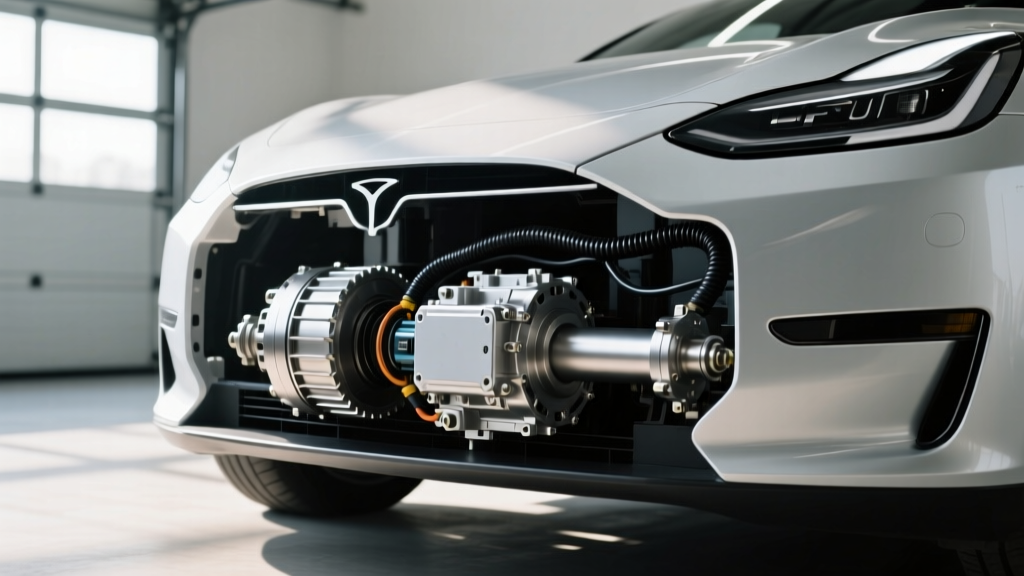
EPAS replaces the hydraulic pump, fluid lines, and reservoir with an electric motor mounted either on the steering column (column-assist) or directly on the steering rack (rack-assist). A torque sensor on the steering shaft detects how much force the driver is applying and in which direction. An electronic control unit (ECU) then commands the electric motor to provide proportional assist.
In a battery-electric vehicle, there is no engine to drive a hydraulic pump, so EPAS isn't optional — it's the only practical steering solution. Some early EV conversions used electrically driven hydraulic pumps, but every mass-production BEV sold in the US today uses a fully electric rack or column system. According to NHTSA's EV overview, modern EVs integrate EPAS with their broader vehicle control architecture for efficiency and safety-system coordination.
EPAS vs. Hydraulic Steering: Efficiency and Range Impact
The efficiency argument for EPAS is straightforward physics. A hydraulic pump consumes engine power continuously — typically 3–5 horsepower of parasitic loss in a conventional car. In an EV, eliminating that constant draw matters more because every watt-hour counts toward range.
| Metric | Hydraulic Power Steering | Electric Power Assisted Steering (EPAS) |
|---|---|---|
| Parasitic energy loss (driving straight) | ~0.5–1.0 kW continuous | ~0 kW (motor idle) |
| Energy draw during active steering | ~1.0–1.5 kW | ~0.1–0.3 kW |
| Estimated range impact (per 300-mi trip) | — | +3 to +8 miles vs. hydraulic equivalent |
| Fluid maintenance | Flush every 30,000–60,000 mi | None |
| Weight (typical system) | ~12–18 lbs (pump, fluid, lines) | ~6–10 lbs (motor, ECU) |
On a vehicle like the 2026 Hyundai Ioniq 5 (84 kWh usable battery, EPA 310 mi range in the SEL AWD trim), EPAS is one of dozens of efficiency optimizations that collectively deliver its 110 MPGe combined rating on fueleconomy.gov. You won't see EPAS credited as a single line item, but its contribution to the overall efficiency picture is real — particularly at low speeds and during parking maneuvers where hydraulic systems waste the most energy.
How EPAS Enables Level 2 Driver-Assist Features
This is where EPAS becomes strategically important for EV buyers. Because the steering assist is fully electronic, the vehicle's computer can command steering inputs without driver force on the wheel. This is the hardware prerequisite for:
- Lane-centering assist: The EPAS motor makes continuous micro-corrections to keep the vehicle centered in its lane (e.g., Tesla Autopilot, Hyundai Highway Driving Assist, Ford BlueCruise).
- Lane-keeping assist: Applies corrective steering torque when the vehicle drifts toward a lane marking.
- Automated parking: The system controls steering entirely while the driver manages throttle and brake (or the system handles everything in Level 2+ implementations like Tesla's Park Assist).
- Evasive steering assist: Adds steering torque to help the driver swerve around a detected obstacle, as seen on the 2026 Ford F-150 Lightning and Mach-E.
Important clarification: All consumer driver-assist features enabled by EPAS — including Tesla FSD (Supervised), GM Super Cruise, and Ford BlueCruise — are SAE Level 2 systems. The driver must remain attentive and keep hands on or near the wheel. These are not self-driving systems. Only Level 4 robotaxi services like Waymo operate without a driver.
Without EPAS, none of these features would be possible on an EV. A hydraulic system has no way for the computer to inject steering commands without adding a separate, redundant actuator — which would add cost, weight, and complexity. EPAS gives every modern EV a steer-by-wire-adjacent capability even though the mechanical connection between the steering wheel and rack remains intact.
Real-World Steering Feel: What EV Buyers Notice
The most common complaint about EPAS — in EVs and gas cars alike — is that it can feel numb or artificially weighted compared to a well-tuned hydraulic system. Here's what shapes the experience:
Speed-sensitive assist: EPAS systems vary assist level based on vehicle speed. At parking-lot speeds, the steering is light and easy to turn. At highway speeds, it firms up for stability. The tuning of this curve is what separates a natural-feeling system (Porsche Taycan, BMW i4) from one that feels vague or disconnected (some earlier-generation systems on budget EVs).
Simulated feedback: Because there's no hydraulic fluid transmitting road forces back to the wheel, EPAS systems use software to simulate steering feel. Premium EVs like the 2026 Porsche Taycan (EPA 246 mi, 105 kWh battery) invest heavily in this simulation. Others prioritize comfort over feedback.
One-pedal driving interaction: When you lift off the accelerator in an EV with aggressive regenerative braking, weight transfers forward, increasing load on the front tires. This changes steering effort mid-corner in a way that doesn't happen in gas cars with coasting behavior. Well-tuned EPAS systems compensate for this seamlessly.
Steer-by-wire frontier: The 2026 Tesla Cybertruck uses a true steer-by-wire system with no mechanical connection between the wheel and rack — an evolution beyond conventional EPAS. The Lexus RZ 450e also offers a steer-by-wire option. These systems use EPAS-style motors on both the steering wheel (providing artificial feel) and the rack (executing commands), with redundant backup systems for safety.
Cost, Maintenance, and Ownership Considerations
EV buyers often ask whether EPAS introduces new costs or failure points compared to hydraulic steering. The honest answer: EPAS is generally lower-maintenance but more expensive to replace if it fails.
| Cost Category | EV with EPAS | Gas Car with Hydraulic PS |
|---|---|---|
| Routine maintenance | $0 (no fluid to flush) | $80–$150 per flush, every 30K–60K mi |
| Common failure points | Torque sensor, ECU, electric motor | Pump, hoses, rack seals, fluid leaks |
| Typical repair cost (out of warranty) | $1,200–$3,500 (rack/motor assembly) | $500–$1,500 (pump); $1,200–$2,800 (rack) |
| Warranty coverage | Typically 5 yr/60,000 mi basic; steering components sometimes covered under powertrain | Typically 3 yr/36,000 mi basic |
The Hyundai Ioniq 5, for example, carries a 5-year/60,000-mile basic warranty and a 10-year/100,000-mile powertrain warranty. EPAS components generally fall under the basic warranty, though some manufacturers classify the steering rack as a powertrain-adjacent component. Always confirm with your dealer before purchase.
From an insurance perspective, EPAS doesn't materially affect premiums. What does affect EV insurance is the vehicle's higher repair costs after collisions (battery pack vulnerability, sensor recalibration) and its higher MSRP. Expect EV insurance premiums to run 15–25% higher than an equivalent gas car, according to industry data — but this isn't driven by the steering system.
Common Misconceptions About EPAS in EVs
| Myth | Fact |
|---|---|
| "EPAS drains the EV battery significantly." | EPAS draws roughly 0.1–0.3 kW during active steering. Over a 300-mile trip, steering assist consumes approximately 0.5–1.5 kWh total — less than 2% of a typical 75–85 kWh battery. |
| "If the 12V battery dies, I lose all steering." | EPAS systems have fail-safe modes. If the assist motor loses power, you retain full manual steering — it just becomes very heavy, similar to a car with the engine off. The mechanical connection between wheel and rack is never severed (except in steer-by-wire systems, which have redundant motors and backup power). |
| "EPAS makes the car less safe in an emergency." | EPAS actually enables emergency features like evasive steering assist and automatic lane-keeping that hydraulic systems cannot provide. IIHS research shows lane-centering systems (which depend on EPAS) reduce certain crash types. |
| "All EPAS systems feel the same." | Steering feel varies enormously by manufacturer tuning. A Porsche Taycan's EPAS provides substantially more road feedback than a Nissan Leaf's, despite both being electric rack-assist systems. |
Decision Framework: What This Means for Your EV Purchase
If you prioritize driving feel and feedback: Test-drive EVs known for well-tuned EPAS — the BMW i4 (EPA 285–307 mi, 81.5 kWh, starting ~$57,000), Porsche Taycan, or Hyundai Ioniq 5 N (performance-tuned steering with enhanced simulated feedback). Avoid making your decision based on spec sheets alone; steering feel is subjective and requires seat time.
If you want the best ADAS features: Confirm the vehicle has EPAS with lane-centering (not just lane-keeping). Lane-centering provides continuous steering input and requires a capable EPAS motor. Vehicles like the Ford Mustang Mach-E with BlueCruise and the Tesla Model Y with Autopilot both use robust EPAS hardware that supports hands-on or hands-off (on approved roads) Level 2 driving.
If you're concerned about long-term repair costs: EPAS is generally reliable, but out-of-warranty replacement is expensive. Consider an extended warranty if you plan to keep the vehicle past 60,000 miles, and verify that the steering rack is covered. The EV's battery and drivetrain warranty (typically 8 yr/100,000 mi) does not usually include EPAS.
If you're comparing an EV to a hybrid: Most modern PHEVs (Toyota RAV4 Prime, Hyundai Tucson PHEV) also use EPAS, so steering feel and maintenance are comparable. The difference is that in a PHEV, the EPAS system draws from the 12V battery (charged by the engine's alternator or the DC-DC converter), while in a BEV, all energy ultimately comes from the traction battery. The efficiency advantage of EPAS matters slightly more in a BEV where every kWh of the traction battery counts toward range.
Frequently Asked Questions
Does electric power assisted steering reduce EV range?
Minimally. EPAS consumes roughly 0.5–1.5 kWh over a 300-mile trip. On a vehicle with an 80 kWh battery and EPA range of 300 miles, that's a range impact of approximately 2–5 miles — far less than the range lost to cold weather (15–30%), highway speeds above 70 mph (10–20%), or aggressive acceleration.
Can EPAS be repaired at any mechanic?
Basic diagnostics (checking fuses, 12V battery health, sensor connections) can be done at independent shops. However, EPAS motor or rack replacement typically requires manufacturer-specific calibration tools and software, making dealer service or a specialized EV shop the better choice. Expect to pay $1,200–$3,500 for a full rack replacement out of warranty.
Do all EVs use the same type of EPAS?
No. There are three main configurations: column-assist (motor on the steering column — common in smaller EVs like the Nissan Leaf), rack-assist (motor on the steering rack — used in the Tesla Model 3/Y, Hyundai Ioniq 5, and most larger EVs), and pinion-assist (motor drives the pinion gear — used in some GM vehicles). Rack-assist generally provides better road feel and is preferred in performance-oriented EVs.
Is steer-by-wire the same as EPAS?
No. EPAS retains a physical mechanical connection (steering shaft) between the steering wheel and the rack; the electric motor simply adds assist force. Steer-by-wire, as used in the Tesla Cybertruck and Lexus RZ 450e, eliminates the mechanical connection entirely, using electronic signals to command rack-mounted motors. Steer-by-wire requires redundant backup systems and is a distinct technology that builds on EPAS principles but operates differently.
Will EPAS work if my EV's high-voltage battery is completely depleted?
If the high-voltage traction battery is fully depleted, the vehicle won't drive at all — so steering assist becomes moot. However, if only the 12V auxiliary battery is dead (which can happen if the vehicle sits unused for weeks), EPAS assist will not function until the 12V system is restored, but you will still have manual steering control. The mechanical link between the wheel and rack is never broken in conventional EPAS systems.