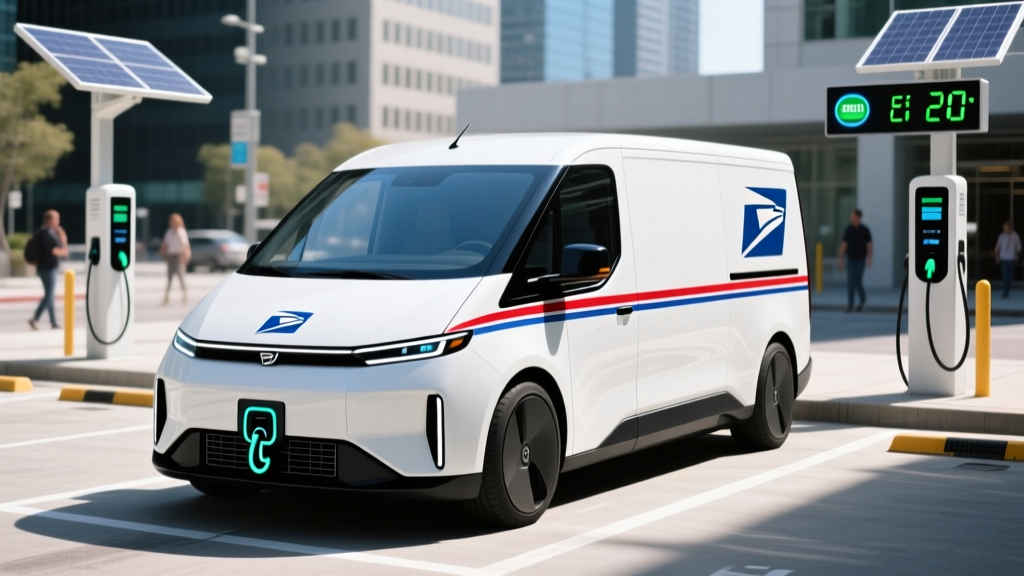
Quick Answer: The USPS is deploying up to 45,000 battery-electric Next Generation Delivery Vehicles (NGDVs) built by Oshkosh Defense, with a 70-mile EPA-estimated range, 94 kWh LFP battery pack, and DC fast charging to 80% in roughly 45 minutes at 125 kW. For consumer EV buyers, the electric postal service van rollout signals expanding public charging infrastructure in residential neighborhoods, growing LFP battery supply chains, and proof that electric delivery vehicles can handle daily stop-and-go routes — even if the NGDV itself isn't available for private purchase.
Why Electric Postal Service Vans Are a Big Deal for EV Owners
If you've noticed a boxy, modern mail truck rolling through your neighborhood, you're witnessing the largest single fleet electrification effort in U.S. history. The United States Postal Service committed to purchasing at least 45,000 battery-electric NGDVs as part of a broader modernization plan, backed by funding from the Inflation Reduction Act and USPS capital investment. By 2026, thousands of these electric postal service vans are in active delivery service across urban and suburban routes.
For everyday EV shoppers and current owners, this matters beyond curiosity. Fleet electrification at this scale drives three tangible benefits:
- Charging infrastructure expansion: USPS depot charging installations often upgrade local grid capacity, and some depot locations are being evaluated for community-charging partnerships.
- LFP battery supply chain maturity: The NGDV uses lithium iron phosphate (LFP) cells, the same chemistry now appearing in consumer vehicles like the Tesla Model 3 RWD and Ford Mustang Mach-E Select. Fleet-scale orders accelerate LFP manufacturing in North America.
- Real-world durability data: Postal routes are punishing — hundreds of stops per day, constant curb impacts, extreme heat and cold. If electric postal service vans hold up, the powertrain longevity arguments for consumer EVs get stronger.
USPS NGDV Electric Van: Full Specifications Breakdown
The Next Generation Delivery Vehicle is built by Oshkosh Defense in a purpose-built South Carolina factory. Here are the confirmed specifications for the battery-electric variant:
| Specification | Value |
|---|---|
| Battery Capacity | 94 kWh usable (LFP chemistry) |
| EPA-Estimated Range | ~70 miles |
| Real-World Range (loaded, hot/cold climate) | 50–65 miles |
| Motor Output | ~200 kW (~268 hp) |
| DC Fast Charge Rate (peak) | 125 kW (CCS1 connector) |
| 10–80% DC Charge Time | ~45 minutes |
| Level 2 Charge Rate | ~19.2 kW (depot chargers) |
| Cargo Volume | ~125 cu ft |
| Payload Capacity | ~1,750 lbs |
| GVWR | Class 6 (~19,500 lbs) |
| Thermal Management | Liquid-cooled battery + heat pump HVAC |
| Safety Features | 360° cameras, automatic emergency braking, lane departure warning |
Real-World Range Reality: The 70-mile EPA estimate assumes a specific delivery-cycle test. On actual postal routes with full cargo loads, frequent door openings (which dump cabin heat/cooling), and summer A/C or winter heater draw, carriers report effective ranges of 50–65 miles. In extreme cold (below 20°F), expect the lower end. This is sufficient for most urban routes (typically 20–40 miles daily) but requires careful route planning for longer rural runs.
Electric Postal Vans vs. the Old Grumman LLV: Cost and Emissions Comparison
The NGDV replaces the iconic Grumman Long Life Vehicle (LLV), which has served USPS since 1987. The contrast is stark — and instructive for anyone comparing EV ownership to an aging gas vehicle.
| Metric | NGDV (Electric) | Grumman LLV (Gas) |
|---|---|---|
| Powertrain | BEV, 94 kWh LFP | 2.5L I4 gasoline |
| Fuel Efficiency | ~1.5–2.0 kWh/mile | ~8–10 MPG (real-world) |
| Energy Cost per Mile | ~$0.18–$0.24 (at $0.12/kWh) | ~$0.35–$0.45 (at $3.50/gal) |
| Annual Fuel/Energy (25 mi/day, 260 days) | ~$1,170–$1,560 | ~$2,275–$2,925 |
| Annual Energy Savings | ~$1,100–$1,365 per vehicle | |
| Maintenance | No oil, no transmission, regen reduces brake wear | Oil changes, transmission service, frequent brake replacement |
| Tailpipe Emissions | Zero | ~4.6 metric tons CO₂/year |
At fleet scale, the math is compelling: 45,000 electric postal service vans saving roughly $1,200 annually in energy costs alone yields approximately $54 million per year in fuel savings, before factoring in reduced maintenance. For a consumer, the parallel is clear — replacing a low-MPG gas vehicle with an EV yields similar per-mile savings, though the upfront price premium remains the barrier.
What the NGDV Battery Choice Tells Consumer Buyers About LFP
The USPS chose LFP (lithium iron phosphate) chemistry for the NGDV — the same decision Tesla, Ford, and Rivian have made for base-trim consumer vehicles. Here's why that matters for your next EV purchase:
| Factor | LFP (NGDV, Tesla Model 3 RWD) | NMC (Most Long-Range EVs) |
|---|---|---|
| Energy Density | Lower (~160 Wh/kg cell-level) | Higher (~250 Wh/kg cell-level) |
| Range per kWh | Slightly less range for same pack weight | More range for same pack weight |
| Cycle Life | 3,000–5,000+ full cycles | 1,500–2,500 full cycles |
| Degradation at 10 Years | ~10–15% capacity loss | ~15–25% capacity loss |
| Charging to 100% Daily | Recommended (no degradation penalty) | Not recommended (accelerates wear) |
| Cold-Weather Performance | Greater range loss in freezing temps (~30–40%) | Better cold-weather retention (~20–30% loss) |
| Cost | ~15–20% cheaper per kWh | Higher due to cobalt/nickel |
| Safety (Thermal Runaway) | Significantly more stable | Requires more active thermal management |
The USPS chose LFP for its durability and tolerance for daily 100% charges — postal vans return to the depot every night and charge fully, 365 days a year. For consumer buyers who drive predictable daily commutes and can charge at home overnight, LFP-equipped EVs like the Tesla Model 3 RWD ($38,990 base MSRP, 272-mile EPA range) or the Ford Mustang Mach-E Select offer exceptional long-term battery health. If you regularly drive in sub-freezing climates or need maximum range for road trips, NMC remains the better choice.
Charging Infrastructure Ripple Effects: How USPS Depots Help Neighborhood EV Owners
Every USPS depot that installs DC fast chargers and Level 2 depot charging requires electrical infrastructure upgrades — often new transformers, switchgear, and feeder lines. In 2025-2026, the USPS has been upgrading hundreds of facilities, and the grid improvements benefit surrounding areas.
Here's the practical impact for EV owners living near USPS facilities:
- Grid capacity: Upgraded transformers and distribution lines reduce the likelihood of your utility denying a Level 2 home charger installation due to insufficient local capacity.
- Utility rate optimization: Utilities serving large depot-charging loads often introduce new time-of-use (TOU) rates that benefit residential EV chargers who charge overnight.
- Public charging access: Some USPS-adjacent charging installations are being evaluated for after-hours public access, though this is not yet widespread policy.
If you're considering an EV purchase and live in an area where USPS has electrified its local depot, you may find that your utility is better prepared for your home charging needs than it was even two years ago.
Real Costs and Savings: What Fleet Electrification Teaches Consumer Buyers
The USPS NGDV program illustrates the core economic trade-off every EV buyer faces: higher upfront cost, lower operating cost. Here's how the numbers break down for the fleet — and how they translate to consumer ownership:
| Cost Factor | USPS NGDV (Fleet) | Consumer EV (e.g., 2026 Hyundai Ioniq 5 SEL) |
|---|---|---|
| Upfront Purchase Price | ~$65,000–$75,000 per unit (estimated) | ~$46,500 MSRP |
| Federal Incentive | IRA fleet procurement funding | §30D tax credit up to $7,500 (income/MSRP/sourcing rules apply) |
| Annual Energy Cost (10,000 mi/yr equivalent) | ~$1,200–$1,500 | ~$540 (at 3.0 mi/kWh, $0.16/kWh national avg) |
| Annual Maintenance | ~$600–$900 (estimated) | ~$400–$600 (no oil, reduced brake wear) |
| 5-Year Energy + Maintenance | ~$9,000–$12,000 | ~$4,700–$5,500 |
| Comparable Gas Vehicle 5-Yr Cost | ~$15,000–$19,000 (LLV equivalent) | ~$8,500–$11,000 (gas equivalent at 28 MPG) |
| 5-Year Net Savings | ~$5,000–$8,000 | ~$3,000–$5,500 |
The lesson for consumer buyers: the savings are real but back-loaded. You pay more on day one (even after the §30D federal tax credit) and recoup the difference over years of lower fueling and maintenance costs. The USPS, which plans to operate NGDVs for 20+ years, captures far more lifetime savings than a consumer who trades in after 5–7 years.
Current IRS §30D rules for 2026 maintain the up-to-$7,500 credit for qualifying new EVs, subject to MSRP caps ($55,000 for sedans, $80,000 for SUVs/pickups/vans), buyer income limits ($300,000 joint / $150,000 single), and critical-mineral/battery-component sourcing requirements. The point-of-sale transfer option lets dealers apply the credit directly at purchase, reducing your out-of-pocket cost immediately. Always verify your specific eligibility with a tax professional.
Common Misconceptions About Electric Postal Service Vans
| Myth | Fact |
|---|---|
| "The electric mail trucks can't handle winter routes." | The NGDV includes liquid battery thermal management and a heat pump. Range drops in extreme cold (to ~50 miles), but most urban routes are 20–40 miles. Depot charging between shifts mitigates this. |
| "USPS abandoned electric vans and went back to gas." | False. While the original 2022 contract included a mix of gas and electric NGDVs, the USPS committed in 2023 to a minimum of 45,000 BEVs out of the total 60,000-vehicle order. Gas NGDVs still exist for routes where range or infrastructure isn't sufficient. |
| "You can buy an electric postal van for personal use." | The NGDV is not available for consumer purchase. However, retired LLVs (the old Grumman trucks) occasionally appear at government surplus auctions, and some have been privately converted to electric — though this is a niche enthusiast project, not a practical commuter solution. |
| "Electric mail trucks are slower and less capable." | The NGDV's 200 kW motor delivers significantly more torque and acceleration than the LLV's 103-hp engine. Carriers report the electric van is noticeably quicker from stoplights and handles steep grades with less strain. |
| "The batteries will need expensive replacement within 5 years." | LFP chemistry is rated for 3,000+ full charge cycles before reaching 80% capacity. At one cycle per day, that's 8+ years before meaningful degradation. The NGDV battery is designed for a 20-year vehicle service life with potential mid-life cell module replacement rather than full pack swap. |
Decision Framework: What the NGDV Program Signals for Your EV Purchase
If you're deciding whether to buy an EV in 2026, the USPS electrification program offers these practical signals:
Choose an LFP-equipped EV if:
- You charge at home nightly and can charge to 100% without worry
- Your daily driving is under 80 miles round-trip
- You prioritize battery longevity over maximum range
- You live in a moderate climate (less extreme cold-weather range loss)
- Budget is a priority — LFP vehicles are typically $3,000–$5,000 less than NMC equivalents
Choose an NMC-equipped EV if:
- You regularly take road trips exceeding 200 miles
- You live in a cold climate (consistent sub-30°F winters)
- You need maximum range from the smallest/lightest battery pack
- You frequently use DC fast charging on the road (NMC handles high-rate charging slightly better over long term)
Delay your EV purchase if:
- You lack reliable home or workplace charging AND your area has limited public DC fast chargers
- You regularly tow heavy loads (towing cuts EV range 40–60%)
- Your budget cannot absorb the upfront premium even after tax credits
Frequently Asked Questions
Can I buy an electric USPS mail truck?
No. The Oshkosh NGDV is manufactured exclusively for the United States Postal Service and is not available for consumer or commercial purchase. There are no announced plans for a civilian variant.
How many electric postal service vans are on the road in 2026?
The USPS has committed to at least 45,000 battery-electric NGDVs out of a total order of up to 60,000 next-generation vehicles. Production ramped through 2024-2025, and thousands are now in active delivery service across urban and suburban routes nationwide.
What battery chemistry does the USPS electric van use?
The NGDV uses LFP (lithium iron phosphate) battery cells in a 94 kWh pack. LFP offers longer cycle life, greater thermal stability, and lower cost than NMC, at the expense of lower energy density and greater cold-weather range loss.
Does the USPS electric van qualify for the $7,500 federal EV tax credit?
The §30D tax credit applies to consumer vehicle purchases, not federal fleet procurement. The USPS NGDV program is funded through separate IRA appropriations and USPS capital budgets. For consumer EV buyers, the §30D credit remains available for qualifying personal vehicles subject to MSRP, income, and sourcing requirements.
How does the NGDV charge, and how long does it take?
The NGDV charges primarily at USPS depots using Level 2 (19.2 kW) and DC fast chargers (125 kW peak via CCS1 connector). A 10–80% DC fast charge takes approximately 45 minutes. Most vehicles charge overnight at depot Level 2 stations, completing a full charge in roughly 5 hours.
What does the USPS electric van program mean for public charging infrastructure?
USPS depot electrification requires significant local grid upgrades — new transformers, distribution lines, and utility interconnection agreements. These upgrades increase grid capacity in surrounding neighborhoods, making it easier for residential EV owners to install Level 2 home chargers and reducing the likelihood of utility capacity denials.
Are electric postal vans reliable in extreme heat and cold?
The NGDV includes active liquid thermal management for the battery pack and a heat pump for cabin climate control. In extreme heat (above 100°F), the thermal management system maintains battery health at the cost of some range. In extreme cold (below 20°F), expect range to drop to approximately 50 miles from the 70-mile EPA estimate — still sufficient for most urban delivery routes.