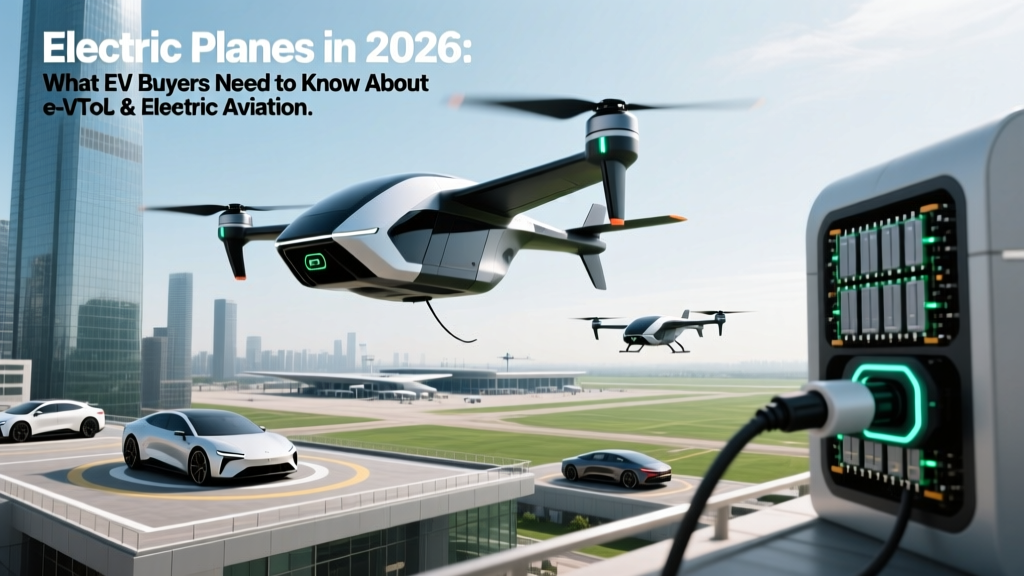
The short answer: Fully electric commercial passenger planes are not yet available for personal purchase in 2026. However, battery-electric air taxis (eVTOLs) from companies like Joby Aviation and Archer Aviation have begun limited commercial operations in select U.S. cities, and electric training aircraft like the Pipistrel Velis Electro are FAA-certified and flying today. For most readers researching "electric planes," the practical reality is this: electric aviation is real but extremely early-stage, with severe range and payload constraints dictated by current lithium-ion energy density. If you're an EV buyer curious about the technology crossover, this guide breaks down what exists, what's announced, and what the battery science actually allows.
What "Electric Planes" Actually Means in 2026
The term "electric planes" covers a wide spectrum, and conflating these categories leads to the biggest misconceptions. Here's what's actually flying versus what's still in development:
- Certified electric training aircraft: The Pipistrel Velis Electro is the only fully electric airplane to receive both EASA and FAA type certification. It uses a 34.5 kWh battery pack, produces 57.6 kW (77 hp) of continuous power, and offers roughly 50 minutes of flight endurance with reserves.
- eVTOL air taxis: Vertical takeoff and landing aircraft from Joby Aviation (S4), Archer Aviation (Midnight), and others. These are battery-electric, carry 1 pilot + 3-4 passengers, and target 20-30 mile urban hop routes. Joby began limited commercial service in 2025-2026; Archer is pursuing FAA certification.
- Electric regional aircraft (announced/preliminary): Companies like Heart Aerospace (ES-30) and Eviation (Alice) have announced electric or hybrid-electric regional planes targeting 9-30 passengers and 200-500 mile routes. These remain in prototype or early certification stages as of 2026.
- Electric personal aircraft: Essentially nonexistent for consumers. No FAA-certified, commercially available personal electric airplane exists that you can buy and fly from a local airfield today.
The common thread: battery energy density is the hard constraint. Current aviation-grade lithium-ion cells deliver roughly 250-300 Wh/kg at the cell level, compared to jet fuel's ~12,000 Wh/kg (even accounting for turbine efficiency, that's a 15-20x gap). This is why electric planes are limited to short hops, light payloads, or both.
Specs That Matter: Electric Aircraft vs. Your EV on the Ground
If you own or are shopping for an EV, you already understand kWh, charge rates, and range trade-offs. Here's how electric aircraft batteries compare to what's in your driveway:
| Vehicle / Aircraft | Battery Capacity (kWh) | Chemistry | Usable Range | Energy Density (Wh/kg, cell) | Recharge / Turnaround |
|---|---|---|---|---|---|
| Pipistrel Velis Electro | 34.5 kWh | NMC lithium-ion | ~50 min flight (~80 mi) | ~250 Wh/kg | ~2 hours (ground charger) |
| Joby S4 eVTOL | ~70-80 kWh (est.) | NMC high-discharge | ~20-30 mi per sortie | ~280 Wh/kg | ~10-15 min between flights |
| 2026 Tesla Model Y Long Range | 75 kWh (usable) | NMC / NCA | EPA 320 mi | ~260 Wh/kg | 10-80% in ~20 min (250 kW DC) |
| 2026 Hyundai Ioniq 5 | 77.4 kWh (usable) | NMC | EPA 305 mi | ~260 Wh/kg | 10-80% in ~18 min (350 kW DC) |
The takeaway is stark: an eVTOL carrying roughly the same battery capacity as a Tesla Model Y can only fly 20-30 miles before needing a recharge. Aircraft require enormous power for vertical lift and sustained flight — the Joby S4's motors produce well over 300 kW combined during takeoff, dwarfing the ~150-200 kW a performance EV draws at peak acceleration. This is why eVTOL business models rely on ultra-short routes and rapid ground turnaround, not long-distance travel.
Cost Reality: Electric Air Taxis vs. Ground EV Ownership
You can't buy a Joby S4 — the company operates as a ride-hailing-style air taxi service. But the per-passenger economics reveal why electric aviation isn't replacing your commute:
| Transport Mode | Cost Per Trip (est.) | Distance | Time | Cost Per Mile |
|---|---|---|---|---|
| eVTOL air taxi (Joby, projected 2026 pricing) | $50-$90 per seat | 20 mi | 7 min flight | $2.50-$4.50/mi |
| Uber Black (ground) | $35-$55 | 20 mi | 30-45 min | $1.75-$2.75/mi |
| Personal EV (Model Y, home charging) | $2.50-$4.00 electricity | 20 mi | 25-35 min | $0.12-$0.20/mi |
| Gas car (28 MPG, $3.40/gal) | $2.43 fuel | 20 mi | 25-35 min | $0.12/mi |
The math is clear: personal EV ownership delivers a per-mile operating cost roughly 15-25x cheaper than projected eVTOL pricing. Electric air taxis compete with helicopter services and premium rideshare on time savings for very specific urban corridors (airport to downtown, for example), not with the economics of owning an EV and charging at home for $0.12-$0.15/kWh.
Battery Technology: The Bottleneck Electric Planes Share With EVs
If you follow EV battery technology, the constraints on electric planes will sound familiar — they're the same physics, just more punishing in aviation:
NMC vs. LFP: Ground-based EVs increasingly offer LFP (lithium iron phosphate) batteries for lower cost and longer cycle life, as seen in base-trim Tesla Model 3 and some Ford Mustang Mach-E variants. But LFP's lower energy density (~160-180 Wh/kg vs. NMC's ~250-280 Wh/kg) makes it essentially unusable for aircraft, where every kilogram of battery directly reduces payload and range. Electric planes must use the highest-energy-density NMC or NCA cells available, at premium cost.
Degradation and cycle life: An eVTOL performing multiple high-discharge sorties per day faces extreme battery stress. While your home-charged EV might see 8-10% degradation over 100,000 miles, aviation batteries operating at high C-rates (discharge rates) may require cell replacement every 1,000-3,000 flight cycles — potentially every 1-3 years in commercial service. This is a major operating cost that has no parallel in ground EVs.
Solid-state batteries — the future promise: Both Toyota and multiple startups have announced solid-state battery targets of 400-500 Wh/kg, which would roughly double electric aircraft range. However, as of 2026, solid-state cells remain in limited production for niche applications and are not yet available at the scale or cost needed for commercial aviation. For ground EVs, solid-state is expected in select premium models by 2027-2028; for aircraft, likely later.
The U.S. Department of Energy tracks battery cell costs, which have fallen from over $1,000/kWh in 2010 to roughly $100-$130/kWh in 2026 for automotive cells. Aviation-grade cells, requiring higher discharge rates and stricter safety margins, command a significant premium.
Common Misconceptions About Electric Planes
| Myth | Fact |
|---|---|
| "Electric planes will replace short-haul flights soon." | No battery-electric airliner is certified or in production. The Eviation Alice (9-passenger) and Heart Aerospace ES-30 (30-passenger, hybrid-electric) remain in certification processes. Regional electric flights are years away from commercial viability. |
| "I can buy a personal electric airplane." | The Pipistrel Velis Electro is the only certified option at ~$175,000+, with 50-minute endurance. It's a training aircraft, not a practical personal transport. |
| "eVTOLs are self-flying air taxis." | All current and near-term eVTOLs require a pilot. These are SAE-equivalent Level 2 systems with automated flight controls, not autonomous aircraft. Full autonomy for passenger aviation faces far greater regulatory hurdles than ground vehicles. |
| "Electric planes are zero-emission." | Like ground EVs, their carbon footprint depends on the electrical grid. An eVTOL charging from a coal-heavy grid still has upstream emissions. However, even on average U.S. grid mix, electric flight produces significantly less CO₂ per passenger-mile than turbine helicopters. |
| "Electric plane tech will make EV batteries better." | Aviation demands are so extreme that aviation R&D focuses on energy density at any cost, while automotive R&D balances cost, cycle life, and manufacturability. Some crossover exists (solid-state), but timelines diverge significantly. |
What This Means for EV Buyers: A Decision Framework
If you landed on this article researching electric planes, here's how to translate that curiosity into practical EV decisions:
If you want electric transportation NOW with maximum range and practicality: Buy a ground-based EV. A 2026 Hyundai Ioniq 5 ($42,450 base, EPA 305 mi) or Tesla Model Y ($44,990, EPA 320 mi) delivers real-world daily usability that no electric aircraft can match. Factor in the federal §30D tax credit (up to $7,500 if you meet income caps, MSRP limits, and battery sourcing requirements — confirm eligibility with a tax professional).
If you're excited about eVTOL air taxis: Watch for service launches in your metro area (Joby has announced initial operations in New York, Los Angeles, and Dubai). Expect to pay premium rideshare pricing for airport-hop trips. This complements — not replaces — your ground EV.
If you're a pilot interested in electric flight training: The Pipistrel Velis Electro and emerging competitors offer real, certified electric flight — but at training-aircraft prices and with strict endurance limits. Flight schools are the primary buyers.
If you're investing in electric aviation companies: This is a high-risk, long-horizon sector. Certification timelines for aircraft are measured in 5-10 year cycles, and multiple well-funded eVTOL startups have faced delays. Do your due diligence — this article is not financial advice.
Real-World Ownership: Why Your EV Is the Practical Electric Vehicle
The reason ground EVs dominate the electric transportation landscape in 2026 isn't a lack of ambition — it's physics and infrastructure:
Charging infrastructure: The U.S. now has over 200,000 public charging ports, with Tesla's Supercharger network open to NACS-equipped vehicles from Ford, GM, Rivian, and others. Home Level 2 charging (7.7-11.5 kW, adding 25-44 miles per hour of charging) covers 90%+ of daily needs for most owners. Electric aircraft have no equivalent "charge anywhere" infrastructure — vertiports and aviation charging are being built from scratch in a handful of cities.
Cost of ownership: According to fueleconomy.gov, a 2026 EV charging at the U.S. average electricity rate of $0.16/kWh costs roughly $0.04-$0.06 per mile in energy. Combined with reduced maintenance (no oil changes, fewer brake replacements due to regenerative braking, no transmission fluid), 5-year total cost of ownership for mainstream EVs now rivals or beats comparable gas vehicles — especially when factoring in available tax credits.
Cold weather reality: Yes, EVs lose 20-35% of range in sub-freezing temperatures — and electric aircraft face the same lithium-ion chemistry limitations, with reduced battery performance in cold air density. Ground EVs mitigate this with heat pump systems and battery preconditioning; aircraft have fewer options for thermal management during flight.
Frequently Asked Questions
Can I buy an electric plane in 2026?
Only the Pipistrel Velis Electro (~$175,000+) is FAA-certified and commercially available. It's a 2-seat training aircraft with ~50 minutes of endurance. No personal electric airplane suitable for practical transport is available for purchase.
When will electric air taxis be available in my city?
Joby Aviation has begun limited commercial operations in select cities (New York, Los Angeles area) as of 2025-2026. Archer Aviation is pursuing FAA certification. Widespread availability across major U.S. metros is not expected before 2028-2030 at the earliest.
Are electric planes safer than gas planes?
Electric powertrains have fewer moving parts and eliminate risks like fuel leaks and carbon monoxide. However, battery thermal runaway is a distinct aviation safety concern, and the certification bar for electric aircraft is extremely high. No commercial eVTOL passenger fatalities have been reported in operations as of early 2026, but the sample size of commercial flights is still very small.
Will solid-state batteries make electric planes practical?
Solid-state cells targeting 400-500 Wh/kg could roughly double electric aircraft range, making 100-200 mile regional flights more feasible. However, mass production at aviation scale is not expected before the late 2020s at the earliest. For ground EVs, solid-state batteries are arriving sooner in premium models.
Should I wait for electric aviation tech before buying an EV?
No. Ground EVs and electric aircraft serve entirely different use cases with different technology timelines. A 2026 EV gives you 250-350 miles of real-world range, $0.04-$0.06/mile operating cost, and an established charging network. Electric aviation will complement ground transport for niche urban routes — it won't replace your car.
Do federal EV tax credits apply to electric aircraft?
No. The IRS §30D Clean Vehicle Credit applies to qualified plug-in electric vehicles for road use — cars, trucks, SUVs, and vans meeting MSRP, income, and battery sourcing requirements. Aircraft do not qualify.