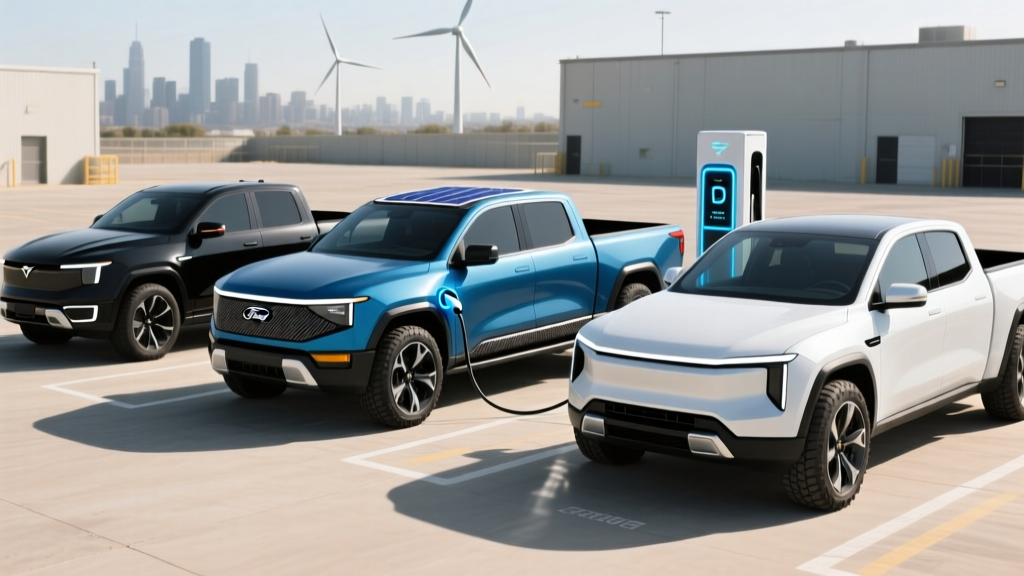
Bottom line for electric pick up buyers: The 2026 electric truck market offers four mainstream options — the Ford F-150 Lightning, Rivian R1T, Chevrolet Silverado EV, and Tesla Cybertruck — with EPA ranges from 270 to 440 miles, towing capacities from 7,500 to 13,000 lbs, and starting prices spanning roughly $55,000 to $100,000+. Real-world highway range drops 15–25% below EPA estimates, and towing can cut range by 40–50%. If you charge at home and drive under 200 miles daily, an electric pick up saves $1,500–$3,000 annually in fuel and maintenance versus a comparable gas truck. If you regularly tow heavy trailers long distances or lack home charging access, a gas or hybrid truck remains the more practical choice today.
The 2026 Electric Pick Up Landscape: What's Available Now
The electric pick up segment has matured significantly. Production volumes have stabilized, dealer inventories are healthier, and second-generation platforms have addressed many early-adopter complaints about build quality and software reliability. Here's where each model stands for the 2026 model year.
| Spec | Ford F-150 Lightning | Rivian R1T | Chevy Silverado EV | Tesla Cybertruck |
|---|---|---|---|---|
| EPA Range | 240–320 mi | 270–420 mi | 390–440 mi | 320–340 mi |
| Battery (usable kWh) | 98 / 131 kWh | 95 / 141 kWh | 200 kWh (Max) | 123 kWh |
| Chemistry | NMC | NMC (Samsung SDI) | NMC (Ultium) | NMC (4680 cells) |
| Peak DC Fast Charge | 150 kW (Std) / 150 kW (Ext) | 200+ kW | 350 kW | 250 kW |
| 10–80% DC Charge Time | ~41 min (Ext Range) | ~30 min (Max Pack) | ~20 min (est.) | ~15–20 min |
| Level 2 Rate | 19.2 kW (80A) | 11.5 kW (48A) | 19.2 kW (80A) | 11.5 kW (48A) |
| 0–60 mph | 3.8 s (Ext, dual motor) | 3.0 s (Tri Motor) | 4.5 s (4WT) | 2.6 s (Cyberbeast) |
| Horsepower | 580 hp | 850 hp (Tri) | 664 hp (4WT) | 845 hp (Beast) |
| Max Towing | 10,000 lbs | 11,000 lbs | 13,000 lbs | 11,000 lbs |
| Payload | 2,235 lbs | 1,760 lbs | 1,800 lbs | 2,500 lbs |
| Starting MSRP | ~$55,000 | ~$69,900 | ~$55,000 (WT) | ~$79,990 |
| Battery Warranty | 8 yr / 100,000 mi | 8 yr / 175,000 mi | 8 yr / 100,000 mi | 8 yr / 120,000 mi |
Source: fueleconomy.gov and manufacturer press pages. Specs vary by trim; verify exact figures for your configuration.
EPA estimates assume a mix of city and highway driving at moderate temperatures. In real-world highway driving at 70–80 mph, expect 15–25% less range than the EPA sticker. In sub-freezing temperatures, add another 15–30% reduction depending on cabin heating demands and whether the truck has a heat pump. For the F-150 Lightning Extended Range (EPA 320 mi), plan for roughly 240–270 mi on a highway road trip in fair weather, and 200–230 mi in winter. The Silverado EV 4WT's 440-mile EPA figure is impressive but reflects the massive 200+ kWh battery — highway real-world still lands around 340–370 mi.
Electric Pick Up vs Gas Truck: The Cost Comparison
The upfront price of an electric pick up is typically $5,000–$20,000 higher than a comparably equipped gas truck. But the total cost of ownership tells a different story — if your driving and charging patterns align.
| Cost Category | F-150 Lightning (Ext Range) | F-150 Gas (3.5L EcoBoost 4WD) |
|---|---|---|
| Purchase Price (MSRP avg) | $72,000 | $58,000 |
| Federal Tax Credit (§30D) | Up to $7,500 (see eligibility below) | $0 |
| Effective Purchase | ~$64,500 | $58,000 |
| Fuel / Energy (5 yr) | ~$4,500 (home charging at $0.14/kWh) | ~$14,600 (at $3.50/gal, 19 MPG combined) |
| Maintenance (5 yr) | ~$1,800 | ~$4,200 |
| Insurance (5 yr avg) | ~$12,500 | ~$9,800 |
| Estimated Depreciation (5 yr) | ~$30,000 | ~$24,000 |
| 5-Year Total Cost | ~$113,300 | ~$110,600 |
Key takeaways: The electric pick up saves roughly $10,000–$12,000 in fuel and maintenance over five years. But higher insurance premiums (typically 15–30% more for EVs) and steeper depreciation partially offset those gains. The math tips in the EV's favor when gas prices rise above $4.00/gal, when you drive more than 15,000 miles annually, or when state/local incentives stack on top of the federal credit.
Critical tax credit note: The IRS §30D credit for 2026 requires the buyer to meet income caps ($300K joint / $150K single modified AGI), the truck must be under the $80,000 MSRP cap for pickups, and battery components and critical minerals must meet escalating domestic-sourcing thresholds. The F-150 Lightning and Silverado EV have qualified for the full or partial credit depending on build date and battery sourcing. The Cybertruck, starting above $80K, may not qualify. Always verify current eligibility on the IRS clean vehicle credit page before purchasing, and consult a tax professional — the credit can be transferred to the dealer at point of sale as a price reduction.
Towing and Payload: Where Electric Trucks Shine and Struggle
Electric pick up trucks deliver instant torque, which makes them genuinely excellent at getting heavy trailers moving. The Silverado EV's 13,000-lb rating and the Rivian R1T's 11,000-lb capacity are competitive with mid-range gas V8 trucks. But there's a physics problem that no amount of software updates can fix: towing at highway speeds in an electric truck is brutally inefficient.
Independent testing and owner data consistently show that towing a 5,000–7,000 lb trailer at 65–70 mph reduces electric truck range by 40–50%. That F-150 Lightning with a 320-mile EPA range? Expect 160–190 miles before you need to charge when towing a mid-size camper. And DC fast charging a 131 kWh battery from 10–80% at 150 kW takes over 40 minutes — meaning a 400-mile towing trip requires at least two lengthy charging stops.
For context, a gas F-150 with the 36-gallon tank and the Max Tow package can cover 350–400 miles while towing before a 5-minute refuel.
- Choose an electric pick up if: You primarily drive unladen or with light loads under 200 miles daily, have reliable home Level 2 charging, want low operating costs for commuting and job-site use, and tow only occasionally on shorter trips.
- Choose a gas or hybrid truck if: You regularly tow 5,000+ lbs over 200+ miles, live in a region with sparse DC fast charging infrastructure, drive extensively in extreme cold (below 10°F), or need maximum flexibility for unpredictable long-haul towing.
- Consider a PHEV truck (if/when available): A plug-in hybrid truck offering 30–40 miles of electric commuting range plus a gas engine for towing would be ideal for mixed-use buyers. As of 2026, no mainstream PHEV full-size pickup is widely available, but this segment is expected to grow.
Home Charging: The Make-or-Break Factor
Home charging is where electric pick up ownership either works beautifully or falls apart. These trucks have large batteries — 98 to 200+ kWh — which means Level 1 (120V) charging is essentially useless for daily use. Plugging into a standard outlet adds roughly 2–4 miles of range per hour. A full charge on Level 1 could take 3–5 days for the larger batteries.
A Level 2 home charger (240V) is non-negotiable for electric pick up ownership. Here's what to budget:
| Component | Low Estimate | High Estimate |
|---|---|---|
| Level 2 Charger (hardware) | $400 | $1,200 |
| Electrical panel capacity check | $0 (included) | $200 |
| 240V circuit installation (50–80A) | $500 | $2,500 |
| Panel upgrade (if needed, 100A→200A) | $1,500 | $4,000 |
| Permits and inspection | $50 | $300 |
| Total (no panel upgrade) | $950 | $4,200 |
| Total (with panel upgrade) | $2,450 | $8,200 |
For a 131 kWh battery (F-150 Lightning Extended Range), a 48-amp Level 2 charger (11.5 kW) adds roughly 20–25 miles of range per hour, fully charging the truck in about 11–12 hours. Upgrading to an 80-amp circuit (19.2 kW) cuts that to roughly 7 hours — which the Lightning and Silverado EV support, but the Rivian R1T and Cybertruck do not (they cap at 11.5 kW AC).
Have a licensed electrician assess your panel before committing. Many homes built before 2000 have 100-amp service, which may not support an 80-amp EV circuit alongside existing loads like electric dryers and ranges.
Common Electric Pick Up Misconceptions — Fact-Checked
| Myth | Fact |
|---|---|
| "Electric trucks can't tow anything real." | The Silverado EV is rated for 13,000 lbs — competitive with gas 3/4-ton trucks. The limitation isn't capability; it's range while towing. |
| "The battery will need replacing in 5 years and cost $20,000." | All four trucks carry 8-year/100,000+ mile battery warranties guaranteeing at least 70% capacity retention. Real-world degradation data from earlier EVs shows most batteries retain 85–90% capacity at 100K miles. Full replacement is rare and costs $10,000–$22,000 depending on pack size, but is typically covered under warranty during the coverage period. |
| "You'll be stranded — there aren't enough chargers." | The U.S. charging network has expanded significantly. Tesla Superchargers (now open to non-Tesla EVs via NACS adapters or built-in NACS ports) exceed 30,000 stalls nationally. Electrify America, EVgo, and ChargePoint DC networks continue to grow. However, rural routes and national park corridors still have gaps — plan accordingly. |
| "Electric trucks are worse in cold weather." | Range drops 15–30% in freezing temperatures due to battery chemistry and cabin heating demands. However, preconditioning the battery while plugged in mitigates much of the loss, and regenerative braking performance improves once the pack warms. Owners in Minnesota and Canada report satisfactory year-round use with adjusted expectations. |
| "All electric trucks qualify for the $7,500 tax credit." | Eligibility depends on MSRP caps ($80K for trucks), buyer income limits, and battery component/critical mineral sourcing requirements that tighten annually. Always check the IRS clean vehicle credit page for current qualifying models. |
What First-Time Electric Pick Up Buyers Should Know
Understand kW vs kWh before you shop. Kilowatt-hours (kWh) measure battery capacity — think of it as the size of your fuel tank. Kilowatts (kW) measure power flow — the rate at which you charge or discharge. A 131 kWh battery charged at 150 kW will not charge in under an hour because charging speed tapers significantly above 80% state of charge. That 10–80% time quoted by manufacturers is the useful fast-charging window; the final 20% can take nearly as long as the first 80%.
Charge curves matter more than peak kW numbers. The Silverado EV advertises 350 kW peak charging, but that rate is only sustained for a narrow portion of the charge curve, typically between 10–30% state of charge. Above 50%, the rate drops substantially. The 10–80% time of ~20 minutes is the more useful metric, and it reflects the average sustained rate, not the peak.
NACS is becoming the standard. Ford has adopted the North American Charging Standard (NACS) for the F-150 Lightning, giving it native access to Tesla Superchargers. The Cybertruck uses NACS natively. Rivian transitioned to NACS for the R1T. GM vehicles including the Silverado EV also adopted NACS. If you're cross-shopping, verify the connector type — CCS1 adapters are available but add a layer of complexity.
Insurance costs more. Electric pick up insurance premiums run 15–30% higher than equivalent gas trucks, driven by higher repair costs (specialized body structures, battery protection requirements, and limited body-shop EV certification). Get quotes before buying — the difference can be $500–$1,200 per year depending on your profile and state.
Maintenance is genuinely lower. No oil changes, no transmission fluid, no spark plugs, no exhaust system. Brake pads last significantly longer thanks to regenerative braking handling most deceleration. Budget for tire rotation, cabin air filter, windshield washer fluid, and brake fluid checks. Annual maintenance typically costs $300–$500 versus $800–$1,200 for a gas truck.
Frequently Asked Questions
What's the best electric pick up for daily commuting and light work?
The Ford F-150 Lightning Extended Range offers the best balance of price (~$65,000–$72,000 depending on trim), practical range (EPA 320 mi, ~250 mi real-world highway), 10,000-lb towing, and the widest dealer service network. The 19.2 kW Level 2 charging capability means faster home charging than the Rivian or Cybertruck. If you value tech and adventure features, the Rivian R1T's gear tunnel and quad-motor option are compelling, but at a higher starting price.
Can I use an electric pick up as a job-site truck?
Yes, with caveats. The F-150 Lightning's Pro Power Onboard offers up to 9.6 kW of exportable power (240V), enough to run power tools, compressors, and job-site lighting directly from the truck battery — eliminating the need for a separate generator. The Cybertruck offers similar vehicle-to-load capability. The limitation is range: if your job site is 80+ miles away and you're running power tools all day, you'll need to charge overnight at home or have job-site charging access.
How long do electric truck batteries actually last?
Current NMC lithium-ion batteries in these trucks are engineered for 1,500–2,000 full charge cycles before dropping to 80% capacity. For a truck with 300 miles of range, that's 450,000–600,000 miles of theoretical cycle life. Real-world degradation is influenced by charging habits (frequent DC fast charging and routinely charging to 100% accelerate wear), temperature exposure, and battery management system quality. Expect 85–92% capacity retention at 100,000 miles based on data from earlier EVs. All manufacturers warrant the battery for at least 8 years/100,000 miles at 70% minimum capacity.
Is an electric pick up worth it if I don't have a garage?
It's harder but not impossible. Outdoor-rated Level 2 chargers are widely available and can be installed on an exterior wall or pedestal. The challenge is access to a dedicated 240V circuit — apartment dwellers and street-parkers face real obstacles. If your workplace offers Level 2 charging, or if reliable public DC fast chargers are within 10 minutes of your regular routes, ownership can still work. But the convenience and cost advantages of electric trucks are maximized with overnight home charging at residential electricity rates ($0.10–$0.18/kWh in most states).
Will an electric pick up hold its resale value?
EV depreciation has been steeper than gas trucks in recent years, driven by rapid technology advancement, price cuts from Tesla, and consumer uncertainty about long-term battery health. Early F-150 Lightnings have depreciated 35–45% over three years, versus roughly 25–30% for comparable gas F-150s. This gap may narrow as the market matures and battery longevity data accumulates, but buyers should factor higher depreciation into their 5-year cost calculations.