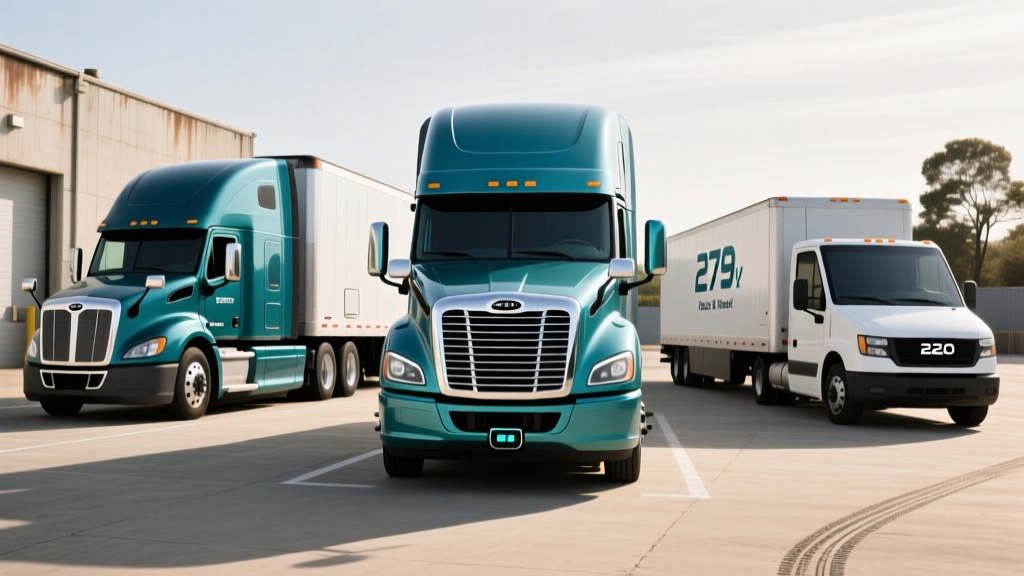
Quick Answer: Peterbilt currently offers three battery-electric models for North American fleets: the Model 579EV (Class 8 regional haul), Model 520EV (Class 8 refuse/vocational), and Model 220EV (Class 6-7 medium-duty delivery). Battery capacity ranges from 282 kWh to 444 kWh depending on configuration, with EPA-estimated ranges between 100 and 150 miles for heavy-duty models and up to 200 miles for the medium-duty 220EV. Base pricing starts around $300,000 for the 579EV before incentives, compared to roughly $180,000–$220,000 for a comparable diesel Peterbilt. The business case hinges on duty-cycle specifics: high-mileage, depot-based routes with overnight charging and access to state or federal incentive programs (such as IRA commercial clean vehicle credits up to $40,000) can achieve payback in 3–5 years; long-haul or irregular routes remain better served by diesel.
Why Fleets Are Evaluating Electric Peterbilt Trucks
The commercial trucking sector accounts for roughly 25% of US transportation-related greenhouse gas emissions despite representing only 4% of vehicles on the road. That math makes Class 6–8 electric trucks a priority for regulators, fleet operators under ESG mandates, and municipalities with zero-emission procurement targets. Peterbilt, a PACCAR subsidiary, has positioned itself as a first-mover among legacy OEMs with purpose-built electric platforms rather than diesel-to-EV conversions.
As of 2026, Peterbilt's electric lineup targets three distinct vocational niches: regional drayage and freight (579EV), municipal and private refuse collection (520EV), and last-mile or regional delivery (220EV). Each platform shares PACCAR's electric powertrain architecture but is optimized for dramatically different duty cycles, payload requirements, and charging strategies.
For fleet managers weighing an electric Peterbilt against sticking with diesel, the decision is less about range on a spec sheet and more about operational predictability: do your trucks return to a depot every night? Do they travel under 150 miles per shift? Can you secure charging infrastructure and incentive funding? If the answer to all three is yes, the total-cost-of-ownership case is increasingly strong.
The 2026 Electric Peterbilt Lineup: Specs and Configurations
| Specification | Model 579EV (Class 8) | Model 520EV (Class 8) | Model 220EV (Class 6-7) |
|---|---|---|---|
| GVWR | 82,000 lbs | 72,000 lbs | 26,000–33,000 lbs |
| Battery Capacity | 396–444 kWh (NMC) | 282–396 kWh (NMC) | 141–282 kWh (NMC) |
| EPA Est. Range | ~150 miles | ~100–130 miles | ~150–200 miles |
| Real-World Range (loaded) | ~100–130 miles | ~70–110 miles | ~120–170 miles |
| Peak DC Fast Charge | ~350 kW | ~250 kW | ~150 kW |
| 10–80% Charge Time | ~60–80 min | ~50–70 min | ~45–60 min |
| Motor Power | 670 HP (peak) | 536 HP (peak) | 335 HP (peak) |
| Base MSRP (approx.) | $300,000–$380,000 | $320,000–$400,000 | $180,000–$250,000 |
| Battery Warranty | 5 yr / unlimited mi | 5 yr / unlimited mi | 5 yr / unlimited mi |
All three models use nickel-manganese-cobalt (NMC) lithium-ion battery packs supplied by PACCAR's powertrain partners. NMC chemistry offers higher energy density than LFP — critical for heavy-duty applications where every pound of battery reduces payload capacity — but requires more careful thermal management and typically shows 15–20% capacity degradation over 8–10 years of daily cycling.
Real-World Range: What the EPA Sticker Doesn't Tell You
The EPA range figures above assume moderate temperatures, partial loads, and mixed driving. In real fleet operations, range varies significantly:
- Fully loaded at 80,000 lbs GCW (579EV): Expect 100–120 miles on a regional highway route. The 150-mile EPA figure assumes lighter loads and lower average speeds.
- Stop-and-start refuse routes (520EV): Regenerative braking actually helps here — the constant deceleration recovers energy. However, the compactor's hydraulic PTO draw can consume 15–25% of battery capacity over a shift, cutting effective range to 70–90 miles on dense collection routes.
- Cold-weather operations (below 32°F): NMC batteries lose 20–35% of usable capacity in freezing temperatures without preconditioning. A 579EV rated at 130 real-world miles in July may deliver only 85–100 miles in January in northern climates.
- Highway speeds above 65 mph: Aerodynamic drag on a Class 8 tractor increases range consumption roughly 2% for every 1 mph above 55. Sustained 70 mph running can reduce range by 15–20% versus the EPA cycle.
Fleets should spec battery capacity for their worst-case day, not their average day. A route that typically consumes 250 kWh might spike to 350 kWh in winter or on a detour day. Running batteries to 5% SoC regularly accelerates degradation.
Electric Peterbilt vs Diesel: Operating Cost Comparison
| Cost Factor | Peterbilt 579EV | Peterbilt 579 (Diesel) | Notes |
|---|---|---|---|
| Vehicle Purchase Price | $320,000 (avg.) | $195,000 (avg.) | ~$125K premium for EV |
| Federal Tax Credit (§45W) | Up to $40,000 | $0 | IRA commercial clean vehicle credit |
| Fuel/Energy Cost per Mile | $0.18–$0.30 | $0.55–$0.75 | Based on $0.12/kWh depot vs $4.20/gal diesel |
| Annual Fuel Cost (60K mi/yr) | $10,800–$18,000 | $33,000–$45,000 | Savings: $15,000–$27,000/yr |
| Maintenance per Mile | $0.08–$0.12 | $0.17–$0.25 | No oil, DEF, DPF, fewer brake replacements |
| Annual Maintenance (60K mi) | $4,800–$7,200 | $10,200–$15,000 | Savings: $5,400–$7,800/yr |
| Depot Charging Install | $50,000–$200,000 | $0 | DC fast charger + electrical upgrades |
| 5-Year Total Cost (excl. infra) | $530,000–$650,000 | $580,000–$720,000 | EV breaks even in 3–5 years |
The math is clear: if a truck runs 60,000 miles per year on a predictable route with depot charging, the electric Peterbilt pays back its price premium in roughly 3–5 years through fuel and maintenance savings alone. But the caveats matter. That $50,000–$200,000 depot charging investment (for a single 350 kW DC fast charger plus panel upgrades and utility interconnection) can erase the early savings for small fleets. And if your route exceeds the truck's real-world range, you'll need opportunity charging mid-shift, which adds both infrastructure cost and downtime.
According to the US Department of Energy, medium- and heavy-duty trucks represent roughly 4% of vehicles but consume over 25% of highway fuel — making them prime targets for electrification economics.
Charging Infrastructure: What It Takes to Power an Electric Peterbilt
Unlike consumer EVs that can rely on public networks, Class 8 electric trucks require purpose-built depot charging. Here's what fleet operators need to plan for:
| Charging Level | Power (kW) | Miles Added per Hour | Use Case |
|---|---|---|---|
| Level 2 AC (J1772/CCS) | 19.2–80 kW | 10–40 mi/hr | Overnight depot top-off |
| DC Fast (CCS1) | 150–350 kW | 80–200 mi/hr | Primary depot charging |
| Megawatt Charging (MCS)* | 750–1,200 kW | 400–600 mi/hr | Future public truck corridors |
*MCS (Megawatt Charging System) is in pilot stages as of 2026, with limited public deployments along key freight corridors in California and Texas.
For overnight depot charging, most fleets install 150–250 kW CCS1 DC chargers. A single 350 kW charger can replenish a 579EV from 20% to 80% in approximately 50–60 minutes — fast enough for mid-shift opportunity charging during a driver's meal break. However, sustained charging at peak rates generates significant heat, and the charge curve tapers substantially above 80% SoC. Fleets should plan charging schedules around the 20–80% window for efficiency.
Infrastructure cost reality: Installing a single 350 kW DC fast charger at a fleet depot typically costs $120,000–$200,000 fully installed, including the charger unit ($60,000–$90,000), electrical service upgrades ($20,000–$60,000), trenching and conduit ($10,000–$30,000), and utility interconnection fees. For a 20-truck fleet, that's a $2–4 million infrastructure investment before any trucks are purchased.
Utility demand charges are the hidden cost. A depot drawing 3–5 MW simultaneously during peak hours can face demand charges of $10–$25 per kW per month — potentially $50,000–$100,000 monthly in some rate territories. Smart charging software that staggers truck charging and avoids utility peak windows is essential, not optional.
Federal and State Incentives for Electric Commercial Trucks
The IRS §45W Commercial Clean Vehicle Credit provides up to $40,000 for qualifying Class 8 electric trucks (or 30% of the vehicle cost, whichever is lower). Unlike the consumer §30D credit, there is no MSRP cap or buyer income limit — but the vehicle must be placed in service for business use, and the manufacturer must meet battery component and critical mineral sourcing requirements.
- Vehicle class: Must be a qualified commercial clean vehicle (Class 6+ qualifies for the full $40,000)
- Incremental cost test: Credit equals the lesser of 30% of vehicle cost or the incremental cost over a comparable diesel model
- Battery sourcing: Battery components must be manufactured or assembled in North America (phase-in schedule through 2029)
- Critical minerals: A percentage of critical minerals must be sourced from the US or FTA-partner countries (increasing annually)
- Transferability: Unlike §30D, the §45W credit is not transferable at point of sale — it is claimed on the business's tax return
Beyond federal credits, state-level incentives can dramatically improve the business case. California's Hybrid and Zero-Emission Truck and Bus Voucher Incentive Project (HVIP) has historically offered $60,000–$120,000 per Class 8 electric truck. New York, New Jersey, and several other states offer similar voucher programs. Combined with §45W, a fleet could offset $100,000–$160,000 of the purchase premium.
Additionally, the EPA's Clean Heavy-Duty Vehicles Program, funded by the Inflation Reduction Act, allocates $1 billion specifically for replacing existing Class 6–7 diesel trucks with zero-emission alternatives, with grants covering up to $275,000 per vehicle replacement plus infrastructure.
Common Misconceptions About Electric Peterbilt Trucks
| Myth | Fact |
|---|---|
| "Electric trucks can't handle real payloads." | The 579EV is rated for 82,000 lbs GCW. Battery weight (~8,000 lbs) does reduce payload by roughly 3,000–4,000 lbs vs diesel, but most regional routes don't cube out by weight. |
| "Batteries will need replacing every 3 years." | Peterbilt warranties the battery for 5 years with unlimited mileage. NMC packs in commercial service typically retain 80% capacity at 8–10 years / 500,000+ miles. Replacement cost is significant ($80,000–$150,000) but rarely needed within the truck's first ownership cycle. |
| "Charging takes too long for commercial operations." | At 350 kW, a 579EV charges from 20–80% in ~50 minutes — aligning with mandatory 30-minute driver rest breaks. Overnight depot charging at lower rates is sufficient for most single-shift operations. |
| "Electric trucks are zero-emission everywhere." | Tailpipe emissions are zero, but the upstream grid matters. A 579EV charged on a coal-heavy grid still produces indirect emissions. That said, even on the dirtiest US grids, lifecycle emissions are typically 40–60% lower than diesel. |
| "You can just plug into any truck stop." | Public DC fast charging for Class 8 trucks is extremely limited in 2026. Depot charging is the operational model; public MCS corridor charging is in pilot stages only. |
Decision Framework: Is an Electric Peterbilt Right for Your Fleet?
Choose an electric Peterbilt if:
- Your trucks run under 150 miles per shift on predictable, repeatable routes
- Trucks return to a central depot nightly (or have a mid-shift layover of 45+ minutes)
- You can invest in depot charging infrastructure ($120K–$200K per charger) or access utility grant programs
- You qualify for §45W credits plus state incentives (potentially $100K–$160K total offset)
- Your fleet operates in a jurisdiction with zero-emission mandates (e.g., CARB states) that will penalize diesel in the near future
- Your annual mileage is high enough (40,000+ mi/yr) that fuel savings recoup the premium within 5 years
Stick with diesel (or evaluate hydrogen fuel cell) if:
- Your routes regularly exceed 200 miles per shift or vary unpredictably day-to-day
- You operate long-haul, multi-day routes without reliable en-route charging for Class 8 vehicles
- Your fleet is small (under 10 trucks) and the per-unit infrastructure cost is prohibitive without grant funding
- You operate in extreme cold climates without access to heated depot facilities for battery preconditioning
- Payload is weight-limited and you consistently max out GVWR — the 3,000–4,000 lb battery penalty may be operationally unacceptable
- Your electrical service cannot support the MW-scale loads required for multi-truck depot charging without a $500K+ utility upgrade
Frequently Asked Questions
How long does it take to charge an electric Peterbilt 579EV?
At a 350 kW DC fast charger, the 579EV's 396–444 kWh battery charges from 10% to 80% in approximately 60–80 minutes. The charge curve tapers significantly above 80% — a full 10–100% session takes 90–120 minutes. Overnight Level 2 charging at 80 kW takes roughly 5–6 hours for a full charge, which is sufficient for single-shift depot operations.
What is the real-world range of a Peterbilt 520EV on a refuse route?
Expect 70–110 miles on a typical residential refuse route, depending on payload, compactor usage, and climate. Stop-and-go operation maximizes regenerative braking, which partially offsets the energy consumed by the hydraulic compactor PTO. In hot climates (above 95°F), battery thermal management draws additional power, reducing range by 5–10%.
Do electric Peterbilt trucks qualify for the $7,500 consumer EV tax credit?
No. The consumer §30D credit applies only to light-duty vehicles under 14,000 lbs GVWR. Electric Peterbilts qualify for the §45W Commercial Clean Vehicle Credit, which provides up to $40,000 for Class 8 vehicles — a significantly larger credit, but one claimed on the business's tax return rather than transferred at point of sale.
What happens when the battery degrades beyond usable capacity?
Peterbilt's battery warranty covers 5 years with no mileage limit, typically guaranteeing 70–80% capacity retention. Beyond warranty, NMC batteries in commercial truck service generally reach 80% State of Health at 8–12 years depending on charge cycling patterns and thermal management. Battery replacement costs $80,000–$150,000 depending on pack size, but most first-owners will trade the truck before replacement is needed. Second-life applications (stationary energy storage) can recover 20–30% of the battery's residual value.
Can an electric Peterbilt tow or haul the same loads as a diesel 579?
The 579EV is rated for the same 82,000 lbs GCW as its diesel counterpart. However, the battery pack adds approximately 7,000–8,000 lbs to the tractor weight, which reduces available payload for weight-limited freight by roughly 3,000–4,000 lbs (accounting for the federal 2,000-lb weight exemption for zero-emission vehicles under 23 U.S.C. §127). For freight that cubes out by volume rather than weight, this is rarely an issue.
What charging connector does Peterbilt use?
Electric Peterbilt models use the CCS1 (Combined Charging System) connector for both AC Level 2 and DC fast charging. The emerging MCS (Megawatt Charging System) connector for ultra-high-power truck charging is expected to be available on future models and retrofit programs as public MCS infrastructure deploys along major freight corridors starting in 2027–2028.