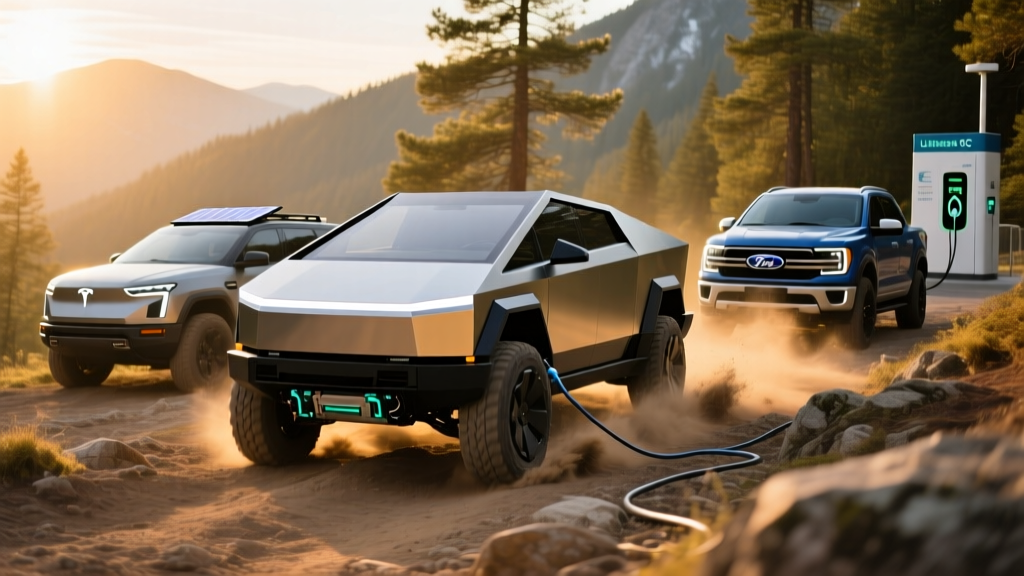
Can an Electric SUV Actually Handle Off-Road Trails?
Short answer: Yes — the best electric off-road SUVs in 2026 rival or exceed gas 4x4s on low-speed rock crawling and trail torque, thanks to instant motor response and precise individual-wheel control. However, EPA range drops 25–45% on technical trails (low speeds, high load, elevation gain), and remote backcountry charging remains a genuine constraint. If your off-roading means weekend forest service roads within 80 miles of a charger, a Rivian R1S or Jeep Wagoneer S works well today. If you run multi-day desert expeditions far from the grid, a gas or diesel rig — or a plug-in hybrid like the Jeep Wrangler 4xe — still holds the edge.
The electric off-road segment has matured past the novelty phase. Rivian's dual-motor R1S Gen 2, GMC Hummer EV SUV, and the upcoming Jeep Recon (announced, preliminary specs) each approach trail capability differently. What unites them is a physics advantage electric motors hold over internal combustion: maximum torque at zero RPM, millisecond-precise traction control without mechanical differentials, and a low center of gravity from the under-floor battery pack.
But capability isn't just about crawling over boulders. It's about whether you can reach the trailhead, complete the loop, and drive home — without a generator strapped to the roof rack. Let's break down the numbers that matter.
2026 Electric Off-Road SUVs: Spec-by-Spec Comparison
| Spec | Rivian R1S Dual-Motor (2026) | GMC Hummer EV SUV 3X (2026) | Jeep Wrangler 4xe Rubicon (PHEV) |
|---|---|---|---|
| EPA Range | ~410 mi (Max Pack) | ~314 mi | ~21 mi electric / 370 mi total |
| Real-World Trail Range | ~220–270 mi (trail use) | ~170–210 mi (trail use) | ~12–15 mi electric trail / 200+ mi gas |
| Battery (usable) | ~141 kWh (Max, NMC) | ~212 kWh (Ultium, NMC) | ~17 kWh (NMC) |
| Ground Clearance | 14.9 in (max air suspension) | 15.9 in (Extract Mode) | 12.9 in |
| Approach / Departure Angle | 35.6° / 36.1° | 49.7° / 38.4° | 44° / 37° |
| Water Fording | 36 in | 32 in | 34 in |
| Peak DC Fast Charge | 220 kW | 350 kW (800V capable) | N/A (Level 2 only, 7.2 kW) |
| 10–80% DC Charge Time | ~28 min | ~22 min | ~2.5 hr (Level 2) |
| 0–60 mph | 4.5 sec | ~3.5 sec (Watts to Freedom) | 6.0 sec |
| Horsepower / Torque | 665 hp / 829 lb-ft | 830 hp / 1,200 lb-ft | 375 hp / 470 lb-ft |
| Towing Capacity | 7,700 lb | 7,500 lb | 3,500 lb |
| Base MSRP | $83,900 (Dual-Motor Max) | $106,400 (3X) | $57,990 (Rubicon 4xe) |
| Federal Tax Credit (§30D) | Up to $7,500 (sourcing dependent) | Up to $7,500 (sourcing dependent) | Up to $3,750 |
Sources: fueleconomy.gov, Rivian specs, GMC Hummer EV, Jeep Wrangler 4xe. Specs reflect 2025–2026 model year data. Tax credit eligibility per IRS §30D rules — battery sourcing, MSRP caps, and buyer income limits apply.
EV vs. Gas Off-Road: Where Electrons Win and Where They Don't
| Category | Electric Off-Road SUV | Gas/Diesel 4x4 (e.g., Wrangler Rubicon, 4Runner TRD Pro) |
|---|---|---|
| Low-Speed Crawl Control | Superior — instant torque, no stall, individual motor control per wheel | Good with crawl control, but drivetrain lash and idle creep remain |
| Trail Torque Delivery | Immediate, linear, no gear hunting | Requires RPM build-up; turbo lag or low-end torque curve limits |
| Center of Gravity | Low (battery floor) — less body roll on side slopes | Higher — engine and fuel tank above axle |
| Range on Trail | 220–270 mi real-world (high-load, low-speed drain) | 300–400+ mi (with auxiliary fuel cans, essentially unlimited) |
| Refueling in Remote Areas | Poor — requires generator, solar, or 50+ mi detour to DCFC | Excellent — jerry cans, portable fuel, any small-town gas station |
| Noise Signature | Near-silent — preserves trail serenity, less wildlife disruption | Loud exhaust, engine drone at low crawl |
| Cold-Weather Range Loss | 25–40% in sub-freezing temps (battery chemistry + cabin heat) | ~10–15% (cabin heat from waste engine heat) |
| Maintenance | No oil, no transmission fluid, fewer moving parts | Regular oil, diff fluid, transmission, belts |
| Weight | Heavy (6,800–9,600 lb) — more tire wear, harder recovery if stuck | Lighter (4,500–5,500 lb) |
Real-world trail range reality check: EPA range assumes mixed highway/city driving at moderate loads. On a technical trail — think Moab's Hell's Revenge or Colorado's Imogene Pass — sustained low-speed, high-torque climbing with HVAC running can cut range by 35–45%. Plan your trail loops at no more than 50–60% of EPA range for safety margin. A 410-mile EPA Rivian R1S Max Pack realistically gives you ~220–250 miles of hard trail use before you need a charger.
The Real Cost of Owning an Electric Off-Road SUV
| Cost Factor (5-Year / 75,000 mi) | Rivian R1S Dual-Motor Max | Toyota 4Runner TRD Pro (Gas Baseline) |
|---|---|---|
| Purchase Price (after credit) | ~$76,400 ($83,900 – $7,500) | ~$57,000 |
| Fuel / Electricity | ~$3,800 (home charging at $0.14/kWh avg) | ~$11,250 (17 MPG avg at $3.50/gal) |
| Maintenance | ~$1,200 (tire rotation, cabin filter, wiper fluid) | ~$4,500 (oil changes, diff fluid, belts, brakes) |
| Insurance (avg) | ~$14,000 ($2,800/yr — EVs cost more to insure) | ~$9,000 ($1,800/yr) |
| Tires (off-road use) | ~$3,600 (heavier vehicle = faster wear, 2 sets) | ~$2,800 (lighter, 2 sets) |
| Depreciation (est.) | ~$30,000 | ~$18,000 (4Runners hold value exceptionally) |
| Estimated 5-Year Total | ~$129,000 | ~$102,550 |
The electric off-road SUV saves dramatically on fuel and maintenance — roughly $7,450 and $3,300 respectively over five years. But those savings are offset by a higher purchase price, steeper insurance premiums (EVs average 20–40% more to insure due to repair complexity and battery replacement cost), and heavier tire wear from the vehicle's mass.
The total-cost gap narrows considerably if you qualify for the full $7,500 §30D federal tax credit (buyer income ≤$150K single / $300K joint, vehicle MSRP ≤$80K for SUVs, battery sourcing requirements met), have access to cheap home electricity, and drive high annual mileage where the per-mile energy savings compound. If you're a weekend-only trail rider doing 8,000 miles/year, the fuel savings shrink and the depreciation hit dominates.
Charging an Electric Off-Road SUV: Home, Trail, and Backcountry
Off-road EV ownership lives or dies on your charging plan. Here's the realistic breakdown:
| Charging Level | Power (kW) | Miles Added per Hour | Use Case |
|---|---|---|---|
| Level 1 (120V household) | ~1.4 kW | ~3–4 mi/hr | Emergency trickle; not viable for daily off-road use |
| Level 2 (240V home) | 7.7–11.5 kW | ~20–35 mi/hr | Daily recharge; overnight full charge in 10–14 hours |
| DC Fast Charge | 150–350 kW | ~500–1,000 mi/hr (peak) | Road trips to trailheads; 10–80% in 22–30 min |
Home charging is essential. If you live in an apartment or lack a garage/driveway with 240V access, an electric off-road SUV is impractical for regular trail use. A Level 2 home installation typically costs $1,200–$3,500 (charger hardware + electrician + permit), but panel upgrades to 200A can push this to $5,000+.
Trailhead charging is improving but inconsistent. Electrify America, EVgo, and Tesla Supercharger (NACS) networks now reach many gateway towns near popular trail systems (Moab, Sedona, Ouray). But the last 30–50 miles to remote staging areas rarely have any charging infrastructure. Plan to arrive at the trail with 80%+ state of charge and carry a portable Level 1 adapter as a backup.
Backcountry charging workarounds: Some overlanders carry portable solar arrays (400–800W) paired with a high-capacity power station, but this adds ~4–10 miles of range per day of full sun — enough for camp power, not meaningful driving range. A gas generator with a Level 1 adapter can add ~3–4 miles per hour of runtime. Neither is a substitute for real infrastructure.
Common Electric Off-Road Myths, Corrected
| Myth | Fact |
|---|---|
| "EVs can't handle water crossings." | The Rivian R1S is rated for 36 inches of water fording; the Hummer EV for 32 inches. Battery packs are sealed to IP67/IP6K9K standards. Water crossings within spec are safe. |
| "You'll get stranded on the trail with no way to refuel." | Range planning is real. With 220+ real-world trail miles, most day-use trail loops (typically 40–80 miles) are well within reach. Stranding risk comes from poor planning, not inherent EV limitation. |
| "EVs are too heavy for soft sand and mud." | Weight is a disadvantage in deep sand (the Hummer EV at ~9,600 lb sinks faster than a 4,500-lb Wrangler). But instant torque and traction control can compensate on moderate terrain. Air-down tire pressure helps. |
| "Cold weather makes off-road EVs useless." | Cold reduces range 25–40% and slows DC charging speeds. Preconditioning the battery while plugged in mitigates this. Winter trail runs are viable with adjusted range expectations — but multi-day winter expeditions remain risky. |
| "You need a $200,000 Hummer EV to go off-road electric." | The Rivian R1S Dual-Motor starts at ~$79,900 (Standard Pack) before credits. The Jeep Wrangler 4xe Rubicon at ~$57,990 offers electric trail crawling for far less, though with limited electric-only range. |
Decision Framework: Should You Buy an Electric Off-Road SUV?
Choose a full BEV off-road SUV (Rivian R1S, Hummer EV) if:
- You have reliable Level 2 home charging (garage or driveway with 240V/50A circuit)
- Your typical trail loops are within 80–100 miles of your home or a known DC fast charger
- You value silent trail operation, instant torque crawling, and low maintenance
- You drive 12,000+ miles/year total (commute + trails), making energy savings meaningful
- You qualify for the §30D credit or can absorb the premium over a gas equivalent
Choose a PHEV off-roader (Jeep Wrangler 4xe) if:
- You want electric trail crawling but need unlimited backcountry range via the gas engine
- You don't have reliable access to DC fast charging near your trails
- Your budget is under $65,000
- You do multi-day remote expeditions where fuel resupply is easier than charging
Stick with gas/diesel (Wrangler Rubicon, 4Runner TRD Pro, Bronco Badlands) if:
- You regularly run multi-day trails far from any charging infrastructure (e.g., deep backcountry routes in Nevada, Alaska, or Baja)
- You need to tow a heavy trailer to remote camps (EV range drops sharply under tow load — expect 50–60% of EPA)
- You live in extreme cold climates and off-road in winter (below 10°F)
- You want maximum aftermarket support and field-repairable mechanical systems
What First-Time Electric Off-Road Buyers Need to Know
Tires matter more than horsepower. The Rivian R1S and Hummer EV ship with all-terrain tires adequate for forest roads and moderate rock crawling. For serious trail use, budget $1,800–$2,800 for a dedicated mud-terrain or aggressive all-terrain set (35-inch where clearance allows). Heavier EVs wear tires 20–30% faster than gas equivalents.
Suspension and armor upgrades are limited (for now). The aftermarket for electric off-road SUVs is still developing. Rivian offers its own gear guard and suspension lift through its outfitter program. The Hummer EV's Extract Mode and adaptive air suspension reduce the need for aftermarket lifts. Traditional skid plates and bumpers designed for gas Wranglers don't bolt onto EV platforms.
Regenerative braking on descents is a superpower. On steep downhill trail sections, max regen can slow the vehicle without touching the friction brakes — reducing brake fade and giving you precise speed control. This is one area where EVs objectively outperform gas rigs on technical descents.
Battery warranty protects your biggest asset. Rivian covers the battery for 8 years/175,000 miles (retaining ≥70% capacity). GM covers the Hummer EV Ultium battery for 8 years/100,000 miles. These warranties cover degradation and defects — but not physical damage from trail impacts. Adding the available underbody armor package is strongly recommended for technical trail use.
Frequently Asked Questions
How much range do you actually lose off-road in an electric SUV?
On moderate forest service roads at 15–25 mph, expect 20–30% range reduction versus EPA. On technical rock-crawling trails with sustained climbing and low-speed high-torque use, plan for 35–45% reduction. Cold weather (below 32°F) compounds this by another 15–25%. Always plan trail loops using no more than 55–60% of your EPA-rated range as your usable budget.
Can I charge an electric off-road SUV from a portable generator on the trail?
Technically yes, but slowly. A 3,500W portable generator connected via a Level 1 (120V) adapter adds roughly 3–4 miles of range per hour. To add 100 miles would require 25+ hours of generator runtime and ~20 gallons of fuel. It's a viable emergency backup but not a practical refueling strategy.
Do electric off-road SUVs qualify for the $7,500 federal tax credit?
Eligibility depends on the specific model year, battery component and critical mineral sourcing, buyer income (≤$150K single, $300K joint), and the vehicle's MSRP (must be ≤$80,000 for SUVs). As of 2026, the Rivian R1S in qualifying configurations is eligible for up to $7,500, and the credit can be transferred at the point of sale to reduce your purchase price directly. The GMC Hummer EV 3X at $106,400 MSRP exceeds the $80,000 SUV cap and does not qualify. Always verify current eligibility at fueleconomy.gov before purchasing.
Is a PHEV like the Wrangler 4xe better for off-road than a full EV?
It depends on your use case. The Wrangler 4xe gives you ~21 miles of silent electric crawling (enough for many trail sections) plus unlimited range from the gas engine for remote backcountry. But it lacks DC fast charging, has less electric range, and its 375 combined hp trails full EVs. If your priority is deep backcountry exploration where charging is unavailable, the PHEV's gas backup is a real advantage. If you mostly do day-trip trails near home with home charging, a full BEV's superior torque control and lower running costs win.
What happens if the battery gets damaged on a rock?
All purpose-built electric off-road SUVs include underbody skid plating over the battery pack. Rivian's available Gear Guard and reinforced underbody shield protect against most rock strikes. However, a severe puncture to the battery enclosure can compromise cells and require module or full-pack replacement — costing $15,000–$30,000+ out of warranty. This is why underbody armor is not optional for serious trail use, and why comprehensive insurance with low deductibles is essential.