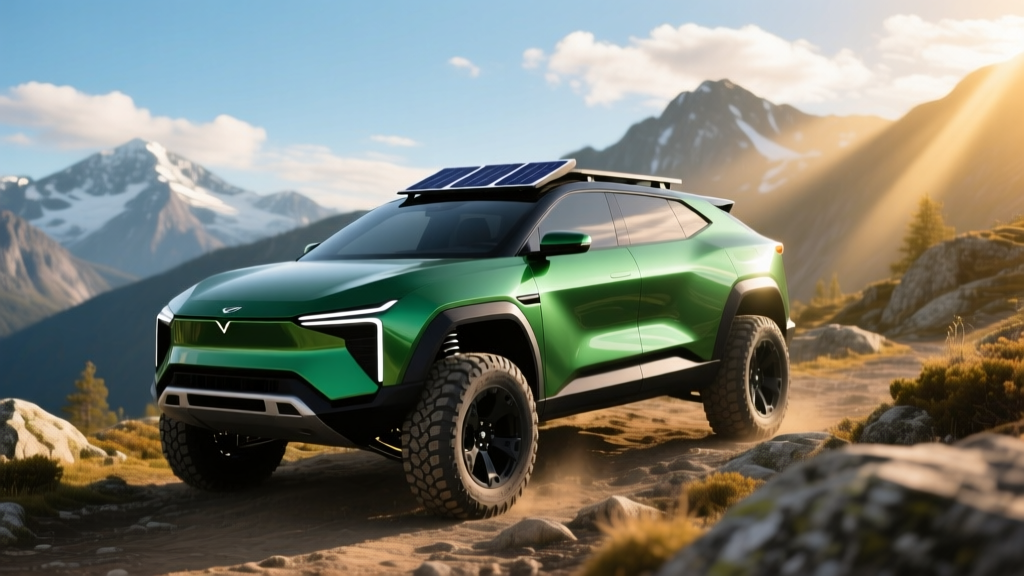
If you're searching for an electric off road car in 2026, the short answer is that three production vehicles dominate the segment: the Rivian R1S (dual/tri/quad motor SUV), the Jeep Wrangler 4xe (plug-in hybrid, not a full EV but the most trail-proven electrified rig), and the GMC Hummer EV SUV (tri-motor, 830 hp). A true electric off road car must deliver low-end torque, ground clearance above 10 inches, skid plating, and a battery large enough to handle trail-crawling energy drain without stranding you. Expect EPA ranges between 270 and 400 miles on pavement, but plan for 30–50% range loss on technical trails due to low-speed high-torque demand, elevation changes, and accessory load.
Quick Answer: Is an Electric Off Road Car Practical in 2026?
Yes, if you have home Level 2 charging and your typical trail is within 100 miles of your garage. Electric motors deliver instant torque at 0 RPM—ideal for rock crawling—and fewer moving parts mean no transmission fluid, transfer case fluid, or front/rear differential service. The tradeoff: DC fast chargers are scarce near trailheads, cold weather cuts range 20–30%, and a fully loaded Rivian R1S or Hummer EV SUV will run $90,000–$110,000 before incentives. If you regularly overland 300+ miles from grid power, a PHEV like the Wrangler 4xe or a diesel remains more practical.
The 2026 Electric Off Road Car Lineup: Exact Specs
The electric off road car market has matured past concept-stage vaporware. Here are the production models you can actually buy, with manufacturer-confirmed and EPA-published figures.
| Spec | Rivian R1S (Dual Max) | Rivian R1S (Tri Max) | GMC Hummer EV SUV (3X) | Jeep Wrangler 4xe (PHEV) |
|---|---|---|---|---|
| Powertrain | Dual AWD | Tri-Motor AWD | Tri-Motor e4WD | 2.0L Turbo PHEV |
| Horsepower | 665 hp | 850 hp | 830 hp | 375 hp combined |
| Torque | 829 lb-ft | 1,103 lb-ft | 1,200 lb-ft | 470 lb-ft |
| Battery (usable) | 149 kWh (Max Pack) | 149 kWh | ~212 kWh (est.) | 17 kWh |
| EPA Range | 410 mi | 380 mi | 314 mi | 22 mi electric + gas |
| Ground Clearance | 14.9 in (max) | 14.9 in (max) | 15.9 in (Extract Mode) | 10.8 in (Rubicon) |
| Approach/Departure | 32.5° / 34.3° | 32.5° / 34.3° | 51.6° / 43.4° | 44° / 37° |
| Max DC Fast Charge | 220 kW | 220 kW | 350 kW | N/A (Level 2 only) |
| 10–80% DC Time | ~30 min | ~30 min | ~22 min | 2.5 hr (L2) |
| 0–60 mph | 3.5 sec | 2.9 sec | 3.0 sec | 6.0 sec |
| Towing Capacity | 7,700 lb | 7,700 lb | 7,500 lb | 3,500 lb |
| Base MSRP | $89,800 | $99,900 | $104,595 | $51,795 |
| Battery Warranty | 8 yr / 175,000 mi | 8 yr / 175,000 mi | 8 yr / 100,000 mi | 8 yr / 100,000 mi |
Sources: Rivian R1S specifications, GMC Hummer EV, fueleconomy.gov (EPA data).
Real-World Trail Range: What the EPA Sticker Doesn't Tell You
EPA range figures assume mixed driving at moderate speeds. On a technical trail, energy consumption skyrockets. Here's what to actually expect when you leave pavement:
Trail Range Reality Check
EPA sticker: Rivian R1S Dual Max — 410 miles
Highway at 75 mph: ~310–330 miles
Forest service road (gravel, 35 mph): ~280–320 miles
Rock crawling / low-range technical: ~150–200 miles equivalent
Cold weather (below 32°F) on trail: Subtract 20–30% from all figures above
Why the drop? Low-speed crawling draws sustained high current (torque demand at near-zero RPM), accessory loads (winch, lights, heated cabin) compound drain, and battery efficiency drops in cold temperatures. Always plan trail loops with a 40% range buffer minimum.
The Hummer EV SUV's massive ~212 kWh battery gives it an edge in raw trail endurance despite its lower EPA rating—more stored energy means more crawling time before you need a charger. The Wrangler 4xe sidesteps the problem entirely: once its 17 kWh battery depletes after ~22 electric miles, the 2.0L turbo kicks in, giving you 350+ total miles of range with any gas station as a "charger."
EV vs Gas 4x4: The Honest Cost Breakdown
Electric off road cars carry a steep purchase premium, but operating costs are substantially lower. Here's a 5-year comparison assuming 12,000 miles/year (10,000 pavement + 2,000 trail), home Level 2 charging at $0.14/kWh, and gas at $3.50/gallon.
| Cost Category | Rivian R1S (Dual Max) | Toyota 4Runner TRD Off-Road (Gas Baseline) | Wrangler 4xe (PHEV) |
|---|---|---|---|
| Base MSRP | $89,800 | $48,500 | $51,795 |
| Est. Federal Tax Credit (§30D) | $0–$7,500* | $0 | $3,750–$7,500* |
| 5-Year Fuel/Energy Cost | $5,880 (electric) | $14,700 (gas, 17 mpg avg) | $8,200 (mix) |
| 5-Year Maintenance | $1,800 | $4,500 | $3,800 |
| 5-Year Insurance (est.) | $14,400 | $7,800 | $9,600 |
| 5-Year Depreciation (est.) | $38,000 | $18,000 | $22,000 |
| 5-Year Total Cost of Ownership | ~$121,680 | ~$93,500 | ~$88,695 |
| Cost Per Mile | $2.03 | $1.56 | $1.48 |
*§30D tax credit eligibility depends on MSRP caps (SUVs: $80,000), buyer income limits ($300k MFJ / $150k single), battery component and critical mineral sourcing requirements, and point-of-sale transfer rules. The Rivian R1S Dual Max base MSRP exceeds the SUV cap, potentially limiting credit eligibility to lower trims or used purchases. Always verify current-year rules at IRS.gov §30D and consult a tax professional.
The numbers are clear: an electric off road car saves significantly on fuel and maintenance (no oil changes, no transfer-case service, regenerative braking saves pads), but higher insurance premiums, steeper depreciation on luxury EVs, and the upfront price gap mean the total cost of ownership still favors gas or PHEV unless you drive high annual miles on cheap electricity.
Charging Infrastructure Near Trails: The Real Bottleneck
Home charging is the backbone of electric off road car ownership. A Level 2 home charger (48A, 11.5 kW) fully recharges a Rivian R1S Max Pack in about 14 hours—perfect for overnight recovery after a trail day. Installation costs vary:
| Item | Typical Cost Range |
|---|---|
| Level 2 Charger (hardwired, 48A) | $500–$800 |
| Electrician (240V/60A circuit run) | $800–$2,500 |
| Permit & inspection | $100–$400 |
| Panel upgrade (if 200A panel full) | $1,500–$4,000 |
| Total (no panel upgrade) | $1,400–$3,700 |
| Total (with panel upgrade) | $2,900–$7,700 |
The bigger challenge: public DC fast charging near trailheads. Most national forests, BLM land, and rock-crawling areas (Moab, Rubicon Trail, Ouray) have limited or zero fast-charging infrastructure within 30 miles. Electrify America and Tesla Superchargers cluster along interstates, not forest roads. This means:
- Plan trail loops that return to your base (garage or hotel with L2 charging) rather than point-to-point overland routes.
- Precondition your battery before any DC fast charge—cold batteries charge dramatically slower, sometimes below 50 kW until the pack warms to ~70°F.
- Carry a portable Level 1/2 EVSE with NEMA 14-50 adapters for campground outlets (verify 240V/50A availability before relying on it).
- Understand the charge curve: Peak kW ratings (220 kW for Rivian, 350 kW for Hummer) apply only between ~10–40% SoC. Above 80%, speeds taper sharply—a 80–100% top-off can take as long as 10–80%.
Common Misconceptions About Electric Off Road Cars
| Myth | Fact |
|---|---|
| "EVs can't crawl rocks—no low range" | Electric motors produce peak torque at 0 RPM with no need for a mechanical low-range transfer case. Rivian's quad-motor setup provides individual wheel torque vectoring that exceeds any locking differential. Approach/departure angles of 32°+ rival dedicated gas crawlers. |
| "Water crossings will kill the battery" | EV battery packs are sealed to IP67 or IP6K9K standards (submersion-rated). The Rivian R1S wades to 43.3 inches; the Hummer EV to 32.7 inches. Gas engines hydrolock far more easily than a sealed battery shorts. |
| "You'll get stranded in the backcountry" | A fully charged R1S Max Pack has 410 EPA miles—enough for most day-trail loops. The risk is real only on multi-day overland trips far from charging. Mitigation: plan routes within 100 miles of base, carry a tow strap, and know nearest DC charger locations via PlugShare or A Better Routeplanner. |
| "Cold weather makes off-road EVs useless" | Cold reduces range 20–30% and slows charging, but EVs still start instantly (no cranking a frozen engine) and heat the cabin from battery without idling a gas motor. Preconditioning while plugged in mitigates most range loss. |
| "EV off-roaders are just for Instagram" | Rivian R1S vehicles have completed the Trans-America Trail, and the Hummer EV's CrabWalk and Extract Mode are genuine trail tools. That said, their 6,800–9,000 lb curb weights create real limitations in deep sand and mud compared to a 4,200-lb Wrangler. |
Decision Framework: Which Electric Off Road Car Is Right for You?
If X, Then Y — Choose Your Rig
- If you want maximum range and family practicality: Rivian R1S Dual Max (410 mi EPA, 3 rows, $89,800 base). Best all-around electric off road car for weekend warriors with home charging.
- If you want extreme trail capability and don't mind the price: GMC Hummer EV SUV 3X (Extract Mode, CrabWalk, 350 kW charging, $104,595). Heaviest and most expensive, but the most capable off-pavement.
- If you regularly overland beyond charging range: Jeep Wrangler 4xe Rubicon ($51,795, 22 mi electric + unlimited gas range). The only electrified option that eliminates range anxiety on multi-day expeditions.
- If you lack home Level 2 charging access: Reconsider a full EV for off-road use. Trail driving drains batteries faster than highway driving, and relying solely on public DC fast chargers is impractical for regular off-roading. A PHEV is the smarter call.
- If budget is the primary concern: The Wrangler 4xe at ~$52k (potentially ~$44k after the §30D credit) is the most affordable entry point, and its solid-axle articulation still outperforms independent-suspension EVs on extreme rock crawling.
- If you prioritize low running costs and mostly day-trip trails within 100 miles: Rivian R1S or Hummer EV. Electricity at $0.14/kWh costs ~$0.04/mile vs $0.21/mile for a gas 4Runner at 17 mpg.
First-Time Buyer Checklist: What to Know Before You Buy
- Verify your home electrical panel has capacity for a 60A circuit. A licensed electrician should assess this before purchase—a panel upgrade adds $1,500–$4,000 and 2–4 weeks.
- Test-drive on actual trails, not just pavement. EV weight (6,800–9,000 lbs) changes how the vehicle behaves in sand, mud, and on side slopes. Heavier vehicles sink deeper and require more momentum recovery.
- Check §30D tax credit eligibility carefully. The SUV MSRP cap is $80,000 for new vehicles. Most electric off road cars exceed this at higher trims. Income caps apply: $300,000 modified AGI for married filing jointly, $150,000 for single filers. Battery sourcing requirements may further limit eligibility. Use the IRS clean vehicle credit tool and consult a tax professional.
- Budget for insurance. Luxury EVs carry premiums 40–80% higher than equivalent gas vehicles. Get quotes before committing.
- Understand battery degradation. Most manufacturers warrant 70% capacity retention at 8 years/100,000–175,000 miles. Off-road use (high-current draw, heat cycles) may accelerate degradation slightly compared to highway-only driving, but real-world data from Rivian owners shows ~5–7% loss at 60,000 miles.
- Plan your charging strategy for trail days. Map DC fast chargers within 50 miles of your typical trailhead using PlugShare. If none exist, accept that your EV off-roading will be limited to day trips from a home base.
Frequently Asked Questions
Can an electric off road car tow a trailer on the highway?
Yes, but towing devastates range. The Rivian R1S tows 7,700 lbs, but expect range to drop 40–50% when pulling a loaded trailer at highway speeds. A 410-mile EPA range becomes roughly 200–250 miles with a 5,000-lb camper in tow. Plan charging stops accordingly and precondition the battery before each DC fast charge.
How does regenerative braking help on trails?
Regen braking recaptures energy on downhill sections that a gas vehicle wastes as brake heat. On a trail with significant elevation change (e.g., descending a mountain pass), an EV can recover 10–20% of the energy used climbing. Rivian and Hummer EV also allow adjustable regen levels—set it high for one-pedal trail crawling, which reduces brake wear and provides smoother speed control on descents.
What happens if I damage the battery pack off-road?
All three vehicles feature reinforced skid plates (titanium on Rivian, steel on Hummer EV) protecting the battery. However, a punctured pack is a $20,000–$35,000 repair. Comprehensive insurance is essential, and you should verify your policy covers off-road battery damage explicitly. Some insurers exclude competitive or extreme off-road use.
Are there electric off road cars under $50,000?
Not in new production for 2026. The Wrangler 4xe starts at $51,795 and can drop below $50k with the §30D credit. Used Rivian R1S models (2022–2024) are appearing in the $45,000–$60,000 range and may qualify for the $4,000 used clean vehicle credit (income caps apply, vehicle MSRP must be under $25,000 at time of original sale—which excludes most R1S units). The sub-$50k electric off-road segment will likely open when more affordable platforms from brands like Scout (VW-backed, expected 2027) reach production.
Do I need NACS or CCS for off-road charging?
In 2026, the North American Charging Standard (NACS) is the dominant connector for new EVs. Rivian switched to NACS for the 2025 model year and provides a CCS adapter for legacy stations. The GMC Hummer EV uses CCS natively. Tesla Supercharger access (via NACS) is the largest fast-charging network in the US and increasingly the most relevant for trail-adjacent charging. Carry the appropriate adapter for your vehicle's native port.
How do EV off-roaders handle extreme cold compared to gas 4x4s?
EVs start instantly in any temperature (no cold cranking amps, no glow plugs), and cabin heat is available immediately from the battery. However, range drops 20–30% below freezing, and DC fast charging speeds can halve until the battery warms. Gas 4x4s lose fuel economy in cold but don't lose range as dramatically. If you winter-wheel in sub-zero temps regularly, preconditioning while plugged in is non-negotiable.