Quick Answer: What Is an Electric NEV?
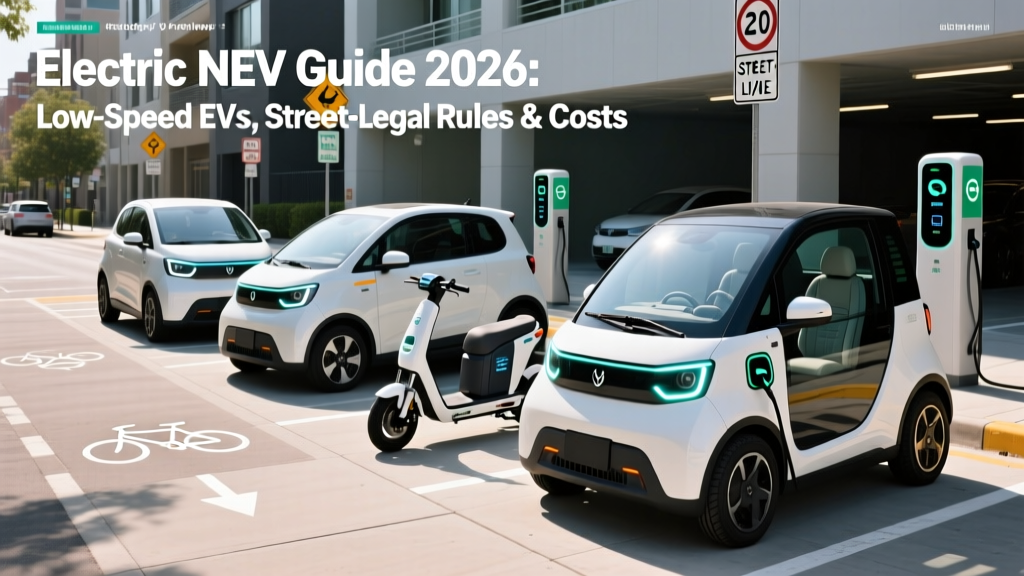
An electric NEV (Neighborhood Electric Vehicle) is a federally classified Low-Speed Vehicle (LSV) with a top speed between 20–25 mph and a minimum range of roughly 25–35 miles on a single charge. NEVs are street-legal on roads with speed limits up to 35 mph (some states allow up to 45 mph with local approval). They cost between $9,000 and $22,000, require no gasoline, and use standard 120V household outlets for charging. NEVs are ideal for planned communities, campus travel, and short errands — but they lack highway capability, crash-test protection, and fast-charging infrastructure.
What Exactly Qualifies as an Electric NEV?
The term "electric NEV" refers to a vehicle built to the Federal Motor Vehicle Safety Standard (FMVSS) No. 500, which defines Low-Speed Vehicles. According to NHTSA's FMVSS 500, an LSV must meet these criteria:
- Top speed: Greater than 20 mph but not greater than 25 mph
- Four wheels and a gross vehicle weight rating (GVWR) under 3,000 lbs
- Mandatory equipment: headlamps, turn signals, stop lamps, reflex reflectors, parking brake, windshield (glazed), VIN, and seat belts
- Not required: airbags, crumple zones, electronic stability control, or standard crash testing
This means NEVs are not held to the same safety standards as a Chevrolet Equinox EV or a Tesla Model 3. They're engineered for low-speed, short-distance travel — think gated communities, beach towns, military bases, and college campuses. Popular 2026 NEV models include the GEM e2/e4/e6 (by Waev), Ajax Electric D5, and various Chinese-manufactured LSVs sold through dealerships like BIGTOWN and HDK Electric Vehicle.
NEV Specs: Range, Battery, and Charging in 2026
Most modern electric NEVs use lithium-ion (NMC or LFP) battery packs, though some budget models still ship with lead-acid batteries. Here's what current models deliver:
| Specification | Typical 2026 NEV (LFP) | Budget NEV (Lead-Acid) |
|---|---|---|
| Battery Capacity | 8–14 kWh | 5–8 kWh |
| EPA-Equiv. Range | 30–60 miles | 15–25 miles |
| Top Speed | 25 mph | 20–25 mph |
| Charge Time (120V) | 6–8 hours (full) | 8–12 hours (full) |
| Charge Connector | Standard NEMA 5-15 (household) | Standard NEMA 5-15 |
| Battery Warranty | 3–5 years | 1–2 years |
| Motor Power | 4–8 kW (5–11 HP) | 3–5 kW (4–7 HP) |
Key distinction: NEV batteries are measured in kWh (energy capacity), while charging happens at roughly 1–1.5 kW (power rate) from a standard wall outlet. Because NEV batteries are small (8–14 kWh vs. 60–100 kWh in a full-size EV), overnight charging on a 120V outlet is perfectly adequate — no Level 2 charger or panel upgrade needed.
Real-World Range Reality
An NEV rated at 50 miles of range will realistically deliver 35–45 miles in mixed driving with two passengers, mild hills, and A/C use. In cold weather (below 40°F), expect 20–30% range loss — the same lithium-ion chemistry limitation that affects full-size EVs, just with less buffer to absorb it. If your daily driving is under 20 miles round-trip, this is a non-issue. If you're pushing the range limit, plan conservatively.
NEV vs. Full EV vs. Gas Golf Cart: Cost & Capability Comparison
Buyers considering an electric NEV are usually cross-shopping three options. Here's how they stack up with concrete numbers:
| Factor | Electric NEV (LSV) | Full EV (e.g., Chevy Equinox EV) | Gas Golf Cart |
|---|---|---|---|
| Purchase Price | $9,000–$22,000 | $33,600–$45,000 | $8,000–$14,000 |
| Street-Legal on Public Roads | Yes (≤35 mph roads) | Yes (all roads) | No (private property only, typically) |
| Top Speed | 25 mph | 95–130 mph | 15–19 mph |
| Range | 30–60 miles | 250–319 miles (EPA) | 50–80 miles (gas tank) |
| "Fuel" Cost per Mile | ~$0.03–$0.05 | ~$0.04–$0.06 | ~$0.12–$0.18 |
| Annual Maintenance | $100–$300 | $300–$600 | $400–$800 |
| Insurance (avg/year) | $200–$600 | $1,200–$2,200 | $150–$400 (if insured) |
| Highway Capable | No | Yes | No |
| Federal Tax Credit (§30D) | Not eligible | Up to $7,500* | Not eligible |
*§30D eligibility requires meeting MSRP caps ($55K cars/$80K trucks/SUVs), buyer income limits, and battery-sourcing requirements. See IRS qualifying vehicle list. NEVs do not qualify because they are not classified as highway-capable passenger vehicles.
5-Year Cost of Ownership Breakdown
| Expense Category | Electric NEV ($14,000 avg) | Gas Golf Cart ($11,000 avg) |
|---|---|---|
| Purchase Price | $14,000 | $11,000 |
| Energy/Fuel (5 yrs, 3,000 mi/yr) | $450–$750 | $1,800–$2,700 |
| Maintenance (5 yrs) | $500–$1,500 | $2,000–$4,000 |
| Insurance (5 yrs) | $1,000–$3,000 | $750–$2,000 |
| Battery Replacement (if needed) | $2,000–$4,500 (LFP lasts longer) | $600–$1,200 (12V batteries) |
| 5-Year Total | $17,950–$23,750 | $15,550–$20,900 |
| Cost per Mile (total) | $0.12–$0.16 | $0.10–$0.14 |
The electric NEV costs slightly more over five years, primarily due to the higher purchase price. However, the NEV provides street-legal road access that a gas golf cart does not — a significant practical advantage. If you can drive legally on public roads to the grocery store, school, or post office, the NEV's utility gap over a golf cart widens considerably.
Who Should Buy an Electric NEV? (Decision Framework)
Choose an Electric NEV If:
- Your daily driving is under 25 miles round-trip on low-speed roads
- You live in a planned community, retirement village, or small town with speed limits ≤35 mph
- You want a street-legal vehicle without the cost of a full EV
- You have access to a standard 120V outlet for overnight charging (garage or carport)
- You want near-zero maintenance — no oil changes, no spark plugs, no transmission fluid
- You're a second-vehicle household and your full-size car covers highway trips
Do NOT Buy an NEV If:
- You need to drive on roads with speed limits above 35 mph regularly
- You live in an area with harsh winters and need reliable cold-weather transportation (NEVs have minimal cabin heating and significant range loss)
- You require modern safety features — airbags, ABS, backup cameras, automatic emergency braking (none are required or typically available on NEVs)
- You need to carry more than 4–6 passengers or tow anything
- You were hoping to claim the $7,500 federal EV tax credit — NEVs don't qualify
Common NEV Misconceptions — Myth vs. Fact
| Myth | Fact |
|---|---|
| "NEVs are just golf carts" | NEVs are federally regulated LSVs with required safety equipment (seat belts, lights, VIN, windshield). Golf carts are not street-legal without local modification and separate registration. |
| "NEVs qualify for the $7,500 EV tax credit" | False. The IRS §30D credit applies to highway-capable passenger vehicles. NEVs/LSVs are excluded. |
| "I need a special charger for an NEV" | No. Virtually all NEVs charge from a standard 120V household outlet (NEMA 5-15). No electrician, no panel upgrade, no Level 2 hardware required. |
| "NEVs are completely safe because they're electric" | NEVs lack crash-test ratings, airbags, and crumple zones. NHTSA does not crash-test LSVs. In any collision with a full-size vehicle, NEV occupants are extremely vulnerable. |
| "NEV batteries need replacing every 2–3 years" | Modern lithium-ion (especially LFP) NEV batteries last 5–10 years with proper care. Only older lead-acid models need 2–4 year replacements. |
| "I can drive my NEV on any road" | NEVs are restricted to roads with posted speed limits of 35 mph or less in most states. Some states allow up to 45 mph with local authorization. Highway use is illegal everywhere. |
First-Time NEV Buyer Checklist
If you've decided an electric NEV fits your use case, here's what to verify before signing the purchase agreement:
- Confirm your state's LSV laws. Every state regulates LSVs differently. Check whether your state requires registration, insurance, and a valid driver's license to operate an NEV. (Most do.) Your state DMV website is the authoritative source.
- Verify the VIN and FMVSS 500 compliance. A legitimate NEV will have a 17-digit VIN and a manufacturer's certificate of origin stating FMVSS 500 compliance. Without this, your DMV may refuse registration.
- Choose lithium-ion over lead-acid. LFP chemistry offers the best longevity (2,000+ cycles) and is less prone to thermal issues. Lead-acid saves $2,000–$4,000 upfront but costs more in replacements over 5 years.
- Test the real-world range. Ask the dealer for a test drive covering at least 5 miles with hills and stops. Check the state-of-charge (SoC) drop to estimate your actual range.
- Budget for insurance. While NEV insurance is cheaper than full-auto policies, some insurers don't cover LSVs at all. Get quotes from GEICO, Progressive, and Hagerty before purchasing.
- Check local HOA or community rules. Some planned communities restrict NEV parking, charging, or road use. Confirm your neighborhood allows them.
NEV Charging and Ownership Practicalities
One of the NEV's strongest selling points is charging simplicity. Here's what ownership actually looks like:
- Charge location: Any standard 120V outlet. A garage, carport, or even an exterior wall outlet works. No dedicated circuit is usually needed because the draw is only ~1–1.5 kW.
- Charge time: 6–10 hours from empty to full, depending on battery size. Most owners plug in overnight and wake up to a full charge — identical to the Level 1 charging experience of a full-size EV, but with a much smaller battery to fill.
- Electricity cost: At the U.S. average of $0.16/kWh (EIA, 2025), fully charging a 12 kWh NEV battery costs about $1.92. For 3,000 miles of annual driving, that's roughly $90–$150 per year in electricity.
- Maintenance: Brake pad inspection (regen braking extends pad life dramatically), tire rotation, windshield wiper fluid, and cabin air filter. That's essentially the full list. No oil, coolant flushes, or emissions checks.
- Storage: NEVs are compact (roughly 9–11 feet long) and fit easily in a standard single-car garage alongside a full-size vehicle.
Frequently Asked Questions
Can I drive an electric NEV without a driver's license?
In most states, no. NEVs are classified as motor vehicles and require a valid driver's license, registration, and insurance to operate on public roads. A handful of states have exceptions for retirement communities or private roads, but assume you'll need a license unless your state DMV says otherwise.
Are electric NEVs safe for kids?
NEVs have seat belts but lack airbags, crumple zones, and crash-test certification. They are not equivalent to a full-size vehicle in a collision. For low-speed neighborhood travel with responsible driving, many families use them — but understand the safety trade-off. Children should always be in age-appropriate car seats or boosters, secured by the NEV's lap belt.
Can I upgrade an NEV to go faster than 25 mph?
Technically, aftermarket speed controllers exist — but modifying an NEV beyond 25 mph reclassifies it as a different vehicle category, voids its FMVSS 500 compliance, and likely makes it illegal to register or insure. It also eliminates any liability protection the manufacturer provides. Don't do it.
Do NEVs work in cold weather?
They work, but with significant limitations. Lithium-ion batteries lose 20–30% of range below 40°F. Most NEVs have only a small electric cabin heater (1–2 kW), which further drains the battery. If you live in a region with sustained sub-freezing winters, an NEV is best treated as a seasonal vehicle (spring through fall).
Is there a used NEV market?
Yes, but it's thin. Used NEVs hold value reasonably well because new inventory is limited and lead times can stretch 3–6 months. Expect to pay $6,000–$14,000 for a 2–5 year-old lithium-ion NEV. Always verify battery state of health (SoH) before buying used — a degraded battery is a $2,000–$4,500 replacement expense.
Where can I buy an electric NEV?
NEVs are sold through specialized dealerships, not conventional auto dealers. Major brands like GEM (Waev) have dealer networks listed on their websites. Some are also sold direct-to-consumer or through golf-cart dealers that carry street-legal LSVs. Always confirm the dealer provides proper titling documentation for your state.