The Short Answer on Electric NASCAR
NASCAR unveiled its first all-electric prototype in mid-2023 and has continued development through 2025-2026, targeting exhibition events rather than full series replacement. The prototype produces over 1,000 horsepower from a ~75 kWh battery pack and weighs approximately 4,200 lbs. While NASCAR has not committed to a full electric racing series, the program serves as an R&D platform for high-performance EV powertrains — technology that eventually trickles down to consumer vehicles in the form of better thermal management, faster charging, and improved battery durability under extreme loads.
What Electric NASCAR Actually Is (and Isn't)
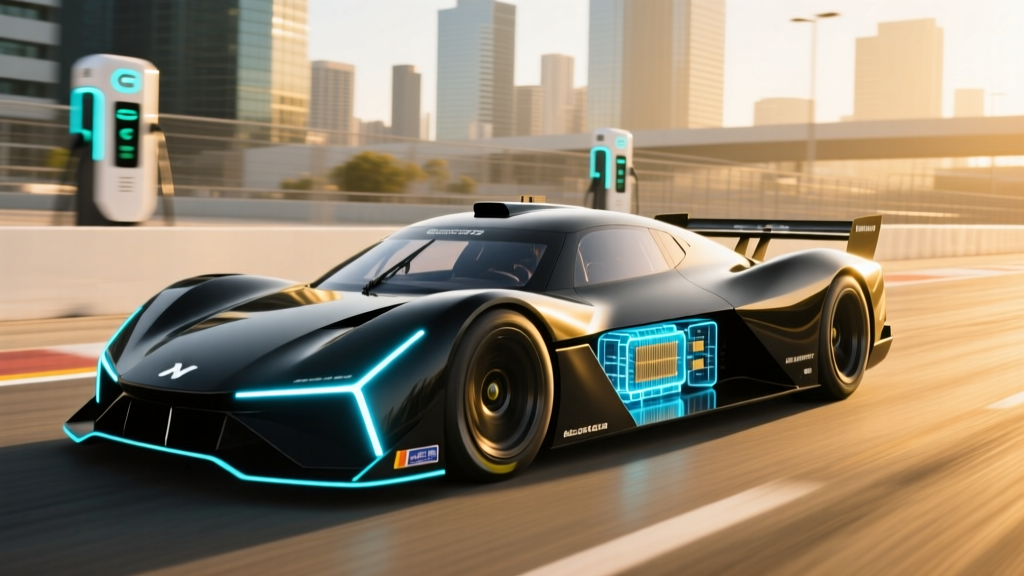
NASCAR's electric prototype is a purpose-built demonstration vehicle, not a replacement for the Next Gen Cup Series cars that still run 5.86-liter pushrod V8s on a blend of Sunoco Green E85 ethanol. The electric prototype was developed in partnership with ABB (the Swiss electrification company) and features a custom tube-frame chassis with a floor-mounted battery enclosure — somewhat similar in layout to the skateboard architectures used in the Hyundai Ioniq 5 or Ford F-150 Lightning, but far more heavily reinforced for racing impacts.
Key prototype specifications released by NASCAR and reporting outlets include:
- Power output: 1,000+ hp (dual-motor AWD configuration)
- Battery capacity: ~75 kWh (estimated usable)
- Weight: ~4,200 lbs (comparable to current Next Gen at ~3,400 lbs dry)
- Top speed target: 200+ mph on superspeedways
- Charging: DC fast-charge capable, specific kW rate not publicly disclosed
What this prototype is not: a signal that NASCAR will go fully electric by 2027 or 2028. NASCAR leadership, including President Steve Phelps, has stated repeatedly that the organization will follow its fanbase and that internal combustion — likely via synthetic or hybrid fuels — will remain central to the series for the foreseeable future. The electric prototype is best understood as a technology demonstrator and a hedge against future OEM participation requirements.
How NASCAR's EV Prototype Compares to Gas-Powered Stock Cars
| Attribute | Electric Prototype | Next Gen V8 (Gas/E85) |
|---|---|---|
| Powertrain | Dual-motor AWD, battery-electric | 5.86L pushrod V8, RWD |
| Horsepower | 1,000+ hp | ~670 hp (race tune) |
| Energy/Fuel Capacity | ~75 kWh battery | 18-gallon fuel cell (E85) |
| Weight | ~4,200 lbs | ~3,400 lbs (dry, without driver) |
| Top Speed | 200+ mph (target) | ~200 mph (Daytona/Talladega) |
| Refuel/Recharge | DC fast charge (rate TBD) | ~12-14 seconds (pit stop) |
| Exhaust Sound | Near-silent (motor whine) | ~100+ dB (V8 roar) |
| Race Distance Feasibility | Limited by battery; pit charges needed | 500+ miles with pit stops |
The most significant gap is endurance. A Next Gen car can run 100+ mile stints on an 18-gallon cell and refuel in seconds during a pit stop. An electric prototype with a 75 kWh pack, even assuming aggressive energy recovery under braking, would struggle to complete a full 500-mile race without multiple lengthy charging stops. This is the same fundamental energy-density problem that affects consumer EVs on long road trips — gasoline and E85 still carry vastly more usable energy per pound than even the best lithium-ion cells.
What NASCAR's EV R&D Means for Consumer EV Buyers
Racing programs have historically accelerated road-car technology. Formula E's development pushed improvements in inverter efficiency and regen-braking algorithms that now appear in consumer EVs from manufacturers like Jaguar and Porsche. NASCAR's electric prototype could yield similar downstream benefits in three areas:
1. Thermal management under extreme loads. Racing batteries must discharge at enormous C-rates (the ratio of discharge power to battery capacity) without overheating. A 75 kWh pack delivering 1,000 hp (~746 kW) is discharging at roughly 10C continuously — far beyond what any road car demands. Solutions developed for this stress (advanced cooling plate designs, phase-change materials, predictive thermal algorithms) directly improve consumer fast-charging durability and hot-climate battery longevity.
2. High-power charging infrastructure. If NASCAR pursues electric pit stops, the series would need charging hardware in the 350-600 kW range — well above today's fastest public chargers at ~350 kW (like Electrify America's newest stations). That R&D pressure helps validate next-generation charging standards and connector durability that benefit consumer networks.
3. Battery safety under impact. NASCAR's tube-frame chassis must protect the battery enclosure through 150+ mph wall impacts and multi-car pileups. The crash-safety engineering developed here feeds directly into OEM battery-pack structural design, improving real-world collision safety for vehicles like the Tesla Model Y and Rivian R1T.
The Real Costs: EV Ownership vs. Gas in 2026
Whether NASCAR goes electric or not, the economics of consumer EV ownership in 2026 are driven by purchase price, electricity costs, maintenance, and the federal §30D tax credit. Here's a concrete comparison using a mid-size crossover as the baseline — the kind of vehicle most buyers actually shop for:
| Cost Category | EV (e.g., Hyundai Ioniq 5 SEL, ~$46,000 MSRP) | Gas (e.g., Hyundai Tucson SEL, ~$32,000 MSRP) |
|---|---|---|
| Purchase Price (after §30D credit) | $38,500 (if eligible) | $32,000 |
| Fuel/Energy (5 yrs, 75,000 mi) | $4,500 (home charging at $0.14/kWh, 3.2 mi/kWh) | $9,375 (28 MPG avg, $3.50/gal) |
| Maintenance (5 yrs) | $1,800 (tires, cabin filter, fluid top-offs) | $4,200 (oil, filters, brakes, belts) |
| Insurance (5 yrs avg) | $9,500 (EVs cost ~15-20% more to insure) | $8,000 |
| Depreciation (est. 5-yr) | $19,000 (~49% of adjusted purchase) | $14,500 (~45% of purchase) |
| Total 5-Year Cost | $73,300 | $68,075 |
| Cost Per Mile | $0.49 | $0.45 |
The EV narrows the gap significantly when you factor in the §30D federal tax credit (up to $7,500, subject to MSRP caps, buyer income limits, and battery-sourcing requirements — always verify current eligibility at IRS.gov). Without the credit, the EV's total cost climbs to roughly $80,800 over five years. And if you cannot charge at home and must rely entirely on public DC fast charging at $0.35-$0.48/kWh, your five-year energy cost jumps to $8,500-$11,500, erasing much of the fuel savings.
This is the ownership calculus real buyers face — not the aspirational math of racing prototypes.
Common Misconceptions About Electric Racing and Consumer EVs
| Myth | Fact |
|---|---|
| "If NASCAR goes electric, gas cars will be banned next." | NASCAR has no announced timeline for full electrification. Synthetic fuels and hybrids are equally likely paths. Consumer ICE vehicles remain widely available and are not being legislated out of existence by racing decisions. |
| "Electric race cars prove EVs can go 500 miles without stopping." | The NASCAR EV prototype has a ~75 kWh battery — smaller than many consumer EVs. It cannot complete a 500-mile race without charging. Real-world consumer EV range still tops out around 400 miles (EPA) for the Lucid Air Grand Touring, with most mainstream models at 250-330 miles. |
| "1,000 hp from an EV means consumer cars will have 1,000 hp soon." | Racing powertrains sacrifice longevity for output. Consumer EVs prioritize efficiency, battery life, and cost. The average new EV in 2026 produces 200-400 hp — more than adequate for daily driving, but nowhere near race-spec. |
| "Electric NASCAR will sound the same with fake engine noise." | NASCAR has acknowledged that sound is a major fan concern. The prototype is near-silent compared to a V8. Artificial sound systems exist (as on some consumer EVs for pedestrian safety), but replicating the visceral experience of 40 stock cars at Talladega remains an unsolved challenge for fan engagement. |
| "EVs can't handle extreme heat from racing." | They can, but at significant engineering cost. The prototype uses aggressive liquid cooling and likely derates power under thermal stress — the same behavior you see in consumer EVs during repeated hard acceleration or sustained high-speed driving in hot weather. |
Decision Framework: Should NASCAR's EV Plans Affect Your Car Purchase?
Use This Framework to Decide Your Next Vehicle
If you drive <40 miles/day and have home charging access:
→ A battery-electric vehicle (BEV) makes strong financial sense. You'll charge overnight at ~$0.10-$0.16/kWh, never visit a gas station, and benefit from lower maintenance. Models like the Chevrolet Equity EV (~$33,000 MSRP) or Tesla Model 3 ($44,990) cover this use case easily. NASCAR's EV plans are irrelevant to your decision.
If you drive 40-100 miles/day with reliable home charging:
→ A BEV still works, but prioritize EPA range above 300 miles to handle highway trips and cold-weather range loss (expect 20-30% reduction below freezing). The Hyundai Ioniq 5 (EPA 318 mi, Long Range AWD) or Tesla Model Y (EPA 311 mi) are strong choices. Consider whether your route has DC fast chargers for longer trips.
If you regularly drive 100+ miles/day or lack home charging:
→ A plug-in hybrid (PHEV) like the Toyota RAV4 Prime (42 mi electric-only, 38 MPG combined after battery depletion) or a conventional hybrid may serve you better until public charging infrastructure matures. NASCAR's electric prototype does not solve your charging-access problem.
If you tow frequently or live in a charging desert:
→ Stick with a hybrid or efficient gas vehicle for now. BEV towing range drops 40-50% from EPA estimates, and rural charging gaps remain a real constraint in 2026. The Ford F-150 Lightning can tow, but real-world range with a 5,000-lb trailer drops to roughly 130-150 miles from its EPA 320-mile sticker.
What First-Time EV Buyers Should Actually Focus On
Racing prototypes are exciting engineering exercises, but they don't pay your bills or solve your commute. If you're considering your first EV in 2026, here's what matters:
- Home charging is the single biggest factor. A Level 2 home charger (240V, 32-48 amps, 7.7-11.5 kW) adds 25-40 miles of range per hour of charging. Installation costs $500-$2,000 if your electrical panel has capacity, or $2,500-$5,000+ if you need a panel upgrade. Without home charging, EV ownership becomes significantly more expensive and inconvenient.
- Check §30D tax credit eligibility before you buy. The credit has MSRP caps ($55,000 for sedans, $80,000 for SUVs/trucks), buyer income limits ($150K single / $300K joint), and battery component/critical mineral sourcing requirements that change annually. Use the IRS tool and confirm with a tax professional — don't assume you'll get $7,500. The point-of-sale transfer option lets you apply the credit at purchase rather than waiting for your tax return.
- Real-world range is 15-30% below the EPA sticker in cold weather or sustained highway driving. The EPA test cycle includes city driving with regenerative braking recovery. At 75 mph on a highway in 30°F weather, expect significant reduction. Plan your road trips around charging stations, not the sticker number.
- Insurance costs 15-25% more for EVs on average. Get quotes before purchasing. Higher repair costs, specialized parts, and battery replacement risk drive premiums up. Some insurers offer EV-specific policies that may narrow the gap.
- Battery degradation is real but slow. Most modern EV batteries (NMC or LFP chemistry) retain 85-92% capacity after 8 years / 100,000 miles based on current fleet data. Federal law mandates a minimum 8-year/100,000-mile battery warranty (10 years/150,000 miles in California and states that follow CARB rules). Full replacement costs $10,000-$22,000 out of warranty, but catastrophic failure is rare.
The Bottom Line
Electric NASCAR is a fascinating engineering project that may eventually improve consumer EV thermal management, charging speed, and crash safety. But in 2026, it remains a prototype — not a racing series, not a consumer product, and not a reason to delay or accelerate your vehicle purchase. Your buying decision should be driven by your daily mileage, home charging access, budget, and local climate — not by what's happening on the superspeedway. Focus on concrete specs (EPA range, kWh capacity, kW charge rate, $ MSRP after incentives) rather than racing headlines, and you'll make a better-informed choice.
Will NASCAR fully switch to electric cars?
Not in the foreseeable future. NASCAR has positioned its electric prototype as a development tool and exhibition vehicle. The series continues to explore synthetic fuels and hybrid powertrains as more fan-acceptable and logistically feasible paths. No timeline for full electrification has been announced.
Does electric NASCAR use Tesla technology?
No. The NASCAR electric prototype was developed in partnership with ABB and uses a custom-built powertrain, not Tesla components. The chassis is a purpose-built tube frame, and the battery pack is a racing-specific design — entirely different from Tesla's production skateboard architecture.
How fast can the NASCAR electric prototype go?
NASCAR has targeted 200+ mph top speed for the electric prototype, which would put it in the same range as current Next Gen Cup cars on superspeedways like Daytona and Talladega. However, sustained high-speed running is limited by battery capacity and thermal constraints.
Will electric NASCAR affect EV prices for consumers?
Indirectly, yes — over time. Racing R&D in thermal management, high-power charging, and battery safety eventually influences consumer vehicle engineering. But this trickle-down effect takes 5-10 years and is one of many factors affecting EV pricing. Battery mineral costs, manufacturing scale, and federal policy have far more immediate impact on what you'll pay at the dealership.
Can I buy an electric NASCAR?
No. The electric prototype is a one-off demonstration vehicle not available for purchase. NASCAR has not announced any plans to produce a road-legal electric stock car for consumers.