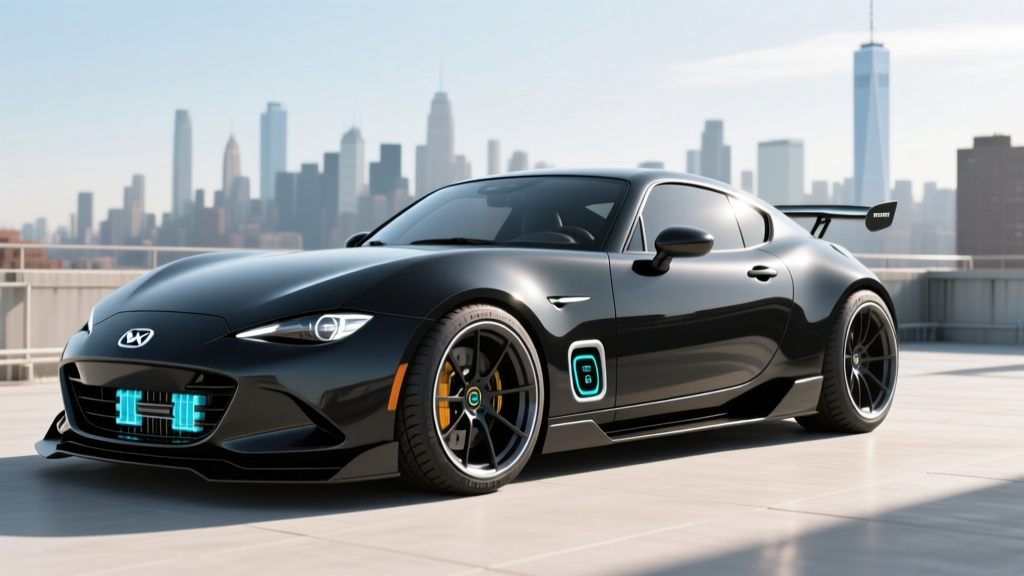
The Mazda MX-5 Miata is one of the most beloved lightweight roadsters ever built — and one of the most popular candidates for an aftermarket electric vehicle conversion. But before you pull the 1.5L or 2.0L engine and drop in a battery pack, you need hard numbers on cost, range, charging, and whether the math works compared to buying a factory EV or keeping your Miata gas-powered.
Quick Answer: Electric MX-5 Conversion at a Glance
Total conversion cost (2026): $25,000–$50,000+ on top of the donor car price ($4,000–$12,000 for an NA/NB/NC chassis).
Typical battery capacity: 20–40 kWh (LFP or salvaged NMC modules).
Real-world range: 80–160 miles depending on pack size, weight, and driving style.
Charging: Level 2 (6.6–7.4 kW) at ~25–35 miles/hour; DC fast charging is rare and adds $3,000–$6,000.
Federal tax credit: Conversions do NOT qualify for the §30D new or used EV credit.
Why Convert an MX-5 to Electric?
The appeal is straightforward: instant torque, near-silent cruising, lower running costs, and the satisfaction of driving a custom-built EV. The MX-5's light curb weight (2,100–2,400 lbs depending on generation) is a major advantage — less mass means less energy consumed per mile, which lets a smaller, lighter, cheaper battery pack deliver usable range.
Most converters target the NA (1990–1997) or NB (1999–2005) generations because they are abundant, inexpensive, mechanically simple, and light. The NC (2006–2015) and ND (2016–present) are heavier and more complex electronically, making them less popular for swaps.
But the romantic vision of an electric Miata needs to survive contact with real-world numbers. Let's break those down.
Electric MX-5 Conversion Cost Breakdown
A conversion is not a single line item. Here is what you are actually paying for in a typical 2026 build using a proven kit (e.g., EV West, Stealth EV, or a custom integrator):
| Component | Typical Cost Range | Notes |
|---|---|---|
| Donor MX-5 (NA/NB running) | $4,000–$12,000 | Clean title, manual preferred for adapter plates |
| Electric motor (AC induction or PMAC, 80–150 kW) | $3,000–$7,000 | Netgain Hyper9, BorgWarner, or Tesla drive unit |
| Battery pack (20–40 kWh, LFP or NMC) | $5,000–$15,000 | Salvaged Tesla/Leaf modules: lower cost. New LFP: higher cost, longer life |
| Motor controller & BMS | $2,000–$5,000 | Curtis, Sevcon, or AEM; BMS matched to cell chemistry |
| Charger (onboard Level 2, 3.3–7.4 kW) | $800–$2,500 | Elcon, TC Charger; DCFC adds $3K–$6K |
| Adapter plate, coupler, drivetrain | $1,500–$3,500 | Custom machining if no kit exists for your generation |
| Wiring, cooling, 12V DC-DC, accessories | $2,000–$4,000 | Power steering, heater, A/C deletes or electric replacements |
| Labor (if not DIY) | $8,000–$20,000 | 80–200+ hours at $75–$150/hr for experienced EV shops |
| Total (DIY, NA/NB, 30 kWh) | $25,000–$35,000 | Plus donor car |
| Total (shop-built, 40 kWh, DCFC) | $40,000–$55,000+ | Plus donor car |
For context, a 2026 Mazda MX-5 Sport starts at approximately $30,170 MSRP. A used 2022–2024 MX-5 trades between $22,000 and $30,000 depending on mileage and condition. Your total all-in cost for a shop-converted electric MX-5 typically lands between $45,000 and $67,000 — firmly in new EV territory.
Range, Battery, and Charging: What the Numbers Actually Look Like
Range is where most first-time converters get a reality check. The MX-5's small chassis limits battery volume. You are typically fitting modules in the transmission tunnel, under the hood (where the engine was), and possibly behind the seats or in a custom sub-floor tray.
Realistic Range Estimates by Pack Size
The MX-5's light weight helps, but aerodynamics (especially with the top down) and highway speeds hurt efficiency. Expect roughly 250–320 Wh/mile in mixed driving.
- 20 kWh usable: ~60–80 miles real-world (city favorable, highway less so)
- 30 kWh usable: ~95–120 miles real-world
- 40 kWh usable: ~125–160 miles real-world
In cold weather (below 40°F / 4°C), expect 15–30% range reduction due to increased battery internal resistance and cabin heating loads. Most conversions lack the sophisticated heat-pump thermal management found in factory EVs like the Tesla Model 3 or Hyundai Ioniq 5, so cold-weather losses hit harder.
Charging Speeds
Most conversions use a single-phase onboard charger rated at 3.3 kW or 6.6 kW (some high-end builds use 7.4 kW). Here is what that means in practice:
- Level 1 (120V, 1.4 kW): ~4–5 miles of range per hour. A full charge from empty takes 15–30 hours.
- Level 2 (240V, 6.6 kW): ~22–28 miles per hour. A 30 kWh pack charges from 10–100% in roughly 4.5 hours.
- DC fast charging (if equipped, 30–50 kW typical): 10–80% in approximately 30–45 minutes. Note that most conversion packs cannot accept high DC charge rates without thermal issues — sustained charging above 0.5C (half the pack capacity per hour) risks overheating modules not designed for it.
For comparison, a 2026 Tesla Model 3 Long Range (82 kWh, NMC) peaks at 250 kW DC and charges 10–80% in ~22 minutes, with an EPA range of 341 miles. The conversion Miata is not competing on road-trip capability — it is a local-drive car.
Electric MX-5 vs. Gas MX-5 vs. Factory EV: Ownership Costs
Let's compare the five-year cost picture. We'll use a shop-built 30 kWh electric NA Miata, a 2015 gas MX-5 (NC, purchased used), and a 2026 Chevrolet Equinox EV (as a representative affordable factory EV).
| Factor | Electric MX-5 Conversion (30 kWh) | 2015 Gas MX-5 NC (Used) | 2026 Chevy Equinox EV LT |
|---|---|---|---|
| Acquisition cost | $42,000 (donor + shop build) | $16,000 | $34,900 (MSRP, before credit) |
| Federal tax credit (§30D) | $0 (not eligible) | $0 | Up to $7,500 (income/MSRP/sourcing rules apply; see IRS §30D details) |
| Net purchase | $42,000 | $16,000 | ~$27,400 (if full credit applies) |
| Fuel/energy cost per mile | ~$0.04–$0.06 (home charging at $0.14/kWh) | ~$0.14–$0.18 (at $3.50/gal, 28 MPG combined) | ~$0.04–$0.05 (home charging) |
| Annual fuel (8,000 mi/yr) | $320–$480 | $1,120–$1,440 | $320–$400 |
| Maintenance (annual avg) | $200–$400 | $800–$1,500 | $300–$500 |
| Insurance (annual avg) | $1,800–$2,800 (specialty/custom) | $1,200–$1,800 | $1,400–$2,000 |
| 5-year total operating cost | $11,600–$18,000 | $13,600–$21,700 | $10,100–$14,500 |
| 5-year total cost of ownership | $53,600–$60,000 | $29,600–$37,700 | $37,500–$41,900 |
The numbers are blunt: an electric MX-5 conversion is the most expensive option by a wide margin. You are not saving money. You are paying a premium for a unique, custom vehicle that combines Miata driving dynamics with electric powertrain smoothness. That is a valid choice — but it is a passion purchase, not an economic one.
Common Misconceptions About EV Conversions
| Myth | Fact |
|---|---|
| "An EV conversion qualifies for the $7,500 federal tax credit." | It does not. The IRS §30D credit applies only to new or qualifying used vehicles from a licensed manufacturer. A home or shop conversion has no manufacturer certification, no VIN reassignment for EV status, and no battery-sourcing documentation. |
| "I'll get 200+ miles of range easily." | Not in an MX-5. The chassis physically cannot hold a 60–80 kWh pack without compromising weight distribution, ground clearance, and safety. 100–140 miles is the realistic sweet spot for a well-executed 30–35 kWh build. |
| "It'll be faster than a gas Miata." | It can be — but it is not automatic. A 110 kW (147 hp) motor in a 2,500-lb car yields a 0–60 time around 5.5–6.5 seconds, which matches or slightly beats a stock 2.0L NC. But adding a 400-lb battery raises weight to ~2,700+ lbs, hurting the handling balance that makes the Miata special. |
| "Maintenance will be nearly zero." | EV drivetrain maintenance is low, but conversion-specific issues are real: contactor wear, BMS cell-balancing faults, coolant leaks on custom loops, and charger failures. Budget $300–$500/year for unexpected conversion-related repairs, especially in the first two years. |
| "I can charge it anywhere." | Without DC fast charging (an expensive add-on), you are limited to Level 2 public chargers and home charging. A 30 kWh pack at 6.6 kW still takes ~4.5 hours for a full charge. Road trips require meticulous planning. |
Real-World Ownership: What First-Time EV Buyers Must Know
If you are seriously considering an electric MX-5 conversion, these practical factors will determine whether you love or regret the project:
Home Charging Access Is Non-Negotiable
A conversion with a 30 kWh pack and no DCFC capability is miserable on public Level 2 alone. You need a 240V Level 2 home charger (a 32A or 40A unit costs $350–$700 for hardware, plus $500–$2,000 for electrician installation depending on panel capacity and run length). If you live in an apartment or lack a dedicated parking spot with electrical access, a conversion is not practical.
Insurance Requires a Specialty Carrier
Most mainstream insurers will not cover a converted vehicle at its build cost. You will likely need an agreed-value policy from a specialty carrier (Hagerty, Grundy, or similar), which typically costs $1,800–$2,800/year for a $40,000–$50,000 agreed value. Document every receipt and photograph the build process — you will need it for the appraisal.
Registration and Inspection Vary by State
Some states (California, Oregon, Washington) have relatively clear processes for registering a converted EV, often requiring a brake-and-light inspection and a VIN verification. Others have ambiguous or restrictive rules. Check your state DMV's converted-vehicle process before starting the build. Emissions testing is usually waived for EVs, but not always automatically.
Resale Value Is Unpredictable
A well-documented conversion by a reputable shop can hold value among enthusiasts. A DIY build with undocumented wiring and unknown battery provenance will be very difficult to sell. Expect to recoup 40–60% of build cost at resale, assuming thorough documentation and a known builder.
Decision Framework: Should You Convert Your MX-5?
If / Then Guide
- Choose the electric MX-5 conversion if: You are an experienced hobbyist or have a trusted EV conversion shop; you want a unique, lightweight EV for local driving (commute under 40 miles round-trip); you have home Level 2 charging; you view this as a passion project with a 5–10 year ownership horizon; and you accept that it will not save money versus a gas Miata or factory EV.
- Keep your gas MX-5 if: You drive more than 150 miles per day regularly; you take road trips; you want the lowest total cost of ownership; you value factory reliability and warranty; or you simply love the sound and feel of a naturally aspirated engine revving to 7,000 RPM.
- Buy a factory EV instead if: You want modern range (250–350+ miles EPA), DC fast charging, ADAS features, a warranty, tax credit eligibility, and a vehicle that any dealer can service. A 2026 Chevy Equinox EV, Tesla Model 3, or Hyundai Ioniq 5 delivers more practical EV ownership at a lower or comparable total cost.
Frequently Asked Questions
How long does an MX-5 EV conversion battery last?
It depends on chemistry and usage. LFP (lithium iron phosphate) cells typically retain 80%+ capacity after 2,000–3,000 full cycles, which translates to 200,000–300,000+ miles in a light car. Salvaged NMC modules from a Tesla or Nissan Leaf may already have 10–30% degradation and could last 80,000–150,000 miles before reaching 70% state of health. Always ask for a capacity test report before buying used modules.
Can I use Tesla battery modules in an MX-5 conversion?
Yes — salvaged Tesla Model S/X modules (5.2 kWh each, NMC) are among the most popular choices. A typical build uses 4–6 modules (21–31 kWh). However, Tesla's BMS protocol is proprietary, so you will need an aftermarket BMS (e.g., from EV West or Thunderstruck) and must carefully manage cell balancing and thermal monitoring.
What is the top speed of an electric MX-5?
Most conversions are electronically limited or gear-limited to 85–110 mph. With a single-speed reduction gear and a 100–150 kW motor, you can reach 100–120 mph, but efficiency drops sharply above 70 mph due to the Miata's poor aerodynamics. Highway driving at 75+ mph can cut range by 30–40% compared to city driving.
Does an electric conversion affect the MX-5's handling?
Yes, and this is the biggest dynamic trade-off. A stock NA Miata weighs ~2,150 lbs with near-perfect 50/50 weight distribution. A 30 kWh battery pack adds 400–600 lbs, typically concentrated low and central (good for center of gravity) but often biased toward the rear or front depending on packaging. The result is usually 2,600–2,800 lbs with a 45/55 or 55/45 front/rear split. The car feels more planted but less nimble. Upgraded springs, dampers, and sway bars are strongly recommended.
Is an electric MX-5 conversion street legal?
Yes, in most US states, provided you complete the required inspections and registration updates. The process varies significantly — some states require a reconstructed-vehicle title, others a simple notation. Consult your state DMV and your insurance carrier before beginning the build. Safety equipment (seatbelts, lights, mirrors, windshield wipers) must remain functional; removing the engine does not exempt you from standard vehicle safety requirements.