Quick Answer: Is an Electric Muscle Car Right for You?
An electric muscle car delivers supercar-level acceleration (0-60 in 3.0-3.7 seconds) with zero tailpipe emissions and lower per-mile fuel costs, but expect real-world highway range of 230-280 miles (below EPA stickers of 260-317 miles), higher insurance premiums (+15-25% vs gas equivalents), and the requirement of reliable home Level 2 charging to make ownership practical. If you drive under 40 miles daily, have access to a 240V outlet or can install one, and want instant torque over exhaust note, an electric muscle car is a compelling daily driver. If you frequently road-trip beyond 200 miles one-way or lack home charging access, a gas V8 or hybrid performance car remains more practical for 2026.
The 2026 Electric Muscle Car Landscape
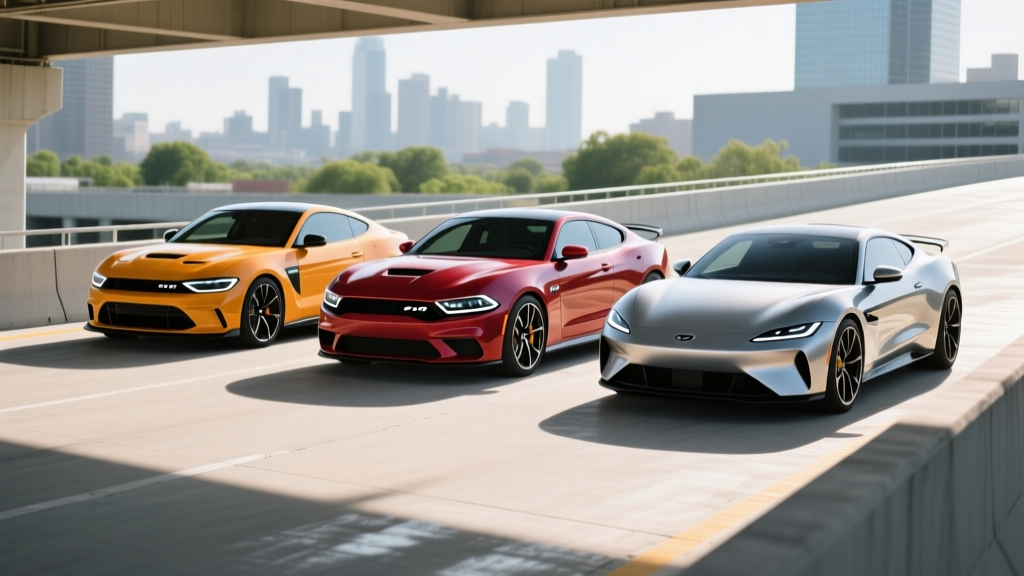
The electric muscle car segment has matured beyond the early Tesla Model S Performance monopoly. Dodge entered the space with the Charger Daytona EV (and its inline-six Hurricane sibling), Ford offers the Mustang Mach-E GT, and the Tesla Model S Plaid continues as the benchmark for straight-line speed. Each takes a different approach to what "muscle" means in an electrified era.
Unlike traditional muscle cars defined by V8 displacement and carburetors, electric muscle cars are defined by battery chemistry, motor count, and software-tuned torque delivery. The trade-offs are fundamentally different: you gain instant torque and low center of gravity but lose the auditory drama, long-distance refueling speed, and (in most cases) the sub-$45,000 entry price.
| Spec | Dodge Charger Daytona R/T | Ford Mustang Mach-E GT | Tesla Model S Plaid |
|---|---|---|---|
| EPA Range | 317 miles | 280 miles (est. extended range) | 396 miles |
| Real-World Highway Range | ~250-270 miles | ~220-240 miles | ~310-340 miles |
| Battery (usable kWh) | 100.6 kWh (NMC) | 91 kWh (NMC) | 100 kWh (NMC) |
| Horsepower | 496 hp | 480 hp | 1,020 hp |
| 0-60 mph | 4.7 sec | 3.5 sec | 1.99 sec |
| Peak DC Fast Charge | ~180 kW | ~150 kW | 250 kW |
| 10-80% DC Charge Time | ~27 min | ~38 min | ~18 min |
| Base MSRP | $59,595 | $59,995 | $89,990 |
| Drivetrain | AWD (dual motor) | AWD (dual motor) | AWD (tri-motor) |
| Battery Warranty | 8 yr / 100,000 mi | 8 yr / 100,000 mi | 8 yr / 120,000 mi |
Sources: fueleconomy.gov, manufacturer specifications. Real-world highway range reflects 70-80 mph sustained driving at moderate temperatures; subtract 15-25% in sub-freezing conditions.
Electric Muscle Car vs Gas Muscle Car: The Real Cost Comparison
The sticker shock of a $60,000-$90,000 electric muscle car is real, but the five-year ownership math tells a different story — particularly when you factor in fuel, maintenance, and available federal tax credits. Here's how a 2026 Dodge Charger Daytona R/T stacks up against a comparable gas Dodge Challenger R/T (5.7L HEMI V8, ~$48,000 MSRP) over five years and 75,000 miles.
| Cost Category | Dodge Charger Daytona R/T (EV) | Dodge Challenger R/T 5.7L (Gas) |
|---|---|---|
| Purchase Price (MSRP) | $59,595 | $48,000 |
| Federal Tax Credit (§30D) | Up to $7,500* | $0 |
| Effective Purchase Price | $52,095 | $48,000 |
| Fuel/Energy (75,000 mi) | $2,625 (home charging at $0.14/kWh) | $10,500 (18 MPG combined at $3.50/gal) |
| Maintenance (5 yr) | $1,200 (tires, cabin filter, fluid top-offs) | $4,500 (oil, brakes, plugs, belts, fluids) |
| Insurance (5 yr, avg) | $14,000 ($2,800/yr) | $11,000 ($2,200/yr) |
| Depreciation (est. 5 yr) | $22,000 | $18,000 |
| Total 5-Year Cost | $91,920 | $92,000 |
*The §30D federal tax credit has income caps ($150K single / $300K joint MAGI), MSRP caps ($55K sedans — note: the Charger Daytona at $59,595 may exceed the sedan cap; verify current eligibility at IRS.gov). Point-of-sale transfer is available at participating dealers.
The EV breaks nearly even over five years despite the higher purchase price and insurance, largely due to the $7,875 fuel savings and $3,300 maintenance savings. Extend ownership to seven or eight years, and the EV pulls ahead meaningfully — assuming the battery retains adequate capacity (most NMC packs lose 10-15% over 8 years based on industry degradation data).
Real-World Ownership: What First-Time EV Buyers Must Know
Home Charging Is Non-Negotiable
Electric muscle cars demand regular access to Level 2 home charging (240V, 32-48 amps) to be practical daily drivers. Without it, you're relying on public DC fast charging, which costs 2-3x more per kWh ($0.35-$0.55/kWh at Electrify America or EVgo vs $0.10-$0.18/kWh at home) and adds 30-40 minutes to your week. A Level 2 home charger installation typically costs $1,200-$2,800 total (equipment + licensed electrician + permit), assuming your electrical panel has capacity. Older homes may need a panel upgrade ($2,000-$5,000 additional).
Charging Curve Reality Check
Peak DC fast-charge rates are marketing numbers, not sustained rates. The Charger Daytona's ~180 kW peak only holds between roughly 10-40% State of Charge (SoC), then tapers progressively. The 10-80% time of ~27 minutes is the meaningful metric. Above 80%, charging slows dramatically to protect the NMC battery chemistry — expect 80-100% to take another 20-30 minutes. For road trips, plan stops at 15-20% SoC and charge only to 80% for the best time efficiency.
Cold Weather Range Loss
NMC batteries lose 20-30% of their range in sub-freezing temperatures (below 32°F), and up to 40% in extreme cold (below 10°F) if you don't precondition the battery. The Charger Daytona's 317-mile EPA range becomes roughly 220-250 miles in winter highway driving. Preconditioning (warming the battery while plugged in before departure) mitigates this loss significantly — always enable it via the vehicle's app or scheduled departure feature.
Decision Framework: Should You Buy an Electric Muscle Car?
Choose an electric muscle car IF:
- You have access to Level 2 home charging (garage or driveway with 240V outlet)
- Your daily commute is under 60 miles round-trip
- You want 3-5 second 0-60 acceleration without spending $100K+
- You value instant torque delivery and quiet operation over exhaust sound
- You drive primarily in moderate climates or accept winter range reduction
- Your household income qualifies for §30D tax credit (verify at IRS.gov)
Choose a gas or hybrid performance car IF:
- You lack reliable home charging access (apartment, street parking, no garage)
- You regularly drive 250+ miles one-way without time for 30-minute charge stops
- You live in extreme cold climates (sustained sub-zero winters) and need maximum range reliability
- Sound, feel, and mechanical engagement are core to your muscle car experience
- Your budget is strictly under $45,000
Consider a PHEV performance car (e.g., BMW M hybrid, Corvette E-Ray) IF:
- You want electric torque for daily driving but gas flexibility for road trips
- You can charge at home but don't want to plan road trips around charging infrastructure
- You want to hedge against charging-desert risk on long rural routes
Common Electric Muscle Car Myths vs Facts
| Myth | Fact (with Data) |
|---|---|
| "EVs can't be real muscle cars — they have no soul" | Performance is objective: the Model S Plaid hits 60 mph in 1.99 seconds, the Mach-E GT in 3.5 seconds. "Soul" is subjective, but torque delivery (instant, no turbo lag or gear shifts) is a genuine performance advantage. |
| "The battery will need replacing and cost $20,000" | NMC battery packs degrade 10-15% over 8 years / 100,000 miles based on fleet data. Full replacement is rare under warranty. All three vehicles above include 8-year/100,000-mile battery warranties covering defects and capacity below 70%. |
| "You'll be stranded — the range isn't enough" | The average American drives 37 miles per day (FHWA data). Even the Mach-E GT's ~220 real-world miles covers 95% of daily driving with a large buffer. Road trips require planning but are feasible with DC fast-charging networks. |
| "Charging takes too long" | Home charging is overnight (8-10 hours on Level 2, adding 200-300 miles). DC fast charging adds 150-200 miles in 20-30 minutes. You only notice the time on road trips — and you're likely stopping for food/rest anyway. |
| "Electric muscle cars are all Teslas" | Dodge, Ford, and several others now compete in the segment. The Charger Daytona specifically targets the traditional muscle car buyer with its coupe styling and "Fratzonic" synthetic exhaust system. |
Federal Tax Credit Eligibility for Electric Muscle Cars
The IRS §30D Clean Vehicle Credit offers up to $7,500 for qualifying new EVs, but eligibility for electric muscle cars is complex in 2026:
- MSRP Cap: Sedans are capped at $55,000; SUVs/trucks/vans at $80,000. The Dodge Charger Daytona ($59,595) is classified as a sedan and likely exceeds the cap — verify with your dealer. The Mach-E GT qualifies under the $80,000 SUV cap. The Model S Plaid ($89,990 sedan) exceeds the cap.
- Buyer Income Cap: Modified AGI must not exceed $150,000 (single), $225,000 (head of household), or $300,000 (married filing jointly).
- Battery Sourcing: Increasing percentages of critical minerals and battery components must be sourced from the US or FTA-partner countries. The qualifying credit amount ($3,750 for minerals + $3,750 for components) changes annually.
- Point-of-Sale Transfer: You can transfer the credit to the dealer at purchase, reducing your out-of-pocket cost immediately rather than waiting for tax filing.
Always confirm eligibility with a tax professional before purchasing — rules change, and vehicle qualification lists update throughout the year.
Frequently Asked Questions
Which electric muscle car has the best real-world range?
The Tesla Model S Plaid delivers the most real-world range at approximately 310-340 highway miles, thanks to its 100 kWh battery, tri-motor efficiency, and industry-leading thermal management. The Dodge Charger Daytona R/T achieves roughly 250-270 real-world highway miles, while the Mustang Mach-E GT lands around 220-240 miles in highway driving at 70-80 mph.
Can I daily-drive an electric muscle car without home charging?
Technically yes, but it's expensive and inconvenient. Public DC fast charging costs $0.35-$0.55/kWh vs $0.10-$0.18/kWh at home, roughly tripling your fuel costs. You'll also spend 2-3 hours per week at charging stations. Without home charging, a gas or hybrid performance car is far more practical.
How fast do electric muscle cars charge on road trips?
Expect 20-38 minutes for a 10-80% charge at a DC fast charger, depending on the model. The Model S Plaid charges fastest at 250 kW peak (10-80% in ~18 min), the Charger Daytona at ~180 kW (~27 min), and the Mach-E GT at ~150 kW (~38 min). Plan stops at 15-20% battery and charge only to 80% to avoid the slow taper above 80%.
Are electric muscle cars more expensive to insure?
Yes. EV insurance premiums run 15-25% higher than comparable gas vehicles due to higher repair costs (specialized body shops, battery replacement risk, aluminum construction). Expect $2,400-$3,200 annually for a Charger Daytona or Mach-E GT, depending on your driving record and state. Get quotes from multiple insurers (including EV-specialist carriers) before purchasing.
Will the synthetic exhaust sound in the Charger Daytona satisfy muscle car fans?
Dodge's "Fratzonic Chambered Exhaust" uses speakers and tuning to simulate V8-style sound. Reviews are polarized — some enthusiasts appreciate the effort, others find it gimmicky. The system can be turned off for silent operation. If authentic mechanical sound is essential to your muscle car experience, test-drive before committing or consider a gas V8 alternative.
What happens if the battery degrades significantly?
All three vehicles carry 8-year/100,000-mile battery warranties (Model S: 8 yr/120,000 mi) that cover defects and capacity loss below 70% of original. Industry data shows NMC batteries typically retain 85-90% capacity at 100,000 miles with normal use. Full battery replacement outside warranty currently costs $12,000-$20,000 depending on the pack, though prices are declining.