Quick Answer: Electric motors in cars convert 85–95% of battery energy into motion, compared to just 20–30% for gasoline engines. This fundamental efficiency gap means an EV like the 2026 Hyundai Ioniq 6 (140 MPGe combined) uses roughly $550 in electricity per year versus $1,700 in gasoline for a comparable gas sedan — a savings of over $1,100 annually. Electric motors also deliver instant torque (no revving required), have only one moving part in the drivetrain, and require zero oil changes, spark plugs, or transmission fluid. The trade-off: higher upfront purchase prices and reliance on charging infrastructure that still varies widely by region.
How Electric Motors Actually Move Your Car
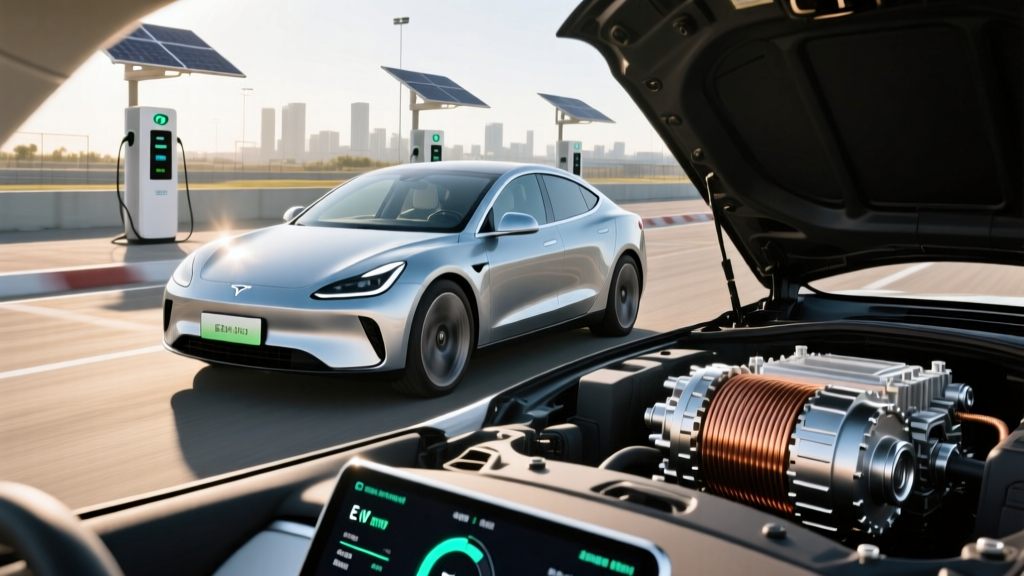
Strip away the marketing, and an electric vehicle's propulsion system is remarkably simple. A battery pack stores electrical energy measured in kilowatt-hours (kWh) — think of it as the fuel tank. An inverter converts the battery's direct current (DC) into alternating current (AC) that powers the electric motor. The motor spins, and that rotation goes through a single-speed reduction gear directly to the wheels.
That's it. No multi-speed transmission, no exhaust system, no catalytic converter, no timing belt.
Most mainstream EVs in 2026 use one of two motor types:
- Permanent Magnet Synchronous Motors (PMSM): Found in the Tesla Model Y, Hyundai Ioniq 5, and most efficiency-focused EVs. These use rare-earth magnets in the rotor and achieve peak efficiencies of 94–96%. The downside is reliance on neodymium and dysprosium supply chains.
- AC Induction Motors: Used in some Tesla dual-motor configurations (typically the front motor for all-wheel-drive variants) and heavier-duty applications. Slightly less efficient at part-load (88–92%) but avoids rare-earth materials entirely and handles high-RPM operation well.
A growing number of automakers — BMW with its fifth-gen eDrive, for instance — are moving to externally excited synchronous motors (EESM) that use a copper-wound rotor instead of permanent magnets, sidestepping rare-earth supply concerns while maintaining 93–95% efficiency.
Electric Motors vs Gas Engines: The Numbers That Matter
The efficiency advantage of electric motors isn't marginal — it's a chasm. Here's how the physics and economics stack up in real ownership scenarios:
| Metric | Electric Motor (2026 EV Avg) | Gasoline Engine (2026 ICE Avg) |
|---|---|---|
| Energy conversion efficiency | 85–95% | 20–30% |
| Moving drivetrain parts | ~1 (motor rotor) | ~200+ (pistons, valves, gears, etc.) |
| Annual fuel/energy cost (15k mi) | $500–$700 (home charging) | $1,500–$2,000 |
| Annual maintenance cost | $300–$500 | $900–$1,200 |
| 0–60 mph (midsize sedan) | 5.0–7.5 sec (single motor) | 7.0–9.5 sec |
| Instant torque from 0 RPM | Yes | No (requires RPM buildup) |
| Regenerative braking | Yes (recaptures 15–25% energy) | No (energy lost as heat) |
| Emissions at tailpipe | None | CO₂, NOx, particulates |
Source: Efficiency data from fueleconomy.gov EV technology overview; maintenance averages from AAA Your Driving Costs 2025.
The torque characteristic deserves emphasis. An electric motor produces maximum torque at zero RPM — the instant you press the accelerator. A gasoline engine needs to rev to 1,500–4,000 RPM before hitting peak torque. This is why even a modest 200-hp EV feels punchier in city driving than a 250-hp gas car. The electric motor eliminates the "wait for the downshift" lag entirely.
Real-World Efficiency: MPGe and Cost Per Mile
The EPA measures EV efficiency in MPGe (miles per gallon equivalent), where 33.7 kWh of electricity equals one gallon of gasoline. Here's what that translates to in actual ownership cost for popular 2026 models:
| Vehicle | EPA MPGe (Combined) | kWh/100 mi | Annual Energy Cost* |
|---|---|---|---|
| 2026 Hyundai Ioniq 6 SE | 140 MPGe | 24 kWh | $540 |
| 2026 Tesla Model 3 RWD | 132 MPGe | 25 kWh | $563 |
| 2026 Chevrolet Equinox EV 2LT | 114 MPGe | 29 kWh | $653 |
| 2026 Ford F-150 Lightning XLT | 70 MPGe | 48 kWh | $1,080 |
| 2026 Toyota Camry LE (gas baseline) | 32 MPG | — | $1,688 (gas) |
*Based on 15,000 miles/year, $0.16/kWh national average electricity rate, and $3.60/gallon regular unleaded. Your rate varies — check your utility's EV time-of-use plan, which can drop costs to $0.08–$0.10/kWh during off-peak hours. Data sourced from fueleconomy.gov.
The efficiency spread matters enormously at scale. Over a 5-year, 75,000-mile ownership period, the Ioniq 6 owner spends roughly $2,700 on electricity versus $8,440 on gasoline for the Camry driver — a $5,740 fuel savings before accounting for any federal or state incentives.
What Electric Motors Mean for Maintenance and Longevity
This is where electric motors fundamentally change the ownership experience. A gasoline engine contains hundreds of moving parts operating under extreme heat and pressure — pistons, connecting rods, camshafts, timing chains, oil pumps, water pumps, turbochargers. Each is a potential failure point and a recurring maintenance item.
An electric motor has essentially one moving part: the rotor spinning inside the stator. There are bearings, and those eventually wear, but typical EV motor bearings are rated for 200,000+ miles. The motor itself is effectively a lifetime component in most vehicles.
What you'll never pay for with an EV:
- Oil changes ($40–$80 each, 2–3 per year)
- Spark plug replacement ($200–$600)
- Transmission fluid flush ($150–$300)
- Timing belt/chain service ($800–$2,500)
- Catalytic converter replacement ($1,000–$3,000)
- Exhaust system repairs ($200–$1,500)
- Emissions testing (where applicable)
What you still pay for:
- Tire rotation and replacement (EVs are heavier and deliver instant torque, so tire wear can be 15–25% faster — budget $800–$1,400 for a set of EV-rated tires every 30,000–40,000 miles)
- Cabin air filter ($30–$80)
- Brake fluid flush every 2–3 years ($80–$150) — though brake pads last far longer due to regenerative braking, often 100,000+ miles
- Windshield washer fluid, wiper blades, 12V battery replacement (yes, EVs still have a 12V battery for accessories)
- Coolant service for the battery thermal management system (typically every 5 years or 60,000 miles)
The net result: AAA's 2025 data shows average EV maintenance costs of $0.061 per mile versus $0.101 per mile for gas vehicles — a savings of $600 per year at 15,000 miles.
Total Cost of Ownership: 5-Year Breakdown
Let's put the electric motor's efficiency advantage into a complete 5-year picture, comparing a 2026 Tesla Model 3 Rear-Wheel Drive (base MSRP $38,990) against a well-equipped 2026 Toyota Camry SE (MSRP $30,500). Both are midsize sedans popular with the same buyer profile.
| Cost Category | 2026 Tesla Model 3 RWD | 2026 Toyota Camry SE |
|---|---|---|
| Purchase price (MSRP) | $38,990 | $30,500 |
| Federal tax credit (§30D) | –$7,500* | $0 |
| Effective purchase price | $31,490 | $30,500 |
| 5-year energy/fuel (75k mi) | $2,813 | $8,438 |
| 5-year maintenance | $1,875 | $4,500 |
| 5-year insurance (avg) | $9,750 | $7,500 |
| 5-year depreciation (est.) | $14,200 | $11,500 |
| Total 5-year cost | $60,128 | $62,438 |
*§30D federal tax credit eligibility depends on your modified adjusted gross income (≤$150k single / ≤$300k joint), the vehicle's MSRP (≤$55k sedans), and battery component/critical mineral sourcing requirements per IRS guidelines. Point-of-sale transfer is available through registered dealers. Always verify current-year eligibility with a tax professional.
The Model 3's higher insurance premiums (EVs average 15–28% more to insure due to repair costs and battery replacement risk) partially offset the energy and maintenance savings. But the electric motor's efficiency still delivers a roughly $2,300 total savings over five years — and that gap widens significantly if gas prices rise or if you qualify for additional state incentives.
Common Misconceptions About Electric Motors in Cars
| Myth | Fact |
|---|---|
| "Electric motors wear out like gas engines" | EV motors have one moving part and are rated for 200,000+ miles. Motor failures are rare and typically covered under the 8-year/100,000-mile powertrain warranty. |
| "EVs are slow unless you buy a Tesla" | Instant torque means even a $35,000 Chevy Equinox EV hits 0–60 in ~6.5 seconds — faster than most V6 gas SUVs. The motor's power delivery is inherently responsive. |
| "Electric motors can't handle towing or hills" | The Ford F-150 Lightning's dual motors produce 580 hp and 775 lb-ft of torque, towing up to 10,000 lbs. Efficiency drops under load (expect 1.5–2.0 mi/kWh vs 2.0+ unloaded), but capability isn't the issue. |
| "You need to replace the motor eventually" | The motor itself almost never needs replacement. The battery pack is the expensive longevity question — but modern LFP and NMC packs are warrantied for 8 years/100,000 miles with ≥70% capacity retention. |
| "All EV motors are the same" | Motor type (PMSM vs induction vs EESM), placement (front/rear/dual), and power output vary significantly. A single-motor RWD setup prioritizes efficiency; dual-motor AWD prioritizes traction and power. |
Real-World Ownership: What First-Time EV Buyers Must Know
The electric motor is the easy part — it works, it's efficient, and it'll outlast the rest of the car. The ownership variables that actually determine your experience are charging access, climate, and driving patterns.
Home charging is the single biggest factor. If you can install a Level 2 (240V) home charger — typically a 32–48 amp unit delivering 7.7–11.5 kW — you'll wake up every morning with a "full tank." Installation costs range from $500 (simple outlet near your panel) to $3,000+ (panel upgrade required for older homes with 100-amp service). Without home charging, EV ownership becomes a weekly chore of finding reliable public chargers.
Cold weather reduces range — not because the motor is less efficient, but because the battery chemistry slows down and cabin heating draws energy. Expect 20–35% range loss below freezing. A 300-mile EPA-rated EV may deliver 200–240 real winter miles. EVs with heat pumps (standard on Hyundai/Kia E-GMP vehicles, Tesla Model Y, and most 2026 models) recover some of this loss by efficiently scavenging waste heat rather than using resistive heating.
Your driving pattern matters. Electric motors are most efficient in stop-and-go city driving where regenerative braking recaptures energy. Highway driving at 75+ mph is less efficient due to aerodynamic drag — the same physics that hurt gas cars, but more noticeable because EV range is more tightly constrained. If 80% of your miles are highway, expect 10–15% below EPA range.
Decision Framework: Is an EV With Electric Motors Right for You?
Choose an EV if:
- You have access to home charging (garage, driveway, or workplace Level 2)
- Your daily commute is under 80 miles round-trip (covers 90% of US drivers)
- You want to minimize recurring maintenance and fuel costs
- You qualify for the §30D federal tax credit (check income and MSRP caps)
- You value instant torque and quiet, smooth acceleration
- You live in a region with reliable public DC fast-charging networks for road trips
Choose a hybrid (HEV) or plug-in hybrid (PHEV) if:
- You cannot charge at home and public charging infrastructure near you is sparse
- You regularly drive 300+ miles in a single day through rural areas
- You live in extreme cold (–20°F or below regularly) where EV range loss is severe
- Your budget is under $30,000 and you need maximum flexibility with zero charging dependency
- You tow frequently and can't accommodate the range penalty of EV towing (50%+ range reduction)
Wait or reconsider if:
- You rent an apartment with zero charging options and no workplace charging
- Your only vehicle must handle 500-mile towing runs without planning stops
- You're counting on a full $7,500 tax credit but your income or the vehicle's sourcing disqualifies you — run the numbers without it first
Frequently Asked Questions
Do electric motors in cars need any regular maintenance?
The motor itself requires essentially zero maintenance — no fluid changes, no filter replacements, no tune-ups. The only motor-adjacent service items are the reduction gear fluid (check/replace every 60,000–100,000 miles per manufacturer spec, typically $100–$200) and bearing inspection during major service intervals. Most EV owners will never think about their motor again after purchase.
How long do electric motors in EVs last?
Electric motors are among the most durable components in any vehicle. Industrial electric motors routinely run for 20+ years in continuous-duty applications. In automotive use, the motor is vastly under-stressed relative to its design capacity. Failures before 200,000 miles are extremely uncommon and are covered under the federally mandated 8-year/100,000-mile EV powertrain warranty. The battery pack, not the motor, is the longevity concern in an EV.
Why do some EVs have two motors?
Dual-motor EVs place one motor on each axle for all-wheel drive. This improves traction in rain and snow, enables torque vectoring for better handling, and provides a power boost — the combined output of both motors typically adds 100–200 hp over a single-motor variant. The trade-off is slightly higher cost ($3,000–$5,000 premium), marginally reduced efficiency (2–5% less range due to the front motor's weight and drag), and added complexity. For most buyers in mild climates, a single rear motor is sufficient.
Can an electric motor make an EV faster than a gas sports car?
Yes, at least in straight-line acceleration. The Tesla Model S Plaid's tri-motor setup produces 1,020 hp and hits 0–60 in 1.99 seconds. The Lucid Air Sapphire does it in under 2 seconds with 1,234 hp. Even mainstream EVs like the Hyundai Ioniq 5 N (640 hp, 3.25 seconds to 60) outpace most gas performance cars. Electric motors eliminate the power-delay of turbo spool-up, transmission shifts, and RPM buildup. Where gas cars may still hold an edge: sustained high-speed track driving, where EV battery thermal limits can reduce power output.
What's the difference between kW and kWh when talking about EV motors?
This is the most common confusion point. kW (kilowatts) measures power — how fast energy is being used or delivered, like horsepower. An EV motor rated at 150 kW can output roughly 201 hp. kWh (kilowatt-hours) measures energy capacity — how much total energy the battery holds, like gallons in a gas tank. A 75 kWh battery running at 150 kW continuously would drain in 30 minutes (though in practice, you'd never sustain full power that long). Charge speed is also measured in kW: a 150 kW DC fast charger delivers energy much faster than an 11.5 kW Level 2 home charger.