The Short Answer: Electric Motors for Electric Vehicles
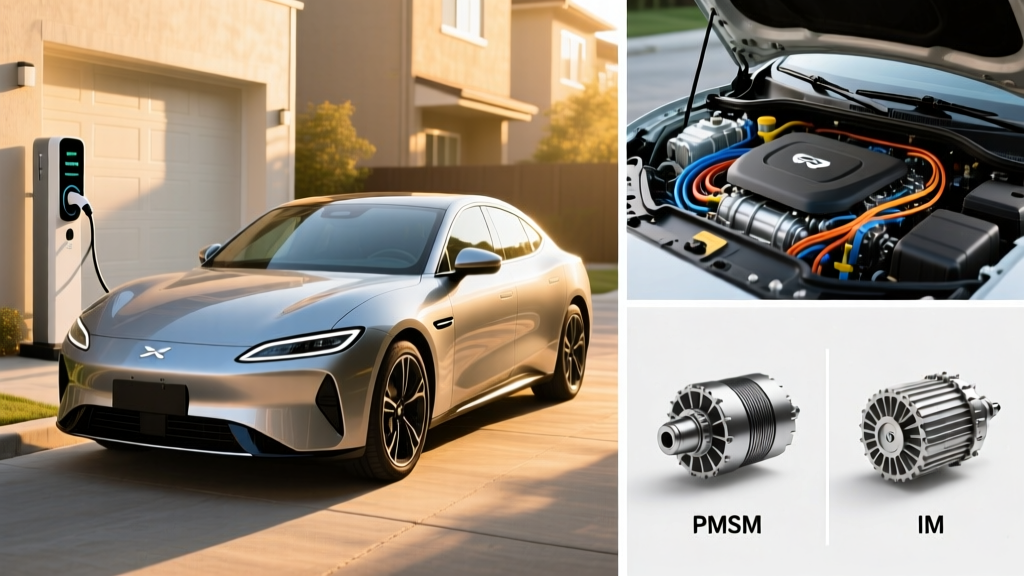
Most 2026 electric vehicles use one of two motor types: Permanent Magnet Synchronous Motors (PMSM), found in roughly 80% of new EVs including the Tesla Model Y, Hyundai Ioniq 5, and BMW iX, or AC Induction Motors, used as secondary motors in dual-motor AWD setups (Tesla, Rivian) and as the primary motor in some models like the base Tesla Model 3 RWD. A third type, axial flux motors, is emerging in performance applications (Mercedes-AMG, Yasa/P100). The motor type affects your EV's efficiency by 3-7%, which translates to roughly 10-25 miles of real-world range difference on a 300-mile pack — but battery size, aerodynamics, and thermal management matter far more to your daily driving experience than motor chemistry alone.
How Electric Motors Actually Work in an EV
An electric motor converts electrical energy from the battery (measured in kilowatt-hours, or kWh) into mechanical rotation to drive the wheels. Unlike a gas engine, which needs to build RPM to produce peak torque, an electric motor delivers maximum torque from zero RPM — which is why even a modest 200-hp EV feels punchy off the line. The motor's power output is measured in kilowatts (kW), where 1 kW ≈ 1.34 horsepower.
In most modern EVs, the motor, power electronics (inverter), and a single-speed reduction gear are packaged into a single unit called an e-axle or electric drive unit (EDU). This integration reduces weight and packaging complexity, freeing up cabin and cargo space — and enabling features like a front trunk (frunk).
The motor itself doesn't degrade meaningfully over the vehicle's life. Unlike a gas engine that loses compression and develops oil leaks, an electric motor has essentially one moving part (the rotor) spinning on bearings. The real longevity concern in an EV is the battery, not the motor. Most manufacturers warranty the motor and powertrain components for 8 years/100,000 miles, and real-world data from high-mileage Teslas shows motors running past 300,000 miles without replacement.
The Three Motor Types in 2026 EVs
Permanent Magnet Synchronous Motor (PMSM)
The dominant motor technology in 2026. PMSMs use rare-earth magnets (typically neodymium-iron-boron, or NdFeB) embedded in or mounted on the rotor. The stator's rotating magnetic field pulls the magnet-laden rotor in sync — hence "synchronous."
Where you'll find it: Tesla Model Y (rear motor), Hyundai Ioniq 5/6, Kia EV6/EV9, BMW i4/iX, Ford Mustang Mach-E, Volkswagen ID.4, Chevrolet Equinox EV, and most Chinese-market EVs (BYD, NIO, XPeng).
Efficiency advantage: PMSMs are typically 94-97% efficient across a wide operating range, particularly excelling at partial-load, low-to-medium speed driving — exactly the urban and suburban conditions that define most daily commutes. This efficiency edge translates to roughly 2-5% more range from the same battery compared to an equivalent induction motor, per fueleconomy.gov's EV technology overview.
Trade-off: PMSMs require rare-earth elements (neodymium, dysprosium), creating supply chain and cost vulnerabilities. China controls roughly 60% of rare-earth mining and 90% of refining globally, which has driven automakers to explore alternatives.
AC Induction Motor (ACIM)
The original Tesla Roadster and Model S used induction motors, and they remain relevant in 2026 — primarily as the secondary motor in dual-motor AWD configurations.
Where you'll find it: Tesla Model 3/Y dual-motor (front motor), Rivian R1T/R1S (front motor in dual-motor trims), and some legacy platforms.
How it works: The stator induces a current in the rotor's conductor bars (no magnets needed). The rotor spins slightly slower than the magnetic field — this "slip" is what generates torque.
Advantages: No rare-earth magnets (lower material cost, less supply-chain risk). Can be completely de-energized when not needed — in a Tesla dual-motor setup, the front induction motor freewheels with near-zero drag during highway cruising, effectively making the car RWD and boosting efficiency. Induction motors also handle high-RPM operation well and tolerate heat better than PMSMs.
Trade-off: Slightly lower peak efficiency (90-94%) and less torque density than PMSMs, meaning a physically larger motor for the same output.
Axial Flux Motor (Emerging)
A newer architecture where the magnetic flux runs parallel to the shaft (axially) rather than radially. This produces an extremely flat, disc-shaped motor with exceptional torque density.
Where you'll find it: Mercedes-AMG ONE (hybrid hypercar), upcoming Mercedes EQXX-derived platforms, and the Yasa P100 motor (acquired by Mercedes in 2021). Also appearing in some commercial EV applications.
Advantages: Up to 30% lighter and more compact than a radial-flux PMSM of equivalent power. Torque density can exceed 50 Nm/kg — roughly double a conventional PMSM.
Trade-off: Manufacturing complexity and cost remain high. Thermal management is more challenging because the disc geometry limits cooling surface area. Not yet cost-competitive for mainstream EVs.
| Attribute | PMSM | AC Induction | Axial Flux |
|---|---|---|---|
| Peak Efficiency | 94–97% | 90–94% | 95–97% |
| Torque Density | High | Moderate | Very High |
| Rare-Earth Magnets | Yes (NdFeB) | No | Yes |
| Typical Use in 2026 | Primary motor (most EVs) | Secondary/AWD motor | Performance/luxury niche |
| Cost (relative) | Medium-High | Low-Medium | Very High |
| Weight (for 200 kW) | ~45–55 kg | ~55–70 kg | ~25–35 kg |
| High-RPM Capability | Good (to ~16,000 RPM) | Excellent (to ~20,000 RPM) | Moderate |
| Freewheel/Decoupling | Requires clutch or active field weakening | Natural (zero flux when de-energized) | Requires field weakening |
How Motor Choice Affects Your Real-World Range and Costs
Here's where buyers need perspective. Motor efficiency matters, but it's one factor among many. Consider two hypothetical 2026 midsize SUVs, both with a 77 kWh (usable) NMC battery:
| Metric | PMSM-Powered EV | Induction-Powered EV (Primary) |
|---|---|---|
| Combined Efficiency | 3.5 mi/kWh | 3.3 mi/kWh |
| EPA Range (77 kWh usable) | ~270 miles | ~254 miles |
| Real-World Highway (70 mph) | ~230–245 miles | ~215–230 miles |
| Annual Electricity (12,000 mi/yr, $0.16/kWh avg) | ~$549 | ~$582 |
| 5-Year Charging Cost | ~$2,743 | ~$2,909 |
The PMSM-equipped vehicle saves roughly $166 over five years in electricity costs and provides about 16 extra EPA-rated miles of range. That's meaningful but not transformative. By comparison, upgrading from a 77 kWh to an 88 kWh battery adds 30+ miles of range — a far bigger impact than motor type.
What Actually Drives Your Efficiency More Than Motor Type
- Vehicle weight: A 5,500-lb electric truck (Rivian R1T) will always be less efficient than a 4,000-lb sedan (Tesla Model 3), regardless of motor. The R1T averages 2.0–2.2 mi/kWh; the Model 3 averages 3.8–4.2 mi/kWh.
- Aerodynamics: Drag increases with the square of speed. The Hyundai Ioniq 6 (Cd 0.21) achieves 360 miles EPA from a 77.4 kWh pack partly because its teardrop shape cuts drag. The boxy Kia EV9 (Cd ~0.28) gets 270 miles from a 99.8 kWh pack.
- Thermal management: A heat pump (standard on Hyundai/Kia EVs, Tesla since 2021, optional on some others) can improve cold-weather range by 10-30% by efficiently heating the cabin without draining the battery through resistive heating.
- Tire choice: Low-rolling-resistance EV-specific tires (Michelin e.Primacy, Hankook iON) can improve range by 3-8% versus standard all-season tires.
Motor Configuration: Single vs. Dual vs. Tri-Motor
Beyond motor type, the number and placement of motors defines your EV's performance, efficiency, and price.
| Configuration | Example Vehicle | Power | 0–60 mph | EPA Range | Price Impact |
|---|---|---|---|---|---|
| Single Motor (RWD) | Tesla Model 3 RWD | 271 hp | 5.8 sec | 363 mi | Base price |
| Dual Motor (AWD) | Tesla Model 3 LR AWD | 346 hp | 4.2 sec | 341 mi | +$4,000–$5,000 |
| Tri-Motor (AWD+) | Tesla Model S Plaid | 1,020 hp | 1.99 sec | 396 mi | +$20,000+ premium |
| Quad-Motor | Rivian R1T Quad | 1,025 hp | ~3.0 sec | 352 mi | Top trim only |
Single motor is the efficiency champion — lighter weight, less drivetrain loss, and lower cost. If you live in a mild climate and don't need AWD traction, a single-motor RWD EV is the most cost-effective choice.
Dual motor adds a second motor (often a different type — Tesla pairs a rear PMSM with a front induction motor) for AWD capability. The efficiency penalty is typically 5-10%, but you gain traction in snow/rain and a 0.5–1.5 second improvement in 0-60 times. Many dual-motor systems decouple the secondary motor during steady cruising to minimize the efficiency hit.
Tri and quad-motor configurations are performance-oriented. They enable torque vectoring (sending precise torque to individual wheels), but at a significant cost and weight premium. These are enthusiast choices, not efficiency plays.
EV Motor Maintenance: What It Actually Costs
This is where electric motors deliver their most compelling ownership advantage over internal combustion engines (ICE).
| Maintenance Item | EV (Motor-Related) | Gas Vehicle (Engine-Related) |
|---|---|---|
| Oil Changes | $0 (no engine oil) | $350–$600 (5–7 changes) |
| Transmission Fluid | $0–$80 (single-speed reducer, long interval) | $150–$400 (multi-speed, periodic) |
| Spark Plugs | $0 | $200–$500 |
| Timing Belt/Chain | $0 | $500–$1,500 (if belt-driven) |
| Exhaust System | $0 | $0–$800 (catalytic converter, O2 sensors) |
| Coolant Flush | $100–$200 (motor + battery thermal loop) | $100–$200 |
| Brake Pads (regen extends life) | $0–$200 (often last 100k+ mi) | $400–$800 (2–3 replacements) |
| 5-Year Total | ~$100–$480 | ~$1,700–$4,800 |
Electric motors require essentially zero scheduled maintenance. There's no oil to change, no spark plugs, no timing belt, no exhaust system, and no multi-speed transmission. The reduction gear in most EVs uses a sealed fluid that rarely needs servicing. Regenerative braking dramatically reduces wear on friction brake pads — many EV owners report original brake pads at 80,000+ miles.
The primary motor-related service event is a bearing replacement, which is rare before 150,000 miles and costs $500–$1,500 if needed. Inverter or power electronics failure is also uncommon but more expensive ($2,000–$5,000 out of warranty). These components are covered under the federally mandated 8-year/100,000-mile EV powertrain warranty (10 years/150,000 miles in CARB states), per IRS guidance on EV components.
Motor Replacement: Worst-Case Cost Reality
If your EV's motor fails out of warranty, replacement costs vary significantly:
- Mainstream EV (Tesla Model 3/Y, Hyundai Ioniq 5): $4,000–$8,000 for a remanufactured drive unit, installed.
- Luxury/Performance EV (BMW iX, Mercedes EQS): $7,000–$15,000.
- Heavy-duty (Rivian R1T quad-motor): $3,000–$5,000 per individual motor unit (modular design allows single-motor replacement).
For context, a gas engine replacement runs $4,000–$10,000 for a mainstream vehicle and $10,000–$25,000 for a luxury model. The motor replacement cost is comparable, but the probability of needing one is dramatically lower for an electric motor — which has far fewer wear components.
Common Misconceptions About EV Motors
| Myth | Fact |
|---|---|
| "EV motors wear out like gas engines" | Electric motors have one moving part (the rotor on bearings). No piston rings, valves, or gaskets to degrade. Motors routinely outlast 200,000+ miles with no service. |
| "More motors = proportionally more range loss" | Dual-motor EVs can decouple the secondary motor during cruising. A Tesla Model 3 AWD loses only ~6% range vs. RWD, not 50%. |
| "EV motors are 100% efficient" | Real-world motor efficiency is 90–97%. The remaining 3–10% is lost as heat, which must be managed by the cooling system. |
| "You can't tow with an EV motor" | EV motors produce peak torque from 0 RPM — ideal for towing. The Ford F-150 Lightning tows 10,000 lbs; Rivian R1T tows 11,000 lbs. Range drops 40–60% while towing, though. |
| "Rare-earth magnets make EVs environmentally worse" | Rare-earth mining has environmental impacts, but a PMSM uses ~1–2 kg of NdFeB magnets. Over its lifetime, a PMSM EV's lower energy consumption offsets this vs. an induction motor requiring more electricity (and potentially more battery capacity). Many manufacturers (BMW, Renault) are developing rare-earth-free or reduced-rare-earth motors. |
| "EV motors can't handle cold weather" | Motors actually prefer cold — cooler temperatures reduce resistance and improve efficiency. The range loss in cold weather comes from the battery (slower chemistry) and cabin heating demand, not the motor. |
What First-Time EV Buyers Should Know About Motors
Decision Framework: Choosing Your Motor Configuration
Choose a single-motor RWD EV if:
- You live in a mild climate with minimal snow/ice
- Maximum range per dollar is your priority
- Your daily commute is under 80 miles round-trip
- Budget is a primary constraint (saves $4,000–$6,000 vs. dual-motor)
Choose a dual-motor AWD EV if:
- You regularly drive in snow, ice, or heavy rain
- You need towing capability (AWD improves traction with a trailer)
- You want sub-4-second 0-60 performance
- Resale value matters (AWD commands a premium in many markets)
Choose a tri/quad-motor performance EV if:
- You're an enthusiast who values torque vectoring and track capability
- Budget allows a $15,000–$40,000 premium over base trims
- You accept the 5–15% efficiency penalty for the performance gain
Motor-Specific Questions to Ask Before Buying
- What motor type does this trim use? Check the spec sheet — some models switch between PMSM and induction across trims or model years (Tesla has done this).
- Is the secondary motor decouplable? In dual-motor EVs, a decouplable front motor (induction type) improves highway efficiency vs. a permanently engaged setup.
- What's the powertrain warranty? Federal minimum is 8yr/100k mi, but some manufacturers offer more (Hyundai/Kia: 10yr/100k mi on all powertrain components).
- Does this EV have a heat pump? Not motor-related per se, but the thermal management system cools the motor and inverter. A heat pump-integrated system (Hyundai E-GMP, Tesla Octovalve) is more efficient overall.
- What's the peak vs. sustained power? Many EVs advertise peak horsepower available for 10–30 seconds. Sustained power (relevant for highway climbing or repeated acceleration) is typically 60–80% of peak. This data is rarely on spec sheets but matters for real-world performance.
The Emerging Shift: Rare-Earth-Free and Next-Gen Motors
Supply chain concerns and ESG pressures are driving R&D into motors that reduce or eliminate rare-earth dependence:
- BMW's externally excited synchronous motor (EESM): Used in the iX and i4, this motor uses a wound rotor with copper coils instead of permanent magnets. Efficiency is competitive with PMSM (93–95%), and it eliminates rare-earth magnets entirely. The trade-off is slightly more weight and the need for a brush/slip-ring assembly to energize the rotor.
- Renault's externally excited motor: Used in the Megane E-Tech and upcoming models. Similar EESM approach, rare-earth-free.
- Tesla's next-gen motor roadmap: Tesla has announced a goal to eliminate rare-earth content in its next motor generation, potentially using ferrite magnets or a switched-reluctance design. Details remain preliminary as of early 2026.
- Switched Reluctance Motors (SRM): No magnets, no rotor windings — just a shaped iron rotor. Extremely robust and cheap to manufacture, but historically noisy and difficult to control smoothly. Advances in power electronics are making SRMs viable for EVs, though no mainstream 2026 model uses one as a primary drive motor yet.
Frequently Asked Questions
Do electric motors in EVs need to be replaced regularly?
No. Electric motors are among the most durable components in an EV. Unlike gas engines, they have no pistons, valves, gaskets, or timing belts. The primary wear items are bearings, which typically last 200,000+ miles. Most EV motors will outlast the vehicle's battery pack and often the vehicle itself.
Why do some EVs use two different motor types?
Tesla's dual-motor vehicles, for example, pair a rear PMSM (for efficient primary propulsion) with a front AC induction motor (which can freewheel with near-zero drag when AWD isn't needed). This "mismatched" setup optimizes both efficiency and all-weather traction. Rivian's dual-motor setup uses two identical PMSMs, while its quad-motor uses four identical units for independent wheel control.
Does motor type affect regenerative braking performance?
Marginally. PMSMs can generate slightly higher regen torque at low speeds due to their strong permanent magnetic field. However, regen performance is more heavily influenced by the battery's charge acceptance rate (which decreases at high state of charge and low temperatures) and the vehicle's software tuning than by motor type.
Can I upgrade my EV's motor for more power?
Not practically. Unlike a gas engine where aftermarket turbochargers or superchargers can add power, an EV's motor is matched to its inverter, cooling system, and battery output capability. Increasing motor power requires upgrading all three — effectively rebuilding the powertrain. Software "tunes" exist for some EVs (notably Tesla) that unlock additional power within the existing hardware's thermal limits, typically adding 20–50 hp for $2,000–$5,000.
How does motor efficiency compare to a gas engine's efficiency?
Electric motors convert 90–97% of electrical energy into mechanical motion. Gasoline engines convert only 20–35% of fuel energy into motion — the rest is lost as heat, friction, and exhaust. This fundamental efficiency gap is why an EV with a 77 kWh battery (equivalent to roughly 2.6 gallons of gasoline in energy content) can travel 250+ miles, while a gas car getting 30 MPG would travel only 78 miles on 2.6 gallons. The motor's efficiency is a primary reason EVs have dramatically lower per-mile energy costs, as documented by the U.S. Department of Energy.
Are EV motors affected by water or flooding?
EV motors are sealed units rated to IP67 or higher (submersible to 1 meter for 30 minutes). Driving through heavy rain or shallow puddles poses no risk. However, sustained submersion (flooding) can compromise seals over time, and saltwater intrusion is particularly corrosive to electronics. Most manufacturers exclude flood damage from powertrain warranties — a consideration for buyers in flood-prone areas.