The Quick Answer on Electric Motorhomes
As of 2026, fully electric motorhomes (Class A, B, or C with battery-electric drivetrains) remain extremely limited in availability. The Winnebago e-RV (built on the Ford E-Transit chassis) offers approximately 126 miles of EPA-estimated range with a 68 kWh usable battery, starting around $125,000. The Lightship L1 travel trailer (towable, not self-propelled) pairs solar and a ~80 kWh battery pack to reduce tow-vehicle energy draw, starting at approximately $125,000. For most RV buyers, electric motorhomes are not yet practical for long-distance travel due to limited range, sparse heavy-duty DC fast-charging infrastructure, and the high energy demands of a large, heavy vehicle. Plug-in hybrid and conventional diesel/gas RVs remain the realistic choice for full-timers and cross-country travelers.
What Electric Motorhomes Exist Right Now?
The electric RV market is narrow but growing. Here is what you can actually order or reserve in 2026:
| Model | Type | Battery (kWh) | EPA Est. Range | Peak DC Charge | Starting MSRP |
|---|---|---|---|---|---|
| Winnebago e-RV | Class B (van) | 68 kWh usable (NMC) | ~126 mi | 115 kW | ~$125,000 |
| Lightship L1 | Travel trailer (towable) | ~80 kWh (LFP) | N/A (reduces tow draw) | N/A (solar + shore) | ~$125,000 |
| Thor Vision Vehicle (concept) | Class C (announced) | Estimated ~110 kWh | ~150 mi (preliminary) | TBD | TBD |
The Winnebago e-RV is the most production-ready option. Built on the Ford E-Transit cutaway chassis, it carries a 68 kWh lithium-ion NMC battery pack. The E-Transit's EPA-estimated range is 126 miles for the low-roof cargo van variant; the e-RV's added weight from living quarters and amenities reduces real-world range further. Expect roughly 90–110 miles on the highway at 65 mph, and potentially 70–85 miles in cold weather (below 40°F), where battery chemistry and cabin heating impose a 20–30% range penalty.
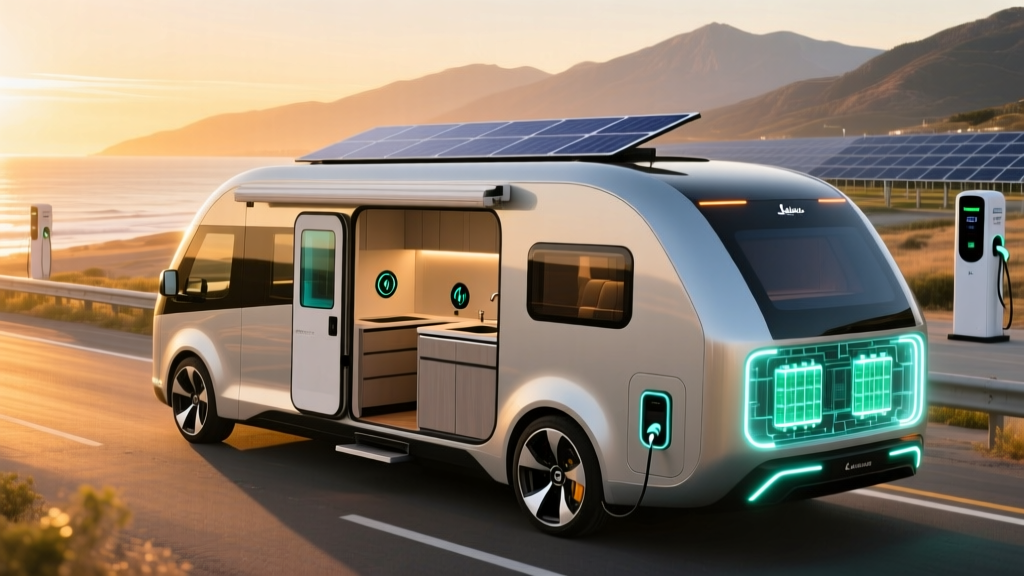
The Lightship L1 takes a different approach. It is a towable travel trailer with an integrated battery pack and rooftop solar array (up to 3 kW of panels). The battery does not propel the trailer itself but powers the living systems and can offset the tow vehicle's energy consumption through a proprietary axle-integrated motor system that reduces drag on the tow vehicle. This is a meaningful innovation for EV owners towing with vehicles like the Ford F-150 Lightning or Rivian R1T, but the L1 is not a self-propelled motorhome.
Electric Motorhome vs. Gas/Diesel RV: Range and Energy Costs
Understanding the gap between electric and conventional motorhomes requires comparing both range and fueling costs directly:
| Metric | Winnebago e-RV (Electric) | Winnebago Travato 59G (Gas) | Typical Class C Diesel |
|---|---|---|---|
| Fuel/Energy Capacity | 68 kWh battery | 25-gallon gas tank | 26-gallon diesel tank |
| Estimated Range | 90–126 mi | ~300–350 mi | ~400–500 mi |
| Energy/Fuel Cost per Mile | ~$0.10–0.18/mi (varies by electricity rate) | ~$0.28–0.35/mi (at $3.50/gal, 10–12 mpg) | ~$0.30–0.40/mi (at $4.00/gal, 8–10 mpg) |
| Refuel/Recharge Time | 45–60 min (10–80% at 115 kW DC) | 5–10 min | 5–10 min |
| Boondocking Capability | Limited by battery + solar | Generator + propane | Generator + diesel |
The per-mile energy cost of an electric motorhome is genuinely lower — roughly half to one-third the cost per mile of a gas Class B van, depending on your local electricity rate and whether you charge at home or at public DC fast chargers. At the national average residential rate of approximately $0.17/kWh (per EIA data), a full 68 kWh charge costs about $11.56 and yields roughly 90–110 real-world miles. That translates to approximately $0.11–0.13 per mile on home charging.
However, public DC fast charging is considerably more expensive — often $0.35–0.55/kWh at networks like Electrify America or EVgo. At $0.45/kWh, that same 68 kWh fill costs $30.60, pushing the per-mile cost to $0.28–0.34 — essentially matching gasoline. The cost advantage of electric motorhomes only materializes with consistent home or campground shore-power charging.
The Charging Infrastructure Problem for RVs
This is the single biggest barrier to electric motorhome adoption. Most DC fast-charging stations in the United States are designed for passenger vehicles, not large RVs:
- Physical space: A Class B van like the e-RV is roughly 20 feet long and may fit in a standard charging pull-through, but Class A and Class C motorhomes (25–40+ feet) cannot fit in most urban and highway charging stalls without blocking traffic.
- Charging speed: The e-RV's peak charge rate of 115 kW means a 10–80% session takes approximately 45 minutes. Larger future electric RVs with 100+ kWh batteries will need 200–350 kW chargers to achieve reasonable charge times, and these are still relatively rare.
- Charging deserts: Rural routes popular with RV travelers — national parks, BLM land, remote campgrounds — often lack any DC fast-charging infrastructure. A 126-mile range means you cannot safely travel between many rural destinations without intermediate charging.
- Campground power: Most RV campgrounds offer 30-amp (3.6 kW) or 50-amp (12 kW) shore power. At a 30-amp hookup, recharging a 68 kWh battery from empty takes roughly 19 hours. At a 50-amp hookup, it takes approximately 6 hours — workable for overnight stays but not for quick stops.
Common Misconceptions About Electric Motorhomes
| Myth | Fact |
|---|---|
| "Electric RVs can go 300+ miles on a charge." | No production electric motorhome exceeds 150 miles EPA range as of 2026. The e-RV delivers ~90–126 miles real-world. |
| "You can charge an RV at any Supercharger." | Tesla Supercharger stalls are sized for passenger vehicles. Towing or driving a large RV into a standard stall is often physically impossible or blocks adjacent chargers. |
| "Electric motorhomes qualify for the $7,500 federal tax credit." | The §30D credit applies to new qualified plug-in EVs, but MSRP caps ($80,000 for vans/SUVs, $55,000 for sedans) and buyer income limits apply. At $125,000+, most electric motorhomes exceed the MSRP cap. Consult a tax professional and review current IRS §30D rules. |
| "Solar panels on an RV can fully recharge the battery." | A 3 kW solar array in ideal conditions generates roughly 15–18 kWh per day — enough for living systems but only a fraction of the 68+ kWh traction battery. |
| "Electric RVs have no maintenance costs." | No oil changes or transmission fluid, but tire wear is higher due to heavy battery packs, and chassis/battery cooling systems still require service. |
Total Ownership Cost: Electric vs. Gas Motorhome
Let's compare five-year ownership costs for the Winnebago e-RV (electric) versus a comparable gas Class B van like the Winnebago Travato 59G on the Ram ProMaster chassis. Assumes 8,000 miles driven annually.
| Cost Category | Winnebago e-RV (Electric) | Winnebago Travato 59G (Gas) |
|---|---|---|
| Purchase Price (MSRP) | ~$125,000 | ~$120,000 |
| Federal Tax Credit (§30D) | $0 (exceeds MSRP cap) | $0 (not a plug-in EV) |
| Fuel/Energy (5 yr, 40k mi) | ~$5,200 (home charging at $0.15/kWh) | ~$12,000 (gas at $3.50/gal, 12 mpg) |
| Maintenance (5 yr) | ~$2,000 (tires, cabin filter, brake inspection) | ~$4,500 (oil, filters, spark plugs, transmission) |
| Insurance (5 yr est.) | ~$9,000 (higher EV premiums) | ~$7,500 |
| Depreciation (5 yr est.) | ~$50,000 (EV depreciation currently steep) | ~$42,000 |
| Estimated 5-Year Total | ~$191,200 | ~$186,000 |
The electric motorhome saves approximately $9,300 on fuel and maintenance over five years but gives back roughly $9,500 in higher insurance and steeper depreciation. Net difference: essentially a wash, with the gas RV holding a slight edge in total cost. These numbers will shift as battery costs decline and charging infrastructure expands, but as of 2026, the economic case for an electric motorhome is not compelling on cost alone.
Real-World Ownership: What First-Time EV RV Buyers Must Know
If you are seriously considering an electric motorhome, these practical realities will shape your ownership experience:
Home Charging Is Nearly Mandatory
To make an electric motorhome financially viable, you need access to Level 2 home charging. The e-RV's onboard charger accepts up to 11.5 kW on Level 2 (240V), meaning a full charge from empty takes roughly 6–7 hours. A Level 2 home charger installation typically costs $1,200–$3,500 depending on your electrical panel capacity and run length. If your home has a 100-amp panel, you may need a $2,000–$5,000 panel upgrade to support a dedicated 48-amp EV circuit. Without home charging, you will rely entirely on public DC fast chargers and campground shore power, which is both slower and more expensive.
Cold Weather Cuts Range Hard
Lithium-ion NMC batteries lose 20–30% of their usable capacity in sustained temperatures below 40°F. The e-RV's 126-mile EPA range drops to approximately 85–100 miles in winter conditions. Heating the living space compounds the problem — electric resistance heaters draw 1.5–3 kW continuously, further depleting the battery. If you camp in cold climates, plan routes with charging stops every 70–80 miles to maintain a safety buffer.
Weight and Payload Trade-Offs
Battery packs are heavy. The Ford E-Transit chassis has a gross vehicle weight rating (GVWR) of approximately 9,500 lbs, and the battery pack alone weighs roughly 1,100 lbs. This limits the payload capacity for water tanks, propane (if equipped), cargo, and passengers. Expect a payload rating of approximately 1,200–1,500 lbs for the e-RV — significantly less than a gas-powered Class B van. Overloading reduces range further and accelerates tire wear.
The Charge Curve Reality
Like all EVs, the e-RV does not sustain its peak 115 kW charge rate for the entire session. DC fast charging follows a tapering curve: the battery charges fastest between 10–40% state of charge, slows noticeably above 60%, and crawls above 80% to protect battery longevity. A realistic 10–80% session at a 150 kW or faster station takes approximately 45–55 minutes. Plan your road trips around 45-minute meal or rest stops, not 15-minute gas-station dashes.
Decision Framework: Should You Buy an Electric Motorhome?
Choose an Electric Motorhome If:
- You primarily take short trips (under 100 miles from home base) to campgrounds with shore-power hookups.
- You have reliable Level 2 home charging and want to minimize per-mile energy costs.
- You camp in moderate climates where cold-weather range loss is not a major factor.
- You value quiet, zero-tailpipe-emission operation at campsites (no generator noise).
- You are willing to accept limited range and plan routes carefully around charging infrastructure.
Choose a Gas/Diesel or Hybrid Motorhome If:
- You travel long distances (300+ miles between stops) or visit remote areas without charging stations.
- You boondock frequently and need generator or propane power for extended off-grid stays.
- You need maximum payload capacity for full-timing with water, cargo, and supplies.
- You tow a vehicle behind your motorhome (adding 3,000+ lbs makes an already short electric range untenable).
- You want access to the widest possible service network for chassis and powertrain repairs.
The Future Pipeline: What's Coming Next
Several manufacturers have announced or hinted at electric RV platforms, but most remain in concept or early-development stages:
- Thor Industries (parent company of Airstream, Jayco, and others) has demonstrated electric and hybrid RV concepts, including the Thor Vision Vehicle Class C on an electric chassis. Production timelines and pricing remain unannounced.
- Lightship plans to expand its towable electric trailer lineup, potentially offering smaller, more affordable models below the L1's $125,000 starting price.
- Grounded Power and smaller upfitters are exploring electric conversions of existing Sprinter and Transit vans, but these are low-volume, custom builds often exceeding $200,000.
Solid-state battery technology, which promises higher energy density and faster charging, is expected to reach commercial EV production in the 2028–2030 timeframe. When it does, electric motorhome range could potentially reach 250–300 miles, making the category far more viable. Until then, buyers should set expectations based on today's lithium-ion NMC and LFP capabilities.
Frequently Asked Questions
Do electric motorhomes qualify for the federal EV tax credit?
Likely not in most cases. The IRS §30D clean vehicle credit has an MSRP cap of $80,000 for vans, SUVs, and trucks. At $125,000+, current electric motorhomes exceed this threshold and are ineligible. Additionally, buyer income caps ($150,000 single / $300,000 joint) and battery critical-mineral sourcing requirements apply. Always verify eligibility with a tax professional and the IRS clean vehicle credit page.
Can I tow a car behind an electric motorhome?
Technically yes, but it dramatically reduces range. Adding a 3,000–4,000 lb towed vehicle to an e-RV that already has limited range could cut real-world miles to 60–75 miles per charge. This makes long-distance travel impractical. Gas and diesel motorhomes handle flat-towing without range penalties of this magnitude.
How long does the battery in an electric motorhome last?
The Ford E-Transit battery is covered by an 8-year/100,000-mile warranty (whichever comes first) with a capacity retention threshold of 70%. Real-world data from commercial E-Transit fleets suggests NMC batteries in this application lose approximately 10–15% capacity over 8 years with typical use. Replacement costs for a 68 kWh NMC pack are estimated at $12,000–$18,000 out of warranty.
What is the best electric RV for boondocking?
No electric motorhome is well-suited for extended boondocking as of 2026. Without shore power or a generator, you are limited to the traction battery (68–80 kWh) and solar panels (typically 1–3 kW). This provides 1–3 days of living-system power depending on usage, but once the battery is depleted, you must drive to a charger. For boondocking, a gas or diesel RV with a built-in generator and propane remains far more capable.
Are electric travel trailers (like the Lightship L1) the same as electric motorhomes?
No. An electric travel trailer like the Lightship L1 is towed by a separate vehicle and does not have its own drivetrain for self-propulsion. Its battery and solar systems power living amenities and can reduce energy draw on the tow vehicle. An electric motorhome (like the Winnebago e-RV) is a self-propelled vehicle with its own electric drivetrain. They serve different use cases and have different range implications.