The Short Answer on Electric Motorhomes
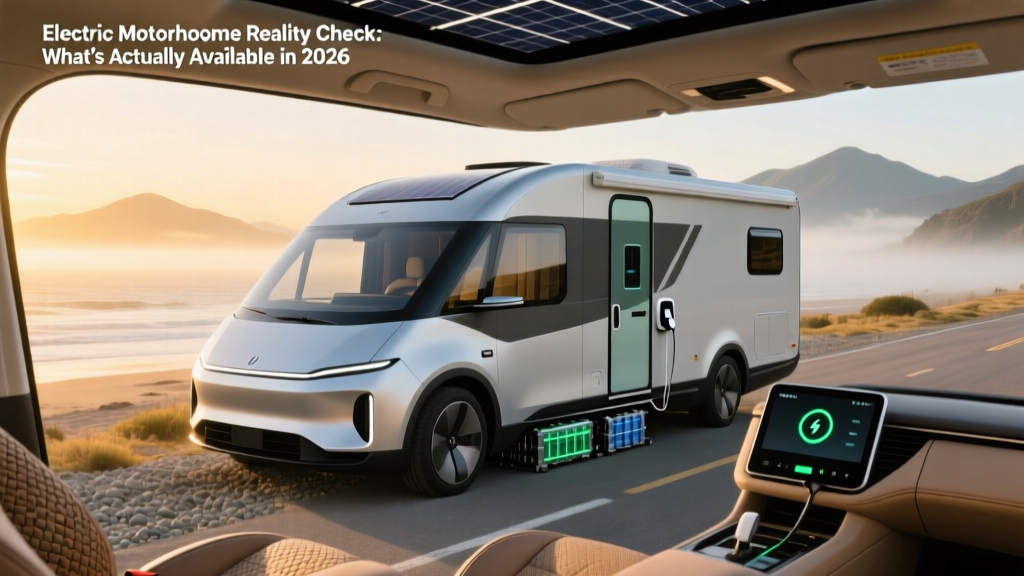
As of 2026, fully electric Class A, B, and C motorhomes remain extremely scarce in the U.S. market. The most viable production option is the Winnebago e-RV (Class B), offering an EPA-estimated ~108 miles of range from a 68 kWh (usable) battery pack, with a base price around $235,000. Several concepts and prototypes — including the Lightship L1 (an EV travel trailer, not a motorhome) and the Thor Vision — have been announced but are not yet in customer hands. For most RV buyers today, a plug-in hybrid tow vehicle paired with an efficient trailer, or a traditional diesel/gas motorhome, remains the practical choice. This guide covers exactly what exists, what it costs, and how to decide if an electric motorhome fits your use case.
What Electric Motorhomes Can You Actually Buy?
The electric RV market is still in its earliest stages. Here is a precise inventory of what's available or firmly announced for U.S. buyers:
| Model | Type | Battery (kWh usable) | EPA Est. Range | Peak DC Charge | Base MSRP | Status |
|---|---|---|---|---|---|---|
| Winnebago e-RV | Class B (van) | 68 kWh (NMC) | ~108 mi | ~115 kW | ~$235,000 | Limited production |
| Lightship L1 | EV travel trailer | 80 kWh (NMC est.) | ~300 mi (with tow vehicle assist) | N/A (charges via tow vehicle or plug) | ~$125,000 | Pre-orders / early deliveries |
| Thor Vision Concept | Class C concept | Not published | ~300 mi (claimed) | Not published | Not announced | Concept — not on sale |
| Grounded G2 (announced) | Class B (Sprinter-based) | ~150 kWh (claimed) | ~200 mi (claimed) | Not published | ~$275,000 (est.) | Announced — no deliveries |
The critical takeaway: only the Winnebago e-RV has been built and sold in any meaningful quantity. The Lightship L1 is a trailer (requiring a separate EV tow vehicle like a Ford F-150 Lightning or Rivian R1T), not a self-propelled motorhome. The Thor Vision and Grounded G2 remain in prototype or pre-production stages.
Range, Charging, and the RV Reality Check
Range is the single biggest hurdle for electric motorhomes. A 30-foot vehicle weighing 10,000+ pounds requires enormous energy to move, especially at highway speeds and on inclines.
Winnebago e-RV: Real-World Range Expectations
EPA estimate: ~108 miles (mixed driving)
Highway at 65-70 mph: Expect ~80-90 miles. Aerodynamic drag on a tall van body is brutal at speed.
Cold weather (below 40°F): Expect ~65-80 miles. Battery chemistry loses efficiency and cabin heating draws heavily from the traction pack.
Mountain grades (e.g., I-70 through Colorado): Consumption can spike to 4+ kWh/mile on sustained climbs, cutting range to 50-60 miles before regeneration on descents partially recovers it.
For context, a diesel Sprinter-based Class B motorhome typically achieves 18-22 MPG, yielding 450-550 miles on a 25-gallon tank. That's a 4-5x range advantage over the e-RV.
Charging Speed and Infrastructure
The Winnebago e-RV charges via a CCS1 connector (the J1772-based DC standard being phased out in favor of NACS). Here's what charging actually looks like:
| Level | Power (kW) | Miles Added per Hour | Time 10-80% |
|---|---|---|---|
| Level 1 (120V household) | ~1.4 kW | ~2 mi/hr | ~48+ hours (full charge) |
| Level 2 (240V, 48A) | ~11.5 kW | ~17 mi/hr | ~6 hours (full charge) |
| DC Fast Charge (CCS1) | Peak ~115 kW | ~150 mi/hr (peak) | ~45 min (10-80%) |
A 45-minute fast charge every 80-90 miles of driving fundamentally changes road-trip logistics. On a 500-mile drive, you're looking at 5-6 charging stops, each lasting 30-45 minutes. That's 3-4 hours of stationary time versus a single 10-minute diesel fill-up.
Campground charging is also a major gap. Most RV parks offer 30A or 50A shore power (3.6 kW to 12 kW), which is adequate for overnight house-battery top-ups but painfully slow for recharging the traction battery. Dedicated DC fast chargers at campgrounds remain rare, though networks like Electrify America and Tesla Superchargers (now open to non-Tesla vehicles via NACS adapters) are expanding along major corridors.
Cost Breakdown: Electric Motorhome vs. Gas/Diesel RV
The economics of electric RVs are challenging at current pricing. Here's a direct comparison:
| Category | Winnebago e-RV (Electric) | Winnebago Revel / Diesel Class B |
|---|---|---|
| Purchase Price (MSRP) | $235,000 | $200,000 - $225,000 |
| Federal Tax Credit (§30D) | $0 (exceeds $80,000 MSRP cap for vans/cars; RV classification uncertain) | $0 (diesel) |
| Fuel/Energy (5 yr, 50,000 mi) | ~$4,500 (at $0.15/kWh home charging) | ~$12,500 (at $4.00/gal, 20 MPG) |
| Maintenance (5 yr) | ~$1,500 (no oil, fewer moving parts) | ~$4,000 (diesel service, DEF, filters) |
| Insurance (annual avg) | $2,800 - $3,500 | $2,200 - $2,800 |
| Estimated Depreciation (5 yr) | High (limited market, uncertain resale) | Moderate (strong used RV market) |
| Est. 5-Year Total Cost | $255,000 - $262,000 | $230,000 - $250,000 |
The electric motorhome saves roughly $8,000-$10,000 on fuel and maintenance over five years, but that's easily offset by the higher purchase price and steeper, more uncertain depreciation. The IRS §30D clean vehicle credit caps eligibility at an MSRP of $80,000 for vans and SUVs (the classification most Class B motorhomes fall under), meaning the e-RV does not qualify. Even if reclassified, the battery sourcing and buyer income requirements add complexity — consult a tax professional before assuming credit eligibility.
Real-World Ownership: Who Is This For?
An electric motorhome makes sense only for a narrow set of use cases:
Decision Framework: Should You Buy an Electric Motorhome?
Choose electric if:
- Your trips are mostly under 150 miles round-trip (weekend getaways, regional camping)
- You have Level 2 home charging (a 240V/48A circuit in your garage or driveway — expect $500-$2,000 for installation if you already have a 200A panel)
- You primarily camp at RV parks with 50A shore power and don't need to boondock far off-grid
- You value silent operation, zero tailpipe emissions at the campsite, and the ability to run climate control from the house battery without a generator
- Budget is not the primary constraint
Choose diesel/gas or wait if:
- You regularly drive 300+ miles to reach destinations (national parks, cross-country trips)
- You boondock (dry camp without hookups) — an EV RV's traction battery and house battery compete for the same energy
- You tow a vehicle behind your motorhome (adding 3,000+ lbs destroys what little range exists)
- You live in an area with limited DC fast-charging infrastructure along your common routes
- You need a Class A or large Class C motorhome (none exist in electric form)
Home Charging Considerations
If you're storing a motorhome at your residence, you'll need a dedicated 240V circuit — ideally 48A or higher — to recharge the traction battery overnight. Many homes with 100A or even 150A electrical panels will need a panel upgrade to 200A ($1,500-$3,000) before an electrician can add the circuit. If your motorhome lives in a storage facility, confirm whether Level 2 charging is available there; most are not equipped for it.
Climate and Seasonal Impact
Electric motorhomes suffer disproportionately in cold weather. The Winnebago e-RV uses an NMC (nickel manganese cobalt) battery pack, which loses roughly 20-30% of usable capacity below freezing. Combined with the energy draw of heating a large, poorly insulated van body, winter range can drop below 70 miles. If you camp primarily in warm climates (Arizona, Southern California, Florida), this is less of a concern. For four-season use in the Mountain West or Northeast, it's a dealbreaker for anything beyond short hops.
Common Misconceptions About Electric Motorhomes
| Myth | Fact |
|---|---|
| "Electric RVs can go 300+ miles on a charge." | No production electric motorhome exceeds ~120 miles EPA. The Lightship L1 trailer claims 300 mi, but that's with a tow vehicle's battery assist — it's not a motorhome. |
| "You can charge at any RV park." | RV parks offer shore power (3.6-12 kW AC) for house systems. Fully recharging a 68+ kWh traction battery on 30A shore power takes 18-24 hours. |
| "Electric motorhomes qualify for the $7,500 federal tax credit." | The §30D credit caps MSRP at $80,000 for vans. At $235,000+, the e-RV does not qualify. Always verify current rules at IRS.gov. |
| "Solar panels on the roof will extend range meaningfully." | Typical RV roof solar (400-800W) generates ~1.5-3 kWh/day in good sun — enough to run house lights and a fridge, but negligible for a 68+ kWh traction battery. |
| "Electric RVs have lower total cost than diesel." | Fuel savings are real (~$1,600/year), but the $10,000-$35,000 purchase premium and uncertain resale value negate savings for most buyers in the first 5-7 years. |
The Lightship L1 and the EV Trailer Alternative
If you already own (or plan to buy) an electric truck like the Ford F-150 Lightning (EPA range up to 320 mi, 131 kWh extended battery) or the Rivian R1T (EPA up to 352 mi, 149 kWh Max Pack), the Lightship L1 travel trailer offers a more compelling EV camping experience than any current electric motorhome.
The L1 features an estimated 80 kWh battery pack and an integrated electric powertrain that propels the trailer itself, reducing range loss on the tow vehicle to roughly 10-15% instead of the typical 40-50% towing penalty. At a base price around $125,000, it's still expensive, but it leverages an EV you may already own and offers ~300 miles of combined range. Early deliveries began in late 2025, with production ramping through 2026.
This combination — EV truck + self-propelled EV trailer — is currently the most practical all-electric RV setup for long-distance travel, though it requires a $90,000-$110,000 truck investment on top of the trailer.
What First-Time EV RV Buyers Should Know
- Plan trips around charging, not destinations. Use tools like PlugShare and A Better Routeplanner to map DC fast chargers along your route before departing. Assume one charger per 70-80 miles on the e-RV.
- Understand kW vs. kWh. kW (kilowatts) is the rate of energy flow — how fast you charge. kWh (kilowatt-hours) is the battery's energy capacity — how far you can go. A 68 kWh battery charged at 115 kW peak doesn't charge at that rate the entire session; the charge curve tapers significantly above 80% SoC to protect battery health.
- Budget for electrical upgrades. If your home doesn't already have a 240V/48A+ circuit near where you park, factor in $1,000-$3,500 for panel work, conduit, and a hardwired Level 2 charger. Always hire a licensed electrician — never DIY high-amperage EV circuits.
- Insurance will cost more. Specialty RV insurers (Progressive, Good Sam, National General) are still building actuarial data on electric motorhomes. Expect premiums 20-40% higher than an equivalent diesel Class B.
- Resale is a wildcard. The used electric RV market is essentially nonexistent. Early adopters should expect steep depreciation — potentially 40-50% in the first three years — until the market matures and battery longevity data accumulates.
Frequently Asked Questions
Does Tesla make an electric motorhome?
No. Tesla has not announced any motorhome or RV product. Rumors of a "Tesla camper" circulate regularly but have no basis in official product plans as of 2026. The Tesla Semi is a commercial truck, not an RV platform.
Can I convert a gas or diesel motorhome to electric?
Technically, yes — companies like EV West and others have done one-off conversions. However, a professional conversion costs $80,000-$150,000+, yields 80-120 miles of range, and voids all original manufacturer warranties. It's not cost-effective for most buyers.
What's the cheapest electric motorhome available?
The Winnebago e-RV at ~$235,000 is currently the only production electric motorhome, making it both the cheapest and most expensive by default. There is no budget-friendly electric motorhome option in 2026.
Will electric motorhome range improve soon?
Incrementally, yes. Solid-state batteries (projected for the late 2020s) could double energy density, potentially pushing electric Class B range to 200+ miles. However, the physics of moving a 10,000-lb, high-drag vehicle means electric motorhomes will always trail diesel range significantly. Expect 150-200 mile electric Class B motorhomes by 2028-2030, not 400-mile ones.
Can I tow a car behind an electric motorhome?
The Winnebago e-RV is not rated for dinghy (flat) towing. Adding a 3,000-lb towed vehicle would further reduce its already limited range by 20-30%. If you need to tow, a diesel or gas motorhome is the practical choice.