The Quick Answer: Are Electric Motor Homes Ready?
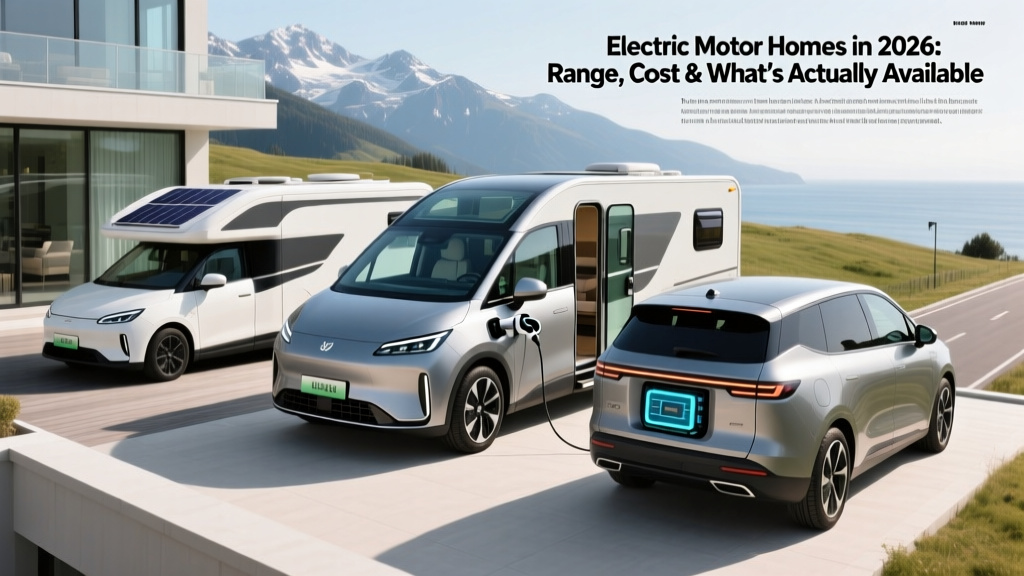
As of early 2026, fully electric motor homes (Class A, B, or C RVs with battery-electric drivetrains) remain extremely limited in availability. The Winnebago e-RV (Class B, ~108 miles EPA-estimated range, ~$125,000 estimated MSRP) and the Lightship L1 (an all-electric travel trailer, not a motorhome, starting around $75,000) are the closest production options. Several concept platforms from Thor Industries and others have been announced but are not yet available for purchase. For most buyers in 2026, a plug-in hybrid or conventional gas motorhome paired with an electric tow vehicle remains the more practical electrified RV choice.
What Electric Motor Homes Exist Today?
The term "electric motor homes" covers a spectrum, and it is critical to understand what is actually drivable off a dealer lot versus what remains in prototype or announcement stage. Here is where the market stands in 2026:
| Model | Type | Battery / Range | Status (2026) | Est. Price |
|---|---|---|---|---|
| Winnebago e-RV | Class B (Ford E-Transit chassis) | 68 kWh usable / ~108 mi EPA | Limited production | ~$125,000 |
| Lightship L1 | Electric travel trailer (aerodynamic) | 80 kWh / solar-assist, ~150 mi tow range impact | Early deliveries | From ~$75,000 |
| Thor Industries / Harbinger EV chassis | Class A/C platform | Announced ~150 mi target | Announced / prototype | TBD |
| Grounded G1 (announced) | Electric van conversion | ~150 mi target | Announced / pre-order | TBD |
The Winnebago e-RV, built on the Ford E-Transit cutaway chassis, is the most tangible electric motorhome available. However, its 108-mile EPA-estimated range severely limits boondocking and long-distance travel. The E-Transit was designed for urban commercial delivery routes, not cross-country recreation.
Electric Motor Homes vs. Gas Motorhomes: The Data
Comparing an electric Class B like the e-RV against a comparable gas-powered Class B (such as a Winnebago Revel on a Mercedes Sprinter chassis) reveals the fundamental trade-offs buyers face.
| Factor | Winnebago e-RV (Electric) | Gas Class B (Sprinter-based) |
|---|---|---|
| EPA Range | ~108 miles | ~400-500 miles (25 gal tank, ~16-20 mpg) |
| Fuel/Energy Cost per Mile | ~$0.05-$0.10/mi (home L2 at $0.13/kWh) | ~$0.20-$0.28/mi (diesel at ~$4.50/gal) |
| "Refuel" Time | ~45 min (DC fast charge 10-80% at 115 kW peak) | ~5-8 min (diesel fill-up) |
| Charging/Fueling Infrastructure | DC fast chargers along interstates; RV parks rarely have 50-amp EV chargers | Gas/diesel stations everywhere, including remote areas |
| Cold-Weather Range Loss | ~25-40% reduction below 30°F | ~5-10% reduction |
| Maintenance | No oil changes, fewer moving parts; brake regen extends pad life | Regular oil, filter, transmission, DEF fluid service |
| Base Price (2026 est.) | ~$125,000 | ~$110,000-$140,000 |
| Noise Level | Near-silent driving; no generator needed for AC if battery allows | Diesel clatter; onboard generator for shore-power appliances |
The range gap is the defining issue. A gas Class B can drive from Denver to Moab (350 miles) on a single tank with fuel stops taking minutes. The e-RV would require at least three DC fast-charging stops, each taking 30-45 minutes — and that assumes chargers exist along the route and can accommodate a vehicle of that size. Many DC fast-charging stations are designed for passenger cars, with bollards, tight pull-through lanes, and canopies too low for a Class B or Class C motorhome.
Real Costs: Purchase, Energy, Maintenance, and Insurance
The economic case for an electric motorhome depends heavily on how you use it. Here is a realistic 5-year ownership comparison assuming 8,000 miles per year (typical for RV owners who take 4-6 trips annually plus weekend use):
| Cost Category (5-Year) | Electric Class B (e-RV) | Gas Class B (Diesel Sprinter) |
|---|---|---|
| Purchase Price | $125,000 | $125,000 |
| Federal Tax Credit (§30D) | Up to $7,500 (if eligible — see IRS rules; MSRP cap for vans is $80,000, so likely ineligible) | $0 |
| Energy/Fuel (40,000 mi total) | ~$2,400 (home charging) to $5,200 (public DC) | ~$9,600 (diesel at $4.50/gal, 17 mpg avg) |
| Maintenance | ~$1,500 (cabin air filter, tire rotation, brake fluid) | ~$4,800 (oil, filters, DEF, transmission service) |
| Insurance (5 years) | ~$12,000-$15,000 (specialty RV, limited EV actuarial data) | ~$9,000-$12,000 |
| Depreciation (est. 5-yr) | ~$50,000-$65,000 (limited resale data; battery degradation uncertainty) | ~$45,000-$55,000 |
| Estimated 5-Year Total | ~$190,900-$207,700 | ~$193,400-$206,400 |
The energy and maintenance savings for the electric motorhome are real — roughly $7,000-$10,000 less over five years. But these savings are often offset by higher insurance premiums (insurers are still building actuarial models for electric RVs) and steeper depreciation uncertainty. The §30D federal tax credit is almost certainly unavailable here: the MSRP cap for vans and SUVs is $80,000, and a motorhome built on a van chassis priced at $125,000 exceeds that threshold.
Charging an Electric Motorhome: The Infrastructure Reality
Charging is where the electric motorhome concept collides hardest with 2026 infrastructure. Here is what you need to know:
At Home
Most electric motorhomes will need a Level 2 home charger (240V, 40-48 amps) to recharge overnight. Expect a full charge from 10% to 100% in 8-10 hours on a 48-amp Level 2 circuit. Installation costs range from $800-$2,500 depending on your electrical panel capacity and run length. If your home has a 100-amp main panel, a panel upgrade to 200 amps may add $1,500-$3,000.
On the Road
The Winnebago e-RV supports DC fast charging at up to 115 kW peak. On the Ford E-Transit's 68 kWh battery, a 10-80% charge takes approximately 45 minutes under ideal conditions. However, charging curves taper significantly above 80%, meaning a full 10-100% session can exceed 70 minutes.
The bigger problem: physical access. Most Electrify America, EVgo, and Tesla Supercharger stalls are designed for passenger vehicles. A Class B motorhome (roughly 20 feet long, 7 feet wide, and 9-10 feet tall) may not fit in standard pull-through lanes. Overhead canopies at some stations are too low. Charging cables may not reach the charge port from a position the vehicle can occupy. This is not a theoretical concern — it is a daily friction point for anyone who has attempted to DC-fast-charge a large van.
At Campgrounds
RV parks and campgrounds typically offer 30-amp or 50-amp shore power (120V/240V) designed to run appliances, not charge traction batteries. A 50-amp RV hookup at 240V delivers roughly 12 kW — adequate for overnight Level 2 charging (adding ~30-40 miles of range per hour of charging). However, many campgrounds do not permit EV charging on shore-power pedestals, as the electrical system was not designed for sustained 12 kW loads across multiple sites simultaneously. Always call ahead and confirm.
Common Misconceptions About Electric Motor Homes
| Myth | Fact |
|---|---|
| "Electric motorhomes can go 300+ miles like electric cars." | Motorhomes are heavy (8,000-12,000 lbs GVWR) and aerodynamically poor. Even with large battery packs, real-world range at highway speeds is typically 100-150 miles. Physics demands more energy to move more mass. |
| "You can charge at any RV park." | Most RV parks lack the electrical capacity or policy allowance for EV traction-battery charging on shore-power pedestals. Dedicated EV charging infrastructure at campgrounds is extremely rare in 2026. |
| "The $7,500 tax credit applies to electric motorhomes." | The §30D credit has an MSRP cap of $80,000 for vans. Most electric motorhomes exceed this. Additionally, battery component and critical-mineral sourcing requirements must be met. Consult a tax professional. |
| "Electric RVs don't need generators." | While the traction battery can theoretically power onboard appliances, doing so drains driving range. Most electric motorhome owners still need shore power or solar supplementation for multi-day camping without driving. |
| "Cold weather doesn't affect electric motorhomes more than gas." | Lithium-ion batteries lose 25-40% of their effective capacity in sub-freezing temperatures. Heating the cabin and battery thermal management draw additional energy. A gas motorhome uses waste engine heat for cabin warming at nearly zero fuel penalty. |
Who Should Consider an Electric Motorhome in 2026?
Electric motor homes are not a mainstream purchase in 2026. They serve a narrow set of use cases well, and fail others entirely. Here is a practical decision framework:
Choose an Electric Motorhome If:
- You camp within 80 miles of home and can charge overnight on a Level 2 home charger before and after each trip.
- You primarily use the RV for weekend trips to established campgrounds with shore power, not boondocking in remote areas.
- Silent operation matters — you want to avoid generator noise at campgrounds with quiet hours, and you value near-silent driving.
- You have solar panels at home and want to offset energy costs, making the per-mile fuel cost effectively near zero.
- You accept the depreciation risk of an early-adopter product with limited resale history.
Choose a Gas/Diesel Motorhome (or Hybrid Setup) If:
- You travel long distances — national park tours, cross-country trips, or routes through charging deserts (rural Montana, West Texas, the Dakotas).
- You boondock off-grid where no charging infrastructure exists and you need maximum range and self-sufficiency.
- You camp in cold climates regularly, where battery range loss and heating demands make electric impractical.
- You need maximum cargo and towing capacity — electric motorhomes sacrifice payload for battery weight.
- You want proven reliability and established service networks — RV service centers are not yet equipped for high-voltage EV drivetrain repairs.
The Hybrid Alternative: Electric Tow Vehicle + Conventional Trailer
For buyers who want some electrification without the range limitations of a fully electric motorhome, the most practical 2026 approach is pairing an electric truck or SUV with a conventional or lightweight travel trailer. The Ford F-150 Lightning (EPA range up to 320 miles, max towing 10,000 lbs), Rivian R1T (up to 352 miles, 11,000 lbs towing), and Chevrolet Silverado EV (up to 440 miles, 10,000 lbs) can tow smaller trailers, though expect a 40-60% range reduction while towing at highway speeds. The Lightship L1 travel trailer, designed with an ultra-aerodynamic profile and integrated solar, aims to minimize that range penalty.
This approach gives you electric daily driving and short-trip capability, with the option to rent or borrow a gas truck for long towing trips — a pragmatic compromise that the current electric motorhome market cannot match.
What First-Time EV Motorhome Buyers Must Know
If you are seriously considering an electric motorhome, go in with eyes open:
- Range is your primary constraint. Plan every trip around confirmed DC fast-charger locations. Use apps like A Better Routeplanner (ABRP) with the correct vehicle profile to model real-world range including elevation, temperature, and payload.
- Verify campground charging policies before booking. Call and ask specifically: "Can I charge an electric vehicle traction battery on the 50-amp pedestal at my site?" Do not assume.
- Budget for home electrical upgrades. A 48-amp Level 2 charger requires a 60-amp dedicated circuit. If your panel is maxed out, a panel upgrade adds significant cost.
- Understand battery degradation. Lithium-ion batteries lose capacity over time and charge cycles. Expect 10-15% capacity loss over 8-10 years. For an RV with a 68 kWh pack that originally delivered 108 miles, that means ~92-97 miles of range in year 10.
- Check service availability. High-voltage EV drivetrain service is not available at most RV dealerships. Confirm that a qualified service center exists within a reasonable distance of your home before purchasing.
- Insurance will cost more. Get quotes before committing. Specialty RV insurers are still developing EV-specific policies, and premiums may be 20-40% higher than equivalent gas motorhomes.
Looking Ahead: What's Coming in 2027-2028
Thor Industries (parent of Airstream, Jayco, and others) has been developing EV chassis platforms in partnership with Harbinger Motors, targeting 150+ mile range in Class A and Class C configurations. Several European manufacturers (e.g., Dethleffs, Iridium) have shown electric motorhome prototypes, but US availability remains uncertain. Solid-state battery technology, if it reaches commercialization by 2028-2030, could dramatically improve energy density and reduce the weight penalty that currently limits electric motorhome range.
Until battery energy density improves and charging infrastructure adapts to large vehicles, electric motor homes will remain a niche product — compelling for the right buyer, impractical for most. If your camping style fits within the range envelope and you have reliable home charging, the e-RV offers a genuinely quiet, low-maintenance, zero-tailpipe-emission experience. If you need range, flexibility, and off-grid capability, a gas or diesel motorhome remains the pragmatic choice in 2026.
Do electric motor homes qualify for the federal EV tax credit?
Most likely not. The §30D credit caps eligible MSRP at $80,000 for vans, and electric motorhomes like the Winnebago e-RV exceed that threshold. Even if priced within the cap, the vehicle must meet battery component and critical-mineral sourcing requirements. Always verify current rules at irs.gov and consult a tax professional.
How long does it take to charge an electric motorhome at home?
On a 48-amp Level 2 home charger (240V, ~11.5 kW), expect a full charge of a 68 kWh battery (Winnebago e-RV) in approximately 7-8 hours from near-empty. This is practical for overnight charging between trips.
Can I tow a car behind an electric motorhome?
Towing behind a motorhome (flat-towing a "dinghy" vehicle) adds significant weight and aerodynamic drag, which will further reduce an already limited range. Check the specific chassis tow rating — the Ford E-Transit chassis has a maximum tow rating of approximately 5,000 lbs, but towing at that limit will substantially cut range.
What happens if I run out of charge in a remote area?
Unlike a gas motorhome that can receive a fuel delivery from a roadside assistance provider, a depleted electric motorhome requires a flatbed tow to the nearest charger. Standard RV roadside assistance plans may not cover this scenario. Verify your coverage explicitly.
Are there electric Class A motorhomes available?
No production electric Class A motorhomes are available for purchase in the US as of 2026. Thor Industries and Harbinger have announced development of larger EV chassis platforms, but these remain in prototype or pre-production stages.