The Short Answer on Electric Motor Homes
As of early 2026, a fully electric Class A or Class C motor home with 200+ miles of range is not yet available for purchase from any major RV manufacturer. What does exist: electric-powered Class B camper vans (notably the Winnebago e-RV and Lightship L1 travel trailer), several electric chassis platforms from Ford and GM aimed at commercial upfitters, and a growing crop of plug-in hybrid and range-extended concepts. If you need a drivable electric motor home today, your options are limited to small-scale conversions and pre-production reservations. For most RV shoppers in 2026, the practical electrified path is a PHEV tow vehicle paired with a lightweight trailer — or waiting 12–24 months for announced production models to reach dealers.
What "Electric Motor Home" Actually Means in 2026
The term "electric motor home" covers several vehicle categories that buyers often conflate, and the distinctions matter enormously for your wallet and travel plans:
- Class A motor home (diesel/gas): 30–45 ft, built on a heavy-duty bus or truck chassis. No production electric version exists yet. Thor Industries and REV Group have shown concepts but nothing in showrooms.
- Class C motor home: 20–33 ft, built on a cutaway van chassis (Ford E-Series, Chevy Express). The Ford E-Transit chassis exists, but RV upfitters have not yet produced a mainstream Class C on it.
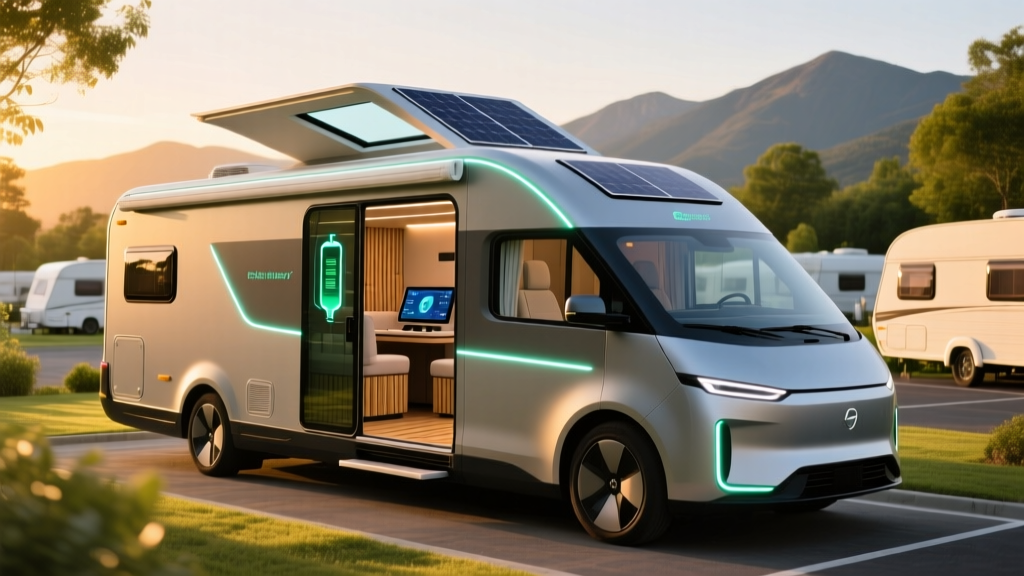
- Class B camper van: 18–22 ft, built inside a standard van body. This is where electric RVs actually live — the Winnebago e-RV (Ford E-Transit based) and upcoming offerings from companies like Grounded and Ozzie.
- Travel trailers / fifth wheels: Towable, not motorized. Lightship L1 and Airstream eStream concept represent the leading edge here, with self-propulsion assist in some designs.
The fundamental engineering challenge: a Class A motor home weighs 15,000–30,000 lbs loaded. Pushing that mass requires a battery pack of 200+ kWh to achieve even 150 miles of range, adding thousands of pounds and $40,000–$80,000 in battery cost alone. This physics problem is why the electric motor home market trails passenger EVs by roughly a decade.
The Current Electric RV Landscape: What You Can Actually Buy
Winnebago e-RV (Class B, Limited Production)
Built on the Ford E-Transit chassis, the e-RV is the closest thing to a purchasable electric motor home from a major manufacturer. Key specifications from Winnebago's published data:
- Battery: 68 kWh usable (NMC chemistry), shared with E-Transit commercial van
- EPA-estimated range: ~108 miles (varies with camper build-out weight and climate use)
- Real-world range: Expect 70–90 miles loaded for camping, with A/C or heat running
- DC fast charging: Up to 115 kW peak, 10–80% in approximately 45 minutes
- Level 2 charging: 10.5 kW onboard charger, full charge in ~8 hours
- Estimated price: ~$125,000+ (limited availability, dealer inquiry required)
The e-RV works for weekend warriors who camp within a 40-mile radius of home and have reliable Level 2 charging at their campsite or destination. It does not work for cross-country touring or boondocking.
Lightship L1 (Electric Travel Trailer — Towable)
Lightship's L1 is an aerodynamic travel trailer with an integrated battery pack and electric axle. It's not a motor home, but it solves a critical EV-towing problem:
- Battery: ~80 kWh pack in the trailer itself
- Self-propulsion assist: The trailer's electric axle helps push itself, reducing tow-vehicle range loss by an estimated 50–70%
- Shore power / campsite power: Can power campsite loads for days without a generator
- Reservation price: $500 deposit, MSRP expected ~$75,000–$100,000
- Status: Taking reservations; production units expected mid-to-late 2026
Concepts and Announcements (Not Yet Buyable)
Thor Industries (parent of Airstream, Jayco, Dutchmen) has demonstrated electric and hybrid RV prototypes and invested in Lightning eMotors, but no production timeline for a full-electric Class A or C has been confirmed. REV Group (Fleetwood, Holiday Rambler) has similarly shown concepts without firm launch dates. Any source claiming these are available now is outdated or inaccurate.
Electric Motor Home vs. Gas/Diesel RV: Cost and Practicality Comparison
| Factor | Electric Class B (e-RV type) | Gas Class C (Typical 28-ft) | Diesel Class A (Typical 38-ft) |
|---|---|---|---|
| Purchase Price (base) | $125,000+ | $85,000–$115,000 | $150,000–$350,000+ |
| Fuel/Energy Cost per Mile | $0.08–$0.15 (home/solar) | $0.30–$0.45 (gas at $3.50/gal, 8 MPG) | $0.40–$0.55 (diesel at $4.00/gal, 7 MPG) |
| Range (realistic loaded) | 70–108 miles | 350–500 miles | 500–800 miles |
| Refuel/Recharge Time | 45 min (DC) / 8 hr (L2) | 10–15 minutes | 15–20 minutes |
| Annual Maintenance | $200–$500 | $1,200–$2,500 | $1,500–$3,500 |
| Campsite Power Needs | Can use 50-amp shore to charge | Generator or shore for house loads | Generator or shore for house loads |
| Cold-Weather Range Loss | 25–40% below freezing | Negligible | Negligible |
| Federal Tax Credit (§30D) | Up to $7,500 (if GVWR ≤ 14,000 lbs and meets sourcing rules) | None | None |
The energy-cost advantage of an electric motor home is real — roughly $0.10/mile vs. $0.35–$0.50/mile for gas/diesel — but the savings take years to offset the higher purchase price, and only if you drive locally. On a 5,000-mile-per-year RV usage pattern (typical for US owners per RVIA data), annual fuel savings run $1,200–$2,000. At that rate, a $30,000 price premium takes 15+ years to recoup, before factoring in battery degradation.
Real-World Ownership Considerations No Brochure Mentions
Charging Infrastructure Is Not RV-Ready
Most public DC fast-charging stations are designed for passenger cars. Pulling a 25-foot motor home through a Tesla Supercharger stall or Electrify America plaza is physically difficult or impossible — the charging cables may not reach your port, and there's no room to maneuver. According to the U.S. Department of Energy's AFDC database, fewer than 5% of public charging stations in the US have pull-through lanes suitable for vehicles over 20 feet long. This is improving (Tesla has announced megacharger sites for Semi trucks), but in 2026, long-distance electric RV travel requires meticulous route planning around RV-friendly chargers.
Campsite Electrical Reality
Most RV campsites offer 30-amp or 50-amp 240V shore power. A 50-amp hookup delivers roughly 12 kW — enough to charge an e-RV-class battery from empty in about 6–7 hours. However, that same hookup also needs to power your A/C, refrigerator, and outlets. Running the air conditioner (1.5–2 kW) while charging slows your charge rate. In hot summer camping, expect overnight charging to add 80–100 miles, not a full battery.
The Weight-Range Physics Problem
Electric motor homes face a vicious cycle: more range requires a bigger battery, which adds weight, which reduces efficiency, which requires an even bigger battery. A fully loaded Class A motor home can weigh 26,000 lbs. At an efficiency of roughly 1.5–2.0 kWh/mile for that weight class, achieving 200 miles of range requires a 300–400 kWh battery pack — which itself weighs 4,000–6,000 lbs and costs $50,000–$80,000 at current cell prices. This is why every production electric RV to date is a Class B van or a lightweight trailer.
Cold-Weather Camping
LFP and NMC batteries lose 25–40% of usable capacity in sub-freezing temperatures. If you camp in Colorado or Minnesota winters, your 108-mile e-RV becomes a 65-mile e-RV. Battery preconditioning helps at DC chargers but doesn't eliminate the loss during driving. Diesel and gas RVs don't face this problem, though diesel gelling in extreme cold is its own issue.
5-Year Cost Breakdown: Electric Class B vs. Gas Class C
| Cost Category (5 Years) | Electric Class B (e-RV type) | Gas Class C (28-ft typical) |
|---|---|---|
| Purchase Price (after §30D credit) | $117,500 | $100,000 |
| Fuel / Energy (5,000 mi/yr × 5 yrs) | $3,750 (home charging at $0.15/kWh) | $8,750 (gas at $3.50/gal, 8 MPG) |
| Maintenance (oil, filters, drivetrain) | $1,500 | $7,500 |
| Insurance (annual avg × 5) | $12,500 | $9,000 |
| Depreciation (est. 40% / 50%) | $47,000 | $50,000 |
| Campsite fees & storage | $15,000 | $15,000 |
| 5-Year Total Cost | $197,250 | $190,250 |
The electric Class B saves roughly $5,000 in fuel and maintenance over five years but costs more upfront (even after the federal tax credit) and carries higher insurance premiums due to specialized repair requirements. Depreciation for electric RVs remains uncertain — the segment is too new for reliable resale data. Per IRS §30D guidelines, the $7,500 clean vehicle credit applies only if the vehicle meets battery critical-mineral sourcing, MSRP caps ($80,000 for vans/light trucks), and buyer income limits ($150K single / $300K joint). Many electric RVs may exceed the MSRP cap, disqualifying them entirely.
Common Electric Motor Home Myths — Corrected
| Myth | Fact |
|---|---|
| "You can buy a full-electric Class A motor home today." | No major manufacturer sells one. Only Class B vans and towable trailers are available or in pre-production as of 2026. |
| "Electric RVs save you money overall." | Energy costs are lower, but higher purchase price, uncertain resale value, and limited charging infrastructure can erase savings for typical RV usage patterns (3,000–7,000 miles/year). |
| "Any EV can tow a trailer." | Most EVs lose 40–60% of range when towing. Only trucks like the F-150 Lightning (EPA 230–320 mi) and Rivian R1T (EPA 270–400 mi) have enough battery to tow meaningfully, and even they drop to 120–180 miles while towing 5,000+ lbs. |
| "Solar panels on the roof will keep it charged." | Typical RV roof solar (400–800W) generates 1.5–4 kWh per day in good sun — enough to run house loads (lights, fridge, fan) but not to charge a 68+ kWh traction battery in any meaningful timeframe. |
| "The §30D tax credit gives you $7,500 off any electric RV." | The credit has MSRP caps, income limits, and battery-sourcing requirements. Many RVs exceed the $80,000 van MSRP cap. Always verify eligibility on IRS.gov before purchasing. |
Decision Framework: Should You Go Electric for Your RV?
Choose an Electric Class B (or wait for electric motor homes) if:
- You camp within a 50-mile radius of home 80%+ of the time
- You have Level 2 charging at home AND at your most-visited campsites
- You travel solo or as a couple (Class B fits 1–2 people comfortably)
- You value silent, emission-free campsite operation (no generator noise)
- You drive fewer than 6,000 RV miles per year
- You're willing to pay a $25,000–$40,000 premium for the electric drivetrain
Choose a Gas/Diesel RV (or PHEV tow vehicle + trailer) if:
- You take multi-state road trips or travel 200+ miles to reach campsites
- You need Class A or large Class C space (family of 4+, full-time RVing)
- You boondock off-grid where no charging infrastructure exists
- You camp in extreme cold (below 20°F) regularly
- You tow boats, ATVs, or a second vehicle behind your motor home
- Budget is a primary concern and you want proven reliability/resale data
Consider a PHEV Tow Vehicle + Electric-Assist Trailer if:
- You want some electric driving for daily use (PHEV gets 25–40 miles electric-only)
- You want to reduce but not eliminate fuel use on RV trips
- Trailers like the Lightship L1 become available and fit your budget
- This is a bridge strategy while full-electric motor homes mature over the next 3–5 years
What First-Time Electric RV Buyers Must Know
If you're seriously considering an electric motor home or electric camper van in 2026, these are the non-negotiable homework items:
- Verify charging at your destinations. Use apps like PlugShare and A Better Routeplanner to confirm that DC fast chargers along your route can physically accommodate a vehicle over 20 feet long. Call campgrounds to confirm 50-amp availability.
- Understand the §30D tax credit limitations. The DOE/FuelEconomy.gov tax credit page lists eligible vehicles. Most electric RVs are too expensive or too heavy to qualify. Consult a tax professional before relying on the credit.
- Budget for electrical upgrades. Charging a 68 kWh battery at home on a standard 120V outlet takes 55+ hours. You'll need a 240V Level 2 charger installed (typically $800–$2,500 for equipment and electrician, more if your panel needs upgrading to 200A).
- Plan for battery degradation. NMC batteries typically lose 10–15% capacity over 8–10 years. In an RV with already-limited range, a 15% loss means your 90-mile real-world range becomes 76 miles. Factor this into long-term usability.
- Check insurance before buying. Electric RVs are a new category. Some insurers don't yet have actuarial data and may quote premiums 30–50% higher than equivalent gas RVs. Get quotes from at least three RV-specialty insurers.
Frequently Asked Questions
Is there a fully electric Class A motor home I can buy in 2026?
No. As of early 2026, no major RV manufacturer (Thor, REV Group, Forest River, Winnebago) offers a production electric Class A motor home. Concepts have been shown, but the weight and battery cost barriers remain unsolved for the 15,000–30,000 lb Class A segment. Expect the first viable electric Class A options no earlier than 2028–2030.
What's the longest-range electric motor home available?
The Winnebago e-RV, built on the Ford E-Transit chassis, offers an EPA-estimated 108 miles of range with its 68 kWh battery. Real-world loaded range for camping trips is typically 70–90 miles. This is a Class B camper van, not a full motor home. No electric RV of any class currently offers more than ~120 miles of real-world range.
Can I tow a trailer with an electric truck for RV use?
Yes, but expect severe range reduction. The Ford F-150 Lightning (EPA 230–320 mi depending on battery) loses roughly 40–60% of range when towing a 5,000–7,000 lb trailer, leaving you with 100–180 miles between charges. The Rivian R1T and Chevy Silverado EV show similar towing penalties. For long-distance RV towing, a diesel truck remains the practical choice in 2026.
Does the federal EV tax credit apply to electric RVs?
It can, but with significant caveats. The §30D credit requires the vehicle to have an MSRP at or below $80,000 (for vans and light trucks), the buyer must meet income caps ($150K single, $300K joint), and the battery must meet critical-mineral and component-sourcing requirements. Many electric RVs exceed the MSRP cap. Always check current eligibility on IRS.gov and consult a tax professional before purchasing.
How do I charge an electric motor home at a campground?
Most RV campsites with 50-amp (12 kW) or 30-amp (3.6 kW) shore power can charge an electric RV overnight using the appropriate adapter and the vehicle's onboard charger. A 50-amp hookup can fully recharge a 68 kWh battery in about 6–7 hours if you're not simultaneously running high-draw appliances like A/C. Dedicated RV EV-charging stations are extremely rare as of 2026 but are beginning to appear at select KOA and state park locations.
Will electric motor homes become practical for long-distance travel?
Likely yes, but not until battery energy density improves substantially (solid-state batteries, expected commercially in the late 2020s) and DC fast-charging infrastructure adds pull-through lanes for large vehicles. The 2028–2032 timeframe is a reasonable window for electric Class C motor homes with 200+ miles of range and 20-minute DC fast charging. Class A electric motor homes may take until the mid-2030s due to the extreme weight and energy requirements.