The Quick Answer: Your Electric Minivan Options Right Now
If you need a true electric minivan today, your only plug-in option is the Chrysler Pacifica Plug-In Hybrid (PHEV). It offers 32 miles of electric-only range, 82 MPGe combined, and qualifies for partial federal incentives. Fully electric minivans like the VW ID. Buzz (passenger version) and upcoming models from Volvo and Kia remain in limited availability or pre-production status for the US market. For most families, a PHEV minivan or a large electric SUV (like the Kia EV9 or Rivian R1S) currently fills the gap.
The family-hauler segment has been frustratingly slow to electrify. While sedans, SUVs, and trucks have dozens of EV options, the minivan market offers slim pickings for buyers wanting to plug in. Let's break down exactly what's available, what's coming, and how the numbers stack up against gas minivans.
What's Actually Available: 2026 Electric and Plug-In Minivans
As of early 2026, here's the reality of the plug-in minivan market in the United States:
| Model | Type | Electric Range | Combined Efficiency | Base MSRP | Status |
|---|---|---|---|---|---|
| Chrysler Pacifica PHEV | Plug-in Hybrid | 32 mi (EPA) | 82 MPGe / 30 MPG (gas) | $51,095 | Available |
| VW ID. Buzz (3-row) | BEV | 234 mi (EPA est.) | ~85 MPGe est. | $59,995 | Limited 2025 rollout; 2026 availability expanding |
| Kia Carnival Hybrid | HEV (non-plug-in) | N/A | 34 MPG combined | $41,900 | Available |
| Toyota Sienna Hybrid | HEV (non-plug-in) | N/A | 36 MPG combined | $38,085 | Available |
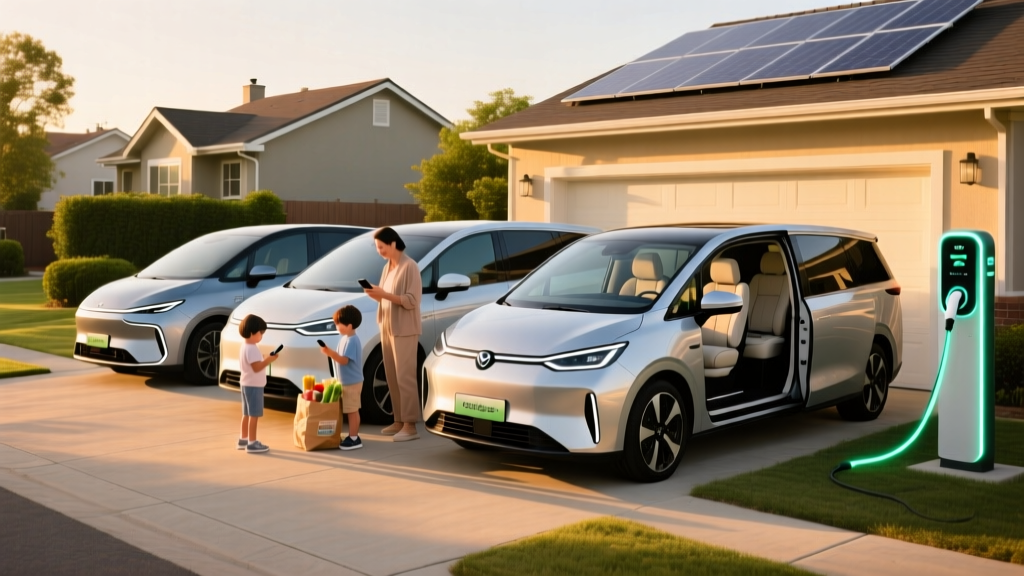
The Chrysler Pacifica PHEV remains the only minivan you can plug in and drive on pure electricity for daily errands and school runs. Its 16 kWh battery pack delivers 32 miles of zero-emission driving — enough for many families' daily loops. After the battery depletes, it operates as a conventional hybrid returning 30 MPG combined.
The VW ID. Buzz passenger version began limited deliveries in late 2024 as a 2025 model, but VW has prioritized the commercial cargo variant and production volumes remain constrained. The 3-row, 7-passenger configuration with the larger 91 kWh (usable) battery targets an EPA range around 234 miles. Real-world highway range at 70 mph with a full family and cargo should be expected closer to 190-205 miles, especially in cold weather where LFP chemistry isn't a factor — VW uses NMC cells in the ID. Buzz, which lose roughly 20-30% range below freezing.
Cost Breakdown: Electric/PHEV Minivan vs. Gas Minivan
The purchase price of a plug-in minivan stings compared to a conventional gas or hybrid model. But the ownership math changes when you factor in fuel, maintenance, and available incentives.
| Cost Factor (5-Year/75,000 mi) | Pacifica PHEV | Toyota Sienna Hybrid | Honda Odyssey (Gas) |
|---|---|---|---|
| Purchase Price (base MSRP) | $51,095 | $38,085 | $39,635 |
| Federal Tax Credit (§30D)* | Up to $7,500 (see eligibility) | $0 | $0 |
| Fuel/Energy Cost (est.) | $3,800 (mixed EV/gas driving) | $6,500 | $8,400 |
| Maintenance (est.) | $2,800 | $3,200 | $3,600 |
| Insurance (est.) | $9,200 | $7,800 | $7,600 |
| 5-Year Total (before incentives) | $66,895 | $55,585 | $59,235 |
| 5-Year Total (after $7,500 credit) | $59,395 | $55,585 | $59,235 |
*Federal tax credit eligibility (§30D): The Pacifica PHEV's credit eligibility has fluctuated due to battery-sourcing requirements under the Inflation Reduction Act. For 2026, check the current fueleconomy.gov tax credit list before purchasing. The credit phases based on critical-mineral and battery-component sourcing, MSRP caps ($80,000 for vans/SUVs), and buyer income limits ($300K joint / $150K single). The point-of-sale transfer option lets you apply the credit as a down payment reduction at the dealer. Always confirm with your tax professional.
Key takeaway: Even with the full $7,500 credit, the Pacifica PHEV costs roughly $3,800 more over five years than the Sienna Hybrid. The gap narrows if you charge at home consistently (reducing fuel costs further) or if your state offers additional rebates. But the Sienna's lower purchase price and strong MPG make it hard to beat on pure economics unless you specifically need electric-only driving for short trips.
Real-World Ownership: What First-Time Plug-In Buyers Need to Know
Buying a plug-in vehicle — whether a full EV or a PHEV — introduces considerations that gas-car buyers never think about.
Home Charging Access Is the Make-or-Break Factor
The Pacifica PHEV's 16 kWh battery charges in roughly 2 hours on a Level 2 (240V, 32A) home charger and about 8-10 hours on a standard 120V outlet (Level 1). For a full EV like the ID. Buzz with its 91 kWh battery, Level 1 charging is impractical (it would take 4+ days from empty). You'd need a Level 2 installation delivering 7.7-11.5 kW to charge overnight.
Level 2 home charger installation typically runs $800-$2,500 if your electrical panel has capacity. If you need a panel upgrade from 100A to 200A, add $1,500-$3,000. Renters and condo owners should verify charging access before committing to any plug-in vehicle.
Cold Climate Range Loss Is Real
PHEV electric range drops in freezing temperatures. Expect the Pacifica's 32-mile EV range to shrink to 22-26 miles in sub-30°F weather due to cabin heating demands and battery chemistry. For the ID. Buzz, plan for 20-30% range reduction in winter — a 234-mile EPA rating becomes roughly 165-185 miles in cold highway driving.
The Charging-Curve Reality for Full EVs
The ID. Buzz supports DC fast charging at up to 200 kW peak, but like all EVs, that peak only holds briefly at low state-of-charge. Expect a 10-80% charge in roughly 26-30 minutes at a capable station. Above 80%, charging slows dramatically to protect battery health — plan your road-trip stops around 10-80% charges, not full fills.
Common Misconceptions About Electric Minivans
| Myth | Fact |
|---|---|
| "There are no electric minivans." | The Pacifica PHEV is a plug-in minivan available now. The VW ID. Buzz (passenger) is a full EV minivan in limited but growing availability. |
| "A PHEV is pointless if I can't charge at home." | Without home charging, a PHEV operates as a conventional hybrid. The Pacifica still returns 30 MPG — but you're paying a premium for electric capability you can't use. A standard hybrid (Sienna, Carnival) makes more financial sense in that scenario. |
| "Electric minivans will save me thousands immediately." | Higher purchase prices, potential insurance premiums, and home-charger installation costs mean payback periods of 5-8 years for most families. The savings are real but gradual. |
| "The VW ID. Buzz is widely available." | As of 2026, VW has been slowly ramping ID. Buzz passenger production. Dealer inventory remains thin in most markets. Check local stock before planning around it. |
| "I can use an electric minivan for road trips just like my gas van." | Full EVs require route planning around DC fast chargers. PHEVs eliminate this concern since the gas engine takes over. If your family takes frequent 500+ mile road trips, the PHEV or a strong hybrid is more practical than a full EV until charging infrastructure matures. |
Decision Framework: Which Plug-In Minivan Is Right for You?
Choose the Chrysler Pacifica PHEV if:
- You have home charging access (Level 2 preferred)
- Your daily driving is under 30 miles round-trip
- You still need gas-engine flexibility for road trips
- You qualify for the federal tax credit and/or state incentives
- You want the only currently available plug-in minivan with minivan packaging (stow-n-go seating, sliding doors, 7-8 passengers)
Choose the VW ID. Buzz if:
- You can find one in your market at or near MSRP
- You want a full EV with no gas engine maintenance
- Your daily range needs fit within ~180 real-world miles
- You have reliable home Level 2 charging
- You're willing to plan road-trip charging stops
Choose the Toyota Sienna Hybrid (or Kia Carnival Hybrid) if:
- You don't have home charging access
- You want the lowest total cost of ownership with no plug-in complexity
- You take frequent long road trips and don't want to plan charging
- Your budget is under $45,000
- You want proven long-term reliability data (Sienna hybrid powertrain is well-established)
Consider a large electric SUV instead (Kia EV9, Rivian R1S) if:
- You need 3 rows but can accept less cargo space than a minivan
- You want a full EV with 270-320+ miles of range
- Sliding doors and minivan-specific features aren't deal-breakers
What's Coming Next: Announced Electric Minivans
The minivan segment will see more electrified options in the 2027-2029 timeframe, though nothing is confirmed for US sale as of early 2026:
- Volvo EM90: A fully electric luxury minivan currently sold in China. Volvo has not confirmed US availability. If it arrives, expect 250+ miles of range, premium pricing ($70K+), and Volvo's safety-focused platform.
- Kia Carnival PHEV/EV: Kia has hinted at electrified Carnival variants for global markets. A US plug-in version would directly challenge the Pacifica PHEV. Specs remain unannounced.
- Chrysler Pacifica next-gen: Stellantis has committed to broader electrification. A next-generation Pacifica could adopt the STLA Large platform with PHEV or BEV options, potentially arriving for the 2028 model year.
All of the above are announced or speculative — not currently available for purchase. Plan your 2026 buying decision on vehicles you can actually order today.
Frequently Asked Questions
Does the Chrysler Pacifica PHEV qualify for the full $7,500 federal tax credit in 2026?
Eligibility changes frequently due to battery-sourcing rules under the Inflation Reduction Act. The Pacifica PHEV has qualified for partial or full credit at various points. Check the latest status on fueleconomy.gov or ask your dealer to verify VIN-level eligibility before purchase. The point-of-sale transfer option allows you to apply the credit directly to your down payment if eligible.
Can I charge the VW ID. Buzz at Tesla Superchargers?
The ID. Buzz uses the CCS1 connector for DC fast charging. Tesla has opened select Supercharger locations to non-Tesla vehicles via the built-in adapter or through the Tesla app, but coverage is limited compared to the CCS networks operated by Electrify America, EVgo, and ChargePoint. VW's ID. Buzz does not have a native NACS port for the 2025-2026 model years.
How much does it cost to charge a PHEV minivan at home?
The Pacifica PHEV's 16 kWh battery costs roughly $2.00-$2.50 to fully charge at the US average electricity rate of ~$0.16/kWh. That works out to about 6-8 cents per mile on electricity, compared to roughly 12-15 cents per mile on gasoline at $3.50/gallon and 30 MPG. Over a year of daily 30-mile electric driving, you'd spend ~$200 on electricity vs. ~$400 on gas for the same miles.
Is the Pacifica PHEV's battery covered by warranty?
Yes. Chrysler covers the Pacifica PHEV's high-voltage battery for 10 years/100,000 miles (in CARB states) or 8 years/80,000 miles (federal standard). The warranty guarantees the battery will retain a minimum capacity threshold (typically 60-70% of original). Replacement cost outside of warranty runs $8,000-$12,000 including labor, based on current dealer estimates.
Should I wait for more electric minivan options?
If your current vehicle is functional and you're not in urgent need, waiting until 2027-2028 will likely yield more plug-in minivan choices. But if you need a family hauler now, the Pacifica PHEV, Sienna Hybrid, and Carnival Hybrid are proven, available options. The ID. Buzz is buyable but requires patience with limited inventory.