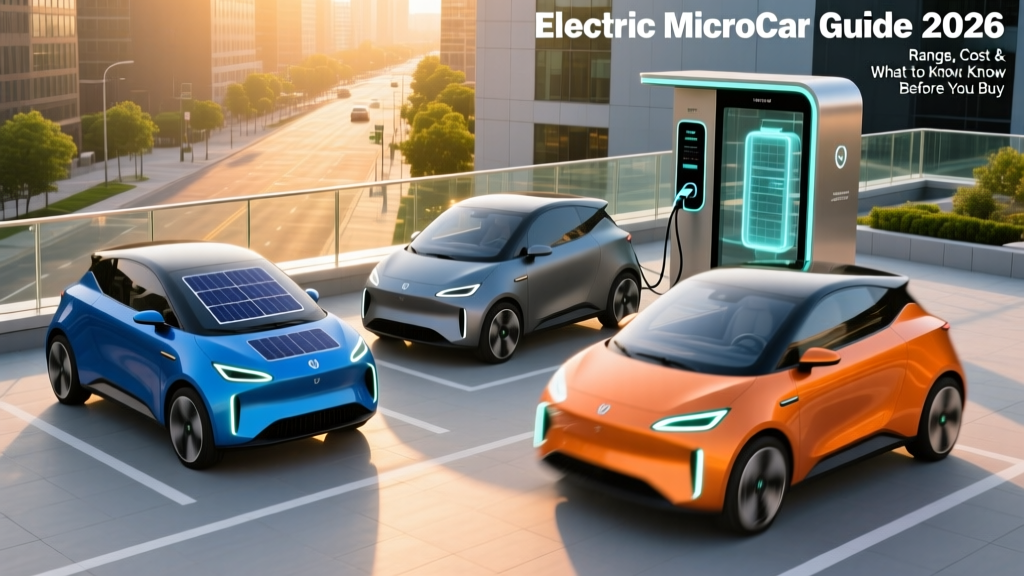
If you've been considering an electric microcar for city commuting, here's the practical truth: these compact EVs deliver 100–150 miles of real-world range, cost between $25,000 and $40,000 before incentives, and can slash your fuel costs by 60–70% compared to a gas subcompact — but only if your driving pattern fits. They excel as urban runabouts with home charging access, but fall short for highway-heavy commutes, cold-climate drivers, or anyone without reliable Level 2 charging. Below, we break down the exact specs, costs, and ownership realities so you can decide whether a microcar EV fits your life or whether a plug-in hybrid is the smarter move.
Quick Verdict: Is an Electric Microcar Right for You?
Yes, if: You drive under 80 miles/day, have home Level 2 charging, live in a mild climate, and want minimal running costs for city errands and commuting.
No, if: You regularly drive over 150 miles in a day, lack home charging, endure sub-freezing winters, or need highway capability for road trips. Consider a PHEV or longer-range EV instead.
What Exactly Is an Electric Microcar? (And What's Available in 2026)
An electric microcar is a purpose-built, compact battery-electric vehicle (BEV) designed for urban and suburban use. These vehicles typically feature battery packs in the 30–60 kWh range, produce 100–200 horsepower, and prioritize efficiency and maneuverability over performance or cargo space. Think of them as the EV equivalent of the Smart Fortwo or Fiat 500 — but with zero tailpipe emissions and dramatically lower operating costs.
As of the 2026 model year, the most prominent electric microcars available in the U.S. market include:
| Model | Battery (kWh) | EPA Range | Real-World Range* | Peak DC Charge (kW) | 10–80% Time | HP | 0–60 mph | Base MSRP |
|---|---|---|---|---|---|---|---|---|
| MINI Cooper SE (2026) | 54.2 (NMC) | 168 mi | ~135–150 mi | 95 kW | ~30 min | 215 | 6.7 sec | $33,900 |
| Fiat 500e (2026) | 42.0 (NMC) | 149 mi | ~120–135 mi | 85 kW | ~35 min | 117 | 8.5 sec | $32,500 |
| Chevrolet Bolt EV (2026) | 65.0 (NMC) | 259 mi | ~220–240 mi | 115 kW | ~28 min | 200 | 6.5 sec | $28,900 |
| Nissan LEAF S (2026) | 40.0 (NMC) | 149 mi | ~120–135 mi | 50 kW (CHAdeMO) | ~45 min | 147 | 7.9 sec | $29,500 |
*Real-world range reflects mixed highway/city driving at 70 mph. Subtract 15–30% in sustained sub-32°F cold weather.
Note that the Chevrolet Bolt EV, while slightly larger than a traditional microcar, competes aggressively in this price segment and offers substantially more range. The EPA's fueleconomy.gov database remains the best source for verifying official range and MPGe figures across all trims.
Electric Microcar vs. Gas Subcompact: The Real Cost Breakdown
The headline advantage of an electric microcar is operating cost. But let's put actual numbers behind that claim, comparing a 2026 MINI Cooper SE against a comparable gas-powered MINI Cooper Hardtop over five years and 75,000 miles of driving.
| Cost Category | 2026 MINI Cooper SE (EV) | 2026 MINI Cooper Hardtop (Gas) | Difference |
|---|---|---|---|
| Purchase Price (base MSRP) | $33,900 | $31,500 | EV +$2,400 |
| Est. Federal Tax Credit (§30D) | –$3,750* | $0 | EV saves $3,750 |
| Fuel / Electricity (75k mi) | $2,625** | $7,500*** | EV saves $4,875 |
| Maintenance (5 yr) | $1,200 | $3,800 | EV saves $2,600 |
| Insurance (5 yr avg) | $9,500 | $8,200 | EV +$1,300 |
| Total 5-Year Cost | $43,475 | $51,000 | EV saves ~$7,525 |
*Tax credit amount depends on battery sourcing, buyer income caps, and MSRP caps under IRS §30D rules. The MINI Cooper SE may qualify for a partial credit — verify with a tax professional.
**Assumes $0.14/kWh national average, 3.5 mi/kWh efficiency, home charging. Public DC fast charging costs 2–3× more.
***Assumes $3.50/gal gas, 30 MPG combined.
The EV wins on total cost, but the savings are front-loaded into fuel and maintenance. If you lack home charging and rely exclusively on public DC fast chargers (at $0.35–$0.50/kWh), your fuel savings shrink to roughly $1,500–$2,000 over five years — dramatically changing the math.
Charging Realities: What Microcar Owners Actually Face
The smaller batteries in electric microcars (30–65 kWh) mean shorter charging sessions but also shorter range buffers. Here's what the charging landscape looks like in practice:
| Charging Level | Power (kW) | Miles Added per Hour | 0–100% Time | Best For |
|---|---|---|---|---|
| Level 1 (120V outlet) | 1.2–1.4 kW | 3–5 mi/hr | ~40+ hours | Emergency/trickle only |
| Level 2 (240V, 32A) | 7.7 kW | 22–28 mi/hr | ~7 hours | Daily home charging |
| Level 2 (240V, 48A) | 11.5 kW | 35–40 mi/hr | ~5 hours | Faster home / workplace |
| DC Fast (peak) | 85–115 kW | 180–250 mi/hr (peak) | 10–80% in 28–35 min | Road trips / en-route |
Key insight on charge curves: Microcar EVs with smaller batteries hit their peak DC charge rate briefly — usually between 10–40% State of Charge (SoC) — then taper significantly. A 95 kW peak rate might sustain for only 8–10 minutes before dropping to 50–60 kW. This means the advertised "10–80% in 30 minutes" is real, but the last 20% (80–100%) can take nearly as long as the first 70%. For daily driving, charging to 80% at home overnight is the practical norm.
Home charging access is non-negotiable for most buyers. A Level 2 home charger installation runs $500–$2,500 depending on panel capacity and wiring distance. If your home has a 200-amp panel with spare capacity, expect $800–$1,200 for a quality 32-amp unit plus electrician labor. If you need a panel upgrade (common in older homes), add $1,500–$3,000. Without home charging, the cost and convenience advantages of a microcar EV erode fast.
Federal Tax Credits and Incentives: What You Actually Qualify For
The IRS §30D Clean Vehicle Credit can reduce your effective purchase price by up to $7,500 — but eligibility for electric microcars in 2026 is anything but guaranteed. Here's the current framework:
§30D Tax Credit Requirements (2026 Model Year)
- MSRP cap: Vehicle must be under $55,000 (cars) — most microcars qualify
- Buyer income cap: AGI under $150,000 (single) / $300,000 (joint)
- Battery sourcing: Critical minerals and battery components must meet escalating domestic/free-trade-agreement percentages — this is where many models lose partial or full credit
- Point-of-sale transfer: You can apply the credit at purchase (dealer reduces price) rather than waiting for tax filing
- Final assembly: Must occur in North America
In practice, the 2026 Chevrolet Bolt EV (assembled in Michigan) has historically qualified for the full $7,500, making its effective starting price around $21,400 — the cheapest new EV in America. The MINI Cooper SE (assembled in the UK) may qualify for only a partial credit or none at all depending on battery component sourcing. Always verify current eligibility on the IRS website or with a tax professional before relying on credit estimates in your budget.
Common Misconceptions About Electric Microcars
| Myth | Fact |
|---|---|
| "The battery will need replacing in 5 years and cost $15,000." | All 2026 microcars carry 8-year/100,000-mile battery warranties (federally mandated). Real-world data shows 10–15% degradation over 8 years for NMC packs. Full replacement is rare and typically covered. |
| "150 miles of range isn't enough for anyone." | The average American drives 37 miles/day (FHWA data). A 135-mile real-world range covers 90%+ of daily trips. The issue is road trips and buffer anxiety, not daily commuting. |
| "Electric microcars are slow and unsafe." | The 2026 MINI Cooper SE does 0–60 in 6.7 seconds — faster than most gas compacts. IIHS and NHTSA crash-test ratings for modern microcars are competitive with larger vehicles, though check individual model scores. |
| "Charging takes too long." | Home Level 2 charging adds 25+ miles per hour — plug in overnight and wake up full. DC fast charging adds 100+ miles in 20–25 minutes. The constraint is availability, not speed. |
| "I'll save money no matter how I charge." | Public DC fast charging at $0.40+/kWh can cost as much per mile as a 35-MPG gas car. Savings depend on home charging at residential electricity rates. |
Real-World Ownership: Cold Weather, Highway Range, and Daily Life
EPA range stickers tell an optimistic story. Here's what electric microcar owners actually experience across different conditions:
Highway driving at 70+ mph: Expect 80–85% of EPA range. A 168-mile EPA rating drops to roughly 135–145 miles on an all-highway trip. Aerodynamic drag hits smaller, boxier microcars harder at speed.
Cold weather (below 32°F): Battery chemistry slows, cabin heating draws energy, and range drops 15–30%. A 149-mile EPA microcar in a Minnesota January might deliver only 100–115 real miles. Models with heat pumps (like the 2026 Bolt EV) lose less — around 15% — compared to resistive-heat systems that can lose 25–30%.
Regenerative braking in practice: City driving with frequent stops actually extends range beyond EPA estimates thanks to regen recovery. Some microcar owners report exceeding EPA range by 5–10% in pure stop-and-go traffic in mild weather.
Cargo and practicality: Most electric microcars offer 7–12 cubic feet of cargo space behind the rear seats (if they have them). The Fiat 500e has just 7.1 cu ft — enough for groceries, not furniture. If cargo flexibility matters, the Bolt EV's 16.3 cu ft is a significant practical advantage.
Decision Framework: Should You Buy an Electric Microcar?
Use This Framework to Decide
Step 1: Check your daily mileage.
- Under 60 miles/day round-trip → Microcar range is sufficient ✓
- 60–120 miles/day → Possible, but you'll need reliable daily charging and a range buffer. Consider a 250+ mile EV instead.
- Over 120 miles/day → Microcar is not practical. Look at longer-range EVs or PHEVs.
Step 2: Confirm home charging access.
- Garage/driveway with 240V outlet or panel capacity for Level 2 → Proceed ✓
- Street parking or apartment without EV charging → High risk. Public charging costs and inconvenience may negate savings. Consider a hybrid.
Step 3: Assess your climate.
- Mild winters (rarely below 32°F) → Minimal range loss, microcar works well ✓
- Moderate winters (frequent 20–32°F) → Budget 15–20% range loss. A 168-mile EV becomes ~135 miles. Still workable for short commutes.
- Harsh winters (frequent sub-zero°F) → 25–30% range loss. A 149-mile microcar drops to ~105 miles. Strongly consider a PHEV or a larger-battery EV with a heat pump.
Step 4: Evaluate road trip needs.
- Road trips 1–2 times/year, under 200 miles, with known chargers along route → Manageable with planning ✓
- Frequent 300+ mile road trips → Microcar will require 2–3 DC fast stops per trip, adding 60–90 minutes each way. A longer-range EV or PHEV is more practical.
Step 5: Run the cost math for YOUR situation.
- If you have home charging and drive under 80 mi/day → Microcar saves $5,000–$8,000 over 5 years vs. gas
- If you rely on public charging → Savings shrink to $1,000–$2,000. A fuel-efficient hybrid (50+ MPG) may break even at lower upfront cost.
Frequently Asked Questions
Are electric microcars safe in a crash?
Modern electric microcars undergo the same NHTSA and IIHS crash testing as larger vehicles. Their low center of gravity (battery pack under the floor) helps stability. However, physics favors mass in multi-vehicle collisions — check specific model ratings at iihs.org and nhtsa.gov before buying.
How long will an electric microcar battery last?
NMC battery packs in current microcars are warranted for 8 years or 100,000 miles against dropping below 70% capacity. Real-world data from earlier-generation EVs suggests 10–15% degradation over 8 years is typical. With proper care (avoiding frequent 100% charges and DC fast charging in extreme heat), packs often last 150,000–200,000 miles before reaching 80% State of Health.
Can I road-trip in an electric microcar?
You can, but it requires planning. With 130–150 real-world miles of range, you'll stop every 90–110 miles for a 25–35 minute DC fast charge. Apps like PlugShare and A Better Routeplanner are essential. For frequent road trippers, a 250+ mile EV or a PHEV is more practical.
What's better: an electric microcar or a plug-in hybrid?
If you have home charging and a short commute, the microcar wins on operating cost and simplicity. If you lack charging access, drive long distances regularly, or live in extreme cold, a PHEV like the Toyota Prius Prime (44 miles electric + 520+ miles gas range) offers flexibility with no range anxiety. The PHEV costs more to fuel on gas days but never strands you.
Do electric microcars qualify for the $7,500 tax credit?
It depends on the specific model. Under current IRS §30D rules, eligibility requires North American final assembly, battery sourcing compliance, buyer income under caps, and MSRP under $55,000. The Chevy Bolt EV has historically qualified for the full credit; imported models like the MINI Cooper SE may receive partial or no credit. Always check the IRS Clean Vehicle Credit list before purchasing.
How much does it cost to install a home charger?
A Level 2 home charger (32-amp, 240V) costs $300–$700 for the unit and $500–$1,500 for electrician installation if your panel has spare capacity. Total: $800–$2,200 in most homes. If you need an electrical panel upgrade (200A service), add $1,500–$3,000. Many utilities offer rebates of $200–$500 for charger installation.