The Short Answer
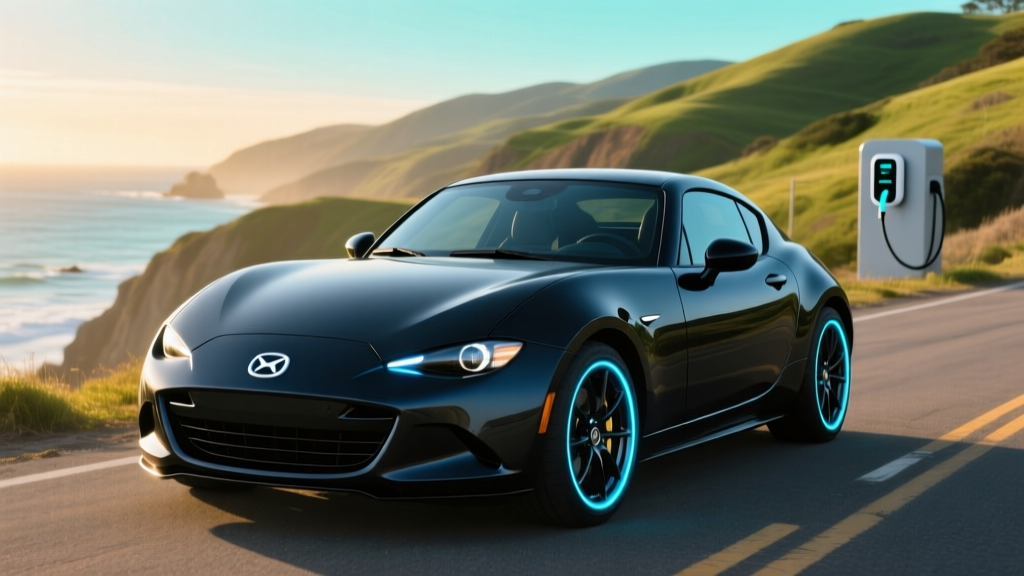
As of 2026, Mazda does not sell a factory electric Miata (MX-5). The MX-5 remains a gasoline-powered roadster with no announced BEV variant. However, several EV sports cars and convertibles deliver a similar lightweight, fun-to-drive experience — including the Fiat 500e Cabrio (announced), MG Cyberster, and the Porsche Boxster EV (expected late 2026). For buyers willing to consider an aftermarket EV conversion, shops like EV West and Stealth EV offer Miata conversions starting around $25,000–$40,000 on top of a donor car.
Why There's No Factory Electric Miata Yet
The Mazda MX-5 Miata has been the world's best-selling two-seat sports car for decades, built on a philosophy Mazda calls "gram strategy" — obsessive weight reduction. The current ND-generation gas Miata weighs roughly 2,300 lbs, which is central to its handling character. Battery packs add significant mass: even a modest 50 kWh usable battery (LFP chemistry) weighs around 750–850 lbs, which would push an electric Miata well past 3,000 lbs and fundamentally alter the car's dynamics.
Mazda has been cautious on full electrification compared to rivals. The brand's EV lineup in 2026 includes the MX-30 (limited availability, ~100-mile range) and the newer three-row CX-70 PHEV. Mazda's CEO has stated the company is exploring sports car electrification but has confirmed no production electric MX-5. Enthusiasts hoping for an electric Miata from the factory will need to wait — likely until the next generation, if Mazda decides the weight trade-off is acceptable.
Best Electric Alternatives to the Miata in 2026
If you want an open-top or sporty EV that captures some of the Miata spirit, here are the closest options available or announced for the U.S. market:
| Vehicle | Type | EPA Range | 0–60 mph | HP | Base MSRP | Status |
|---|---|---|---|---|---|---|
| Mazda MX-5 Miata (gas) | ICE Roadster | N/A (~26 MPG comb.) | 5.8 sec | 181 | $29,990 | Available |
| MG Cyberster | BEV Roadster | ~270 mi (est.) | 4.9 sec | 335 | ~$55,000 (est.) | Available (limited markets) |
| Porsche Boxster EV | BEV Roadster | ~280 mi (est.) | ~4.0 sec (est.) | ~400 (est.) | ~$80,000 (est.) | Announced / Expected late 2026 |
| Fiat 500e Cabrio | BEV Convertible | ~180 mi (est.) | ~7.0 sec (est.) | ~118 | ~$38,000 (est.) | Announced |
| Tesla Roadster (2nd gen) | BEV Sports Car | ~620 mi (claimed) | ~1.9 sec (claimed) | 1,000+ | $200,000+ | Announced (delayed repeatedly) |
Reality check: None of these match the Miata's sub-$30K price or sub-2,400-lb curb weight. The MG Cyberster is the closest in spirit — a two-seat electric roadster with scissor doors — but it weighs over 4,000 lbs and costs nearly double the Miata. The Porsche Boxster EV will be dynamically excellent but sits in a completely different price bracket.
Aftermarket EV Miata Conversions: What It Costs
For enthusiasts committed to the Miata chassis, aftermarket EV conversions are a real option. Companies like EV West, Stealth EV, and smaller specialist shops convert NA, NB, and NC-generation Miatas to electric powertrains.
| Cost Component | Budget Build | Premium Build |
|---|---|---|
| Donor Miata (used NA/NB) | $4,000–$8,000 | $8,000–$15,000 |
| EV conversion kit (motor, controller, BMS) | $8,000–$12,000 | $15,000–$22,000 |
| Battery pack (20–40 kWh) | $6,000–$10,000 | $12,000–$18,000 |
| Labor (professional install) | $5,000–$8,000 | $10,000–$20,000 |
| Charging hardware & misc. | $1,500–$2,500 | $3,000–$5,000 |
| Total | $24,500–$40,500 | $48,000–$80,000 |
What you get: A typical budget conversion uses a 20–30 kWh pack (often salvaged Nissan Leaf or Tesla modules) yielding 70–120 miles of real-world range, with Level 2 charging at 3.3–6.6 kW. DC fast charging is rarely included in budget builds. A premium build might use a 40+ kWh pack with 150+ miles of range and CCS fast-charging capability.
Important caveats: Converted EVs do not qualify for the federal §30D tax credit (the credit applies only to new vehicles meeting IRS battery-sourcing requirements). Registration requirements for converted vehicles vary by state — some states require special inspections, and a few make titling a converted EV difficult. Check your state DMV before committing.
Electric Miata vs. Gas Miata: Real Cost of Ownership
Let's compare what it actually costs to own and drive a gas MX-5 Miata versus a typical EV Miata conversion over 5 years, assuming 10,000 miles per year.
| Cost Factor | Gas Miata (2026 ND) | EV Miata Conversion (30 kWh) |
|---|---|---|
| Purchase price (total) | $33,000 (Sport + dest.) | $35,000 (mid-range build) |
| Fuel / electricity (5 yrs, 50K mi) | $5,750 (26 MPG, $3.00/gal) | $2,250 ($0.135/kWh, 3.5 mi/kWh) |
| Maintenance (5 yrs) | $2,500 (oil, brakes, tires) | $800 (tires, cabin filter, brake fluid) |
| Insurance (5 yrs avg.) | $6,500 | $7,500 (specialty EV conversion) |
| Estimated depreciation | -$8,000 | -$12,000 (niche market) |
| 5-Year Total Cost | $39,750 | $33,050 |
The EV conversion saves on fuel and maintenance, but higher insurance premiums and steeper depreciation (conversions are hard to resell) offset much of the advantage. The gas Miata also retains strong resale value — EPA data at fueleconomy.gov confirms the ND Miata's combined 26–30 MPG depending on transmission, keeping fuel costs reasonable for a sports car.
Common Misconceptions About an Electric Miata
| Myth | Fact |
|---|---|
| "Mazda is releasing an electric Miata in 2026." | No production electric MX-5 has been announced. Mazda's EV roadmap focuses on crossovers and SUVs through 2027. |
| "An EV conversion makes the Miata faster." | Instant torque improves 0–30 mph punch, but added battery weight (300–600 lbs) hurts cornering, braking, and overall balance — the Miata's core strengths. |
| "I'll get 200+ miles of range from a conversion." | Most conversions use 20–35 kWh packs due to space/weight limits. Expect 70–150 real-world miles, less in cold weather or at highway speeds. |
| "EV conversions qualify for the $7,500 tax credit." | The IRS §30D credit applies only to new qualifying vehicles with specific battery sourcing. Conversions do not qualify. |
| "An electric Miata is a practical daily driver." | Limited range, minimal cargo space, no DC fast charging (in most builds), and a convertible top make it a fair-weather weekend car for most owners. |
First-Time EV Buyer? What to Know Before Chasing an Electric Miata
If you're drawn to the idea of an electric Miata but new to EVs, consider these practical realities:
- Home charging is essential. With a conversion's typical 3.3–6.6 kW Level 2 onboard charger, a full charge takes 5–10 hours. Public DC fast charging is uncommon on conversions, meaning you're almost entirely dependent on home or workplace Level 2 charging.
- Range shrinks in cold weather. LFP and NMC packs alike lose 20–30% range below freezing. A conversion with 100 miles of summer range may deliver only 70–80 miles in January.
- Insurance can be tricky. Specialty insurers (Hagerty, Grundy) may cover conversions, but mainstream carriers sometimes decline or charge premiums 20–40% above the gas equivalent.
- Resale is a niche market. Unlike factory EVs with established depreciation curves, a converted Miata sells to a small enthusiast audience. Expect longer listing times and lower offers.
- Safety systems are absent. NA/NB Miata chassis predate modern ADAS. No automatic emergency braking, lane-keeping, or blind-spot monitoring. The NHTSA has limited crash-test data on older Miata generations.
Decision Framework: Should You Pursue an Electric Miata?
Choose an EV Miata Conversion If:
- You already own or can source an affordable donor Miata (NA/NB under $8K)
- You have reliable home Level 2 charging and a short daily commute (under 50 miles round trip)
- You're an enthusiast who values the project experience over practicality
- You accept the range, insurance, and resale limitations
Choose a Gas Miata If:
- You want a warranty-backed, reliable sports car you can drive anywhere today
- You take road trips longer than 150 miles regularly
- You want strong resale value and easy insurance
- Budget is under $35,000 total
Choose an EV Sports Car Alternative If:
- You want factory warranty, modern safety, and DC fast charging
- You can stretch your budget to $55,000+ (MG Cyberster) or $80,000+ (Porsche Boxster EV)
- You prioritize instant torque and low running costs over lightweight handling purity
Frequently Asked Questions
Will Mazda ever make an electric Miata?
Mazda has not announced a production electric MX-5. The company has hinted at electrified sports cars in its long-term vision, but the earliest realistic timeline for a next-generation MX-5 with any form of electrification is 2028–2030. Even then, Mazda may opt for a mild-hybrid or PHEV approach to preserve weight targets rather than a full BEV.
How much does an EV Miata conversion cost?
Expect $25,000–$40,000 for a basic conversion (donor car + parts + labor) and $48,000–$80,000 for a premium build with larger battery, DC fast charging, and professional finish. The conversion alone (excluding the donor car) typically runs $18,000–$35,000.
What range does an electric Miata conversion get?
Most conversions use 20–35 kWh battery packs due to the Miata's limited space and weight tolerance. Real-world range is typically 70–150 miles depending on pack size, driving style, and weather. Highway driving at 70+ mph and cold weather both reduce range significantly.
Can I daily-drive an electric Miata?
It's possible if your round-trip commute is under 60 miles and you have home charging. However, the lack of DC fast charging on most conversions, limited cargo space, and minimal weather protection make it better suited as a weekend or fair-weather car.
Is the MG Cyberster a good electric Miata alternative?
The MG Cyberster is the closest production EV to the Miata concept — a two-seat electric roadster. However, it weighs over 4,000 lbs (nearly double the Miata), costs roughly $55,000, and is currently available only in limited markets. U.S. availability remains uncertain as of 2026. It's a grand tourer, not a lightweight roadster.
Do EV conversions qualify for federal tax credits?
No. The IRS §30D clean vehicle credit applies only to new qualifying vehicles that meet battery component and critical mineral sourcing requirements. An aftermarket conversion on a used Miata chassis does not qualify. Some states may offer separate incentives for EV conversions — check your state energy office for details.