The Short Answer on Electric Miata Conversions
An electric Miata conversion replaces the NA/NB/NC gas engine with an EV powertrain — typically a salvaged Tesla or Nissan Leaf motor paired with aftermarket battery modules. Expect to spend $15,000–$30,000+ on parts alone (or $25,000–$50,000+ for a professional turn-key build), achieving 60–150 miles of real-world range depending on battery capacity (15–40 kWh typical). The result is a lightweight, instant-torque roadster that's thrilling around town but limited on road trips. It's a passion project, not a cost-saving commuter hack.
The Mazda MX-5 Miata has always been about driving purity — low weight, perfect balance, and an open top. Converting one to electric power preserves that chassis magic while swapping tailpipe emissions for silent, torque-heavy acceleration. But unlike buying a factory EV with an EPA sticker and a warranty, an electric Miata conversion is a custom fabrication project with real trade-offs in range, charging speed, insurance, and daily usability.
Below, we break down exactly what a conversion involves, what it costs, what kind of range and charging you'll actually get, and whether it makes more sense than simply buying a production EV like the Fiat 500e or a used Tesla Model 3.
What an Electric Miata Conversion Actually Involves
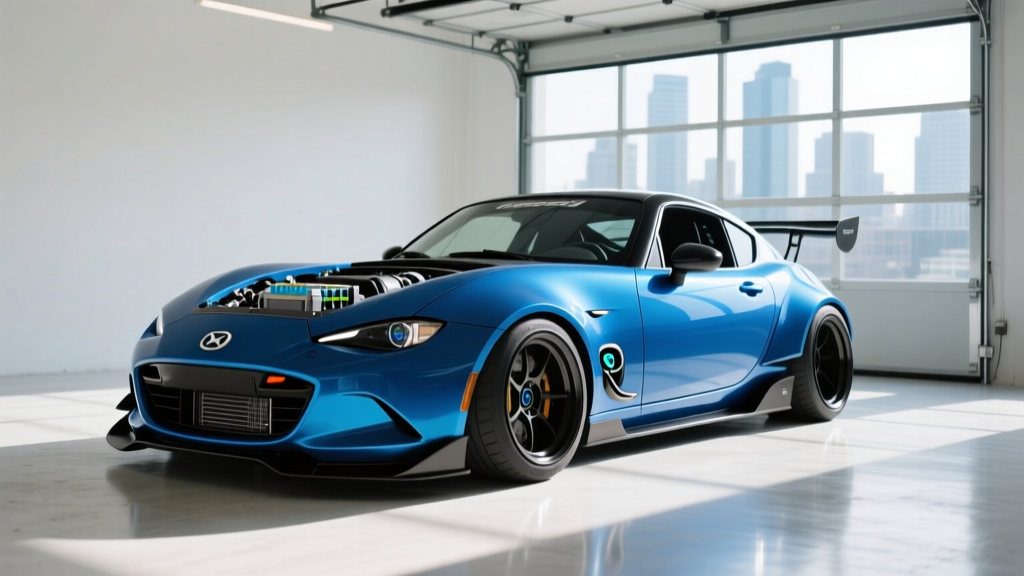
A typical electric Miata conversion removes the internal combustion engine, transmission, exhaust system, and fuel tank. In their place, builders install:
- Electric motor: Most common choices are a salvaged Nissan Leaf motor (80–110 kW / 107–147 HP), a Tesla Model S/3 rear drive unit (200+ kW / 268+ HP), or aftermarket units like the NetGain Hyper9 or HPEVS AC-50 for simpler builds.
- Battery pack: Lithium-ion modules sourced from salvaged Leaf packs (30–40 kWh), Chevy Volt modules wired in series/parallel, or new aftermarket cells. Physical space in a Miata is extremely limited — the tunnel, trunk, and former engine bay are the primary locations, and weight distribution is a constant engineering challenge.
- Motor controller / inverter: Manages power delivery from the battery to the motor. Open-source options like the OpenInverter platform or commercial controllers like the Curtis 1238 are common.
- BMS (Battery Management System): Monitors cell voltage, temperature, and state of charge. Essential for safety and battery longevity. Orion BMS or SimpliBMS are popular picks.
- Charging hardware: Most conversions use a J1772 inlet for Level 1/Level 2 AC charging. DC fast charging is rare in conversions due to added complexity, weight, and cost — expect to rely on AC charging exclusively.
- Adapter plate and coupler: Custom-machined to mate the electric motor to the Miata's existing manual transmission (yes, you can keep the stick shift — and many converters do, for the driving experience).
The Miata's compact size is both its charm and its biggest constraint. The NA/NB chassis (1989–2005) weighs roughly 2,100–2,400 lbs stock, but adding batteries pushes curb weight to 2,600–3,000 lbs. That's still lighter than most production EVs (a Tesla Model 3 weighs ~3,900 lbs), but it's 400–600 lbs heavier than stock, which affects the car's legendary handling balance.
Real Costs: Parts, Labor, and the Full Build Budget
Here's where the reality check begins. An electric Miata conversion is not a budget EV alternative. It's a custom engineering project, and costs add up fast.
| Component | DIY Build (Used Parts) | Professional / Turn-Key Build |
|---|---|---|
| Donor Miata (NA/NB, running) | $3,000–$7,000 | $5,000–$10,000 |
| Electric motor + controller | $2,000–$5,000 | $5,000–$12,000 |
| Battery pack (15–40 kWh) | $3,000–$8,000 | $8,000–$18,000 |
| BMS + wiring + safety gear | $800–$2,000 | $2,000–$4,000 |
| Charging hardware (J1772 + onboard charger) | $500–$1,500 | $1,500–$3,000 |
| Adapter plate, coupler, fabrication | $1,000–$3,000 | $3,000–$7,000 |
| Cooling, HVAC, power steering | $500–$2,000 | $2,000–$5,000 |
| Labor (if professional) | N/A (your time) | $8,000–$20,000 |
| Total Estimated Cost | $10,800–$28,500 | $26,500–$79,000 |
For context, a well-equipped used Tesla Model 3 Standard Range (2023–2024) sells for $22,000–$28,000 in 2026 and comes with 272 miles of EPA range, DC fast charging, a full warranty, and Autopilot. The conversion only makes financial sense if you value the Miata experience itself — the analog driving feel, the project satisfaction, and the uniqueness of an electric roadster that no one else has.
Range and Charging: What You'll Actually Get
Range in an electric Miata conversion depends almost entirely on battery capacity and driving style. The Miata's aerodynamics are poor (it's a convertible with an upright windshield), and highway driving at 70+ mph will drain the pack faster than city use with regenerative braking.
| Metric | Electric Miata (25 kWh pack) | Gas Miata NA 1.8L (stock) | Tesla Model 3 RWD (2025) |
|---|---|---|---|
| Energy capacity | 25 kWh usable | 11.9 gal gasoline | 57.5 kWh usable |
| Range (real-world mixed) | 70–100 miles | 300–340 miles | 250–272 miles |
| Range (highway, 70 mph) | 55–80 miles | 280–310 miles | 220–250 miles |
| Range (cold weather, 30°F) | 50–70 miles | 260–300 miles | 190–230 miles |
| Energy efficiency | ~250–300 Wh/mile | ~25–28 MPG | ~230–260 Wh/mile |
| 0–60 mph | 6–9 seconds (motor dependent) | 7.9 seconds (stock NA8) | 5.8 seconds |
| Refuel / recharge time | 4–8 hours (Level 2) | 3 minutes (gas station) | 25–35 min (DCFC 10–80%) |
Charging setup: Virtually all electric Miata conversions charge via AC only — typically through a J1772 inlet connected to an onboard charger rated at 3.3 kW or 6.6 kW. That means:
- Level 1 (120V, 1.4 kW): Adds ~4–5 miles of range per hour. A full charge from empty takes 15–18 hours.
- Level 2 (240V, 3.3–6.6 kW): Adds ~12–22 miles per hour. A full charge takes 4–8 hours depending on pack size and charger rating.
- DC Fast Charging: Extremely rare in conversions. Adding CCS or NACS DC fast-charge capability requires a compatible high-voltage architecture, a DC-charge controller, and liquid-cooled cabling — adding $3,000–$6,000+ in parts and significant engineering complexity. Most builders skip it entirely.
Electric Miata vs. Buying a Production EV: Honest Comparison
This is the decision most prospective converters wrestle with. Here's a data-driven look at how the conversion stacks up against buying a factory EV.
| Factor | Electric Miata Conversion (DIY) | Used Tesla Model 3 (2023–24) | New Mini Cooper SE (2025) |
|---|---|---|---|
| Total cost | $15,000–$35,000+ | $22,000–$28,000 | $30,900 MSRP |
| Range (real-world) | 60–120 miles | 240–270 miles | 110–130 miles |
| DC fast charging | No (typically) | Yes (170 kW peak) | Yes (95 kW peak) |
| Warranty | None (custom build) | Remaining factory / extended | 4 yr / 50,000 mi basic |
| Battery warranty | None | 8 yr / 100,000 mi (if remaining) | 8 yr / 100,000 mi |
| Insurance | Specialty / kit-car policy | Standard EV policy | Standard EV policy |
| Federal EV tax credit (§30D) | Not eligible | Not eligible (used credit up to $4,000 may apply) | Potentially up to $7,500 (verify IRS §30D sourcing rules) |
| Driving experience | Unique, analog, open-top | Refined, quiet, tech-heavy | Fun, compact, go-kart feel |
| Daily usability | Limited range, no road trips | Full daily driver + road trips | City driver, short road trips |
The electric Miata conversion wins on experience — there's nothing else like a silent, torquey, stick-shift roadster with the wind in your hair. It loses on nearly every practical metric: range, charging speed, warranty, insurance ease, and total cost relative to capability.
Real-World Ownership Considerations
Before committing to a conversion, these practical factors will determine whether the project is a joy or a burden:
Home Charging Access Is Mandatory
Without DC fast charging, you'll depend entirely on home AC charging. A dedicated 240V / 30-amp circuit (NEMA 14-30 or 14-50) is strongly recommended to get 6.6 kW Level 2 speeds. If you live in an apartment or lack off-street parking, an electric Miata conversion is not viable — there's no public charging infrastructure that supports 4–8 hour AC-only sessions conveniently. Budget $500–$1,500 for a Level 2 home charging setup (charger + electrician), or $1,500–$3,000+ if your electrical panel needs an upgrade to 200 amps.
Climate Matters More Than You Think
Lithium-ion batteries lose performance in cold weather and degrade faster in extreme heat. Most Miata conversions lack active thermal management (liquid cooling/heating), which means:
- Cold climates (below 32°F): Expect 15–25% range loss. Charging speeds also slow significantly when cells are cold.
- Hot climates (above 95°F): Sustained high-speed driving or fast charging without cooling accelerates battery degradation. Cell temperatures above 113°F (45°C) cause permanent capacity loss.
- Mild climates (50–80°F): Ideal for conversions. If you live in coastal California, the Pacific Northwest, or the Southeast, your battery will last longer and your range will be more consistent.
Insurance and Registration
Converted EVs often require specialty insurance through providers like Hagerty, Grundy, or American Collectors, which offer agreed-value policies for modified and kit cars. Expect premiums of $800–$1,800/year depending on your state, driving record, and agreed value. Registration requirements vary by state — some states require a special inspection for converted vehicles, and a few have additional EV registration fees ($50–$225/year) to offset lost gas tax revenue.
Maintenance and Repair
The upside: no oil changes, no timing belts, no exhaust repairs, no spark plugs. The downside: when something breaks on a custom conversion, there's no dealer service department. You are the warranty. Common maintenance items include:
- Battery cell balancing and BMS diagnostics (annual)
- Coolant system checks for motor/controller cooling loops
- Brake maintenance (less frequent thanks to regen, but still needed)
- High-voltage cable inspection and connector integrity
Common Misconceptions About Electric Miata Conversions
| Myth | Fact |
|---|---|
| "It'll save me money compared to buying a used EV." | A DIY conversion typically costs $15,000–$30,000 in parts alone for 60–120 miles of range. A used Tesla Model 3 or Chevy Bolt EUV costs $18,000–$28,000 with 230–259 miles of range, DC fast charging, and a warranty. The conversion is a passion project, not a budget move. |
| "I can use Tesla Superchargers." | No. Tesla Superchargers require NACS connectors with vehicle authentication and CAN-bus communication. Most conversions use J1772 for AC charging only and cannot access any DC fast-charging network. |
| "The battery will last forever." | Salvaged lithium-ion cells from a Nissan Leaf or Chevy Volt may already have 20–40% degradation. Expect 5–10 years of usable life depending on usage patterns, climate, and cell quality. Replacement battery modules cost $3,000–$8,000+. |
| "It's a weekend project." | Even experienced builders report 200–500+ hours for a complete, roadworthy conversion. First-time converters should budget 6–18 months of part-time work. |
| "I'll qualify for the $7,500 federal EV tax credit." | The IRS §30D credit applies only to new qualifying vehicles from OEMs meeting battery sourcing and MSRP caps. Custom conversions are not eligible. The used-EV credit (up to $4,000) also requires a dealer sale of a qualifying pre-owned EV — conversions don't qualify. |
| "The weight won't matter." | Adding 400–800 lbs of batteries changes the Miata's suspension geometry, braking distances, and handling balance. Upgraded springs, dampers, and brake pads are often necessary to maintain safe, predictable handling. |
Decision Framework: Should You Convert or Buy?
Choose an Electric Miata Conversion If:
- You own or can source a Miata shell cheaply ($3,000–$5,000) and enjoy fabrication/wiring work
- Your daily driving is under 50 miles round-trip, mostly in mild weather
- You have home Level 2 charging (or can install it)
- You already own another vehicle for longer trips
- The project itself — the building, learning, and uniqueness — is a primary motivation
- You accept that there is no warranty, no dealer support, and limited resale market
Choose a Production EV Instead If:
- You need reliable daily transportation with 200+ miles of range
- You take road trips longer than 100 miles one-way
- You want DC fast charging for public charging networks
- You need a vehicle warranty and professional service options
- You want to qualify for federal or state EV tax credits
- You don't have 200–500+ hours to invest in a build
Consider a PHEV or Hybrid Roadster If:
- You want open-top driving with real range — a used Honda S2000 or a Mazda MX-5 with its stock engine gets 25–30 MPG and 300+ miles per tank
- You're not ready to commit to full EV but want lower emissions — a PHEV like the Toyota Prius Prime offers 44 miles of electric-only range plus a gas engine for longer trips (see EPA data)
Frequently Asked Questions
How much does a professional electric Miata conversion cost in 2026?
A turn-key professional conversion from a reputable EV conversion shop typically runs $35,000–$79,000 depending on battery capacity, motor choice, and finish quality. At the high end, shops like EV West or EV Tuning have built Miatas with Tesla drive units producing 250+ HP and 120–150 miles of range. At that price point, you're paying more than a new Tesla Model 3 Performance — the value is entirely in the Miata driving experience and custom craftsmanship.
Can I keep the manual transmission in an electric Miata?
Yes, and many builders do. The electric motor is coupled to the stock gearbox via a custom adapter plate and coupler. You can shift gears for fun (typically using 2nd or 3rd gear for most driving), though it's not mechanically necessary since electric motors produce torque from 0 RPM. Some builders opt for a single-speed reduction gear instead, which saves weight and simplifies the drivetrain.
What's the top speed of an electric Miata conversion?
Most conversions are electronically limited to 85–110 mph, which is appropriate for the Miata's chassis dynamics and the motor's power band. With a Tesla drive unit, some builders have achieved 120+ mph, but the Miata's light weight and short wheelbase make high-speed stability a real concern. For a car designed for back-road carving, 90–100 mph is more than adequate.
How long will the battery last in a converted Miata?
It depends on the source cells. New aftermarket lithium iron phosphate (LFP) modules can last 2,000–3,000+ charge cycles (potentially 10–15 years at moderate use). Salvaged Nissan Leaf NMC cells may have already experienced 20–30% degradation and could provide 5–8 years of usable service. Proper BMS configuration, avoiding deep discharges below 10% SoC, and keeping cells between 50–80°F will maximize lifespan.
Is an electric Miata conversion street-legal?
Yes, in most US states, but the process varies. You'll typically need to pass your state's rebuilt/converted vehicle inspection, which may include brake testing, lighting verification, and a VIN inspection. Some states (notably California) have specific procedures for EV conversions, while others are less defined. Check your state DMV's requirements before starting the build. Emissions testing is generally waived for EV conversions, which is a bonus.
Can I tow with an electric Miata conversion?
No. The Miata was never rated for towing in stock form, and adding batteries reduces the available payload capacity further. An electric Miata is a solo or two-person weekend car, not a utility vehicle.
What's the cheapest viable electric Miata conversion?
The lowest-cost approach uses a NetGain Hyper9 or HPEVS AC-50 motor (~$2,000–$3,000), salvaged Chevy Volt battery modules (~$2,000–$4,000 for 15–18 kWh), a basic Curtis controller, and DIY fabrication. Total parts cost: roughly $10,000–$15,000. Range will be limited to 50–70 miles, top speed around 80 mph, and you'll charge on Level 1 or Level 2 AC. It's a fair-weather, around-town car — but it's the most affordable entry point into an electric roadster.