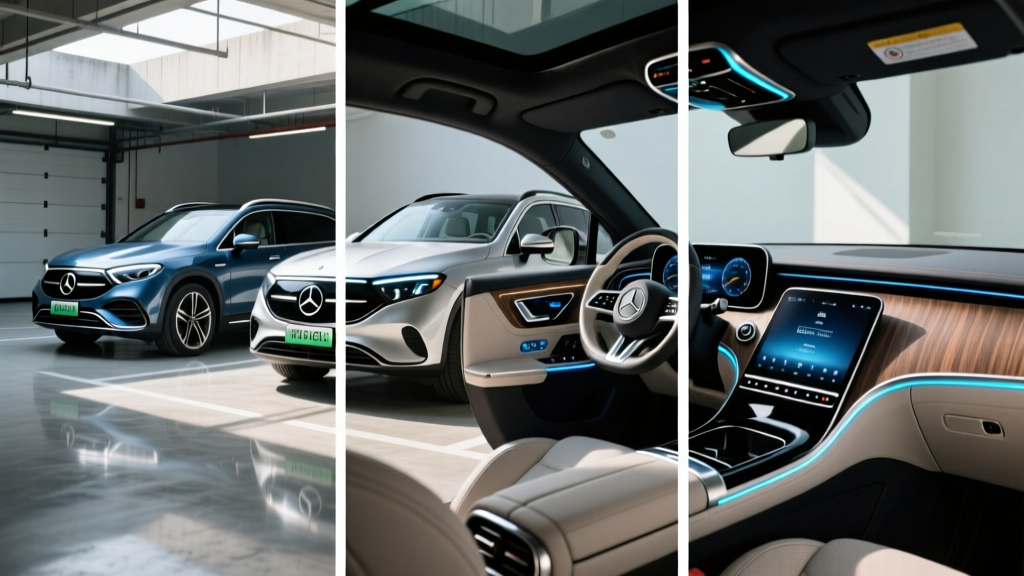
The Electric Mercedes SUV Lineup: What You Need to Know
Quick Answer: Mercedes-Benz offers three fully electric SUVs for 2026: the compact EQB (3-row, ~245 mi EPA, ~$55k), the midsize EQE SUV (~280 mi EPA, ~$78k), and the flagship EQS SUV (~330 mi EPA, ~$105k). None currently qualify for the full $7,500 federal §30D tax credit due to battery-sourcing and MSRP-cap rules. If you want a three-row electric Mercedes on a budget, the EQB is your entry point; if you need long-range highway cruising and luxury, the EQE SUV hits the sweet spot; if budget is secondary to tech and space, the EQS SUV leads.
Choosing an electric Mercedes SUV means weighing luxury, range, and charging infrastructure against a premium purchase price and evolving federal incentive rules. This guide breaks down every model with exact EPA data, real-world range expectations, charging curves, and a total-cost-of-ownership comparison so you can decide which model — if any — fits your driving life.
2026 Electric Mercedes SUV Lineup at a Glance
| Spec | EQB 300 4MATIC | EQE 350+ SUV | EQS 450+ SUV |
|---|---|---|---|
| Base MSRP | $54,950 | $77,900 | $105,550 |
| EPA Range | 245 mi | 280 mi | 330 mi |
| Battery (usable kWh) | 66.5 kWh (NMC) | 90.6 kWh (NMC) | 108.4 kWh (NMC) |
| Peak DC Fast Charge | 100 kW | 170 kW | 200 kW |
| 10–80% DC Charge Time | ~32 min | ~32 min | ~31 min |
| Level 2 (AC) Rate | 7.2 kW | 9.6 kW | 9.6 kW |
| 0–60 mph | 7.7 sec | 6.4 sec | 6.5 sec |
| Horsepower | 225 hp | 288 hp | 355 hp |
| Drivetrain | AWD (dual motor) | RWD (single motor) | RWD (single motor) |
| Seating | 5 or optional 7 | 5 | 5 (optional 3rd row) |
| Battery Warranty | 8 yr / 100,000 mi | 8 yr / 100,000 mi | 8 yr / 100,000 mi |
Sources: fueleconomy.gov, Mercedes-Benz USA spec sheets. Range figures are EPA estimates; real-world results vary.
Real-World Range: What the EPA Sticker Doesn't Tell You
EPA vs. Reality
- EQB 300 4MATIC: EPA 245 mi — expect ~200–220 mi at sustained 70 mph highway speeds; ~175–195 mi in sub-30°F winter conditions.
- EQE 350+ SUV: EPA 280 mi — expect ~240–260 mi highway; ~210–230 mi in cold weather.
- EQS 450+ SUV: EPA 330 mi — expect ~280–305 mi highway; ~245–270 mi in cold weather.
Mercedes uses NMC (nickel manganese cobalt) chemistry across all three models, which offers higher energy density than LFP but is more sensitive to extreme temperatures. In real-world highway testing, the EQS SUV's larger 108.4 kWh pack provides the most buffer against range loss — a critical advantage on long road trips where DC fast chargers may be spaced 80–120 miles apart.
The EQB's 66.5 kWh pack and 100 kW peak charge rate mean it charges slower in absolute terms but also needs less energy to refill. On a road trip, you'll stop more often in the EQB, but each stop is shorter proportionally. The EQE and EQS both taper their charge rate significantly above 80% SoC — a typical NMC charge-curve behavior. If you're planning a 500-mile trip, budget roughly two 25-minute charging stops in the EQS, and three in the EQB.
Charging at Home and on the Road
Home Level 2 charging is where Mercedes EV owners will do 85–95% of their charging. Here's what to expect:
| Charging Level | Power (kW) | Miles Added per Hour | Typical Use |
|---|---|---|---|
| Level 1 (120V outlet) | 1.2–1.4 kW | 3–5 mi/hr | Overnight top-up; emergency |
| Level 2 (240V, home wallbox) | 7.2–9.6 kW | 22–35 mi/hr | Daily home charging |
| DC Fast Charge (public) | 100–200 kW (peak) | 150–400 mi/hr (at peak) | Road trips, quick top-ups |
Home installation reality: A Level 2 wallbox (like the Mercedes-Benz Home Wallbox or a ChargePoint Home Flex) costs $500–$800 for the unit. Professional installation by a licensed electrician runs $800–$2,500 depending on panel proximity and local permit fees. If your home has a 200-amp panel with spare capacity, expect the lower end. A panel upgrade to 200A adds $1,500–$3,500. The EQE and EQS charge at 9.6 kW on Level 2, meaning a full charge from 10% takes roughly 9–10 hours — easily done overnight. The EQB at 7.2 kW needs about 8–9 hours for the same refill.
On the road, Mercedes partners with Electrify America and has access to the Tesla Supercharger network via the included NACS adapter (standard on 2026 models). The EQS SUV's 200 kW peak rate is competitive but trails the 250–350 kW peaks of rivals like the Hyundai Ioniq 9 or Lucid Gravity. That said, 200 kW still delivers roughly 180 miles of range in 20 minutes under ideal conditions.
Cost of Ownership: Electric Mercedes SUV vs. Gas Equivalent
Let's compare the EQE 350+ SUV against its closest gas-powered stablemate, the GLE 350 4MATIC (MSRP ~$62,000), over five years and 75,000 miles.
| Cost Category (5 yr / 75k mi) | EQE 350+ SUV (EV) | GLE 350 4MATIC (Gas) |
|---|---|---|
| Purchase Price (base MSRP) | $77,900 | $62,000 |
| Federal Tax Credit (§30D) | $0–$3,750* | $0 |
| Fuel / Electricity | $4,200 (home L2, $0.14/kWh avg) | $9,750 (22 MPG combined, $3.20/gal) |
| Maintenance | $1,800 (no oil changes, less brake wear) | $4,500 (oil, filters, brakes, fluids) |
| Insurance (avg) | $12,500 ($2,500/yr) | $9,500 ($1,900/yr) |
| Estimated Depreciation | $38,950 (~50%) | $27,900 (~45%) |
| Total 5-Year Cost | ~$130,450 | ~$113,650 |
*The EQE SUV may qualify for a partial $3,750 credit if critical-mineral or battery-component sourcing requirements are partially met. The full $7,500 is unlikely due to the $80,000 MSRP cap for SUVs under IRS §30D rules. Verify current eligibility at irs.gov.
The EV saves roughly $5,550 on fuel and $2,700 on maintenance over five years — about $8,250 total. However, the higher purchase price, steeper depreciation, and elevated insurance premiums erase those savings and then some. The electric Mercedes SUV makes financial sense primarily if: (a) you can secure a partial tax credit or state rebate, (b) your electricity rate is below $0.12/kWh, or (c) you value the driving refinement and tech enough to absorb the premium.
Federal Tax Credit: What Mercedes EV Buyers Must Know
§30D Federal Tax Credit Requirements (2026):
- MSRP Cap: SUVs must be priced at or below $80,000. Only the EQB and base EQE 350+ trims qualify; the EQS SUV exceeds the cap.
- Income Limits: Modified AGI ≤ $150,000 (single), ≤ $225,000 (head of household), ≤ $300,000 (joint).
- Battery Sourcing: Critical minerals and battery components must meet phased-in percentages from US/free-trade-partner sources. Mercedes sources from CATL (China) for some cells, which may disqualify the full credit.
- Point-of-Sale Transfer: Eligible buyers can transfer the credit to the dealer for an upfront price reduction — no need to wait until tax filing.
- Final Assembly: Vehicle must undergo final assembly in North America. All three Mercedes EV SUVs are assembled in Bremen, Germany or Kecskemét, Hungary — this disqualifies them from §30D entirely.
This is a critical point many buyers miss: because Mercedes assembles its electric SUVs in Europe, none of the EQB, EQE SUV, or EQS SUV qualify for the §30D new-vehicle credit as of current IRS rules. Some buyers may be eligible for a used-EV credit (up to $4,000 or 30% of sale price, whichever is lower) if purchasing a qualifying pre-owned model from a dealer. Check the latest VIN eligibility at fueleconomy.gov.
Common Misconceptions About Electric Mercedes SUVs
| Myth | Fact |
|---|---|
| "The EQS SUV can drive itself on the highway." | Mercedes Drive Pilot is SAE Level 3 but only approved in Nevada and California at speeds ≤40 mph in specific conditions. The standard driver-assist suite is Level 2 — you must remain engaged at all times. |
| "I'll save $7,500 on any electric Mercedes SUV." | European assembly disqualifies all three models from the §30D new-vehicle credit. A used-EV credit of up to $4,000 may apply on pre-owned purchases. |
| "The battery will need replacing in 5 years." | Mercedes warranties the high-voltage battery for 8 years/100,000 miles against dropping below 70% capacity. Industry data from Recurrent shows NMC packs typically retain 85–90% capacity at 100,000 miles under normal use. |
| "DC fast charging ruins the battery." | Occasional DC fast charging has minimal impact on long-term health. Mercedes' thermal management system actively cools the pack during fast charging. The real degradation accelerant is regularly sitting at 100% SoC for extended periods — set your daily charge limit to 80%. |
| "The EQB has the same range as the EQS." | The EQB's 245-mile EPA range is 85 miles less than the EQS SUV's 330 miles. The gap widens further in cold weather and highway driving. |
Decision Framework: Which Electric Mercedes SUV Is Right for You?
Choose the EQB 300 4MATIC if:
- You need an optional third row for occasional kid-hauling
- Your daily commute is under 80 miles round-trip
- You want the most affordable entry into a Mercedes electric SUV
- You have reliable home Level 2 charging and rarely road-trip beyond 200 miles
Choose the EQE 350+ SUV if:
- You want the best balance of range, luxury, and price in the lineup
- You take regular 200–350 mile highway trips and value fewer charging stops
- You prefer a midsize footprint with a spacious, quiet cabin
- You prioritize ride comfort over sporty handling
Choose the EQS 450+ SUV if:
- Maximum range (330 mi EPA) and flagship tech are non-negotiable
- Budget is flexible above $100,000
- You want MBUX Hyperscreen, rear-seat entertainment, and the most advanced ADAS suite
- You frequently drive 300+ miles between charging stops
Choose a competitor (or wait) if:
- You need a federal tax credit — consider the BMW iX (assembled in the US? No — also Germany. Consider the Rivian R1S or Tesla Model X instead)
- You need 350+ miles of range — the Lucid Gravity (440 mi EPA) or Tesla Model X (348 mi EPA) offer more
- You tow more than 3,500 lbs — the Rivian R1S tows up to 7,700 lbs
What First-Time EV Buyers Should Know Before Purchase
If this is your first electric vehicle, the transition from gas to electric requires a few practical adjustments:
1. Confirm home charging access before buying. A dedicated 240V/40A or 50A circuit is ideal. If you live in a condo or apartment without garage access, research public charging options near your home — apps like PlugShare and A Better Routeplanner map charger availability. Relying solely on public DC fast charging is viable but costs 2–3× more per mile than home Level 2.
2. Set your charge limit to 80% for daily use. NMC batteries last longest when kept between 20–80% SoC. Use 100% only for road trips. The MBUX system lets you schedule charge limits and departure preconditioning.
3. Precondition the battery before DC fast charging. Mercedes' navigation system automatically warms or cools the pack when you route to a charger. This can cut your 10–80% charge time by 5–10 minutes in cold weather — a meaningful difference on winter road trips.
4. Budget for higher insurance. EV insurance premiums run 15–30% higher than equivalent gas vehicles due to repair costs and battery replacement values. Get quotes from GEICO, Progressive, and EV-friendly carriers like Lemonade or Root before signing a purchase agreement.
5. Understand the charging-curve taper. Peak charge rates (100–200 kW) only apply between roughly 10–50% SoC. Above 80%, charging slows dramatically to protect the battery — often dropping below 30 kW. Plan your road-trip stops around the 10–80% window for the fastest overall travel time.
Frequently Asked Questions
Does Mercedes make a fully electric SUV?
Yes. For 2026, Mercedes-Benz offers three battery-electric SUVs: the compact EQB, the midsize EQE SUV, and the flagship EQS SUV. All are fully electric (BEV) with no gas engine.
Which electric Mercedes SUV has the longest range?
The EQS 450+ SUV leads with an EPA-estimated 330 miles of range, thanks to its 108.4 kWh battery. Real-world highway range is approximately 280–305 miles.
Do Mercedes electric SUVs qualify for the federal tax credit?
No. The §30D new clean vehicle credit requires final assembly in North America. The EQB, EQE SUV, and EQS SUV are assembled in Europe and do not qualify. A used-EV credit of up to $4,000 may apply on pre-owned models — check eligibility at fueleconomy.gov.
How long does it take to charge a Mercedes electric SUV at home?
On a Level 2 (240V) home charger, the EQB takes roughly 8–9 hours for a near-full charge; the EQE and EQS take 9–11 hours. Most owners charge overnight and wake to a full battery every morning.
Are Mercedes electric SUVs reliable?
Long-term reliability data for the EQ lineup is still limited (the EQS launched for the 2023 model year). The high-voltage battery is warranted for 8 years/100,000 miles against dropping below 70% capacity. Mercedes' EV drivetrain has fewer moving parts than a gas powertrain, which generally reduces mechanical failure risk. Check IIHS and NHTSA for the latest safety ratings.
Can I use Tesla Superchargers with a Mercedes electric SUV?
Yes. 2026 Mercedes EVs come with a NACS charge port or include a CCS-to-NACS adapter, granting access to Tesla's Supercharger network — the largest and most reliable DC fast-charging network in the US.